Feeler Gauge Size Chart: Blade Thicknesses Explained
Feeler gauge sets compared on blade count, thickness range and markings, so you can match a blade to the gap.

On this page
Top picks at a glance
As an Amazon Associate I earn from qualifying purchases.
- 1
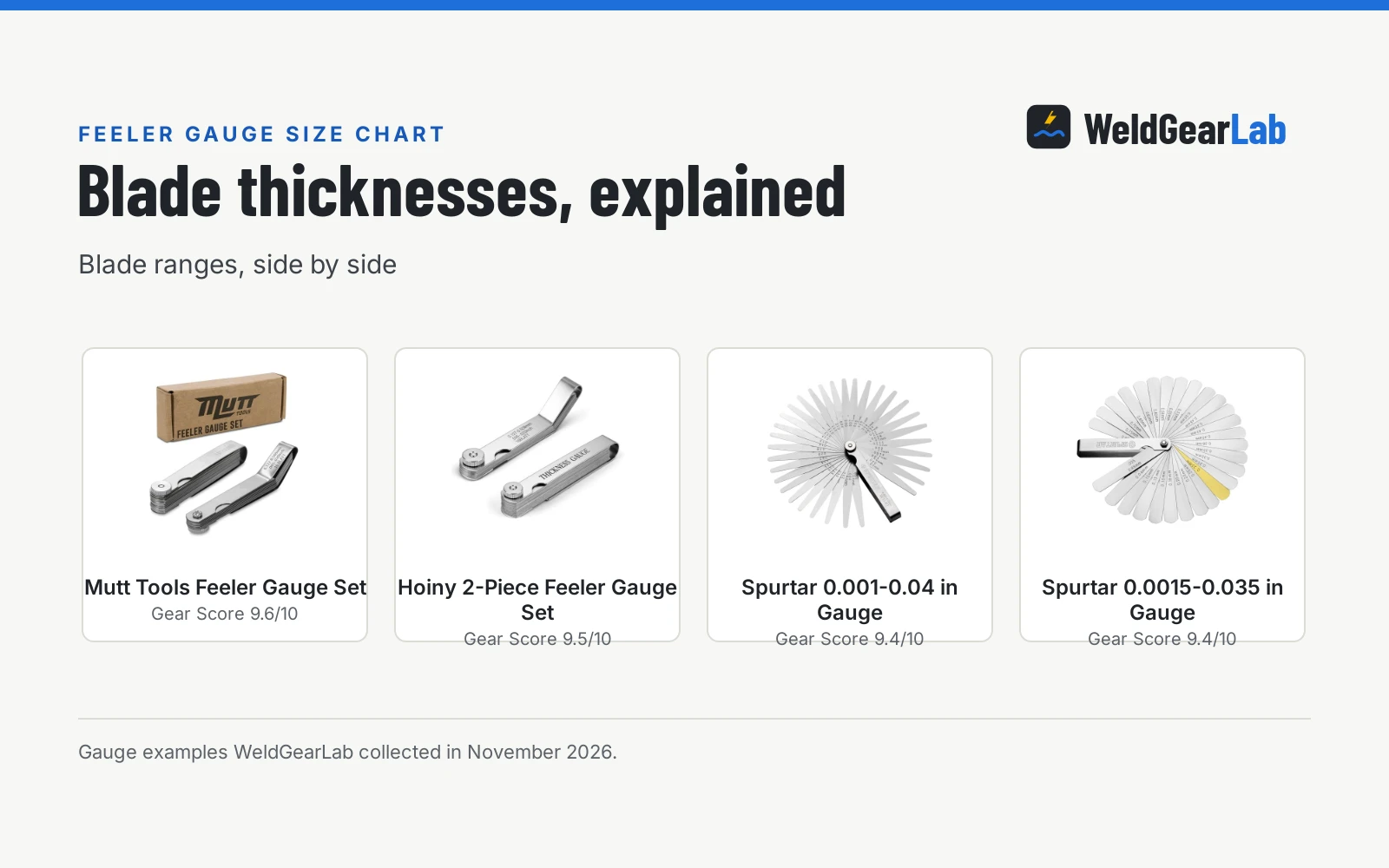
 Mutt Tools Feeler Gauge Set Metric and Inch9.6/10View on Amazon
- 2
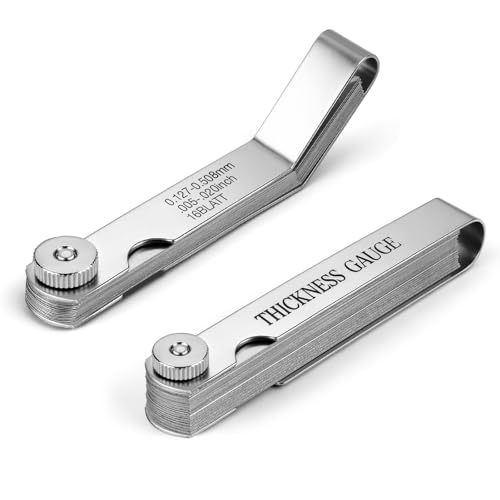 Hoiny 2pcs Feeler Gauges Set Stainless Steel9.5/10View on Amazon
- 3
 Spurtar Feeler Gauges 0.001-0.04" (0.03-1.00mm)9.4/10View on Amazon
- 4
 Spurtar Feeler Gauges 0.0015-0.035'' (0.04-0.88mm)9.4/10View on Amazon
A valve that ticks and a spark plug that misfires both point at a gap, and the gap is measured with a feeler gauge. A feeler gauge size chart lists the blade thicknesses in a set, in inches and in millimetres, so you can pick the blade that slides into the gap with a light drag. This guide reads the chart for the sets here, from the thinnest blade to the thickest, and shows how to match a blade to the gap.
This guide links to our product roundups, where WeldGearLab gets a commission on purchases made through links on this page, and your price stays the same. Read our affiliate disclosure.
Mutt Tools Feeler Gauge Set Metric and Inch
32-blade dual gauge set in metric and SAE, from 0.001 to 0.040 inch, with a limited lifetime warranty.
Pros
- 32 blades from 0.001 to 0.040 inch, dual marked metric and SAE
- Straight and angled gauges reach tight spaces
- Laser-etched markings stay readable
- Limited lifetime warranty stated
Cons
- 32 blades, while the Hoiny set adds 16 angled blades
- Protective holder, not a folding steel case
- No oil coating is stated for the blades
- Thinnest blade is 0.001 in, above the Hoiny 0.0008 in
Hoiny 2pcs Feeler Gauges Set Stainless Steel
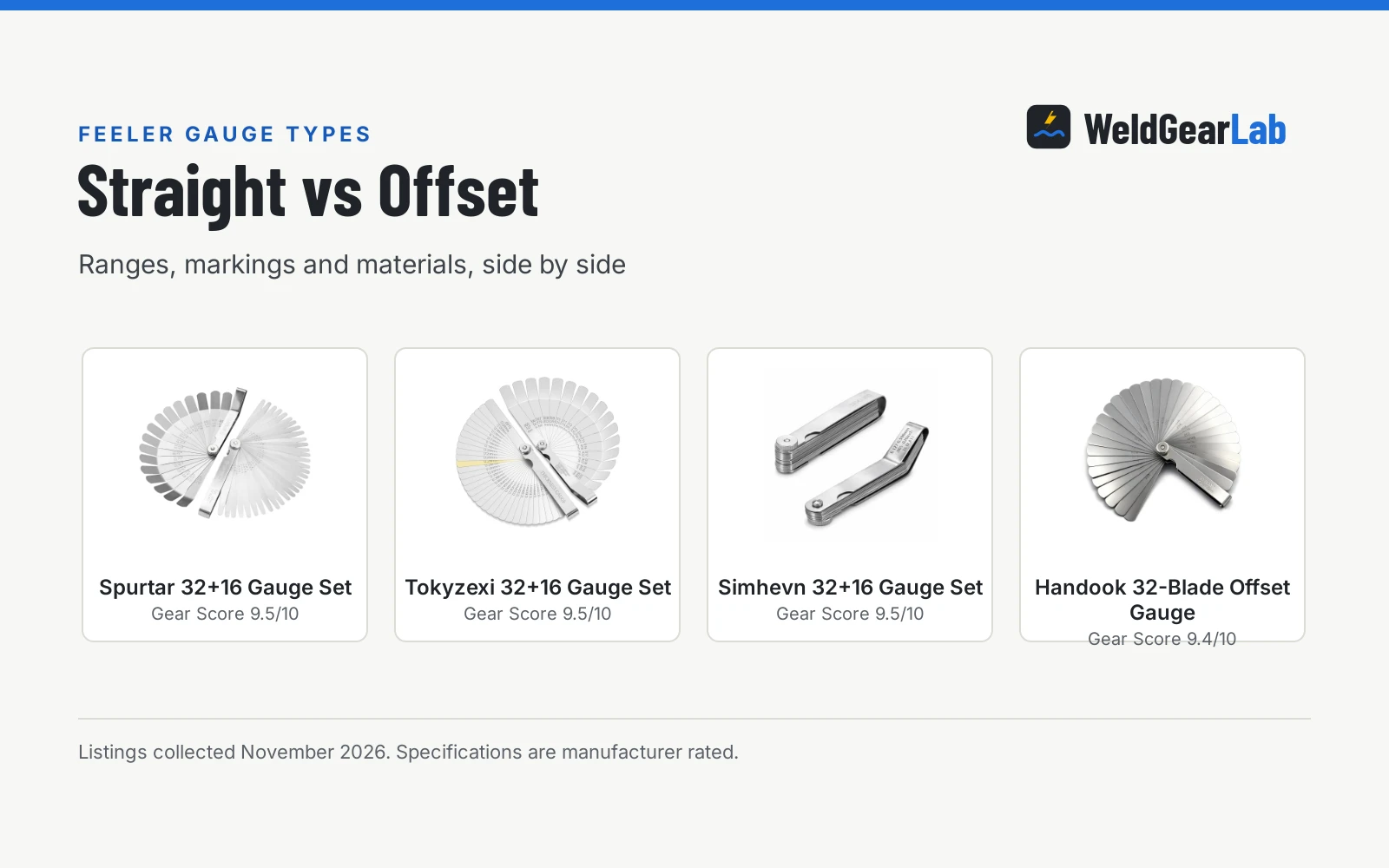
Two-piece set with 32 straight and 16 angled blades, from 0.0008 in to 0.04 in, dual marked SAE and metric.
Pros
- Widest range here: 0.0008 to 0.04 in on the straight gauge
- 32 straight blades plus 16 angled blades for narrow spaces
- Laser-etched dual marked scales in SAE and metric
- Stainless steel, corrosion and rust resistant
Cons
- No warranty term is stated
- Angled gauge covers 0.005 to 0.02 in only, a narrower range
- Two gauges to carry instead of one folding set
- 0.375 pounds, heavier than the Spurtar sets
Spurtar Feeler Gauges 0.001-0.04" (0.03-1.00mm)
32 tapered blades from 0.001 to 0.04 in, dual marked SAE and metric, in a folding steel case.
Pros
- 32 tapered blades from 0.001 to 0.04 in
- Dual marked in SAE and metric, etched for easy reading
- Manganese steel, hardened and polished
- Folds into a plated steel case with a thumbscrew
Cons
- No warranty term is stated
- No angled gauge is included
- Manganese steel needs its oil coating to stay rust free
- Thinnest blade is 0.001 in, above the Hoiny 0.0008 in
Spurtar Feeler Gauges 0.0015-0.035'' (0.04-0.88mm)
32 blades from 0.0015 to 0.035 in, dual marked SAE and metric, with a rust-preventive oil coating.
Pros
- 32 blades from 0.0015 to 0.035 in, dual marked
- Laser-etched numbers for clear reading
- #65 manganese steel with a rust-preventive oil coating
- Portable set, easy to carry and store
Cons
- Narrowest range here, from 0.0015 to 0.035 in
- No angled gauge is included
- Thinnest metric mark is 0.04 mm, above the 0.03 mm of the other Spurtar set
- Blades need a light coat of oil before storage
The chart in one paragraph
A feeler gauge size chart is a list of blade thicknesses, from the thinnest blade in the set to the thickest. The sets here run from 0.0008 in to 0.04 in on the straight gauges, with metric marks from 0.02 mm to 1 mm. The Hoiny set adds an angled gauge from 0.005 in to 0.02 in for narrow spaces.
Side by side
| Gear Score | Blades | Range | Warranty | |
|---|---|---|---|---|
| Mutt Tools Feeler Gauge Set | 9.6/10 | 32 | 0.001-0.040 in | Limited lifetime |
| Hoiny 2-Piece Feeler Gauge Set | 9.5/10 | 32 straight, 16 angled | 0.0008-0.04 in | Not stated |
| Spurtar 0.001-0.04 in Gauge | 9.4/10 | 32 | 0.001-0.04 in | Not stated |
| Spurtar 0.0015-0.035 in Gauge | 9.4/10 | 32 | 0.0015-0.035 in | Not stated |
Thicknesses are the maker’s stated ranges. The Hoiny set also carries an angled gauge with its own range.
The gear for a feeler gauge size chart
Reading the chart is one step; measuring the gap needs a set whose blades cover the range, so the gear below covers the sets in this guide.
How to read the chart
Find the gap in the manual, then find the blade that matches it on the chart. Slide the blade into the gap: it should pass with a light drag, not loose and not forced. If one blade is loose and the next is tight, stack blades whose thicknesses add up to the gap.
How to choose a set
Match the range to the gaps you measure. A set that starts at 0.0008 in covers the thinnest gaps, while a set that ends at 0.035 in stops short of 0.04 in. Each straight gauge here carries 32 blades, and the Hoiny set adds 16 angled blades for narrow spaces. Pick dual marked blades if you work from SAE and metric manuals. See the best professional digital caliper roundup for the measuring tools that sit beside a feeler gauge set.
FAQ for welders
What is the thinnest feeler gauge blade here?
The Hoiny straight (on Amazon) gauge starts at 0.0008 in, which is 0.02 mm. The other sets start at 0.001 in or 0.0015 in. Pick the set whose thinnest blade matches the gap you measure.
Are these feeler gauges marked in SAE and metric?
Yes. Each set here is dual marked, with inch and millimetre marks on the blades. The Hoiny, Mutt Tools and Spurtar 0.0015-0.035 (on Amazon) in sets carry laser-etched marks in both systems, and the other Spurtar set carries etched marks.
What is an angled feeler gauge for?
An angled gauge reaches gaps that a straight blade cannot, such as a valve under a cover. The Hoiny set includes a 16-blade angled gauge from 0.005 in to 0.02 in, beside its 32-blade straight gauge.
How to keep feeler gauge blades from rusting?
For the manganese steel sets, wipe the blades clean after use and apply a light coat of oil before storage, as the Spurtar listing advises. The Spurtar sets arrive coated with oil, and the Hoiny blades are stainless steel, which resists rust.
Related: micrometer vs caliper, digital vs vernier caliper, how to use digital calipers, best large digital caliper, and the metal fab tools hub.