Types of Feeler Gauge: Straight vs Offset and Which to Buy
Straight and offset feeler gauge blades compared on shape, reach, ranges and markings, with four sets for valves, spark plugs, pistons and guitar work.

On this page
Top picks at a glance
As an Amazon Associate I earn from qualifying purchases.
- 1
 Spurtar Feeler Gauge Set9.5/10View on Amazon
- 2
 Tokyzexi 2Pcs Feeler Gauge Set,Premium Straight9.5/10View on Amazon
- 3
 Feeler Gauges Set, 2pcs Stainless Steel 329.5/10View on Amazon
- 4
 Stainless Steel Feeler Gauge Universal Standard9.4/10View on Amazon
The types of feeler gauge you will meet are straight and offset blades: straight blades slide into gaps, and offset blades bend at an angle to reach gaps in confined engine spaces. The Spurtar straight blades are tapered, narrowing toward the tip for tight gaps. The sets in this guide cover valve clearances, spark plug gaps, piston gaps and guitar work.
This guide links to our product roundups, where WeldGearLab gets a commission on purchases made through links on this page, and your price stays the same. Read our affiliate disclosure.
Spurtar Feeler Gauge Set
A 32-blade tapered set and a 16-blade offset set in manganese steel, dual marked in SAE and metric.
Pros
- 32 tapered and 16 offset blades in one set
- Tapered range 0.001 to 0.040 inches, offset range 0.005 to 0.020 inches
- Dual marked SAE and metric with laser-etched markings
- Manganese steel blades with a protective holder
Cons
- No warranty term is stated
- Offset blades cover a narrower range than the tapered blades
- Manganese steel, not stainless steel
- No stated range below 0.001 inches on the tapered set
Tokyzexi 2Pcs Feeler Gauge Set,Premium Straight
A 2-piece set of 32 straight and 16 offset stainless steel blades with removable, adjustable blades.
Pros
- 32 straight and 16 offset blades in one set
- Straight range 0.0015 to 0.035 inch, offset range 0.005 to 0.02 inch
- Hardened stainless steel with laser-etched markings
- Knurled knob releases clamping pressure to remove blades
Cons
- No warranty term is stated
- Offset range tops out at 0.02 inches
- No holder is stated
- No stated range below 0.0015 inches on the straight set
Feeler Gauges Set, 2pcs Stainless Steel 32
A 2-piece set of 32 straight and 16 angled stainless steel blades, dual marked in SAE and metric.
Pros
- 32 straight and 16 angled blades in one set
- Stainless steel blades, rust resistant
- Dual marked SAE and metric on each blade
- Angled blades reach tight spaces and awkward angles
Cons
- No measurement ranges are stated
- No holder is stated
- No blade protector is stated
- No lube oil coating is stated
Stainless Steel Feeler Gauge Universal Standard
A 32-blade offset gauge in hardened tempered steel, dual marked in SAE and metric, for measuring gap width and thickness.
Pros
- 32 offset blades from 0.0008 inch to 0.040 inch
- Hardened tempered steel with a lube oil coating
- Dual marked metric and imperial with laser-etched sizes
- Foldable with a blade protector to prevent loss
Cons
- Offset blades only; no straight blades in the set
- No spark plug use is stated
- No holder beyond the blade protector is stated
- No stated use for machinery alignment
Types of feeler gauge
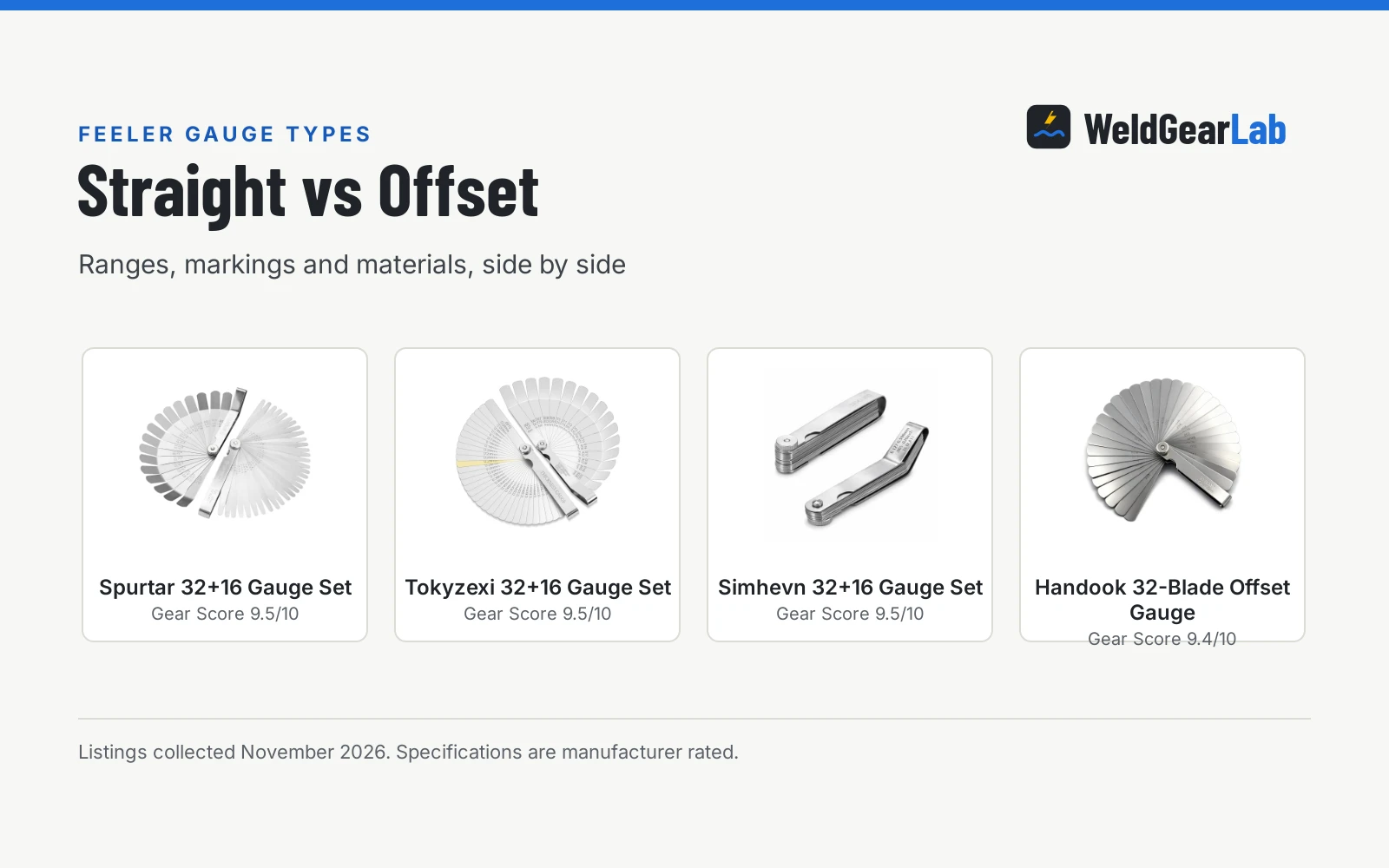
A feeler gauge is a set of thin blades in known thicknesses, and you slide one into a gap to find its size. The shapes in this guide are straight and offset. Straight blades run flat from handle to tip. The Spurtar straight blades are tapered, narrowing progressively toward the tip so they slide into tight gaps. Offset blades bend at an angle so they reach gaps in confined engine spaces where a straight blade cannot reach effectively. Three of the sets here pair 32 straight blades with 16 angled blades, and the Handook set is 32 offset blades on its own.
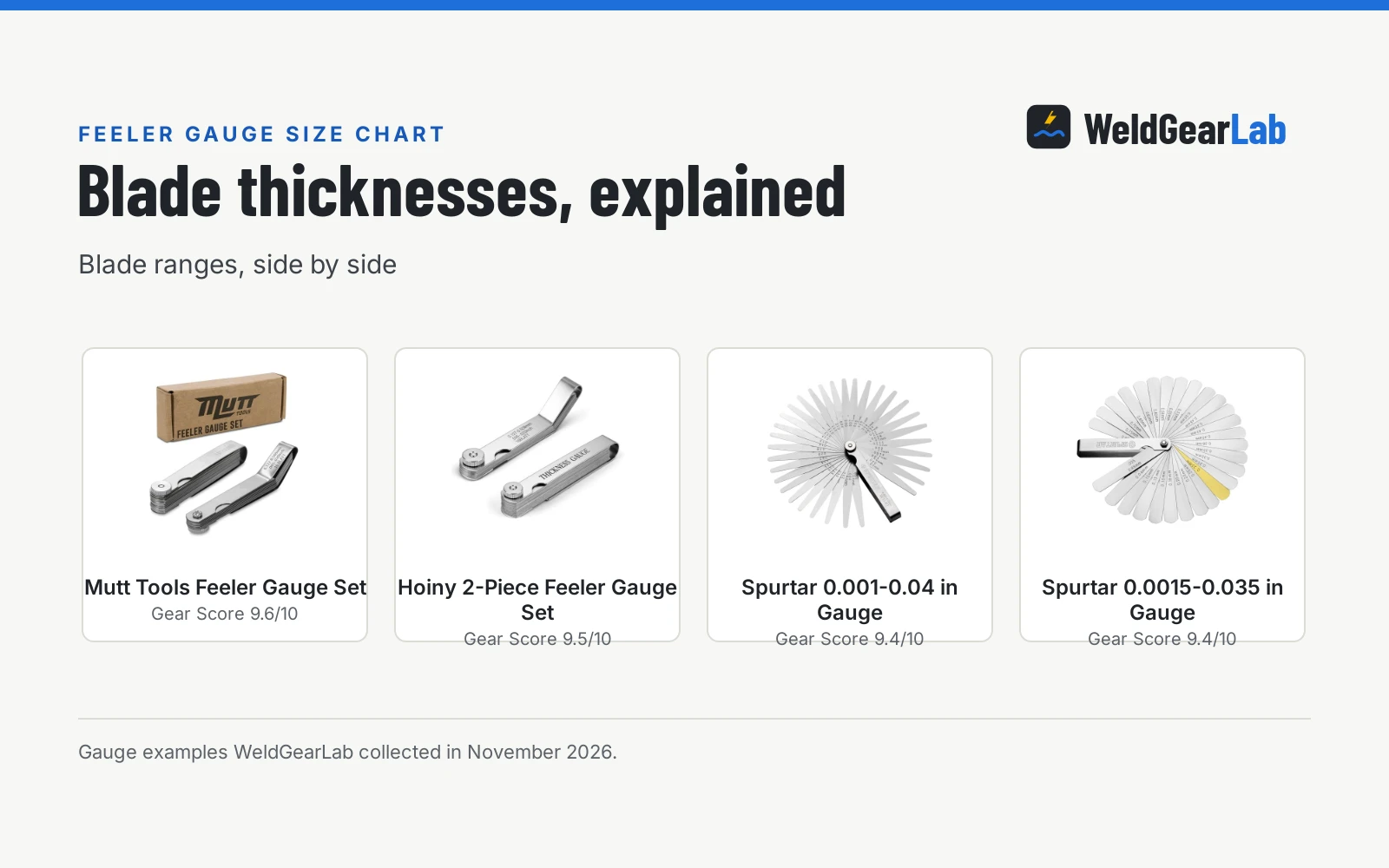
Ranges differ by set. The Spurtar tapered blades (on Amazon) run 0.001 to 0.040 inches (0.03 to 1.00 mm), and its offset blades run 0.005 to 0.020 inches (0.127 to 0.508 mm). The Tokyzexi straight blades (on Amazon) run 0.0015 to 0.035 inch (0.04 to 0.88 mm), and its offset blades run 0.005 to 0.02 inch (0.127 to 0.508 mm). The Handook offset (on Amazon) blades run 0.0008 inch (0.02 mm) to 0.040 inch (1 mm). The Simhevn set states no ranges.
Side by side
| Straight | Offset (angled) | Notes | |
|---|---|---|---|
| Shape | Straight blades, tapered toward the tip in the Spurtar set | Blades bent at an angle | Both shapes measure gap thickness |
| Reach | Tight gaps | Confined engine spaces and awkward angles | Offset blades work where straight blades cannot reach effectively |
| Range in the Spurtar set | 0.001 to 0.040 inches (0.03 to 1.00 mm) | 0.005 to 0.020 inches (0.127 to 0.508 mm) | Dual marked SAE and metric |
| Blades per set | 32 in the Spurtar, Simhevn and Tokyzexi sets | 16 in the Spurtar, Simhevn and Tokyzexi sets | Handook is 32 offset blades only |
| Jobs stated | Valve clearances, spark plug gaps, machinery alignment | Tappet clearances, confined engine spaces | All four sets list guitar work |
The Spurtar, Simhevn and Tokyzexi sets pair straight and angled blades, while the Handook set is offset blades only.
When to use straight blades
- Valve clearances. A straight blade slides into a valve gap to find the clearance.
- Spark plug gaps. The Spurtar, Simhevn and Tokyzexi sets list spark plug work, and a straight blade fits the plug gap.
- Machinery alignment. The Spurtar set lists machinery alignment, where a straight blade checks a gap between two faces.
- Piston gaps. The Simhevn and Tokyzexi sets list piston gaps, which a straight blade measures directly.
When to use offset blades
- Confined engine spaces. The Spurtar offset blades bend at an angle and work in confined engine spaces easily.
- Tappet clearances. The Spurtar set lists tappet clearances, and its offset blades work in confined engine spaces.
- Awkward angles. The Simhevn angled blades (on Amazon) reach tight spaces and awkward angles where straight blades cannot reach effectively.
- Guitar work. All four sets list guitar work, including action height on the Simhevn set.
How to read the markings
Every blade in these sets is marked in both SAE and metric sizes, so you read the thickness straight off the blade. The Spurtar, Tokyzexi and Handook blades have laser-etched markings, and the Simhevn blades are marked with both SAE and metric measurements. The Tokyzexi blades can be used individually or stacked together to measure thickness, and its knurled knob releases clamping pressure so individual blades come out.
Feeler gauge sets for the job
Measuring a valve clearance or a spark plug gap calls for a set that covers the gap with a blade of the right shape, and the four sets below cover straight and offset blades for that work.
FAQ for welders
What is the difference between straight and offset feeler gauges?
Straight blades run flat and slide into gaps, while offset blades bend at an angle and reach gaps in confined engine spaces. The Spurtar straight blades are tapered, narrowing toward the tip. The Spurtar, Simhevn and Tokyzexi sets include both shapes, and the Handook set is offset blades only.
Which set here covers the widest range?
The Handook offset gauge, from 0.0008 inch to 0.040 inch, with the Spurtar straight set close behind at 0.001 to 0.040 inches. The Simhevn set states no ranges.
Are the blades marked in SAE and metric?
Yes. All four sets mark each blade in both SAE and metric sizes, and the Spurtar, Tokyzexi and Handook blades have laser-etched markings.
Can I stack blades to measure a gap?
The Tokyzexi set states that blades can be used individually or stacked together to measure thickness.
Which set here has removable blades?
The Tokyzexi set, whose knurled knob on the pivot shaft releases clamping pressure so individual blades come out.
Related: feeler gauge size chart, metal fab tools, best flux core welder, and the best welder for beginners guide. Also see our steel workbench vs welding table.