Electric vs Hand Metal Nibbler: Which One Should You Buy?
Electric and hand metal nibblers cut sheet metal differently. How they differ on speed, capacity and setup, with three electric nibbler listings ranked.

On this page
Top picks at a glance
As an Amazon Associate I earn from qualifying purchases.
- 1
 VEVOR 2-Speed Electric Chain Hoist 2200 lbs9.7/10View on Amazon
- 2
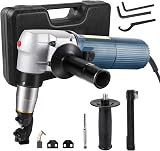 VEVOR Electric Metal Nibbler 625W Nibbler Metal Cutter9.5/10View on Amazon
- 3
 MtiolHig Cordless Metal Nibbler Compatible with DeWalt 20V9.5/10View on Amazon
- 4
 Genesis Electric Metal Cutting Shear 4 Amp 14-GaugeView on Amazon
- 5
 Sheet Metal Cutter for DrillView on Amazon
- 6
 VEVOR Sheet Metal NibblerView on Amazon
- 7
 Eastwood Electric Throatless Shear Variable Speed Metal ShearView on Amazon
- 8
 REXBETI Double Head Sheet Metal NibblerView on Amazon
- 9
 Metal Nibbler Drill AttachmentView on Amazon
Electric vs hand metal nibbler comes down to how much metal you cut and where you cut it. An electric nibbler punches its way along sheet metal fast, with a motor doing the work; a hand nibbler cuts one bite per squeeze, slower but with no cord, battery or noise. Pick electric when you cut long lines, curves or production runs; pick hand for small patches, quick trims and tight spots. This guide compares the two types, then ranks three electric nibbler listings as the gear section.
Other welders and gear to compare
 Genesis Electric Metal Cutting Shear 4 Amp 14-GaugeCheck price on Amazon
 Sheet Metal Cutter for DrillCheck price on Amazon
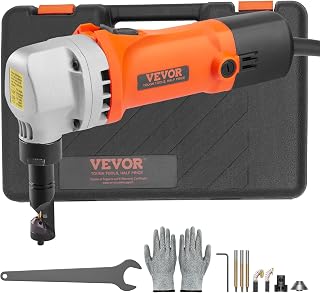 VEVOR Sheet Metal NibblerCheck price on Amazon
 Eastwood Electric Throatless Shear Variable Speed Metal ShearCheck price on Amazon
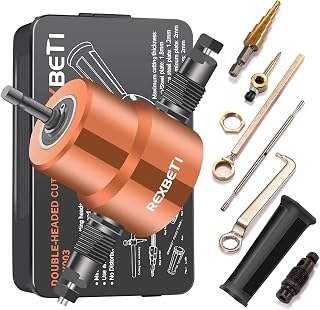 REXBETI Double Head Sheet Metal NibblerCheck price on Amazon
 Metal Nibbler Drill AttachmentCheck price on Amazon
This guide links to our product roundups, where WeldGearLab gets a commission on purchases made through links on this page, and your price stays the same. Read our affiliate disclosure.
The difference in one paragraph
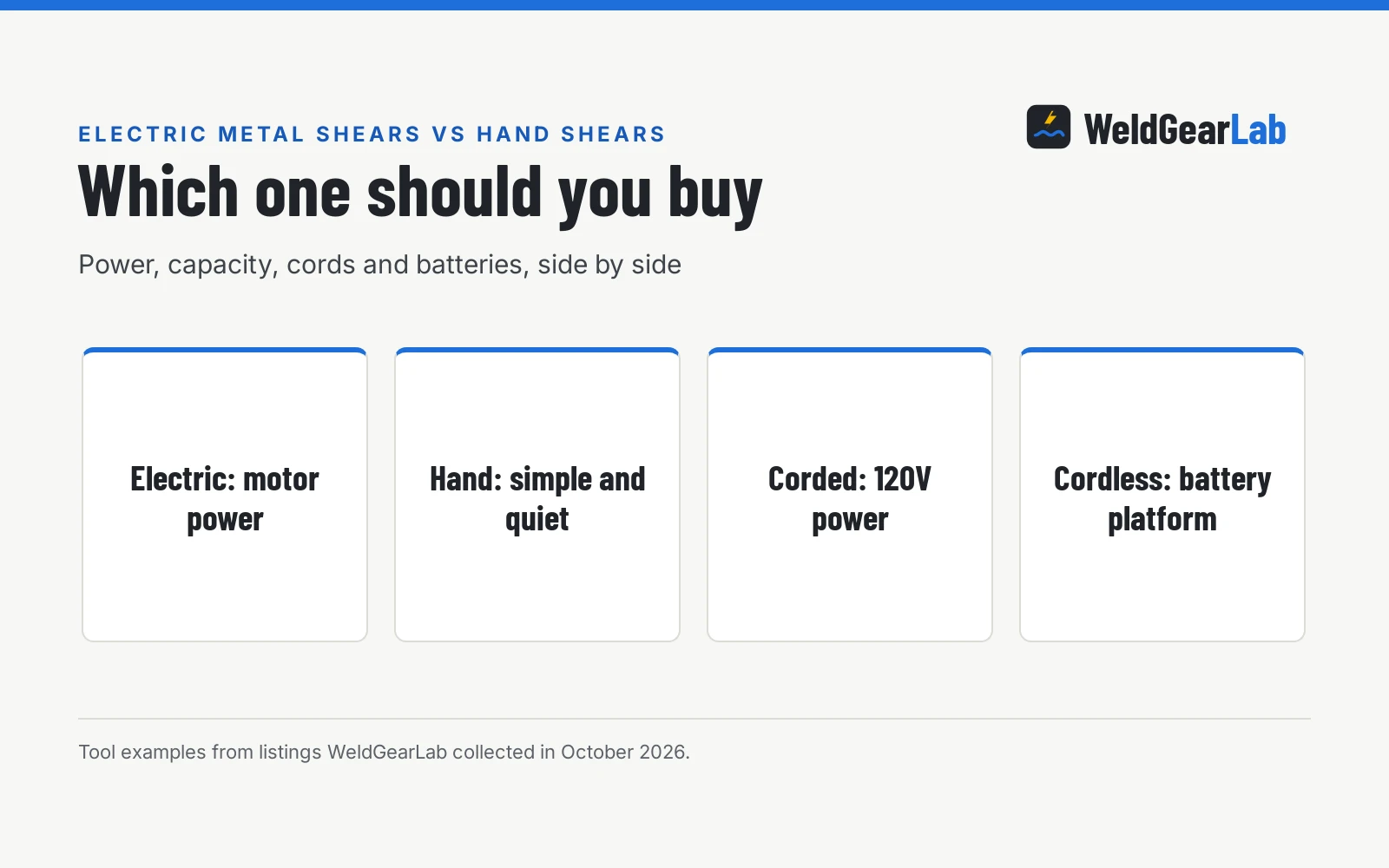
A nibbler cuts sheet metal by punching out small crescents, one bite at a time, leaving a narrow kerf with no sparks. An electric nibbler drives that punch with a motor, so the tool moves along the cut line while your hands guide it. A hand nibbler uses a lever you squeeze, so each bite costs hand effort. The motor is what separates them: speed and ease on one side, simplicity and quiet on the other.
Electric vs hand metal nibbler: side by side
| Electric nibbler | Hand nibbler | Listing example | |
|---|---|---|---|
| Drive | Motor: corded or cordless | Hand lever or squeeze | MtiolHig is cordless 18V; Makita and VEVOR are corded |
| Cutting action | Punches small crescents, fast | One bite per squeeze, slower | 1900 RPM on the MtiolHig |
| Capacity | Up to 16 gauge mild steel on the MtiolHig | Thinner sheet, short runs | 10 gauge on the Makita JN3201 |
| Best for | Long cuts, curves and production | Small patches and tight spots | VEVOR includes gloves and tool case |
| Noise and fatigue | Motor noise; less hand fatigue | Quiet; hand fatigue on long cuts | 81 dB(A) stated on the Makita |
| Cost and setup | Higher; needs power or battery | Low; no power needed | MtiolHig battery not included |
Capacities below come from the listings in the gear section; always check the gauge your nibbler lists before cutting.
When electric is the better choice
- Long cuts and curves. Ductwork, patch panels, trailer skins and long straight runs go far faster under power.
- Thicker sheet. The listings here rate electric nibblers up to 16 gauge mild steel and 10 gauge on the Makita.
- Less hand fatigue. The motor does the punching, so the tool only needs steering, which matters on big jobs.
- Cleaner edges. The listings describe spark-free, burr-free cuts, and the MtiolHig adds a 360-degree rotating head for curves and angles.
Our cordless vs corded metal nibbler guide compares the two electric styles with listings of each type.
When a hand nibbler is the better choice
- Small patches and quick trims. One cut, a few inches long, is faster by hand than setting up a power tool.
- Tight spots. A hand nibbler fits where a motor body will not, such as inside a cabinet or under a dash.
- No power. Field repairs and remote sites need nothing but the tool itself.
- Quiet work. No motor noise, which matters in shared shops and late hours.
The gear: three electric nibblers, ranked
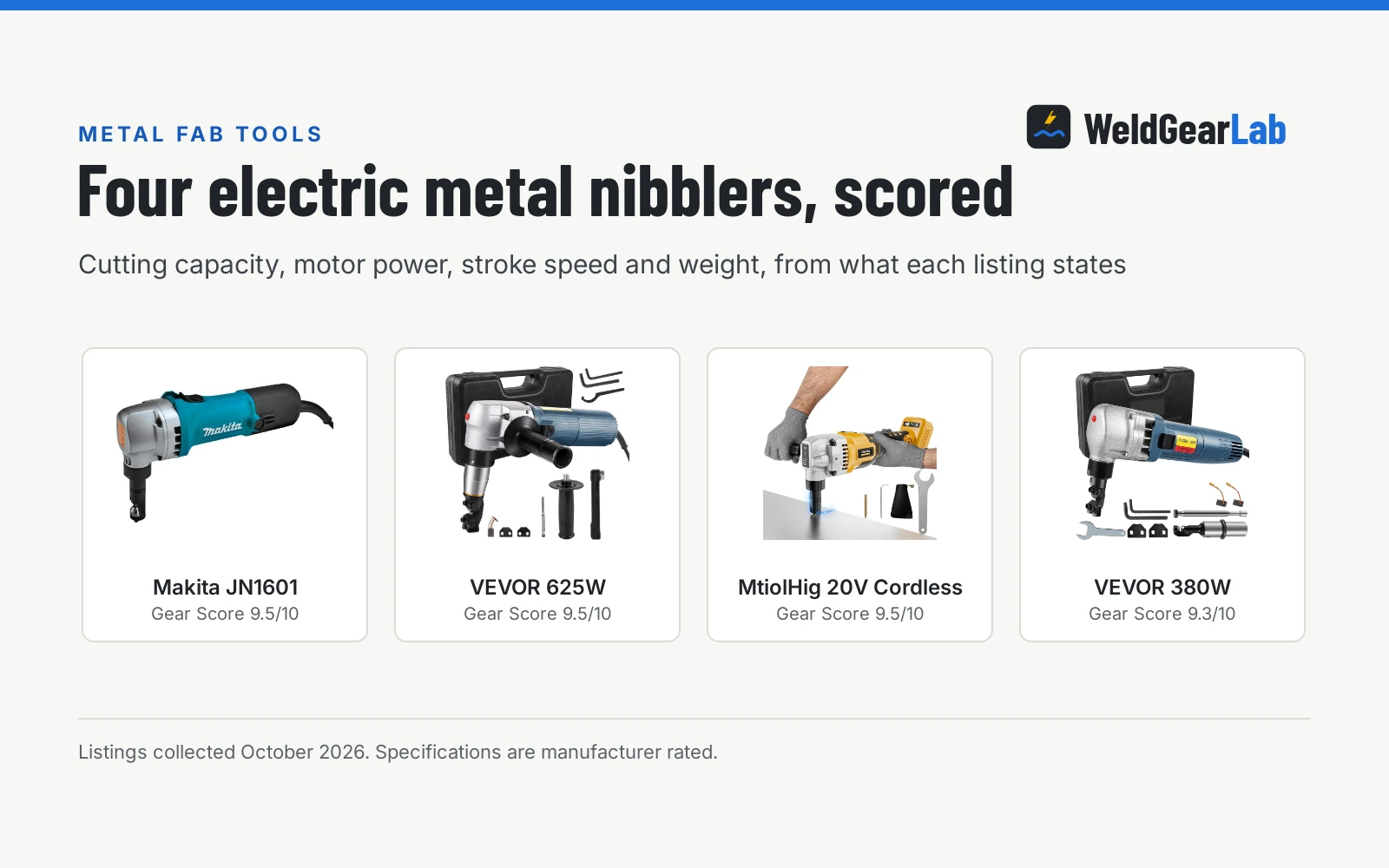
The three listings below are all electric nibblers, ranked by how completely each listing describes the tool: power, capacity, weight and stated warranty.
Makita JN3201 leads: a 10 gauge nibbler with a 710 watt brushless motor on 120 volts, a rubberized soft grip, a lock-on switch for continuous operation, and 81 dB(A) stated noise, at 7.4 lbs. It is the only one of the three with a stated warranty: a 1-year limited warranty.
MtiolHig cordless follows: an 18 volt brushless nibbler at 1900 RPM with 3-speed settings, a 360-degree rotating head, and 2 tungsten-titanium blades, cutting 16 gauge mild steel, 18 gauge stainless and 12 gauge aluminum at 2.2 lbs. It is tool only; the battery is not included.
VEVOR is the kit pick: a 550 watt, 2200 RPM nibbler on 110 volts with a 360-degree dual head, a 50mm cutting radius, anti-cut gloves and a portable tool case in the box, at 6.6 lbs. The listing rates it for carbon steel, stainless, copper, aluminum, plastic and wood board.
Nibbler safety. Nibblers punch sharp crescents out of the sheet, so wear eye protection and gloves, and clamp the workpiece before cutting. The VEVOR listing includes anti-cut gloves. Keep the cord clear of the cut line on corded models, and remove the battery before changing blades on cordless ones.
Buying advice: match the nibbler to the job
Start with capacity. The Makita is the only 10 gauge nibbler here, so it suits thicker mild steel; the MtiolHig and VEVOR are 16 gauge mild steel tools. If the listing does not state a gauge for your material, do not assume it will cut it.
Then check power and weight. The MtiolHig runs cordless on Milwaukee 18V batteries, which are not included, at 2.2 lbs: the lowest weight of the three, and the only option for work away from outlets. The Makita and VEVOR are corded at 110 to 120 volts, weighing 7.4 and 6.6 lbs. The VEVOR ships the full kit: two cutting heads, wrenches, blade parts, a manual, anti-cut gloves and a portable tool case.
For curves, both the MtiolHig and VEVOR list a 360-degree rotating head, Only the Makita states a warranty: a 1-year limited warranty.
FAQ for welders
What gauge metal can a nibbler cut?
The MtiolHig lists 16 gauge mild steel, 18 gauge stainless and 12 gauge aluminum; the Makita is a 10 gauge nibbler.
Do I need a hand nibbler if I own an electric one?
For small patches, quick trims and tight spots, a hand nibbler is handy; none of the three listings here is a hand model. See our straight vs offset tin snips guide for hand cutting options.
Which listing includes safety gear?
The VEVOR listing includes anti-cut gloves and a portable tool case. The others state no included safety gear.
Which nibbler has a warranty?
The Makita listing states a 1-year limited warranty. The MtiolHig and VEVOR listings state no warranty term.
Corded or cordless?
The MtiolHig runs on Milwaukee 18V batteries, which are not included. The Makita and VEVOR are corded at 110 to 120 volts.
Related: metal nibbler vs jigsaw, sheet metal shears vs tin snips, cordless vs corded metal nibbler, and the metal fab tools hub.