Bead Roller vs Slip Roll: Which One Should You Buy?
Bead rollers press profiles into flat sheet while slip rolls bend it into curves, and the listed bead rollers differ on throat depth, dies, capacity and warranty.

On this page
Top picks at a glance
As an Amazon Associate I earn from qualifying purchases.
- 1
 Eastwood Metal Fabrication Bead Roller with Dies9.7/10View on Amazon
- 2
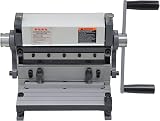 KAKA INDUSTRIAL Metal Brake9.6/10View on Amazon
- 3
 Eastwood Elite 8In Heavy Duty Bead Roller Durable Design 22MmView on Amazon
- 4
 3-Station Roller for Bending Metal Roofing Materials at 0-90°View on Amazon
A flat-sheet bead roller forms beads, ribs and channels in flat sheet, while a slip roll curves sheet into cylinders and cones. For bead roller vs slip roll, the choice comes down to the shape you need: beads and ribs point to the bead roller, curves point to the slip roll. This guide compares them for home, farm and hobby fab work, with bead roller listings as gear examples.
Other welders and gear to compare
 Eastwood Elite 8In Heavy Duty Bead Roller Durable Design 22MmCheck price on Amazon
 3-Station Roller for Bending Metal Roofing Materials at 0-90°Check price on Amazon
This guide links to our product roundups, where WeldGearLab gets a commission on purchases made through links on this page, and your price stays the same. Read our affiliate disclosure.
Bead roller vs slip roll in one paragraph
A flat-sheet bead roller passes flat sheet between shaped rolls, called dies, that press a bead, rib, channel or flange into the panel. The dies change, so the same machine can press several profiles. A slip roll passes flat sheet between rolls that bend it into a curve, so the output is a cylinder, cone or curved panel rather than a profiled flat panel. The bead roller adds shape to the panel without rolling it into a curve; the slip roll makes the curve itself.
Side by side
| Feature | Bead roller | Slip roll | Why it matters |
|---|---|---|---|
| Job | Beads, ribs, channels and flanges in flat sheet | Curves, cylinders and cones from flat sheet | Decides which machine to buy |
| How it shapes | Rolls press a profile into the sheet | Rolls bend the sheet around a curve | Profile vs curve is the core difference |
| Typical work | Floor pans, firewalls, trunk floors, door panels | Tanks, ducts and curved panels | Match the machine to the panel |
| Throat or capacity | Throat depth sets the reach: 18 inch and 19 inch on the listings | Roll width sets the widest sheet it takes | Reach limits panel size |
| Dies or rolls | Changeable die sets, including offset dies | Rolls adjusted for the curve | Die sets widen the work |
| Material thickness | 18 gauge mild steel; steel 18 gauge, aluminum 16 gauge, stainless 20 gauge | Not stated | Gauge limits the metal |
| Size and weight | 52 pounds and 50 pounds on the listings | Not stated | Shop space and moving |
| Warranty | 1 yr warranty; 1-year limited warranty and 90-day return | Not stated | Cover after purchase |
Capacities are the listings’ own figures; check the listing before ordering.
When a bead roller is the better choice
Pick the bead roller when the panel stays flat and needs shape pressed into it. The Eastwood listing names strengthening ribs in panels for replacement floor pans, firewalls, trunk floors and inner fenders, plus decorative designs in door panels and dashes. Its offset dies create channels, flanges and a multitude of profiles, so one machine covers ribs and trim work. Throat depth decides how far into a panel the rolls reach: the Eastwood listing gives a 19 inch throat and says it works the center of a 38 inch panel, while the Woodward listing gives an 18 inch throat. Keep fingers and hands away from moving parts when operating, and wear a work glove, protective clothing and eyewear, as the Eastwood listing advises.
When a slip roll is the better choice
Pick the slip roll when the sheet itself must become a curve. Tanks, ducts and curved panels all start as flat sheet and come off the rolls bent, which no bead roller die can do. A slip roll suits work where the curve is the product, not a detail pressed into a flat panel. All three gear examples below are bead rollers, so judge a slip roll by the roll width and capacity figures on its own listing, and check whether it handles the sheet size the job needs.
Gear examples
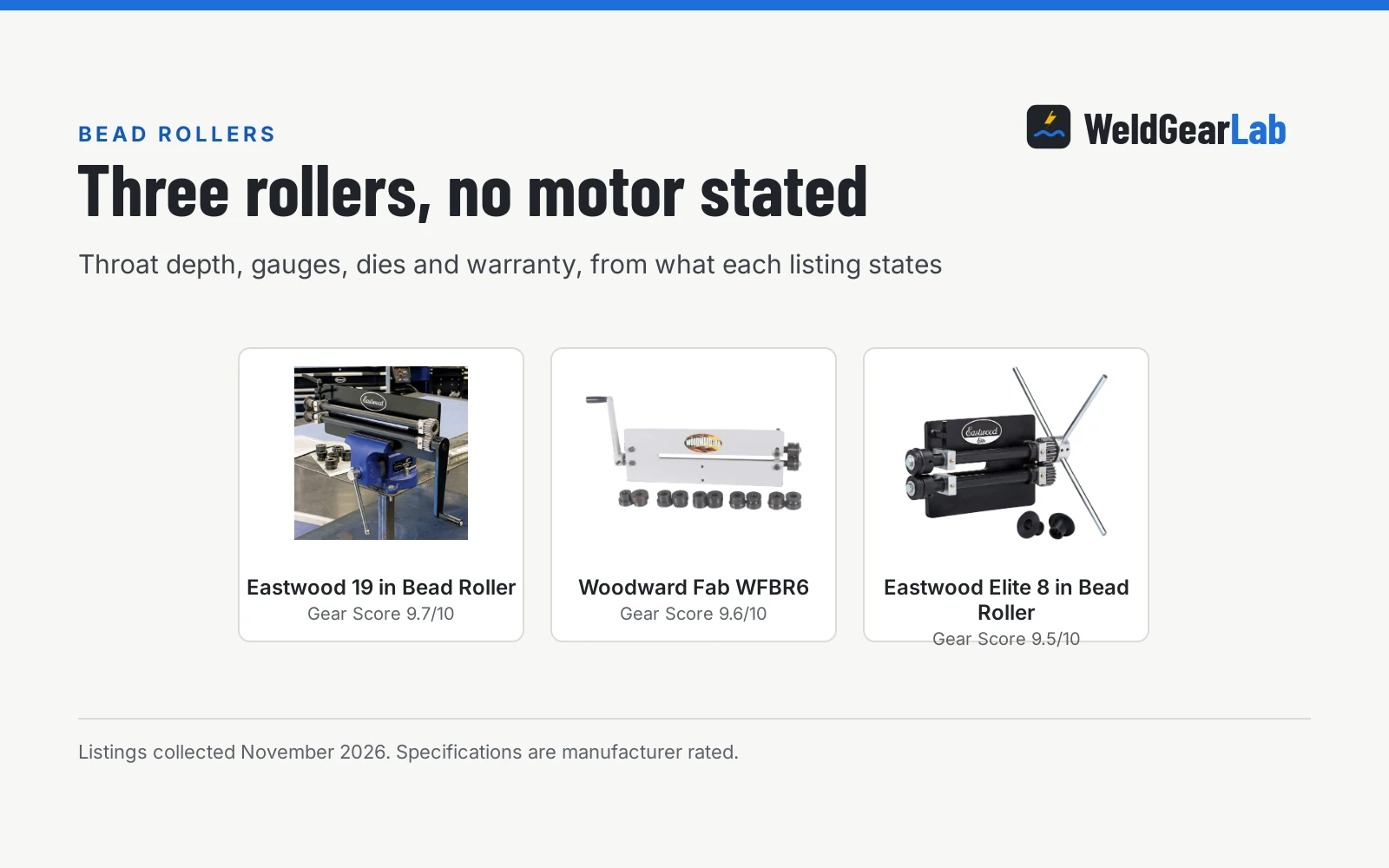
The gear examples below are the three bead roller listings: the Eastwood and Woodward Fab flat-sheet machines and the HiwowSport tube beader.
First, the Eastwood bead roller, with a 19 inch throat that works the center of a 38 inch panel. It handles steel at 18 gauge, aluminum at 16 gauge and stainless at 20 gauge, and its offset dies create channels, flanges and a multitude of profiles. The listing describes a gear-driven machine that delivers forming power while requiring minimal handle force. It weighs 50 pounds and comes with a 1-year limited warranty and 90-day return.
Next, the Woodward Fab bead roller kit, with an 18 inch throat and 18 gauge capacity in mild steel. It includes 6 sets of dies: 1/4, 3/8 and 1/2 bead roll dies, plus 1/16, 1/8 and 1/4 step dies. It weighs 52 pounds and carries a 1 yr warranty on material and workmanship. It suits a shop that wants a full die set in the box rather than buying dies separately.
Last, the HiwowSport tube beader, a vise-mounted tool of a different class. It forms a bead on the end of aluminium or copper tubing: insert the tubing end between the dies and crank the turning handle. It fits 5/8 inch and larger tubing, weighs 3.98 pounds, and suits intercooler and intake piping work rather than flat sheet panels. It ranks last here because it beads tube ends, not sheet panels.
How to tell which one you need
Start from the shape, not the machine. A flat panel that needs ribs, beads, channels or flanges calls for a bead roller with the right dies. A panel that must come out curved calls for a slip roll, and the roll width must cover the sheet size. For tube ends, neither flat-sheet machine fits: the vise-mounted tube beader covers tubing at 5/8 inch and larger. Then check throat depth against the panel: a 19 inch throat reaches the center of a 38 inch panel, while an 18 inch throat reaches less far. Finally, compare die sets and warranty terms on the listings before ordering.
FAQ for welders
Can a bead roller curve sheet into a cylinder?
No. A bead roller presses profiles into flat sheet. For a cylinder or cone, use a slip roll, which bends the sheet itself into the curve.
Can a slip roll make beads or ribs?
No. A slip roll bends sheet into curves and does not press profiles. For beads, ribs, channels or flanges, use a bead roller with the matching dies.
What thickness can the listed bead rollers handle?
The Woodward listing states 18 gauge capacity in mild steel. The Eastwood listing states steel at 18 gauge, aluminum at 16 gauge and stainless at 20 gauge. The tube beader states no sheet thickness, since it beads tube ends rather than sheet.
Do the listed bead rollers include dies?
The Woodward listing includes 6 sets of dies, with 1/4, 3/8 and 1/2 bead roll dies and 1/16, 1/8 and 1/4 step dies. The Eastwood listing includes offset dies for channels, flanges and profiles. The tube beader works between dies as well, sized for tubing at 5/8 inch and larger.
Which listed tool suits tube ends?
The HiwowSport tube beader. It is vise-mounted and forms a bead on the end of aluminium or copper tubing at 5/8 inch and larger. The Eastwood and Woodward machines are flat-sheet bead rollers, not tube tools.
Related: how to use a bead roller, bead roller vs english wheel, slip roll vs sheet metal brake, and the metal fab tools hub. Also see our best sheet metal nibbler.