Plasma Cutter Amperage vs Thickness Chart
A plasma cutter amperage vs thickness chart shows how output current, travel speed, and supply voltage determine clean cuts and sever limits on steel.
 By WeldGearLab Editorial
Updated October 9, 2026
By WeldGearLab Editorial
Updated October 9, 2026
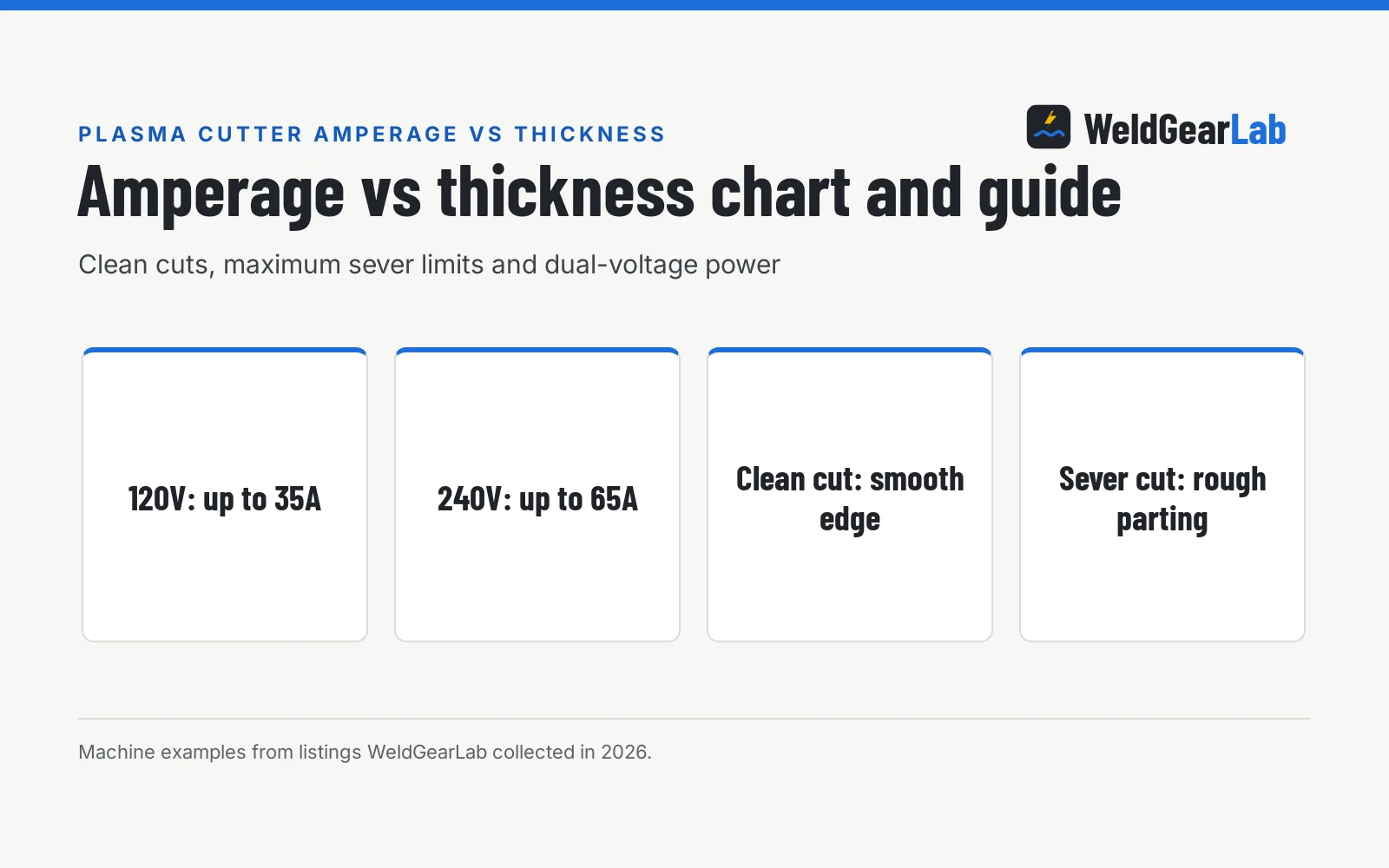
A plasma cutter amperage vs thickness chart pairs output current with metal thickness to show what a machine can cleanly cut or sever. On standard mild steel, machines running at 35A on a 110V or 120V household line deliver clean cuts around 5/16 inch to 3/8 inch and sever up to 5/8 inch, while 55A to 65A machines running on 220V or 240V deliver clean cuts from 1/2 inch to 5/8 inch and sever steel up to 1 inch thick. This guide explains how amperage ratings translate to real workshop cuts, how clean cuts differ from sever cuts, and how air pressure and voltage change what you can cut.
As an Amazon Associate I earn from qualifying purchases. This guide links to our product roundups, where WeldGearLab earns a commission when you buy through links, at no extra cost to you. Read our affiliate disclosure.
Clean cut versus sever cut ratings
Every plasma cutter listing publishes two cutting capacities: a clean cut rating and a maximum sever rating. Knowing the difference keeps you from buying a machine that struggles on your routine metalwork.
- Clean cut rating. The plasma jet travels through the plate with a steady arc, leaving a smooth, square edge with minimal dross. Metal cut within this rating requires almost no grinding before welding. For example, YESWELDER lists a 5/16 inch clean cut on 110V and a 9/16 inch clean cut on 220V at 65A, GNI specifies a 2/5 inch (10mm) clean cut at 35A on 120V, and LOTOS APEX rates a 5/8 inch clean cut (16mm) on steel at 60A.
- Maximum sever rating. The absolute limit the plasma stream can push through at a slow crawl. Sever cuts leave heavy slag, beveling, and rough edges that require grinding. Bestarc lists a 1.18 inch maximum cut at 50A on 220V with 65 PSI, and ARCCAPTAIN lists a 1 inch maximum cut (26mm) at 55A on 220V with 60 PSI.
Always match your regular steel thickness to the machine’s clean cut rating, keeping sever capacity for occasional demolition or rough salvage. See our guide on how to reduce dross when plasma cutting for cleaner edges.
Plasma cutter amperage vs thickness chart
| Amperage and Machine | Supply Voltage | Clean Cut Rating | Maximum Sever Rating | Stated Air Pressure |
|---|---|---|---|---|
| 35A (GNI CUT-60PRO) | 120V | 2/5 inch (10mm) | 3/5 inch (15mm) | 90 PSI |
| 35A (Bestarc BTC650XP) | 110V | Not stated | 5/8 inch (16mm) | 50 PSI |
| 50A (Bestarc BTC650XP) | 220V | Not stated | 1.18 inch (30mm) | 65 PSI |
| 55A (ARCCAPTAIN CUT55) | 220V | 3/5 inch | 1 inch (26mm) | 60 PSI |
| 60A (LOTOS APEX LTP6010D) | 240V | 5/8 inch (16mm) | 3/4 inch (19mm) | 70 PSI |
| 65A (YESWELDER CUT-65DS PLUS) | 220V | 9/16 inch | 1 inch | Not stated |
The chart above draws from published workshop plasma cutter specifications. Across these machines, cutting capacity scales with amperage, while input voltage determines the maximum current the machine can deliver.
How input voltage limits cutting thickness
Most portable plasma cutters support dual voltage, but input supply directly limits cutting output:
- 110V and 120V household power. Output caps between 20A and 35A. ARCCAPTAIN lists 20-35A on 110V, and GNI lists a 2/5 inch (10mm) clean cut and 3/5 inch (15mm) maximum cut at 35A on 120V. LOTOS APEX specifies clean cuts up to 3/8 inch on 120V, while YESWELDER specifies a 5/16 inch clean cut on 110V. Reaching full 35A output on 110V or 120V requires substantial input current; Reboot recommends a 50A breaker on 120V, and Bestarc notes input breaker draws up to 40A or 60A on 110V. Standard household receptacles (such as the 120V 15A MVP plug supplied with Hobart’s AirForce 27i) limit cutting to lighter duty cycles and thinner sheet.
- 220V and 240V workshop power. Unlocks the full 50A to 65A range. LOTOS APEX delivers a 5/8 inch clean cut and 3/4 inch sever cut at 60A on 240V, while YESWELDER reaches a 9/16 inch clean cut and 1 inch maximum cut at 65A on 220V.
For fabrication on plate thicker than 3/8 inch, our guide to the best plasma cutter under 1000 covers machines that utilize full 240V power.
Air pressure and air compressor requirements
Compressed air blows molten metal out of the cut. Insufficient air pressure leaves heavy dross and ruins torch consumables. Look for these maker specifications:
- Operating pressure. Most units connect through a 1/4 inch NPT fitting and require 50 PSI to 70 PSI. ARCCAPTAIN monitors pressure with digital sensors, alerting E80 below 30 PSI and E81 above 80 PSI, recommending 55 PSI on 110V and 50 PSI to 75 PSI on 220V. GNI recommends 90 PSI at 2.1 CFM, and LOTOS APEX calls for at least 70 PSI at approximately 4.0 SCFM.
- Air flow volume. Bestarc specifies air flow of 250 liters per minute at 65 PSI to 70 PSI.
- Post-flow cooling. Reboot, GNI, and Bestarc feature adjustable post-flow timers from 2 seconds or 3 seconds to 15 seconds, with 4 seconds to 8 seconds recommended to cool the nozzle and electrode.
Check our guide on what size air compressor do I need for a plasma cutter before setting up your shop air line.
Cutting steel, aluminum and stainless steel
Thickness charts assume mild carbon steel. Other conductive metals conduct heat differently, altering cut capacity:
- Aluminum and copper. High thermal conductivity pulls heat from the arc, requiring more current or slower travel speeds. ARCCAPTAIN rates 55A for up to 3/5 inch clean cuts on steel, aluminum, and copper, while Bestarc rates 1/2 inch clean cuts across iron, steel, aluminum, and copper. LOTOS APEX specifies 60A clean cuts of 5/8 inch (16 mm) and sever cuts of 3/4 inch (19 mm) across steel, stainless steel, aluminum, and copper.
- Stainless steel. Melts cleanly but produces viscous dross. ANDELI rates its 65A unit across carbon steel, stainless steel, and aluminum.
- Painted and rusted metal. Non-touch pilot arc torches, like the IPT40 on YESWELDER or IPT60 on ARCCAPTAIN, start without touching the plate, cutting through dirty metal and mesh. See our comparison of pilot arc vs blowback start plasma cutter torches.
Choosing the right amperage for your shop
Match your machine amperage to the material thickness you work with most often:
- Sheet metal and light brackets (up to 1/8 inch or 1/4 inch). A 35A setting on 120V household power gives clean edges without excessive heat warping.
- General shop and farm repair (1/4 inch to 1/2 inch). A 50A to 55A machine on 220V provides steady travel speeds and clean edges on plate and tubing.
- Heavy fabrication (1/2 inch to 5/8 inch and above). A 60A to 65A unit on 240V provides clean cuts on thick steel with sever capability up to 1 inch.
For home shops seeking additional options, browse the wider plasma cutters hub to compare machine ratings and configurations.
Plasma cutting safety. Plasma cutting produces intense UV arc radiation, hot spatter, electrical hazards, and metal fumes. Protect your eyes with proper shading; see what shade for plasma cutting and whether you need a welding helmet for plasma cutting. Wear dry leather gloves, keep fire extinguishers ready, and work with good ventilation. Never touch the torch tip while energized.
Frequently Asked Questions
How thick can a 40 amp plasma cutter cut?
A 40A plasma cutter bridges entry-level 35A household units and heavier 50A to 60A workshop machines. Across published specifications, 35A units on 110V or 120V deliver clean cuts from 5/16 inch to 3/8 inch and sever up to 5/8 inch, while 55A to 60A machines on 240V deliver clean cuts from 1/2 inch to 5/8 inch. A 40A machine typically provides clean cuts on mild steel around 3/8 inch with maximum sever cuts reaching 1/2 inch. Actual cutting performance depends on available supply voltage and air pressure.
What is the difference between a clean cut and a sever cut?
A clean cut leaves a smooth, square edge with minimal dross that is ready for welding or assembly with almost no cleanup. A sever cut represents the maximum metal thickness the plasma stream can penetrate at a slow crawl. Sever cuts produce heavy slag and rough edges that require grinding before the part can be used.
Can a plasma cutter cut through rust or paint?
Yes, plasma cutters equipped with a non-touch pilot arc can initiate and sustain an arc through heavy paint, rust, and surface contamination. The pilot arc ignites inside the torch head without needing electrical contact with clean bare metal. This feature also allows continuous cutting across expanded metal and perforated mesh.
Why is my plasma cutter not cutting all the way through?
Incomplete penetration usually occurs when travel speed is too fast, amperage is set too low for the metal thickness, or air pressure drops below the required operating level. Worn torch consumables like nozzles and electrodes also cause the plasma jet to widen and lose cutting force. If your cut stalls, consult our guide on why is my plasma cutter not cutting through.
What air pressure is required for plasma cutting?
Most portable workshop plasma cutters require compressed air supplied between 50 PSI and 70 PSI, with certain models operating up to 90 PSI. The air compressor must also supply sufficient volume, typically between 2.1 CFM and 4.0 SCFM depending on machine amperage. Using clean, dry air free of water and oil is essential to prevent arc instability and rapid consumable wear.
Related: what size plasma cutter do I need, how to plasma cut a straight line, can a plasma cutter cut aluminum, CUT 50 plasma cutter tips, and the plasma cutter for metal guide.
About the author
WeldGearLab Editorial is the editorial team behind WeldGearLab. We research product listings, specifications, safety listings and warranty terms, score every pick with the published Gear Score method, and correct errors when readers report them. We do not run our own shop trials; see How We Pick for exactly how picks are made.