Why Is My Plasma Cutter Not Cutting Through?
A plasma cutter fails to cut through metal when ground contact is weak, air pressure is incorrect, consumables are worn, travel speed is off, or the plate exceeds machine limits.
 By WeldGearLab Editorial
Updated October 9, 2026
By WeldGearLab Editorial
Updated October 9, 2026
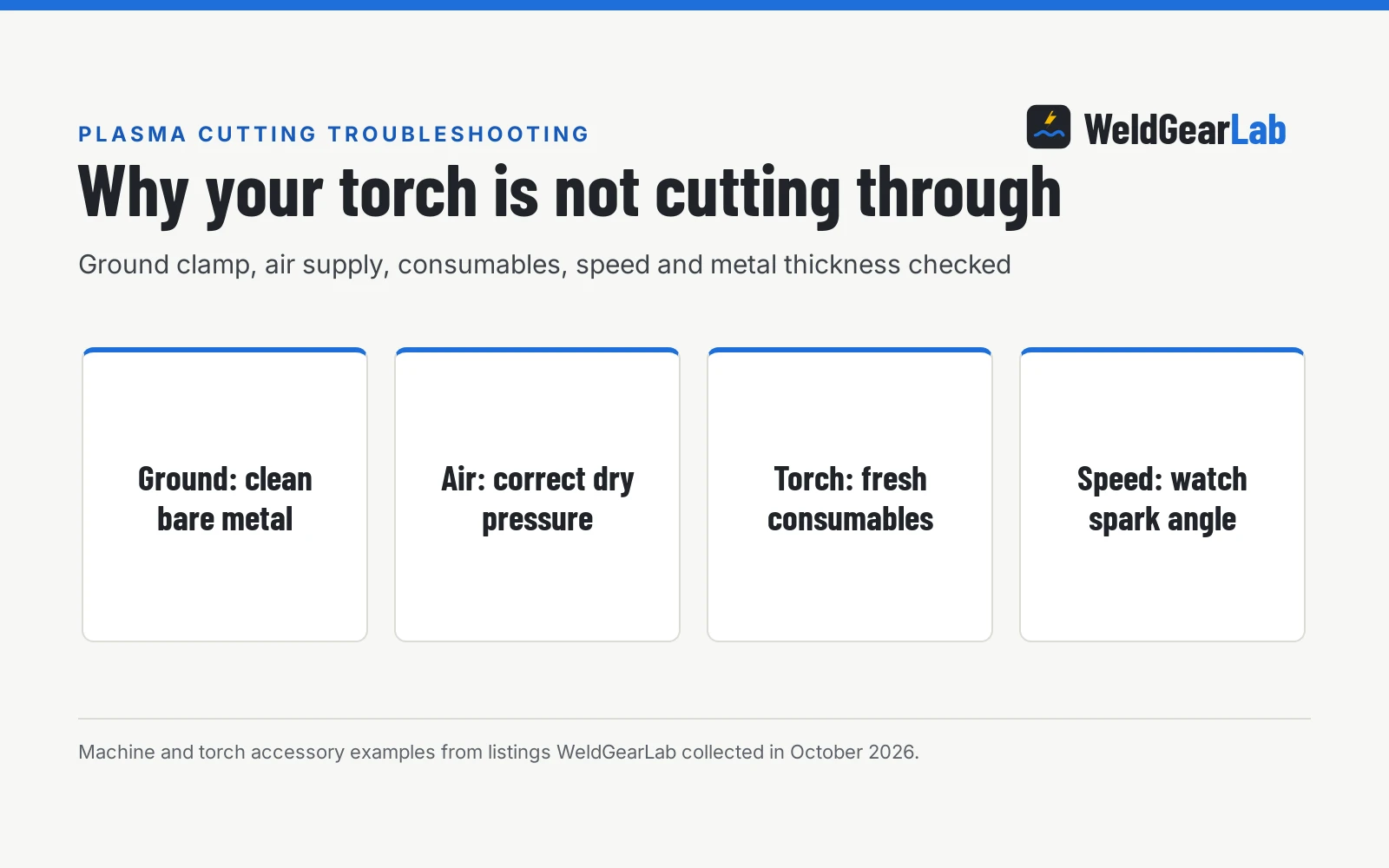
When a plasma cutter is not cutting through metal, the cause is almost always an incomplete ground circuit, improper air pressure, worn torch consumables, excessive travel speed, or plate thickness beyond machine capacity. A plasma arc needs clean electrical contact and steady airflow to sustain the high-temperature stream and clear molten dross. If the ground clamp sits on rust, air pressure drops, or the nozzle is blown out, the arc skims the surface. This guide explains why is my plasma cutter not cutting through and walks through the steps to get clean cuts in your shop.
As an Amazon Associate I earn from qualifying purchases. This guide links to our product roundups, where WeldGearLab earns a commission when you buy through links, at no extra cost to you. Read our affiliate disclosure.
Why is my plasma cutter not cutting through?
Plasma cutting relies on a constricted jet of ionized gas to melt conductive metal and blow molten material through the kerf. When that jet cannot penetrate, the arc leaves the bottom edge fused by uncut metal and heavy slag. Diagnosing the issue requires checking work clamp conductivity, air pressure, consumable wear, travel speed, and machine amperage limits.
Troubleshooting checks at a glance
| Cutting factor | Observed problem | What to inspect | Correct shop fix |
|---|---|---|---|
| Ground circuit | Pilot arc ignites but fails to transfer to plate | Work clamp jaws and contact point | Clamp directly to clean bare metal, clearing rust and mill scale |
| Compressed air | Low pressure leaves dross; high pressure blows out arc | Regulator gauge while air flows | Set air regulator to maker pressure specification with dry air |
| Torch nozzle | Wide kerf, severe bevel, or no penetration | Nozzle orifice roundness and bore | Replace nozzle showing oval wear or melted bore edges |
| Torch electrode | Erratic arc transfer and shallow cutting | Hafnium emitter pit depth | Replace electrode when hafnium center forms a deep crater |
| Travel speed | Sparks spray upward and arc skips bottom | Underside spark angle during cut | Slow travel until spark stream exits out bottom of plate |
| Plate thickness | Molten metal pools and bridges kerf bottom | Workpiece thickness against machine rating | Stay within clean cut rating or step up to higher amperage |
Always disconnect power and bleed air pressure before inspecting torch internals. Verify settings on scrap metal before making finished cuts.
Inspect the ground clamp and work circuit
A plasma power source cannot transfer cutting energy without a low-resistance return path. A weak ground connection is the most common reason a pilot arc ignites in the torch but fails to transfer to the workpiece.
- Clean to bare metal. Clamp directly to shiny metal. Paint, rust, and mill scale act as insulators. Grind a clean contact patch for the clamp jaws.
- Clamp the workpiece directly. Avoid clamping to dirty table slats or frame members where loose contact introduces resistance.
- Inspect the cable. Check for loose lugs, frayed strands, or weak clamp springs that starve cutting current.
Check air pressure, flow rate, and moisture
Compressed air forms the ionized plasma jet and cools the torch head while blowing molten metal out of the cut. Insufficient air pressure prevents the arc from clearing the kerf, while excessive pressure can blow out the arc.
Air requirements vary by machine design. TOOLIOM specifies recommended air pressure between 60 PSI at 110V and 65 PSI at 220V for its 50A unit. The bestarc BTC500XP lists 50 PSI at 110V for 35A and 65 PSI at 220V for 50A, requiring a flow rate of 250 liters per minute. The bestarc CUT55XP calls for 70 PSI with 250 liters per minute, and SILATU lists a recommended pressure of 70 PSI for its 55A model. The LOTOS APEX LTP6010D requires at least 70 PSI at approximately 4.0 SCFM, while Reboot specifies 90 PSI at 60 L/min or above for its 60A unit. Check the pressure gauge while air is flowing, as pressure drops when the torch opens.
Moisture in the air line disrupts the plasma column and quickly erodes nozzles. Drain compressor tanks regularly and install a filter at the machine inlet. Check our guide on what size air compressor do I need for a plasma cutter for sizing advice.
Examine torch consumables for wear and damage
The consumable stack inside the torch head focuses the plasma arc into a tight stream. As parts wear, the arc wanders, leaving beveled edges and incomplete cuts.
- Nozzle orifice wear. When the nozzle hole erodes into an oval or develops notches, the plasma jet spreads out and loses piercing force. Replace any nozzle with an irregular hole.
- Electrode pit depth. The electrode houses a hafnium core that emits the electric arc. Once this core pits deeply, arc transfer becomes unstable and cutting depth drops. Replace the electrode and nozzle together.
- Swirl ring and cup. Inspect swirl ring holes for debris and ensure the retaining cup threads firmly in place.
- Correct parts matchup. Verify that parts match your torch. PLAXCON supplies replacement parts for AG-60 torches, while WeldingStop and Reboot produce guides and parts for PT-31 torches. SILATU specifies AG60P consumables, ANDELI uses the FPT60 torch, and Reboot uses AG60 parts. Mismatched parts cause gas leaks and erratic cuts.
Refer to our guide on cut 50 plasma cutter tips and our roundup of best arc plasma cutter consumables for torch maintenance.
Adjust torch standoff distance and travel speed
Torch position and travel speed directly govern how the plasma arc penetrates the plate.
Torch standoff distance. Unless a torch is designed for drag cutting on thin sheet metal, such as the drag-cut pilot arc on the LOTOS APEX LTP6010D, holding an unprotected nozzle too close allows molten blowback to bridge the tip and ruin consumables. Holding the torch too far away stretches the arc, dropping cutting energy. Standoff guides maintain an exact gap. PLAXCON lists spring spacer guides for AG-60 torches. For PT-31 torches, WeldingStop lists a roller guide with wheel bracket height adjustment up to 1.81 inches (46 mm), and Reboot lists a double-wheel guide with bracket height adjustment from 45 mm (1.77 inches) to 53 mm (2.08 inches) and torch clamp inner diameter adjustment from 21 mm (0.83 inch) to 25 mm (0.98 inch). These guide assemblies roll across the plate to keep the nozzle tip slightly elevated.
Travel speed and spark direction. Watch the sparks underneath the plate while cutting. At proper speed, the spark trail angles slightly back behind torch travel and exits cleanly out the bottom. If sparks shower upward toward the torch face, travel speed is too fast. Slow down travel until the jet drops through. If travel speed is excessively slow, the arc gouges a wide kerf and forms heavy dross along the bottom.
Piercing technique. When piercing thick plate, tilt the torch slightly when pressing the trigger, then roll it upright once the arc breaks through to deflect blowback away from the nozzle.
Verify plate thickness and input power limits
Every plasma cutter has physical thickness limits determined by amperage output and incoming power supply. Attempting to cut metal beyond clean cut capacity results in incomplete cuts and molten dross bridging the bottom.
Dual voltage machines deliver lower cutting capacity on 110V or 120V household outlets compared to 220V or 240V circuits. For example, bestarc lists a 1/2 inch clean cut and a 5/8 inch (16 mm) maximum cut at 35A on 110V, increasing to a 1 inch (26 mm) maximum cut at 50A on 220V. SILATU rates its machine for a maximum cut of 1/2 inch (12 mm) at 110V with 40A, and up to a 7/10 inch (18 mm) maximum cut and 9/16 inch clean cut at 220V with 55A. TOOLIOM rates its 50A cutter for a clean cut of 5/16 inch (8 mm) at 110V and 1/2 inch (12 mm) at 220V, with a maximum capacity of 1/2 inch (12 mm) at 110V and 5/8 inch (16 mm) at 220V. ANDELI lists a 65A output cutting 1 1/16 inch at 220V or 3/5 inch at 110V, and piercing 5/16 inch at 220V or 1/4 inch at 110V. LOTOS APEX rates its 60A unit for up to 3/8 inch clean cuts on 120V, delivering a 5/8 inch (16 mm) clean cut and 3/4 inch (19 mm) sever cut on 240V lines. Reboot rates its 60A cutter for 1/2 inch clean cuts and 3/4 inch maximum cuts.
Circuit breakers also limit sustained power. Reboot lists a breaker requirement of 50A for 120V operation and 30A for 240V. Bestarc models specify breakers up to 40A on 110V at 35A and up to 30A on 220V at 50A or 55A, while SILATU requires a 40A circuit breaker.
If you regularly work near machine limits, see our guide to the best plasma cutter under 1000 for higher-output options, or our review of the best plasma cutter under 500 for budget machines. You can also consult what size plasma cutter do I need to match amperage to plate thickness.
Plasma cutting safety and arc radiation. Plasma cutting produces intense optical radiation, electrical voltages, hot sparks, and metal fumes. Always wear an approved shade lens when operating or viewing the arc. See our guide on what shade for plasma cutting and read do you need a welding helmet for plasma cutting for protective lens selection. Wear leather gloves and flame-resistant clothing, ensure good ventilation, and disconnect electrical power before servicing the torch.
Frequently Asked Questions
Why does my plasma cutter arc start but stop cutting immediately?
This problem usually indicates a pilot arc that fails to transfer to the cutting circuit. Ensure your ground clamp is attached directly to bare metal on the workpiece, and verify that your air pressure and consumables are within maker specifications.
How do I know when plasma torch consumables need replacement?
Replace the nozzle when the center orifice erodes into an oval or shows visible melting around the edges. Replace the electrode when the center hafnium insert forms a deep pit, as cutting with eroded parts causes arc wander and severe beveling.
Can moist compressed air stop a plasma cutter from piercing steel?
Yes. Moisture destabilizes the plasma stream, rapidly erodes copper nozzles, and causes severe arc sputter. Wet air cools the plasma column unevenly, preventing it from reaching the heat density needed to pierce through steel plate.
Why does molten metal blow back into the torch nozzle?
Blowback occurs when attempting to pierce thick plate while holding the torch completely perpendicular and flush against the plate. Tilt the torch slightly when initiating a pierce or use a standoff guide to keep the nozzle protected.
What is the difference between clean cut and sever cut capacity?
A clean cut rating indicates the maximum thickness a machine cuts smoothly by hand with minimal dross and square edges. A sever cut rating represents the maximum thickness the machine can physically separate at slow speed, leaving heavy slag that requires grinding.
Related: best plasma cutter under 500, what size air compressor do I need for a plasma cutter, what size plasma cutter do I need, and the plasma cutters hub. Also see our guide on cut 50 plasma cutter tips.
About the author
WeldGearLab Editorial is the editorial team behind WeldGearLab. We research product listings, specifications, safety listings and warranty terms, score every pick with the published Gear Score method, and correct errors when readers report them. We do not run our own shop trials; see How We Pick for exactly how picks are made.