Plasma Cutter vs Angle Grinder for Cutting Steel: Which One Should You Buy?
Plasma cutters and angle grinders cut steel in different ways, each offering distinct advantages in speed, plate thickness, curve cutting, portability, and equipment cost.
 By WeldGearLab Editorial
Updated October 10, 2026
By WeldGearLab Editorial
Updated October 10, 2026
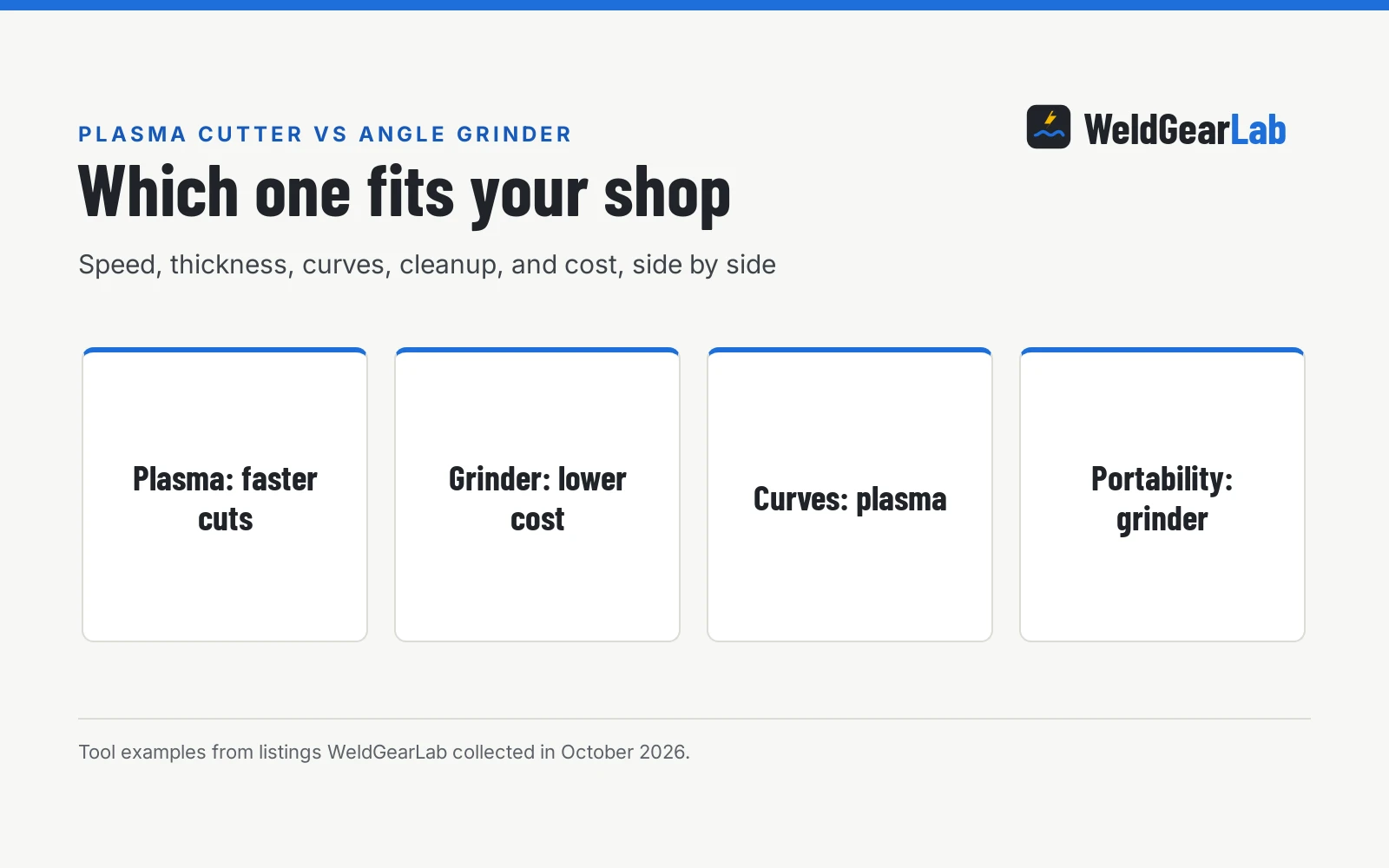
When deciding between a plasma cutter vs angle grinder for cutting steel, plate thickness, cut shapes, and shop power dictate the choice. A plasma cutter uses high-velocity ionized gas to melt and sever steel plate, making quick work of thick stock, curved cuts, and expanded metal, but it requires electrical power and clean compressed air. An angle grinder with an abrasive cut-off wheel offers a low-cost, portable option running on standard power without a compressor, while handling grinding, surface blending, and weld cleanup that a torch cannot do. This guide compares cutting speed, capacities, setup demands, and operating costs.
As an Amazon Associate I earn from qualifying purchases. This guide links to our product roundups, where WeldGearLab earns a commission when you buy through links, at no extra cost to you. Read our affiliate disclosure.
Plasma cutter vs angle grinder for cutting steel
Thermal cutting and mechanical grinding work through completely different principles. A plasma cutter strikes an electric arc between an internal electrode and the steel workpiece, ionizing compressed air into high-temperature plasma that melts the metal and blows molten puddle out through the cut. An angle grinder spins an abrasive wheel, using friction to wear away a narrow channel of steel until the piece separates. That mechanical difference governs cut speed, maximum thickness, curve capability, and necessary shop equipment.
Side by side
| Plasma cutter | Angle grinder | Best for | |
|---|---|---|---|
| Cutting mechanism | High-temperature ionized gas arc melts and blows metal away | Abrasive wheel friction grinds a kerf through the metal | Different cutting principles |
| Straight cuts | Fast travel speed along a straightedge | Straight following a scribed line, slower on thicker stock | Both tools |
| Curved and interior cuts | Follows curves, circles, and starts internal cutouts directly | Limited to straight lines; cannot cut tight curves or pockets | Plasma cutter |
| Equipment setup | Power source, compressed air supply, torch, and ground clamp | Tool and abrasive cut-off wheels | Angle grinder |
| Cut speed on plate | Fast, maintains travel speed through thick plate | Slows significantly as steel thickness increases | Plasma cutter |
| Edge finish | Leaves dross on bottom edge; needs chipping or scraping | Leaves smooth face with burrs along the cut edge | Angle grinder |
| Sparks and debris | Hot dross, molten spatter, and fine metallic fumes | Directional shower of abrasive dust and hot grinding sparks | Varies by workspace |
| Non-ferrous metals | Cuts steel, stainless steel, aluminum, and copper | Requires wheel formulated for specific metals like aluminum | Plasma cutter |
| Surface finishing and cleanup | Dedicated to cutting and gouging | Swaps wheels for grinding, blending, and weld cleanup | Angle grinder |
Cutting capacity and consumable wear depend on steady travel speed, metal alloy, and correct air pressure. Always match abrasive wheels to spindle ratings and verify plasma pressure before cutting.
When a plasma cutter is the better choice
- Thick plate cutting speed. Plasma torches sever medium and heavy steel plate rapidly, maintaining travel speed without heavy physical pressure.
- Curves and shapes. The plasma jet moves in any direction without binding, allowing operators to trace patterns, cut curves, and cut holes directly.
- Internal cutouts. A pilot arc torch pierces solid sheet to start internal cutouts without pre-drilled pilot holes.
- Expanded metal and dirty stock. Pilot arc machines hold an arc across gaps to slice through expanded metal, mesh, paint, and rust where wheels catch.
Our guide to the best plasma cutter under 500 reviews dual-voltage machines capable of clean cuts on structural steel.
When an angle grinder is the better choice
- Low entry cost. An angle grinder delivers dependable cutting capability at a fraction of the price of a plasma power source and air compressor.
- Jobsite portability. A grinder runs from household power or batteries, requiring no pneumatic air hoses or moisture filters in the field.
- Versatility beyond cutting. A grinder swaps between cut-off wheels, grinding discs, flap discs, and wire wheels to grind bevels, strip rust, and clean welds flush.
- Square cuts on tubing. Rigid cut-off wheels track straight lines accurately on square tubing and bar stock without dross, leaving only a light burr.
For shop tools, see our roundup of the best angle grinder for cutting metal and our review of the best cut off wheels for metal.
Cutting capacity and thickness limits
A plasma cutter relies on amperage and air pressure to blow through thick sections. In published manufacturer specifications, the PrimeWeld CUT50DP listing states a 1/2 inch clean cut and a 3/4 inch severance cut, while the ARCCAPTAIN CUT55 MP listing specifies cutting steel up to 1 inch (26mm) thick at 240V. Inverter plasma units in this class, such as the bestarc BTC500XP, publish a 1/2 inch clean cut with a maximum cutting thickness of 5/8 inch (16mm) at 35A on 110V and 1 inch (26mm) at 50A on 220V.
An angle grinder cuts by wearing a kerf through the metal, meaning resistance climbs as thickness increases. For thin sheet and light profiles, a dedicated cut-off tool works fast; for example, the SHALL cut off tool listing specifies a 3.5 Amps motor producing 400 W at 120 volts with a no-load speed of 24000 RPM, using 3-inch cutting wheels featuring a 3/64 inch thickness and a 3/8 inch arbor. On thick plate, however, the broad contact area slows cutting, creates friction heat, and consumes abrasive discs rapidly.
Air compressor and power requirements
Most plasma cutters require a continuous volume of clean, dry compressed air to sustain the arc and blow molten metal away. For example, the PrimeWeld CUT50DP listing specifies an operating air pressure of 75 PSI at 5 CFM, and bestarc listings call for air pressure of 65 PSI with a flow rate of 250 liters per minute. Check our guide on what size air compressor do I need for a plasma cutter to verify compressor capacity.
For electrical power, plasma machines demand high voltage to achieve full penetration. The ARCCAPTAIN CUT55 MP runs on 120V and 240V, while the bestarc BTC500XP operates on 110V and 220V, delivering maximum cutting output on 220V or 240V. In contrast, corded angle grinders run on standard household outlets and cordless units use batteries, requiring no pneumatic lines or high-output circuits.
Consumables and ongoing operating costs
Plasma torches consume copper nozzles, electrodes, swirl rings, and shields. Consumable life depends on air dryness and torch cooling; YESWELDER recommends a cooling time of 5-8 seconds for torch consumables, while bestarc specifies post-flow cooling times adjustable from 3-15s to cool the torch head. Clean air and proper standoff protect nozzles from premature wear.
Angle grinder expenses involve abrasive discs. As a cut-off wheel grinds through steel, the bonded grain wears down, shrinking the disc diameter until it cannot reach through the stock. Grinder discs wear quickly on thick steel but remain inexpensive individually and require no air dryers or filters.
Cut accuracy, kerf, and post-cut cleanup
A plasma torch leaves dross along the bottom cut edge and a slight bevel along the cut face. On mild steel with proper travel speed, dross chips off easily, but uneven travel leaves hardened dross requiring grinding. Straight cuts benefit from a straightedge guide; see our guide on how to plasma cut a straight line. For circular work, the Gugxiom listing specifies a plasma cutting compass for AG60 and SG55 torches with a maximum cutting diameter of 100 cm (39.4 inches). In contrast, an angle grinder cut-off wheel tracks straight lines cleanly on structural shapes without dross or thermal slag, leaving only a fine burr along the cut edge.
Shop safety and protective gear
Plasma cutting generates an electric arc with intense ultraviolet and infrared radiation, requiring a shaded welding helmet or cutting shield, leather gloves, and protective clothing. Molten dross spatter and metallic fumes also require good ventilation or an approved respirator. Angle grinders produce no arc flash, allowing clear eye protection with a full-face shield, but they generate directional spark showers and wheel fragmentation hazards. Always keep wheel guards mounted, wear leather gloves and ear protection, keep flammables clear, and follow OSHA guidelines for cutting and welding.
Frequently Asked Questions
Is a plasma cutter faster than an angle grinder for cutting steel?
A plasma cutter is substantially faster than an angle grinder on medium and heavy steel plate. The thermal arc melts and blows through metal in seconds where an abrasive wheel grinds slowly. On light sheet metal and small tubing, an angle grinder cuts quickly with minimal setup.
Can an angle grinder cut curved lines in steel plate?
An angle grinder cannot cut tight curves because rigid cutting discs bind and shatter when twisted in a kerf. Operators can approximate wide curves with multiple straight cuts followed by grinding, but true curved cuts belong to a plasma torch. A plasma jet steers freely in any direction without binding.
Do I need an air compressor to run an angle grinder?
Standard electric angle grinders run on corded AC power or tool batteries and require no compressed air. This makes grinders portable for outdoor and field repairs. Only pneumatic air tools need a compressor, whereas plasma cutters always require clean, regulated air to cut.
Which tool leaves a cleaner cut edge on steel?
An angle grinder leaves a square, flat cut face on structural tubing without dross or thermal slag, leaving only a mechanical burr that cleans up with a flap disc. A plasma cutter leaves molten dross on the bottom edge and a slight bevel that requires scraping or grinding. On thick plate, however, the plasma cutter cuts so much faster that dross cleanup is well worth the time.
Should a beginner buy a plasma cutter or an angle grinder first?
Most home shops and beginners should buy a quality angle grinder before a plasma cutter. An angle grinder handles cutting, edge beveling, rust removal, and weld cleanup for general fabrication. Fabricators can add a plasma cutter later when regular plate cutting, curved shapes, or sheet metal volume justify the investment.
Related: best angle grinder, best plasma cutter under 500, plasma cutter with air compressor, and our plasma cutters hub.
About the author
WeldGearLab Editorial is the editorial team behind WeldGearLab. We research product listings, specifications, safety listings and warranty terms, score every pick with the published Gear Score method, and correct errors when readers report them. We do not run our own shop trials; see How We Pick for exactly how picks are made.