Stick Welder vs Wire Welder: Which One Should You Buy?
A stick welder and a wire welder suit different metal thicknesses, job locations, and skill levels. How they differ on steel thickness, outdoor wind, cleanup, equipment cost, and setup, plus how to tell which process fits your shop.
 By WeldGearLab Editorial
Updated October 9, 2026
By WeldGearLab Editorial
Updated October 9, 2026
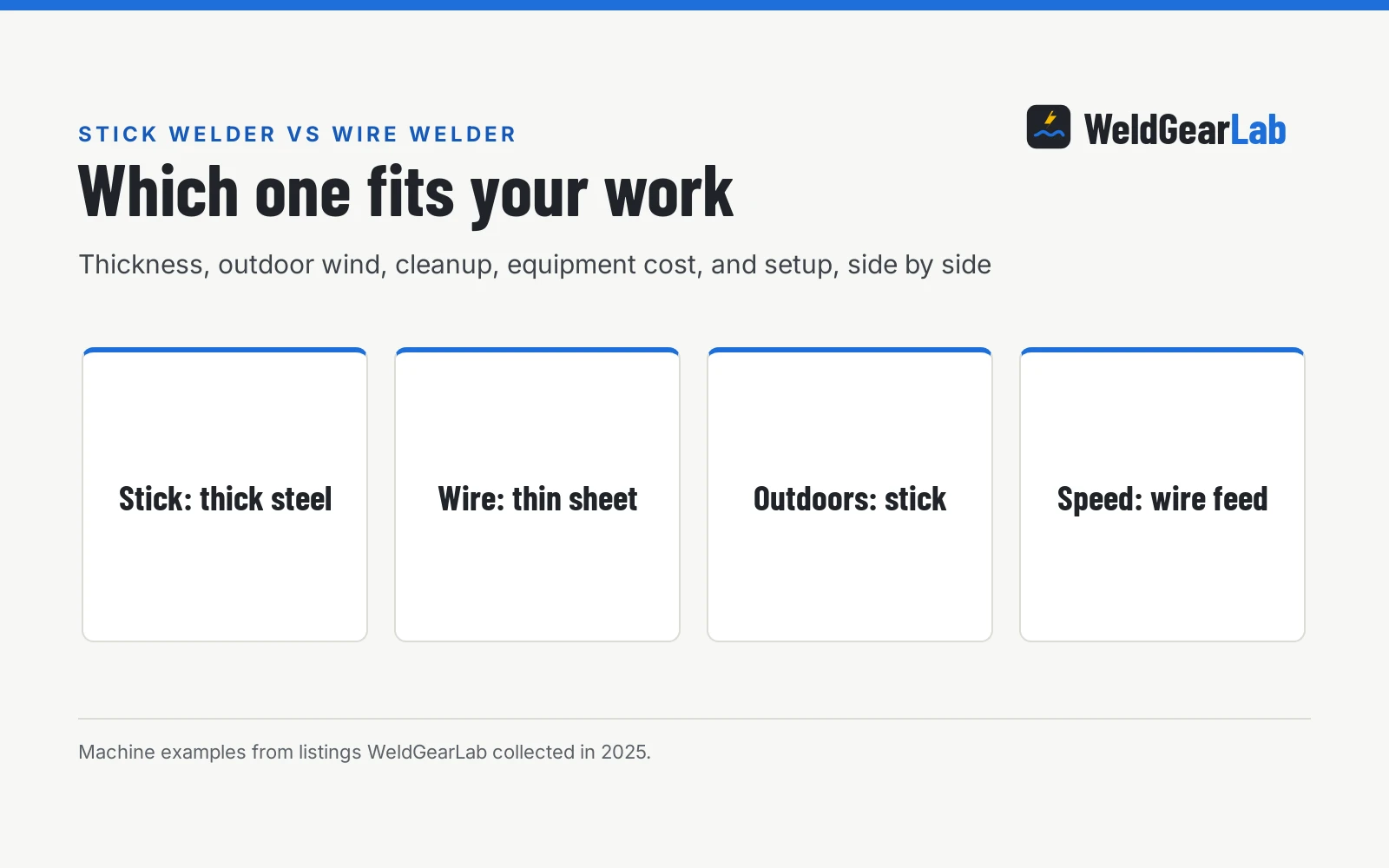
A stick welder uses an electrode holder to grip a flux-coated consumable rod, while a wire welder continuously feeds wire through a handheld gun from an internal spool. When choosing between a stick welder vs wire welder, stick welding is better suited for thick steel, outdoor breezes, and rusty metal on farms and job sites. A wire welder offers an easier learning curve for beginners, welds thin sheet cleanly when running gas MIG, and provides fast trigger operation. This guide compares both processes for home, farm, and hobby shops to help you choose the right machine for your fabrication work.
As an Amazon Associate I earn from qualifying purchases. This guide links to our product roundups, where WeldGearLab earns a commission when you buy through links, at no extra cost to you. Read our affiliate disclosure.
The difference in one paragraph
Both processes join metal by striking an electric arc between an electrode and the base metal to melt the joint, but they shield the molten puddle differently. A stick welder uses a flux-coated electrode rod that melts into the puddle as you weld; the burning flux coating vaporizes into a protective gas shield and leaves a solid slag blanket over the cooling bead. A wire welder mechanically drives continuous solid or flux-cored wire through a gun liner, shielding the weld either with compressed gas from an external cylinder or with flux compounds contained inside hollow wire.
Stick welder vs wire welder side by side
| Stick welder (SMAW) | Gas MIG (GMAW) | Flux core (FCAW) | |
|---|---|---|---|
| Electrode and filler feed | Consumable flux-coated rod clamped in holder | Continuous solid wire fed through a gun | Continuous flux-cored wire fed through a gun |
| Shielding method | Flux coating produces protective gas and slag | External shielding gas from cylinder | Flux compounds packed inside hollow wire core |
| Gear beyond the welder | Electrode holder, work clamp, rods, chipping hammer | Solid wire spool, drive rolls, gas cylinder, regulator | Flux wire spool, knurled drive rolls, work clamp |
| Wind and outdoor work | Tolerates outdoor wind and breezes without losing shielding | Gas blows away; requires shelter or still air | Tolerates outdoor wind and breezes |
| Dirty, rusty, or painted steel | Forgiving on rust, mill scale, and surface contamination | Requires clean, ground bare steel | More forgiving on light rust and mill scale |
| Thin sheet and auto body | Difficult on thin sheet; high risk of burn-through | Smooth control on thin sheet and auto body panels | Moderate control; prone to burn-through on thin sheet |
| Thick steel penetration | Deep penetration on heavy plate and structural joints | Requires higher output or beveling on thick plate | Good penetration on medium steel; requires multiple passes on thick plate |
| Learning curve and bead control | Striking and maintaining an arc takes manual practice | Simple trigger feed; fastest for beginners to run sound beads | Simple trigger feed; easy for beginners to learn |
| Slag and cleanup | Heavy slag coating requires chipping and wire brushing | Zero slag and minimal spatter | Slag coating requires chipping and wire brushing |
| Portability and setup | Lightweight and compact; no drive rolls or gas cylinders to carry | Bulkier cabinet with drive motor; gas cylinder needed | Lightweight to medium cabinet; no gas cylinder needed |
Settings vary by joint design and material thickness; always check your machine door chart or product manual for starting values. While wire welders rely on motor-driven drive rolls, stick machines use simple lead connections with an electrode holder.
When a stick welder is the better choice
- Outdoor wind and field repairs. Breezes and outdoor wind that blow away MIG shielding gas rarely disrupt stick welding because the burning flux coating generates shielding gas directly at the arc tip. This makes stick welders ideal for outdoor fence posts, gates, farm implements, and trailer repairs where erecting wind screens is impractical.
- Dirty, painted, or rusty steel. The aggressive arc and heavy flux chemistry of a stick welder burn through mill scale, surface corrosion, and paint far better than wire processes, reducing the time spent grinding metal down to bright bare steel.
- Thick steel fabrication. Stick electrodes deliver deep penetration on structural steel, thick plate, and heavy repair joints. Even compact portable machines provide substantial capacity; TECWELD, for example, lists its mini inverter capable of welding steel up to 1/4 inch thick, while ESAB lists its Rogue ES 180i capable of running electrodes up to 5/32 inch.
- Job site portability and simplicity. A stick welder has no wire feed drive rolls to jam, no fragile gun liner to kink, and no gas cylinder to transport. A compact inverter machine plugs into available power and operates anywhere the welding leads can reach.
Our best portable stick welder and best stick welder for farm use guides review dedicated inverter machines built for field and shop maintenance.
When a wire welder is the better choice
- Thin sheet metal and auto body repair. When set up for gas MIG with solid wire, wire welders operate at low heat and voltage, allowing you to stitch auto body panels and thin sheet without burning through or warping the metal.
- Beginner learning curve and speed. A wire feed gun uses a simple squeeze trigger to feed wire and start the arc simultaneously. Beginners can run smooth, consistent beads in an afternoon without struggling to strike an arc or maintain tight arc length.
- Clean welds with minimal slag. When running solid wire with shielding gas, a wire welder leaves zero slag and creates minimal spatter, saving significant grinding and chipping time on visible furniture, brackets, and clean shop fabrications.
- Higher production efficiency. Because the wire feeds continuously from a spool, you can lay down long, uninterrupted weld seams without stopping every few inches to replace a burned-down stick rod.
How to tell what a machine supports
Many modern welding machines on the market support multiple processes in a single cabinet. When browsing listings, check the stated specifications to confirm what the power source includes:
- Dedicated stick machines. Pure stick welders include an electrode holder and work clamp. They use constant current (CC) power and do not contain an internal wire drive motor, spool spindle, or gas solenoid. For example, HONE lists a 110V stick machine rated at 120A, while TOOLIOM lists a dual-voltage 110V/220V inverter rated at 135A.
- Wire feed welders. Wire machines operate on constant voltage (CV) and house an internal wire drive mechanism. Entry-level models may be gasless flux-core only, like the ACEWELDER 140A gasless flux core machine, while standard MIG units include a rear gas solenoid valve and hose for shielding gas cylinders.
- Multi-process combinations. Multi-process units can switch between wire feed and stick welding. Several machines on the market also include Lift TIG capability alongside stick or wire functions, providing broad flexibility if you plan to tackle varied fabrication projects.
A shielding gas regulator and cylinder are rarely included with wire feed packages. If you choose to weld with solid wire MIG, plan to obtain a regulator and source a gas cylinder from a local welding supplier.
Power supply and household voltage
Both stick and wire welders are available in 110V household models and 220V shop units. A 110V machine plugs into standard household circuits, making it convenient for garage repairs, hobby builds, and mobile work. For example, WRDLOSY lists a 110V stick machine with a maximum input of 15A and recommends a dedicated 20A circuit for best results.
Dual-voltage machines that run on both 110V and 220V supply lines offer greater versatility. Running on 220V provides higher maximum amperage and better duty cycle performance for fabricating thick steel plate. For advice on power setups, see our guide on 120V vs 240V welders.
Can one machine do both stick and wire?
Yes. Multi-process machines combine constant voltage wire feeding with constant current stick welding in one chassis. If your budget allows, a multi-process machine lets you run gas MIG or flux core wire in the shop for sheet metal and thin tubing, then plug in an electrode holder to stick weld heavy structural steel or rusty gate hardware outdoors.
Our roundup of the best welder for beginners explores versatile machines that simplify process setup across different welding methods.
Welding safety and ventilation. Both processes generate intense ultraviolet arc radiation, hot spatter, and hazardous fumes. Stick welding and self-shielded flux core generate substantial smoke and particulate matter, requiring adequate cross-ventilation or dedicated fume extraction when working indoors. Always wear a shaded welding helmet, flame-resistant leather jacket or sleeves, and heavy welding gloves. Keep a certified fire extinguisher nearby and ensure flammable materials are cleared from your welding space.
Frequently Asked Questions
Which is easier for a beginner, stick or wire?
A wire feed welder is generally much easier for a beginner to learn. Squeezing the gun trigger feeds wire at a steady rate and starts the arc, allowing a newcomer to focus on travel angle and speed. Striking and maintaining an arc with a stick welder requires manual dexterity and practice to avoid sticking the rod to the metal.
Are 120V stick welders any good?
Compact 120V stick machines are effective for light maintenance, hobby projects, and repairs on steel plate. Modern inverter technology allows small units to run smooth arcs on standard household circuits, though running at upper output settings typically requires a dedicated 20A outlet to avoid tripping breakers. They have lower maximum output than dual-voltage machines connected to a 220V supply line.
What is an inverter stick welder?
An inverter stick welder uses modern solid-state electronics to convert alternating mains power into high-frequency electricity before stepping it down to welding current. This electronic design replaces heavy copper transformers with compact circuitry, reducing machine weight down to portable lunchbox sizes. Many units also feature built-in arc force and hot start controls to prevent electrode sticking.
Can a wire welder weld thick steel?
A wire welder can weld thick steel, but doing so requires either high amperage or beveling the joint edges to complete multiple weld passes. For thick structural steel or farm equipment repairs, stick welding often provides deeper penetration with less joint preparation on heavy plate sections.
Can stick welders weld aluminum?
Stick welding aluminum is possible with specialized coated electrodes, but it is challenging and rarely yields clean results due to aluminum’s high heat conductivity and rapid oxidation. For welding aluminum, wire feed welders equipped with a spool gun or dedicated TIG welders are far superior choices.
Related: best portable stick welder, best small inverter stick welders, stick welder AC vs DC, flux core vs MIG, and the stick welders hub. Also explore our overview on welding machines.
About the author
WeldGearLab Editorial is the editorial team behind WeldGearLab. We research product listings, specifications, safety listings and warranty terms, score every pick with the published Gear Score method, and correct errors when readers report them. We do not run our own shop trials; see How We Pick for exactly how picks are made.