5/32 vs 3/16 Welding Rod: Which One Should You Buy?
5/32 vs 3/16 welding rod: how diameter, thickness and amperage decide the size, with four 5/32-inch rods ranked for the home shop.

On this page
Top picks at a glance
As an Amazon Associate I earn from qualifying purchases.
- 1
 Victory Welding Alloys 6010 Welding Rod 5/32" E6010 5/32" 59.6/10View on Amazon
- 2
 50 lb Steel Can E6010 5/32" Stick electrodes welding rod9.6/10View on Amazon
- 3
 Forney 31105 E6011 Welding Rod9.6/10View on Amazon
- 4
 Forney 31310 E6011 Welding RodView on Amazon
- 5
 Victory Welding Alloys 6011 Welding Rod 5/32" E6011 5/32" 5View on Amazon
- 6
 Victory Welding Alloys 7018 Welding Rod 5/32" E7018 5/32" 5View on Amazon
- 7
 Victory Welding Alloys 7014 Welding Rod 5/32" E7014 5/32" 5View on Amazon
- 8
 Victory Welding Alloys 6013 Welding Rod 5/32" E6013 5/32" 5View on Amazon
- 9
 Forney 30510 E6013 Welding RodView on Amazon
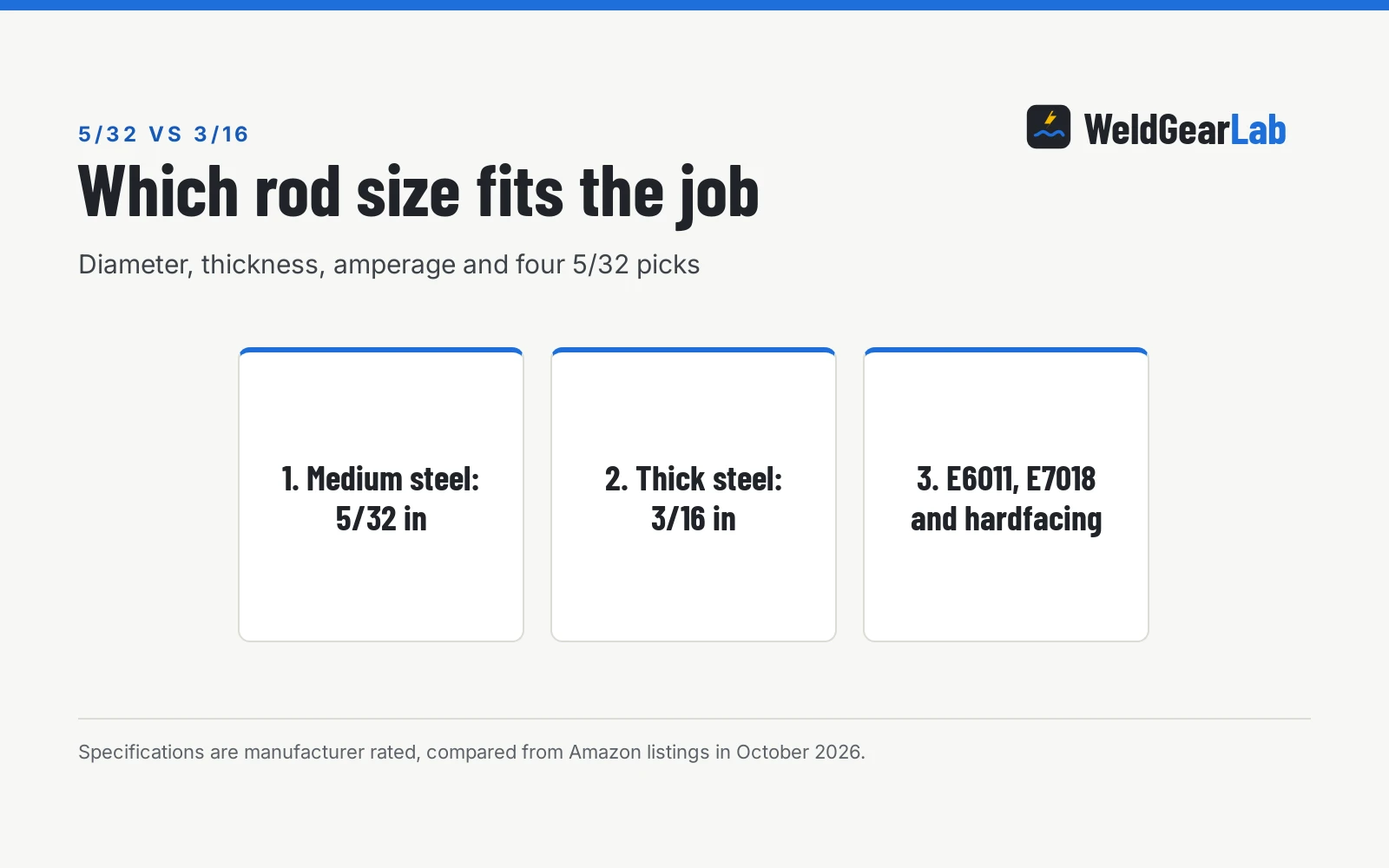
You have a piece of steel on the bench and a rod rack with two sizes in it. For most home shop stick welding, the 5/32 vs 3/16 welding rod question comes down to metal thickness and how much amperage your machine can deliver. The 5/32-inch rod is the middle size for medium steel and general repair. The 3/16-inch rod is the step up for thicker material and heavier passes, and it asks more of the machine. This guide sorts the two sizes by job, then ranks four 5/32-inch rods.
Other welders and gear to compare
 Forney 31310 E6011 Welding RodCheck price on Amazon
 Victory Welding Alloys 6011 Welding Rod 5/32" E6011 5/32" 5Check price on Amazon
 Victory Welding Alloys 7018 Welding Rod 5/32" E7018 5/32" 5Check price on Amazon
 Victory Welding Alloys 7014 Welding Rod 5/32" E7014 5/32" 5Check price on Amazon
 Victory Welding Alloys 6013 Welding Rod 5/32" E6013 5/32" 5Check price on Amazon
 Forney 30510 E6013 Welding RodCheck price on Amazon
WeldGearLab gets a commission on purchases made through links on this page, and your price stays the same. Read our affiliate disclosure.
5/32 vs 3/16 welding rod: how to choose
Diameter sets how much metal the rod puts down and how much current it needs to run. A thicker rod deposits more per pass but needs a hotter machine and a steadier hand. A thinner rod is easier to control and runs on a smaller supply. Pick the rod class first (E6011 for dirty metal, E7018 for structural work, hardfacing for wear surfaces), then the diameter.
Side by side
| 5/32 in rod | 3/16 in rod | Why it matters | |
|---|---|---|---|
| Steel thickness | Medium steel and general repair | Thicker steel and heavier passes | Match rod diameter to the metal so the puddle does not blow through or sit cold |
| Amperage | Runs on a mid-range machine output | Needs more output than a 5/32 rod | Check the rod maker’s chart and your machine’s rating before buying |
| Position work | Rods like E6011 and E7018 are sold for all-position use | Confirm the positions on the package | A bigger puddle is harder to hold out of flat |
| Rod type | E6011, E7018 and hardfacing in this guide | Same rod classes, larger diameter | Pick the class for the job first, then the diameter |
| Pack to buy | Boxes and tubes from 1 lb to 10 lb here | Check the pack size on the listing | Low-hydrogen rod wants a sealed tube or dry storage |
Product figures on this page are the listings’ own claims, not our measurements.
When 5/32 is the right call
- Medium steel. This is the size for general shop and farm repair where the plate is not heavy.
- Machines with limited output. A 5/32 rod stays within reach of a smaller stick welder, and you can stay out of the top of the range.
- Out-of-position work. A smaller puddle is easier to hold on vertical and overhead joints.
- Dirty or rusty steel. The Forney E6011 listing is written for rusty, oily and painted material with minimal surface preparation.
- Wear surfaces. The Forney 42401 hardfacing rod is listed for buildup on cast and manganese steel parts.
When 3/16 makes sense
- Thicker steel. The larger diameter lays down more metal per pass, which suits heavy plate and fewer passes.
- Machines with headroom. A bigger rod wants more current, so check that your machine’s output range covers what the rod maker recommends.
- Flat and horizontal joints. The bigger puddle is easiest to manage when gravity helps, so confirm the positions on the package.
- Buildup and fill. When the job is filling a gap or building up a worn part, more deposition per rod saves time.
The four 5/32-inch rods ranked
These are ranked by how much each listing documents. All four are 5/32 in.
1. YESWELDER E7018. A 10 lb box of 5/32 by 14 inch low-hydrogen iron powder rods. The maker lists 150 to 220 amps, all positions on AC or DC reverse polarity, and claims high quality x-ray welds, steady arc, low spatter, excellent re-striking and high deposition efficiency. It is aimed at medium grade carbon steels where no preheat is used, and at cold rolled steels that show porosity with conventional electrodes.
2. Forney 31310 E6011. A 10 lb box of the all-purpose rod: deep penetration and fast freezing on dirty, rusty and painted material, with smooth arc wetting and spread and good spatter control. It is ideal for AC and can be run DC+ too. The listing gives 170 amps maximum, 60,000 tensile strength, all-position welding and a 90 day warranty against manufacturer defects.
3. Forney 42401 Supercote hardfacing. A 1-pound pack for surface buildup on new or worn machine parts of cast steel and manganese steel. The maker lists RC 52-58 hardness for moderate abrasion and low impact, a crack resistant weld, smooth arc action, easy slag removal and the same 90 day warranty. It is a specialty rod, not a general joining rod.
4. Blue Demon E7018. A 5 lb plastic tube of 5/32 by 14 inch low-hydrogen carbon steel rods for AC/DC. The listing says little beyond that, so there are no amperage, position or warranty details to weigh, which is why it ranks last.
Welding rods safely
Stick welding throws arc flash, sparks and fumes. Wear a proper welding helmet, gloves and flame-resistant clothing, and weld with ventilation or outdoors, especially on galvanized or painted steel. Keep the electrode holder insulated and dry, clamp the ground close to the work, and clear flammables from the area. Match the rod to your machine’s amperage range and read the rod maker’s chart. See the metal fab tools hub for more shop gear.
FAQ for welders
Which is better for beginners, 5/32 or 3/16?
The 5/32 rod is the easier size to start with. The puddle is smaller and the current needed is lower. Move up to 3/16 when the steel is thick enough to need heavier passes and your machine can supply the current.
Can I run 5/32 rod on a small stick welder?
Check the rod’s recommended amperage against your machine’s output range. The YESWELDER E7018 lists 150 to 220 amps and the Forney E6011 lists 170 amps maximum, so a machine has to reach those figures to use the rod as stated.
What is the difference between 6011 and 7018?
The E6011 is listed for deep penetration and fast freezing on dirty, rusty and painted steel, and it is ideal for AC. The E7018 is a low-hydrogen rod claimed to make high quality x-ray welds with low spatter. See our 6011 vs 7018 welding rod comparison.
Which of these rods carry a warranty?
Both Forney rods state a 90 day warranty against manufacturer defects. The YESWELDER and Blue Demon listings state no warranty term.
What is hardfacing rod for?
The Forney 42401 listing says it is for surface buildup on new or worn machine parts of cast steel and manganese steel, at RC 52-58 hardness for moderate abrasion and low impact.
Related: the 6011 vs 7018 welding rod comparison and the metal fab tools hub.