120V MIG vs 120V TIG Welder: Which One Should You Buy? (2026)
120v mig vs 120v tig welder: which should you buy? The LOTOS 150A runs flux-core MIG on a 120V outlet; the ARCCAPTAIN 200A runs five TIG processes on 110V or 220V.

On this page
Top picks at a glance
As an Amazon Associate I earn from qualifying purchases.
- 1
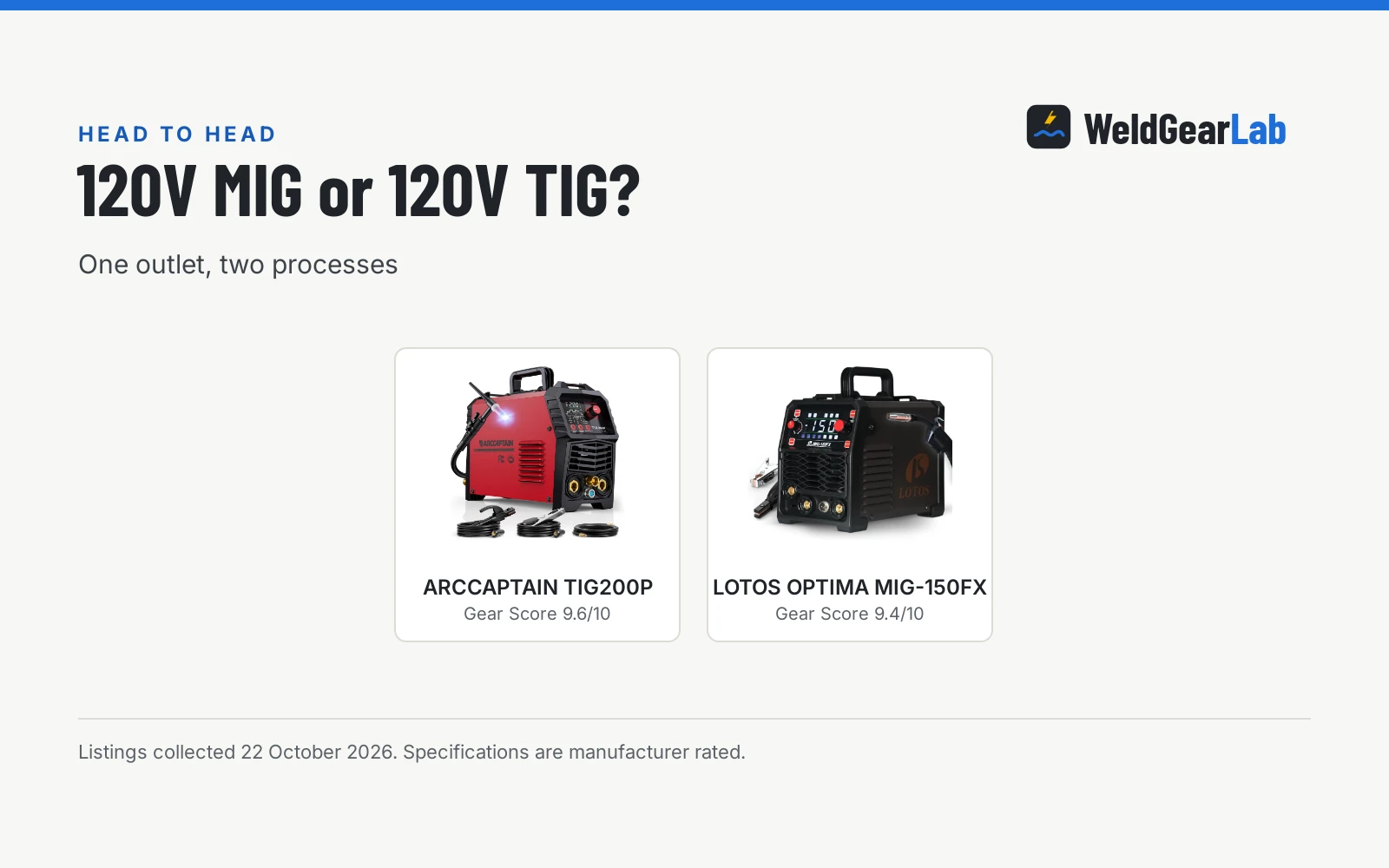
 ARCCAPTAIN DC 5 In 1 TIG Welder With Pulse9.6/10View on Amazon
- 2
 150A 3-in-1 Synergic MIG Flux Core Spot Welder9.4/10View on Amazon
Verdict. In this 120v mig vs 120v tig welder matchup, pick the LOTOS OPTIMA MIG-150FX for 120V MIG work: 150A output, a stated 25% duty cycle, synergic setup and a spot countdown timer for panel tacks, all in a complete kit. Pick the ARCCAPTAIN TIG200P for TIG work on 110V or 220V input: a 200A maximum rating, five processes including HF, Pulse and Spot TIG, foot pedal support and a 2-year quality guarantee. The listing states no separate output figure for 120V input, so the 200A figure is the machine maximum, not a 120V rating. Both listings disagree with their own spec tables on weight, so confirm that figure before you carry either machine.
The job on the bench is a familiar one: one 120V outlet in the garage and a repair that could go either way. A cracked bracket wants the speed of wire feed, while a thin stainless patch wants the control of a TIG torch. The question behind 120v mig vs 120v tig welder is really which process your work rewards more, and these two listings give the question concrete form: the LOTOS OPTIMA MIG-150FX on the MIG side and the ARCCAPTAIN TIG200P on the TIG side.
WeldGearLab gets a commission on purchases made through links on this page, and your price stays the same. Read our affiliate disclosure.
Below: the two machines side by side, what separates them on power, processes, weight and warranty, and which buyer each one suits.
The two machines

ARCCAPTAIN DC 5 In 1 TIG Welder With Pulse
200A 5-in-1 DC TIG welder with HF, Lift, Pulse and Spot TIG modes on 110V or 220V.
Pros
- 200A max output with HF TIG, Lift TIG, Pulse TIG and Spot TIG plus stick
- Dual voltage 110V/220V input for shop or jobsite power
- Foot pedal control supported in 2T TIG modes
- VRD plus over-current, over-voltage, overload and overheat protection, with a 2-year quality guarantee stated
Cons
- DC output only, with no AC TIG mode stated for the listing
- No safety certification stated in the listing
- Included components list names only the machine itself

150A 3-in-1 Synergic MIG Flux Core Spot Welder
150A 3-in-1 synergic MIG welder for 120V outlets, with flux-core, stick and lift TIG modes.
Pros
- 150A output with a stated 25% duty cycle for 120V work
- 3-in-1 with synergic auto-calibration of wire feed speed and current
- Adjustable spot countdown timer plus 2T, 4T and automated spot modes for panel tacks
- Complete kit: MIG gun, stick stinger, ground clamp and contact tips in the box
Cons
- 120V input only, with no dual voltage option stated
- No warranty term stated in the listing
- No safety certification stated in the listing
Other welders and gear to compare
 YESWELDER 140A MIG WelderCheck price on Amazon
 YESWELDER 5-in-1 TIG Welder & Plasma CutterCheck price on Amazon
 AWT LED Display 180A Cold TIG Welder with DC PulseCheck price on Amazon
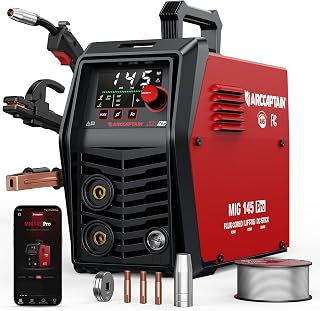 ARCCAPTAIN MIG145 Pro Flux Core MIG Welder 145A 120V 3-in-1Check price on Amazon
 Miller 907757 Multimatic® 220 AC/DC Multiprocess WelderCheck price on Amazon
 Forney 410 220 Multi-ProcessCheck price on Amazon
Side by side
| Model | Verdict | Output | Voltage | Processes | Weight | Warranty |
|---|---|---|---|---|---|---|
| ARCCAPTAIN TIG200P | Pick for TIG work | 200A | 110V/220V | Lift/HF/Pulse/Spot TIG, Stick | 10.25 lbs (spec table: 21.1 pounds) | 2-year quality guarantee |
| LOTOS OPTIMA MIG-150FX | Pick for 120V MIG work | 150 Amp | 120V | Flux-core MIG, Stick/MMA, Lift TIG | 8.2 lbs (spec table: 12 pounds) | Not stated |
22 October 2026
120v mig vs 120v tig welder: power and output
The ARCCAPTAIN TIG200P states a 200A maximum output, its maximum rating on dual 110V/220V input, against the LOTOS MIG-150FX at 150 Amp. The listing states no separate output figure for 120V input. On maximum output alone the ARCCAPTAIN leads, but the two numbers describe different processes: 200A of TIG current and 150 Amp of MIG current do not do the same work. What the numbers do tell you is headroom. The LOTOS pairs its 150 Amp with a stated 25% duty cycle, which is the figure a buyer should weigh against long beads on thicker stock. The ARCCAPTAIN listing lets the operator adjust duty cycle among its TIG settings but states no duty cycle figure, so the listing leaves that comparison unclear.
Processes
The process lists are where the two sides diverge most. The LOTOS is a 3-in-1: gasless flux-core MIG, manual DC stick/MMA and touch-start lift TIG, with synergic control that automatically synchronizes wire feed speed with current. The ARCCAPTAIN is a 5-in-1 DC machine: Lift TIG, HF TIG, Pulse TIG, Spot TIG and Stick, with Hot Start and Arc Force on the stick side. Both listings name spot functions, the LOTOS an adjustable spot countdown timer for panel tack welds and the ARCCAPTAIN a Spot TIG mode, so a buyer doing auto body tack work finds something on either side.
Two honest limits. The LOTOS processes all run from 120V only, while the ARCCAPTAIN runs on 110V or 220V. And the ARCCAPTAIN is DC only, naming stainless steel, mild steel and copper as its metals, with no aluminum claim and no AC TIG mode stated.
Duty cycle and thickness
The LOTOS listing states a 25% duty cycle and a max thickness of 3/16 in (5 mm) on carbon steel and stainless steel plates. The ARCCAPTAIN listing states no duty cycle figure and no max thickness figure, though it names pulse welding with low heat input for thin stock. Do not read the ARCCAPTAIN’s higher amperage as thicker capacity: the listings do not state that spec on both sides, so the comparison stays where the listings put it.
Weight and build
Both listings contradict themselves on weight, and the contradictions are large. The LOTOS bullets state 8.2 lbs while its spec table lists 12 pounds. The ARCCAPTAIN bullets state 10.25 lbs with a carrying handle and shoulder strap while its spec table lists 21.1 pounds. This site’s rule is to trust the title and bullets over the spec table, so use 8.2 lbs and 10.25 lbs as the planning figures until the listings agree. On build features, the LOTOS states a large vivid digital display with real-time voltage, amperage and wire feed speed, plus error-code diagnostics. The ARCCAPTAIN states a large LED display, a smart cooling fan that runs only when needed, and VRD with over-current, over-voltage, overload and overheat protection.
What is in the box
The LOTOS is the complete kit of the pair: MIG gun, stick stinger, ground clamp and contact tips are all named in the listing. The ARCCAPTAIN’s included components entry names only the machine itself, the TIG200P-2025, though the listing mentions a carrying handle and shoulder strap in the bullets. A buyer comparing out-of-the-box readiness should price the ARCCAPTAIN’s torch and accessories separately.
Warranty
The ARCCAPTAIN listing states a 2-year quality guarantee with responsive technical support, and says every machine is checked at the ARCCAPTAIN factory before shipping. The LOTOS listing states no warranty term. On the stated terms alone, the ARCCAPTAIN is the safer buy for a buyer who values written backup.
Choose the LOTOS OPTIMA MIG-150FX if
You weld on 120V only and want wire feed speed. The synergic auto-calibration removes setup guesswork, the spot countdown timer suits panel tack work, and the box includes everything to start. Accept the 120V ceiling and confirm the weight before you plan to carry it.
Choose the ARCCAPTAIN TIG200P if
You want TIG control and room to grow. Five processes, pulse settings, foot pedal support in 2T modes and dual voltage cover more kinds of work, and the 2-year quality guarantee is written down. Accept the DC-only limit and the thin stated kit, and confirm the weight.
The 120V outlet decides more than the brand
Both machines in this comparison run on the 120V power a home garage already has, but they use it differently. The LOTOS states 120V input with a ±15% safety buffer and puts all of it into 150 Amp of MIG output with a stated 25% duty cycle. The ARCCAPTAIN accepts 110V or 220V, with a 200A maximum rating across five processes; the listing states no output figure for 120V input alone. On a 120V circuit, the practical difference is not the headline amperage but the process: the LOTOS lays wire-feed beads and panel tacks with synergic setup doing the dialing, while the ARCCAPTAIN gives manual control of pulse, slope and post gas for thin work. A buyer who only ever plugs into 120V should weigh the LOTOS’s stated duty cycle against the ARCCAPTAIN’s adjustability, and check the breaker and the manual before long beads on either machine.
Before You Strike an Arc
- The LOTOS runs on 120V with a stated ±15% safety buffer; the ARCCAPTAIN takes 110V or 220V, so match the machine to your outlet before the first bead.
- The listings disagree with their own spec tables on weight, so confirm before you carry either machine: 8.2 lbs and 10.25 lbs in the bullets against 12 pounds and 21.1 pounds in the tables.
- The LOTOS kit names a MIG gun, stick stinger, ground clamp and contact tips; the ARCCAPTAIN’s included list names the machine only, so budget for torch and accessories.
- The ARCCAPTAIN supports foot pedal control in 2T TIG modes, which is worth setting up before fine work on thin stock.
FAQ for welders
Can I run these welders on a standard 120V outlet?
The LOTOS listing states 120V input with a ±15% safety buffer, so yes on a standard outlet. The ARCCAPTAIN supports 110V and 220V input, so it runs on a standard outlet on its 110V input.
Which machine is better for thin sheet metal?
The ARCCAPTAIN names pulse TIG with low heat input for thin stock and supports a foot pedal in 2T modes. The LOTOS offers an adjustable spot countdown timer for panel tack welds. Neither listing states a minimum thickness, so confirm with the manual.
Do either of these weld aluminum?
Neither listing claims it. The ARCCAPTAIN names stainless steel, mild steel and copper with DC output and no AC TIG mode. The LOTOS names carbon steel and stainless steel plates. Shop aluminum on a listing that states it.
What does the stated 25% duty cycle mean for the LOTOS?
It is the figure the LOTOS listing states for its 150 Amp output. The ARCCAPTAIN listing lets the operator adjust duty cycle among its TIG settings but states no figure, so the listings do not give a side-by-side comparison on this spec.
Can the ARCCAPTAIN use a foot pedal?
The listing states foot pedal control is supported in 2T TIG modes. No foot pedal is named in the included components, so confirm what ships in the box.
Is there a warranty?
The ARCCAPTAIN listing states a 2-year quality guarantee. The LOTOS listing states no warranty term.
Related: our TIG vs stick for thin metal comparison, MIG vs stick for thick steel and flux core vs MIG for thick steel.
Scoring, line by line
| Product | Gear Score | Perf. /35 | Build /25 | Value /25 | Safety /10 | Warranty /5 |
|---|---|---|---|---|---|---|
| ARCCAPTAIN TIG200P | 9.6 | 30 | 21 | 21 | 0 | 3 |
| LOTOS OPTIMA MIG-150FX | 9.4 | 28 | 20 | 20 | 0 | 0 |
A pick’s weighted total decides where it lands between a 9.2 floor and a 9.8 ceiling, and a bigger total never produces a smaller number.