How Thick Can a 120V MIG Welder Weld?
A 120V wire feed welder welds steel from 24-gauge sheet up to 1/4 inch plate depending on amperage output, joint preparation, and wire selection.
 By WeldGearLab Editorial
Updated October 9, 2026
By WeldGearLab Editorial
Updated October 9, 2026
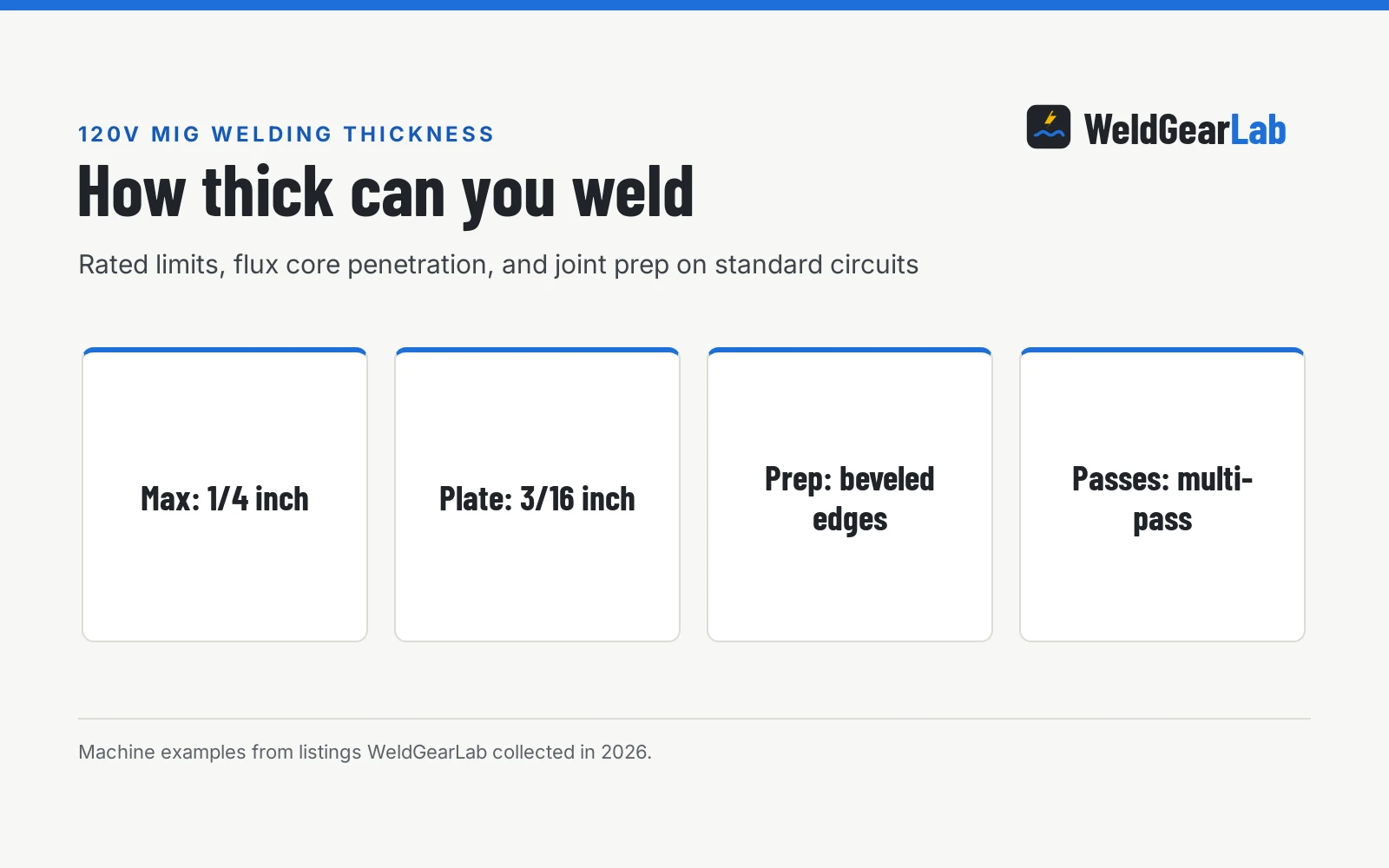
If you want to know how thick can a 120v mig welder weld, the short answer is that published listings for 120V machines rate mild steel plate up to 3/16 inch or 1/4 inch, with select models specifying from 24-gauge sheet. On a standard 120V household branch, available electrical input sets a firm ceiling on heat. While thin sheet metal fuses quickly, joining plate at or above 3/16 inch requires proper joint preparation and multi-pass technique to achieve sound penetration.
As an Amazon Associate I earn from qualifying purchases. This guide links to our product roundups, where WeldGearLab earns a commission when you buy through links, at no extra cost to you. Read our affiliate disclosure.
How thick can a 120v mig welder weld?
The thickness a wire feed welder can join depends directly on electrical output, process type, and joint preparation. Plugged into a standard 120V outlet, compact machines in published listings produce between 125A and 160A of peak current. For thin sheet metal, the Forney 140-Amp welder publishes ratings starting down at 24-gauge mild steel. For heavier plate, listings from DURATECH and LOTOS OPTIMA rate capacity up to 3/16 inch (5 mm) thick, though listings do not state whether these limits apply to single-pass or multi-pass joints.
Reaching plate up to 1/4 inch requires specific joint preparation. Self-shielded flux-cored wire operates with higher arc penetration in home machines than solid wire under typical shop conditions. To weld 1/4 inch steel on 120V power, welders grind a bevel on the plate edges, leave a root opening, and deposit multiple passes to avoid cold lap.
Some listings publish higher maximum limits, citing capacities up to 4.0mm plate or 2/5 inch material. In shop practice, welding steel approaching 2/5 inch (or 3mm to 5 mm plate) on 110V or 120V power requires extensive beveling, preheating, and running successive passes within duty cycle limits, such as a published 25% duty cycle.
Side by side
| Specification | DURATECH 125A | Forney 140-Amp | LOTOS OPTIMA 150A |
|---|---|---|---|
| Stated maximum thickness | 3/16 inch plate | 1/4 inch plate | 3/16 inch (5 mm) plate |
| Stated minimum thickness | Not stated | 24-gauge sheet | Not stated |
| Single or multi pass | Not stated | Not stated | Not stated |
| Stated wire sizes | 0.030 and 0.035 inch | Not stated | Not stated |
| Peak amperage rating | 125A | 140 Amps | 150 amp |
| Published duty cycle | Not stated | Not stated | 25% duty cycle |
| Input power source | 120V (15A to 20A adapter) | 120V household outlet | 120V lines |
Published specifications show clear differences among compact 120V units. The Forney 140-Amp gasless machine lists a thickness span from 24-gauge up to 1/4 inch on mild steel, whereas the DURATECH 125A flux-core unit lists up to 3/16 inch plate. Where listings omit minimum thickness or pass counts, practical results depend on joint preparation and wire choice.
What maker ratings publish for 120V thickness
Published specifications for wire feed machines show thickness limits varying across brands and wire setups:
- Forney: The Forney Easy Weld 140-Amp unit runs on 120V and rates mild steel from 24-gauge up to 1/4 inch thickness.
- DURATECH: The DURATECH 125A welder operates on 120V, listing mild steel capacity up to a 3/16 inch plate with 0.030 and 0.035 inch flux-core wire.
- LOTOS OPTIMA: The LOTOS OPTIMA 150A machine delivers 150 amp output on 120V lines with a 25% duty cycle, joining plates up to 3/16 inch (5 mm) thick.
- Acewelder: The Acewelder 140A unit specifies welding mild steel up to 4.0mm plate with .030, .035, and 0.040 inch wire.
- migbloom: The migbloom 145 amp model runs on 110V, handling mild steel up to 2/5 inch thick with wire feed speed from 120 to 420 inches per minute.
- BESTMIG: The BESTMIG 145A unit lists mild steel up to 3mm (2/5 inch) thick using 0.8mm wire on 110V or 220V power.
- Reboot: The Reboot 160A unit lists up to 160A output on 120V across multi-process modes.
- ARCCAPTAIN: The ARCCAPTAIN MIG145 Pro delivers 145A on 120V, while the dual-voltage MIG205DP Pro reaches 205A on 120V/240V lines.
While conservative makers like DURATECH cite 3/16 inch for 125A, others cite 1/4 inch at 140A or 2/5 inch at 145A. In practical fabrication, ratings above 3/16 inch require beveled joints and multiple passes on 120V power. For model comparisons, see our best 120V MIG welder and best flux core welder guides.
Why flux core penetrates deeper than gas MIG
If you need maximum joint penetration on a 120V machine, wire selection plays a major role alongside amperage. Gasless flux-cored wire (FCAW) frequently achieves deeper fusion in thicker steel than solid wire with shielding gas (GMAW).
This advantage stems from wire construction. Self-shielded flux-core wire is tubular, with flux packed inside a thin outer metal sheath. Because electrical current travels primarily through this outer sheath, current density remains concentrated at modest amperage. In addition, internal flux deoxidizers stabilize the arc column and produce a digging arc that fuses root edges on heavier plate.
Solid wire MIG uses solid filler under shielding gas with DCEP polarity, producing clean, low-spatter beads on thin sheet. On heavy plate near machine limits, solid wire requires clean bare metal and high heat to avoid cold lap. For welders delivering 125A to 150A, flux-core wire provides extra penetration margin on 3/16 inch and 1/4 inch steel. Read our guide on whether can you MIG weld without gas and review the best MIG wire for mild steel.
How to weld thicker steel with joint prep
When plate reaches 3/16 inch or 1/4 inch, proper joint preparation allows a 120V welder to achieve sound fusion:
- Bevel the joint edges. Grind a V-groove along mating edges so the arc reaches the root of the joint before filling.
- Set a root opening. Leaving a slight gap between plates allows molten filler to penetrate completely through the joint.
- Clean mill scale and rust. Clean bare steel conducts smoothly; mill scale and rust rob arc heat and create porosity.
- Run multi-pass beads. Lay a narrow root pass along the V-groove to fuse the base, chip slag, and deposit a cover pass over the top.
- Maintain a short stickout. Keeping the contact tip close to the puddle prevents voltage drop and keeps heat concentrated.
Preheating the plate with a torch also reduces heat sink into cold steel, helping a 140A or 145A arc establish a fluid puddle. For more tool advice, check our guide on how to choose a MIG welder and our picks for the best welder for beginners.
Circuit limits and electrical supply
A welder can only draw as much power as the branch circuit provides. Standard US household outlets deliver 120V on 15A or 20A circuits. Understanding these limits prevents breaker tripping near maximum machine output.
Operating at 125A to 145A draws heavy current from the wall. The DURATECH 125A welder listing includes a 15A to 20A plug adapter, showing that sustained welding benefits from a dedicated 20A line. On a standard 15A receptacle, running long continuous beads can overheat the breaker. See our guide on whether can you run a MIG welder on a 15 amp circuit.
Duty cycle also limits sustained welding. For example, the LOTOS OPTIMA 150A machine lists a 25% duty cycle at maximum output, meaning the welder must rest periodically for fan cooling. Pushing 120V power on 1/4 inch plate hits this thermal limit quickly; read more in welding duty cycle explained.
For frequent thick metal fabrication, dual-voltage units like the ARCCAPTAIN MIG205DP Pro run on 120V household outlets or 240V for 205A output. Compare options in our 120V vs 240V MIG welder comparison and explore our reviews of the best MIG welder under 500.
Shop safety rules. Always wear a shade-appropriate welding helmet, flame-resistant gloves, and protective clothing. Ensure adequate ventilation or weld outdoors with flux-core wire. Never weld galvanized steel without respiratory protection against zinc fumes.
Frequently Asked Questions
Can a 120V MIG welder weld 1/4 inch steel?
Yes, a 120V machine can weld 1/4 inch steel using gasless flux-core wire, beveled edges, and multi-pass beads. The Forney 140-amp unit explicitly lists 1/4 inch maximum thickness on mild steel.
Can a 120V MIG welder run on a 15A household circuit?
Compact wire feed welders run on standard outlets, but top output often benefits from a 20A breaker. The DURATECH 125A welder provides a 15A to 20A adapter to fit standard household receptacles.
Why does flux-core wire weld thicker steel than solid wire?
Self-shielded flux-core wire concentrates current through its thin outer sheath, delivering high current density into the joint. Internal flux agents stabilize the arc column to produce deeper fusion than solid wire at equal amperage.
What wire size should you use for maximum thickness on 120V?
Using 0.030 inch or 0.035 inch wire provides the best balance of current density and arc control on 120V welders. Listings from migbloom and Acewelder support 0.030, 0.035, and 0.040 inch flux-core wire, with 0.035 inch running smoothly at 140A or 145A.
How thin of metal can a 120V MIG welder weld?
Certain compact wire feed welders publish ratings down to 24-gauge sheet metal for auto body and repair work. For example, the Forney 140-amp welder explicitly specifies a lower range starting at 24-gauge mild steel.
Related: best 120V MIG welder, best flux core welder, 120V vs 240V MIG welder, can you run a MIG welder on a 15 amp circuit, and our MIG welders hub.
About the author
WeldGearLab Editorial is the editorial team behind WeldGearLab. We research product listings, specifications, safety listings and warranty terms, score every pick with the published Gear Score method, and correct errors when readers report them. We do not run our own shop trials; see How We Pick for exactly how picks are made.