Flux Core vs Mig for Thick Steel: Which One Should You Buy?
Self-shielded flux core is the usual pick for thick mild steel, with multi-pass welds and no gas cylinder, while gas MIG stays the cleaner choice for stainless and thinner work, with stainless flux core as the gasless option.

On this page
Top picks at a glance
As an Amazon Associate I earn from qualifying purchases.
- 1
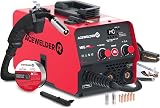 140A Gasless Flux Core MIG Welder/Lift TIG/Stick 3 in 19.6/10View on Amazon
- 2
 YixangDD 2 Pack 030 Flux Core Welding WireView on Amazon
- 3
 YESWELDER Stainless Steel MIG Solid WireView on Amazon
- 4
 YESWELDER Gasless Flux Core MIG WireView on Amazon
- 5
 Forney 42303 Flux Core Mig WireView on Amazon
- 6
 VEVOR Flux Core MIG Welding WireView on Amazon
- 7
 YESWELDER Flux Core Gasless MIG Welding WireView on Amazon
A cracked trailer tongue, a loader bucket edge worn thin, a gate hinge that finally gave up. Thick steel jobs like these are where the wire question stops being theory: flux core vs mig for thick steel. The short answer is that self shielded flux core is the usual pick for thick mild steel, because the flux inside the wire makes its own shielding and the wire can be run in several passes to build a heavy joint, while gas MIG stays the cleaner pick for stainless and thinner sections, with a self-shielded stainless flux core wire as the gasless alternative.
Other welders and gear to compare
 YixangDD 2 Pack 030 Flux Core Welding WireCheck price on Amazon
 YESWELDER Stainless Steel MIG Solid WireCheck price on Amazon
 YESWELDER Gasless Flux Core MIG WireCheck price on Amazon
 Forney 42303 Flux Core Mig WireCheck price on Amazon
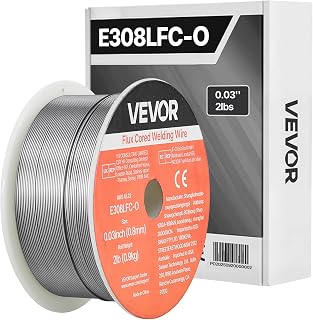 VEVOR Flux Core MIG Welding WireCheck price on Amazon
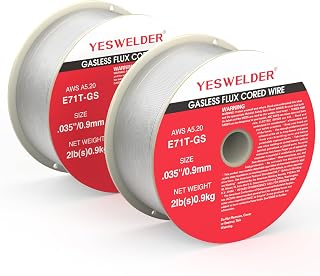 YESWELDER Flux Core Gasless MIG Welding WireCheck price on Amazon
This guide links to our product roundups, where WeldGearLab gets a commission on purchases made through links on this page, and your price stays the same.
Flux core vs mig for thick steel: the short answer
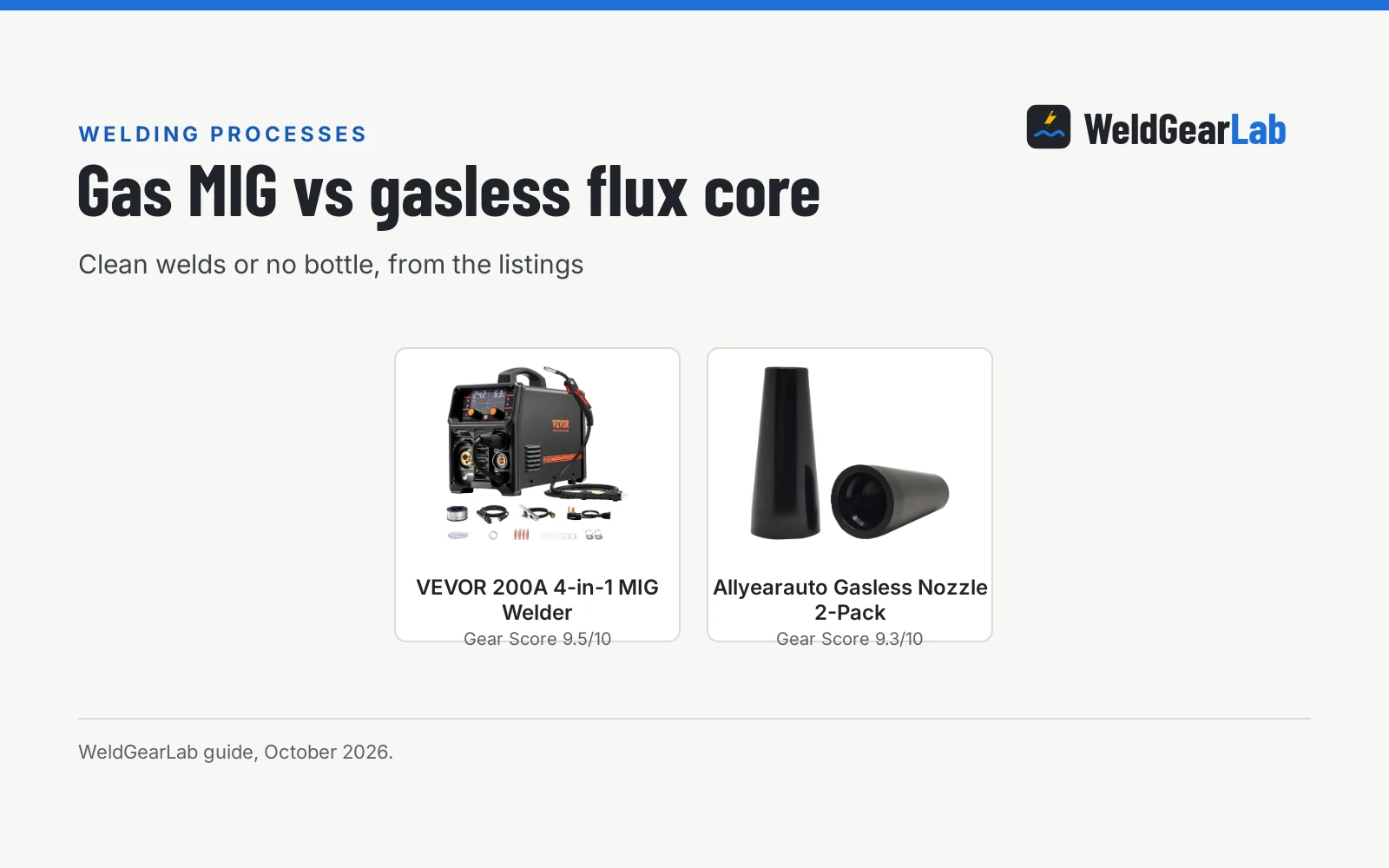
Both processes are wire feed welding, and many home machines can run one or both. The difference is how the puddle is shielded from air. Gas MIG protects it with shielding gas from a cylinder, fed through the gun around solid wire. Self shielded flux core wire is hollow and filled with flux that burns to make its own shielding gas and leaves a layer of slag on the bead. No cylinder, no hose, no regulator.
For thick mild steel, flux core is usually the practical pick. It penetrates deeper at a given setting, shrugs off wind and dirty metal, and a wire like the YESWELDER E71T-GS below is stated for multi-pass work, so you can stack passes to fill a heavy joint. Gas MIG earns its place on stainless and thinner sections, where you want a clean bead with little cleanup.
Side by side
| Flux core (self shielded) | Gas MIG (solid wire) | For thick steel | |
|---|---|---|---|
| Shielding | Flux inside the wire | Gas from a cylinder | Flux needs no cylinder |
| Gear beyond the welder | Self-shielded wire | Solid wire, cylinder, regulator, gas hose | Flux is simpler |
| Thick mild steel | Multi-pass builds heavy joints | Needs the right gas and settings | Flux |
| Wind and outdoor work | Tolerates a breeze | Gas blows away, needs shelter | Flux |
| Dirty or rusty steel | More forgiving | Needs cleaner metal | Flux |
| Spatter and cleanup | Slag to chip between passes | No slag, less spatter | Gas MIG |
| Fumes | More smoke | Less smoke | Gas MIG |
| Stainless grades | The carbon wires here are not for stainless | ER308L and E308LFC-O listings suit 304 and 308 grades | Gas MIG |
| Typical polarity | Often DCEN, follow the wire label | DCEP, follow the wire label | Check the label |
Polarity is general practice for common wires; always follow the polarity printed on your wire’s label and in the machine’s manual. Most machines that run both have a polarity lead you swap when you change wire.
Wire picks for thick steel
The four wires below are the ones this comparison is built on, ordered by how well each fits thick steel work.
1. YESWELDER E71T-GS Flux Core Wire .030, 5-Pack
A self-shielded E71T-GS flux core wire on 2-pound ABS spools, sold as a 5-pack. The listing states single and multi-pass use in all positions, with deoxidizing agents in the core that handle light rust and mill scale, and no external gas cylinder. One oddity: the spec table lists the power source as “hand_powered”, which is plainly wrong for a welding wire, so trust the title and bullets.
Pros
- Stated for single and multi-pass applications, which is exactly what thick steel needs.
- Self-shielded, so there is no cylinder, regulator or gas hose to buy or refill.
- Deoxidizing agents in the core handle light rust and mill scale, per the bullets.
- Low spatter with full slag formation and easy removal, in all positions.
Cons
- Each spool holds only 2 pounds, so long jobs mean more spool swaps.
- Stated for carbon and low-alloy structural steel only, so it is not the wire for stainless.
- Slag forms on every bead and must be chipped and brushed before the next pass.
- No warranty term is stated in the listing.
2. Forney 42303 Flux Core Wire .035, 10-Pound Spool
Forney’s 42303 is a self-shielded E71T-GS flux core wire for mild steel in .035 on a 10-pound spool. The spec table states 79,000 psi tensile strength. Note the title and bullets say .035 while the spec table lists 0.04 inches: trust the title and bullets.
Pros
- .035 diameter in the title and bullets, the thickest wire in this group.
- 79,000 psi tensile strength stated in the spec table.
- Self-shielded and listed as working well on rusty, dirty and painted material.
- 10-pound spool for long runs with fewer changeovers.
Cons
- Spec table lists wire diameter as 0.04 inches against .035 in the title and bullets; trust the title and bullets.
- The recommended-uses text mentions single pass applications, and multi-pass is not stated.
- No concrete warranty term is stated; the spec table’s Warranty Description just says “Warranty”.
- Mild steel wire only, not stated for stainless grades.
3. YESWELDER ER308L Stainless MIG Wire .030, 10-Pound Spool
A 10-pound spool of ER308L stainless solid wire in .030, for MIG welding 304, 304L, 308, 308L, 321 and 347 stainless steels. It needs 100% Argon or an Argon/Helium blend per the bullets, so this is the gas MIG side of the comparison.
Pros
- 10-pound spool on a stated strong ABS plastic spool.
- Minimal spatter with a stable arc and smooth feeding, per the bullets.
- All-position wire for common stainless grades.
- Balanced ferrite content for crack and corrosion resistance, per the listing.
Cons
- Needs 100% Argon or an Argon/Helium blend, so add a cylinder, regulator and gas cost.
- Stainless ER308L only; not the wire for thick mild carbon steel.
- No tensile strength is stated in the listing.
- The listing repeats the same performance bullet twice, word for word.
4. Rumvita E308LFC-O Stainless Flux Core Wire .030, 2-Pound Spool
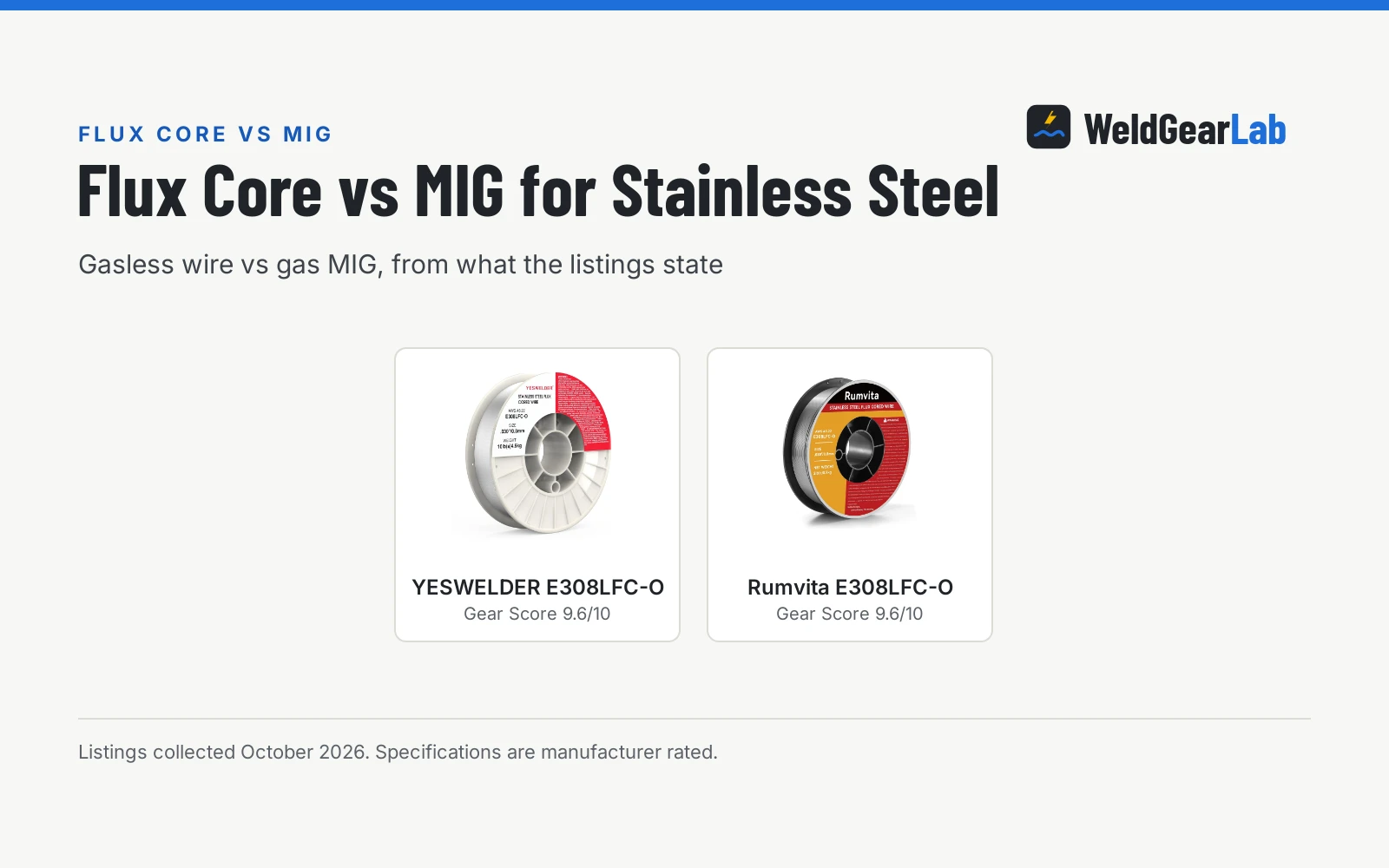
Rumvita’s E308LFC-O is a self-shielded stainless flux core wire in .030 on a vacuum-packed 2-pound spool, stated for 304, 304L, 308, 308L, 321 and 347 stainless in all positions, with no gas needed.
Pros
- Gasless stainless wire: self-shielded, so no cylinder is needed.
- Less spatter with little cleanup or slag removal, per the bullets.
- All-position wire for common stainless grades.
- Individually vacuum-packed spool.
Cons
- Only 2 pounds of wire, a small spool for big jobs.
- Stainless only; not stated for mild carbon steel.
- No tensile strength is stated in the listing.
- No warranty term is stated.
When flux core wins on thick steel
- Outdoor and farm work. Wind that ruins gas shielding barely touches self-shielded wire. Trailer frames, gates and equipment repairs in the field are flux core territory.
- Thick joints on a small machine. Flux core penetrates deeper at a given setting, and multi-pass wire stacks beads to fill a heavy joint.
- Rusty or painted steel. E71T-GS tolerates mill scale and light rust better than solid wire, so there is less grinding before you strike an arc.
- No gas gear. No cylinder to buy or lease, no regulator, nothing to refill.
Our best flux core welder guide covers six gasless machines for outdoor and farm repairs.
When gas MIG wins
- Stainless work. The ER308L listing is the gas-shielded solid-wire route for 304 and 308 grades; the Rumvita E308LFC-O is the self-shielded flux-core route for the same grades, with no cylinder.
- Clean beads and less cleanup. No slag to chip and less spatter, which matters on visible work.
- Indoor shop work. Less smoke than flux core, though you still need ventilation.
- Thin sections. Smaller, cleaner beads mean less burn-through on sheet.
Setting up for a thick joint
Thick steel with wire this size is a multi-pass job. Set the polarity the wire label calls for, check the machine’s door chart or manual for a starting point, and keep the joint fit-up snug so the first pass has something to fuse into. Chip and brush the slag between passes: a fresh pass laid over old slag traps it in the weld. Watch the puddle wash into both sides of the joint.
Flux core smoke and slag. Flux core makes more smoke and fumes than gas MIG, and hot slag can flick off when you chip it. Weld with good ventilation or outdoors with your head out of the plume, wear safety glasses under the helmet when chipping, and clear dry grass and anything flammable from the area. Secure gas cylinders upright with a chain.
FAQ for welders
Can I run flux core wire in a MIG welder for thick steel?
Usually, if the machine lists flux core. Set the polarity the wire calls for, often DCEN, and you may need knurled drive rolls, which many machines include. After that it is the same multi-pass approach: fill the joint one pass at a time and clean the slag between passes.
How do I fill a thick joint with .030 wire?
With more than one pass. The YESWELDER E71T-GS listing states both single and multi-pass applications: lay a pass, chip and brush off the slag, then stack the next pass over it until the joint is full. Never weld over slag you have not removed.
Is flux core strong enough for thick steel?
It can be. The Forney 42303 listing states 79,000 psi tensile strength for its E71T-GS wire, and multi-pass flux core welds are a standard way to join heavy mild steel. Strength still depends on the joint design and the welder’s skill, so for structural or load bearing work, have a certified welder do or inspect it.
Why is my flux core weld covered in a crust?
That is slag from the flux, and it is normal. Chip it off with a chipping hammer and wire brush before the next pass or before painting.
Related: how to choose a MIG welder, best MIG welder for hobbyists, best flux core welder, and the MIG welders hub. Also see our why a MIG welder spatters and the best welder for beginners guide.