What Size Generator to Run a MIG Welder?
How to determine what size generator to run a MIG welder based on input voltage, continuous wattage draw, arc strike surge headroom, and clean inverter power.
 By WeldGearLab Editorial
Updated October 9, 2026
By WeldGearLab Editorial
Updated October 9, 2026
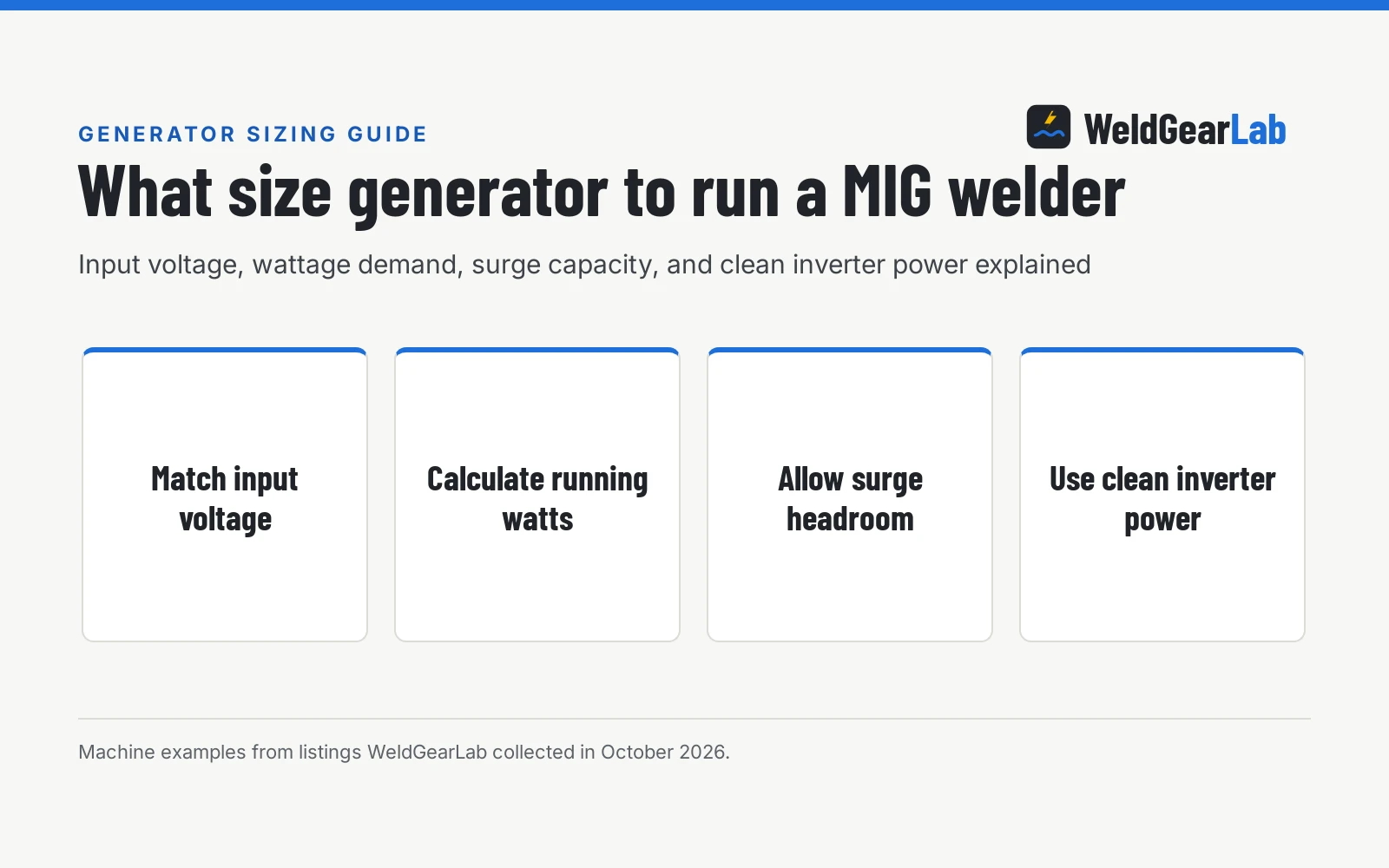
To answer what size generator to run a mig welder, you must match the generator continuous running wattage to the maximum input power draw of the machine, while ensuring sufficient surge wattage capacity for arc strike spikes. Running a wire feed machine on a generator also demands clean alternating current with low harmonic distortion so sensitive circuit boards remain protected during voltage swings. This guide explains how generator capacity, input voltage, and arc strike surge interact for shop and field wire welding.
As an Amazon Associate I earn from qualifying purchases. This guide links to our product roundups, where WeldGearLab earns a commission when you buy through links, at no extra cost to you. Read our affiliate disclosure.
What size generator to run a mig welder
A welding machine converts incoming line power into high-amperage welding current. The electrical draw on a generator peaks during arc ignition and steady wire feeding at upper output ranges. In listing specifications, zinnore provides a dedicated engine generator supplying 2000 watts of DC output matched to a 130A welding capacity. Standalone wire feed units require an external generator sized for their specific input voltage and rated load. Dual-voltage machines like the Hobart Handler 210MVP operate on 115V or 230V input power and deliver up to 210A of welding current, requiring substantially greater continuous generator capacity and surge allowance than smaller 110V units like the Acewelder 140A or PANERGYRIC 160A.
Side by side
| Compact 110V MIG | Dual-Voltage MIG (115V/230V) | Engine-Driven Welder Combo | |
|---|---|---|---|
| Input power | 110V AC input | 115V or 230V AC input | Engine-driven DC generator |
| Stated welding output | 140A to 160A maximum | 210A maximum | 130A maximum |
| Power source | External generator required | External generator required | Built-in 2000 watt engine generator |
| Generator wattage demand | Continuous wattage plus surge buffer | High continuous wattage plus surge buffer | Self-contained 2000 watts of DC output |
| Generator power quality | Clean inverter AC required | Clean inverter AC required | Dedicated DC welding output |
| Primary outlet style | Standard 110V receptacle | 115V or 230V receptacle | Direct generator welder terminals |
| Listing reference | Acewelder 140A or PANERGYRIC 160A | Hobart Handler 210MVP | zinnore 130A combo |
| Portability focus | Lightweight mobile field repair | Shop and heavy fabrication | Outdoor field repair without line power |
Power requirements vary across machine classes; always verify the input current rating and line voltage printed on your machine rating plate and in the manual before connecting a generator. Inverter wire feed welders demand clean alternating current to safeguard internal control electronics.
When 110V to 115V power is the better choice
- Mobile field repairs. Smaller wire welders operate on 110V or 115V circuits, pairing well with portable generators for remote gate, fence, and equipment work.
- Lower maximum power demand. Because compact 110V units cap output at lower amperage, such as 140A on an Acewelder or 160A on a PANERGYRIC, their peak power draw is lower than heavy 210A shop machines.
- Common generator receptacles. A 110V machine connects to standard 110V or 115V generator outlets without requiring specialized 230V connections.
- Light gauge fabrication. Listing specifications state that an Acewelder 140A unit welds mild steel up to 4.0mm plate, providing useful capability on sheet metal and light repairs without requiring high-output generator circuits.
Our guide to the best budget MIG welder covers capable wire feed machines suited for entry-level and mobile shop setups.
When 230V power is the better choice
- Thicker structural steel. Sustaining high-amperage welds on thick steel plate demands the higher wattage delivery that 230V generator circuits provide.
- Maximum welding output. Dual-voltage machines like the Hobart Handler 210MVP achieve their maximum 210A welding power only when connected to 230V supply power.
- Lower primary current draw. Operating on 230V draws half the primary input amperage of a 115V circuit for the same welding wattage, reducing heat and strain in supply cords.
- Reduced breaker tripping. High-amperage welding on 115V quickly reaches the limit of standard branch circuits, whereas a 230V connection provides ample breaker headroom for continuous beads.
How to tell what a machine requires
Every wire welder listing publishes electrical specifications that dictate generator requirements. Look for these indicators on the machine rating plate and specification table:
- Rated input voltage. Specifications show whether the unit requires 110V, 115V, or 230V input power. Single-phase dual-voltage units accommodate both outlet styles.
- Maximum primary input current. The specification plate lists maximum input current in amperes at rated output, which determines the minimum continuous running wattage needed from the generator.
- Power supply technology. Specifications indicate whether the unit uses inverter circuitry that demands clean generator power with low total harmonic distortion to protect sensitive control electronics.
A generator must supply both continuous running wattage and surplus surge capacity. Check the machine specification plate before selecting a generator model.
Which generator style for clean inverter power
Modern wire welders rely on sensitive inverter power modules and digital microprocessors to regulate wire feed speed and arc voltage. Conventional open-frame jobsite generators often produce harmonic distortion and voltage spikes that can degrade sensitive control boards. An inverter generator produces clean sine wave alternating current with low total harmonic distortion, providing stable power that protects delicate internal circuitry. When comparing an inverter welder vs transformer welder, inverter machines demand cleaner generator power but offer superior electrical efficiency.
Can a generator run both 115V and 230V welders?
Yes, provided the generator provides both 115V and 230V receptacles and has adequate running capacity for the machine’s draw. Dual-voltage machines like the Hobart Handler 210MVP include interchangeable plugs to operate on either 115V or 230V power. This versatility allows operators to connect to standard 115V generator outlets for light maintenance or switch to a 230V generator receptacle to access the machine’s full 210A welding output on heavier steel. Explore our best welder for beginners guide for practical machine setups.
Generator and electrical safety. Never operate an engine-driven generator indoors, inside garages, or near open windows due to deadly carbon monoxide exhaust fumes. Position the generator on dry, level ground outdoors and protect electrical connections from moisture and rain. Ensure the generator frame is properly grounded according to the manufacturer manual and local electrical regulations. Keep a suitable fire extinguisher nearby, clear dry grass and flammable debris from the exhaust path, and inspect all extension cords and power cables before striking an arc. Consult our best extension cord for portable welder guide for proper conductor sizing.
Frequently Asked Questions
What happens if a generator is too small for a MIG welder?
An undersized generator will experience severe voltage drops whenever you strike an arc or feed wire at higher settings. The generator engine may bog down, hunt for engine speed, or trip its circuit breaker under the sudden electrical load. Repeated voltage sags can also starve the welding machine, producing poor penetration, excessive spatter, or internal error codes on digital inverter models.
Can a 2000 watt generator run a wire welder?
No. A standalone wire feed welder cannot reliably run on a 2000 watt generator. While listing specifications show that zinnore pairs an integrated 2000 watt generator with a 130A stick welding unit, standalone wire feed machines draw higher continuous power and sharp inrush current when striking an arc. Running a wire feed welder on a 2000 watt generator will cause severe voltage drop, stalling the engine or tripping the breaker.
Why do inverter wire welders need clean generator power?
Inverter wire welders use microprocessors and solid-state power switches to control arc dynamics and wire feeding. Low-cost generators often produce dirty alternating current with high total harmonic distortion and erratic voltage surges. Supplying clean sine wave power prevents electrical noise from interfering with synergic controls and protects sensitive electronic components from damage.
Should I use starting watts or running watts when sizing a generator?
You must account for both running watts and starting surge wattage. Continuous running watts represent the steady electrical power needed to maintain the welding arc and drive motor during a continuous bead. Starting surge watts provide the momentary headroom necessary to absorb the initial short-circuit spike when the wire touches the workpiece without stalling the generator.
Can I run a MIG welder from a portable generator using an extension cord?
Yes, but you must select a heavy-duty cord with thick copper conductors to prevent voltage drop between the generator receptacle and the machine. Long, thin cords create electrical resistance that robs the machine of power and causes the generator to work harder under load. Keep cord lengths as short as practical and verify that the conductor gauge matches the input amperage rating of your welder.
Related: how to choose a MIG welder, best welder generator, and the MIG welders hub. Also see our guide on how to learn welding at home.
About the author
WeldGearLab Editorial is the editorial team behind WeldGearLab. We research product listings, specifications, safety listings and warranty terms, score every pick with the published Gear Score method, and correct errors when readers report them. We do not run our own shop trials; see How We Pick for exactly how picks are made.