Variable Pitch vs Constant Pitch Band Saw Blade: Which One Should You Buy?
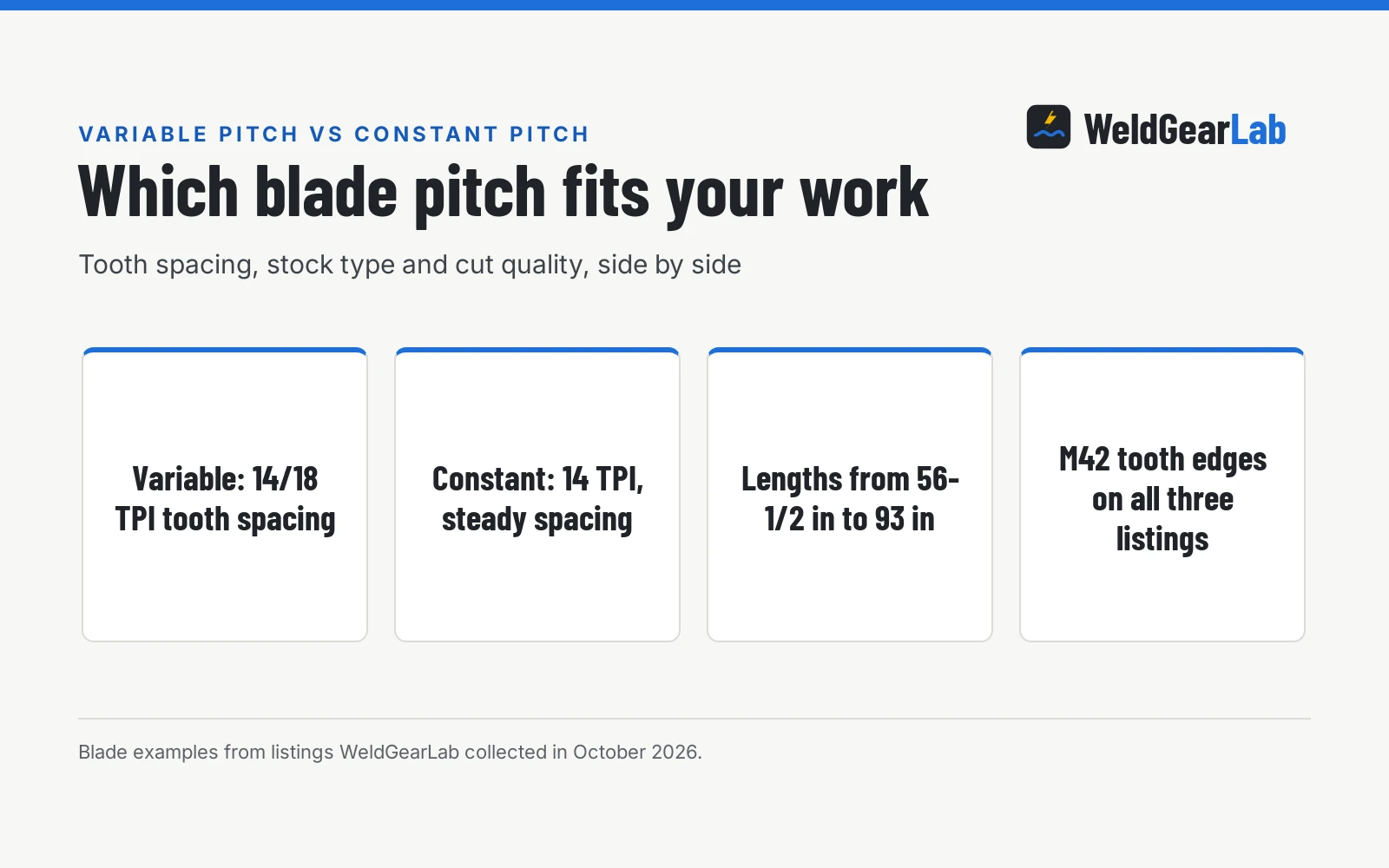
Variable pitch varies tooth spacing along the blade while constant pitch keeps it even; this guide compares what 14/18 TPI and 14 TPI each suit, with three blade listings ranked.

On this page
Top picks at a glance
As an Amazon Associate I earn from qualifying purchases.
- 1
 Delta Power Tools 23-196 6-Inch Variable Speed Bench Grinder9.6/10View on Amazon
- 2
 FOXBC 35-3/8 Inch Bandsaw Blade 10/14 TPI for Milwaukee9.6/10View on Amazon
- 3
 Dark Stone 105" Carbide-Tipped Variable Pitch Resaw BandsawView on Amazon
- 4
 WEN BB5651 56.5-Inch Bi-Metal Bandsaw Blade with VariableView on Amazon
- 5
 Imachinist S641212812 Bimetal Band Saw Blade 64-1/2" X 1/2" XView on Amazon
- 6
 DEWALT Portable Band Saw BladeView on Amazon
- 7
 Morse Master Cobalt Bi-Metal Portable Band Saw Blade 44 7/8 xView on Amazon
- 8
 FOXBC 35-3/8 Inch Bandsaw Blade 18 TPI for MilwaukeeView on Amazon
Variable pitch and constant pitch both cut steel, but they do not cut the same way. A variable pitch band saw blade varies its tooth spacing along the blade, while a constant pitch blade keeps every tooth the same distance apart. That spacing difference decides how the blade handles thin tube, how it behaves in thick stock, and how much vibration you feel on the saw. This guide compares variable pitch vs constant pitch band saw blade designs so you can match one to your work.
Other welders and gear to compare
 Dark Stone 105" Carbide-Tipped Variable Pitch Resaw BandsawCheck price on Amazon
 WEN BB5651 56.5-Inch Bi-Metal Bandsaw Blade with VariableCheck price on Amazon
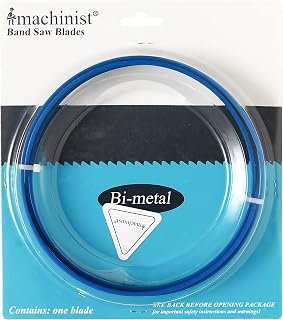 Imachinist S641212812 Bimetal Band Saw Blade 64-1/2" X 1/2" XCheck price on Amazon
 DEWALT Portable Band Saw BladeCheck price on Amazon
 Morse Master Cobalt Bi-Metal Portable Band Saw Blade 44 7/8 xCheck price on Amazon
 FOXBC 35-3/8 Inch Bandsaw Blade 18 TPI for MilwaukeeCheck price on Amazon
This guide links to our product roundups, where WeldGearLab gets a commission on purchases made through links on this page, and your price stays the same. Read our affiliate disclosure.
Variable pitch vs constant pitch band saw blade: the difference
Tooth spacing is measured in teeth per inch, or TPI. A constant pitch blade keeps one TPI from end to end: the Lenox listing here, for example, is 14 TPI everywhere, 93 in long and 3/4 in wide with a 0.035 in thickness. A variable pitch blade mixes two TPI values along its length: both Imachinist listings here are 14/18 TPI, one 64-1/2 in long and the other 56-1/2 in long, each 1/2 in wide and 0.025 in thick. The varied spacing breaks up the harmonic that builds when identical teeth hit the work at a steady rhythm, which is why variable pitch blades tend to run quieter and cut smoother in tube and profiles.
Side by side
| Variable pitch | Constant pitch | Note | |
|---|---|---|---|
| Tooth spacing | 14/18 TPI on both Imachinist listings | 14 TPI on the Lenox listing | TPI from the listing titles |
| Blade lengths | 64-1/2 in and 56-1/2 in | 93 in | Length must match your saw |
| Blade width | 1/2 in | 3/4 in | Width from the listings |
| Thickness | 0.025 in | 0.035 in | Thickness from the listings |
| Tooth edge | M42, 8% cobalt | M42 high speed steel tooth edge | Edge from the listings |
| Set | Varied teeth profile | Regular tooth, wavy set | Set from the listings |
| Stated for | Soft ferrous metal, thin pipe and tube profiles | Carbon, alloy, tool, structural and stainless steel, plus aluminum | From the bullets |
| Non-ferrous | Listings say do not cut non-ferrous metal like aluminum | Listing names aluminum among cut metals | Bullets disagree with spec tables |
Both Imachinist listings name the same 14/18 TPI profile; they differ in length. Tooth spacing is only one factor in blade life: feed rate, tension and coolant matter too, so follow your saw manual alongside the listing.
Blade examples from the listings
The three listings in this space show both designs. The Lenox 1770089 is the constant pitch example: 93 in long, 3/4 in wide, 0.035 in thick, 14 TPI, with a regular tooth and wavy set. The listing names carbon steel, alloy steel, tool steel, structural steel, stainless steel and aluminum among the metals it cuts, and credits the tuff tooth design with reducing tooth strippage and the M42 high speed steel tooth edge with heat and wear resistance. The wavy set, per the listing, helps prevent stripping on thin workpieces.
The two Imachinist blades are the variable pitch examples. The S6412121418 is 64-1/2 in long and the S5612131418 is 56-1/2 in long; both are 1/2 in wide, 0.025 in thick, M42 with 8% cobalt, and both state they are for cutting soft ferrous metal such as thin pipe and tube profiles, and not for non-ferrous metal like aluminum. Read these listings carefully: their spec tables say 6/10TPI under Blade Teeth and list aluminum and copper under Suitable for, which contradicts the 14/18 TPI titles and the do not cut aluminum bullets. The titles and bullets are the claims to trust, and the conflict itself is a reason to weigh the listing harder.
How to choose
Choose variable pitch when you cut a mix of tube, pipe and structural shapes, especially thin walled stock where vibration and tooth strippage are the enemies. The 14/18 TPI listings here are pitched exactly for that: thin ferrous tube and profiles. Choose constant pitch when your stock is consistent and solid, like bar and plate, where one steady TPI does the job and the listing names the metals plainly. In both cases, match the blade length and width to your saw: 64-1/2 in and 56-1/2 in blades fit different saws than a 93 in blade, and the listings say so. Re-check the stated TPI before you buy, since both Imachinist spec tables print 6/10TPI against the 14/18 TPI titles.
FAQ for welders
What does 14/18 TPI mean on a band saw blade?
It means the tooth spacing varies along the blade between 14 teeth per inch and 18 teeth per inch. Both Imachinist listings here carry that 14/18 TPI profile. The varied spacing breaks up cutting vibration, which helps on thin tube and profiles.
Is variable pitch better than constant pitch?
Neither is better in the abstract. Variable pitch suits mixed stock and thin walled tube, where the varied teeth smooth out the cut. Constant pitch suits steady, solid stock, where one TPI works across the whole cut. Match the pitch to the stock you actually cut.
Can I cut aluminum with these blades?
The Imachinist listings say not to cut non-ferrous metal like aluminum. The Lenox listing names aluminum among the metals it cuts. Always go by the listing for the blade you hold, not by the pitch alone.
Does blade length affect tooth pitch choice?
Length and pitch are separate specs, but both must fit your saw. The listings here run 56-1/2 in, 64-1/2 in and 93 in, each for a different class of saw. Buy the pitch you want in the length your saw takes.
What is a wavy tooth set?
It is a tooth pattern where teeth lean left and right in a wave, which the Lenox listing says helps prevent stripping on thin workpieces. It is a set style, not a pitch: a blade can be constant pitch and wavy set at the same time.
Related: bi-metal vs carbide band saw blades, portable vs stationary band saws and chop saw vs horizontal band saw.