Sandblasting Nozzle Types and Uses
Ceramic, steel and boron carbide nozzles compared by bore size, wear life and air supply, with the sizes the listings state and how to tell when a nozzle is worn out.

On this page
Top picks at a glance
As an Amazon Associate I earn from qualifying purchases.
- 1
 Large Ceramic Sandblaster Assembly: C19.6/10View on Amazon
- 2
 Sandblaster Nozzle Combo Pack for Accessories9.7/10View on Amazon
- 3
 Jewboer Sand Blaster Gun Kit9.5/10View on Amazon
A rusted bracket comes out of the cabinet still patchy, or a glass panel comes out etched deeper on one side than the other, and the nozzle is usually the reason. Sandblasting nozzle types decide how wide the blast pattern runs, how fast the media wears the bore, and which jobs the gun suits. This guide explains the liner materials, the bore sizes the listings state, and how to tell when a nozzle is worn out.
This guide links to our product roundups, where WeldGearLab gets a commission on purchases made through links on this page, and your price stays the same. Read our affiliate disclosure.
Sandblasting nozzle types in one paragraph
A sandblasting nozzle is the tip at the end of the gun or hose that shapes the air and abrasive stream. The Jewboer listing states the taper and length of the nozzle inlet and outlet decide the pattern and velocity of the abrasive, and the liner material decides how well the bore resists wear. Ceramic, steel and boron carbide are the liner materials in the listings here, and the bore size decides whether the nozzle suits fine detail work or a wide patch of rust.
Side by side
| Ceramic | Steel | Boron carbide | |
|---|---|---|---|
| Bore sizes in the listings | 2mm to 6mm in metric sizes, plus 1/8 and 5/16 inch | 1/4 inch inside diameter | 8mm |
| Wear life stated | Not stated | About 1 to 2 hours per nozzle | Not stated |
| Air supply stated | Not stated | 10 to 15 CFM at 60 to 100 PSI | Not stated |
| Typical jobs | Engraving, rust removal, paint stripping | Rust removal and surface prep in a cabinet | Glass, surface polishing, machinery parts |
| Media named in the listings | Garnet, corundum, walnut shells, soda, beads, silica sand, glass beads, aluminum oxide | Not stated | Not stated |
Bore size is the inside diameter of the nozzle tip. The listings state it in millimetres or in fractions of an inch, so check which unit your gun uses before ordering, and match the air jet to the nozzle size.
Ceramic nozzles
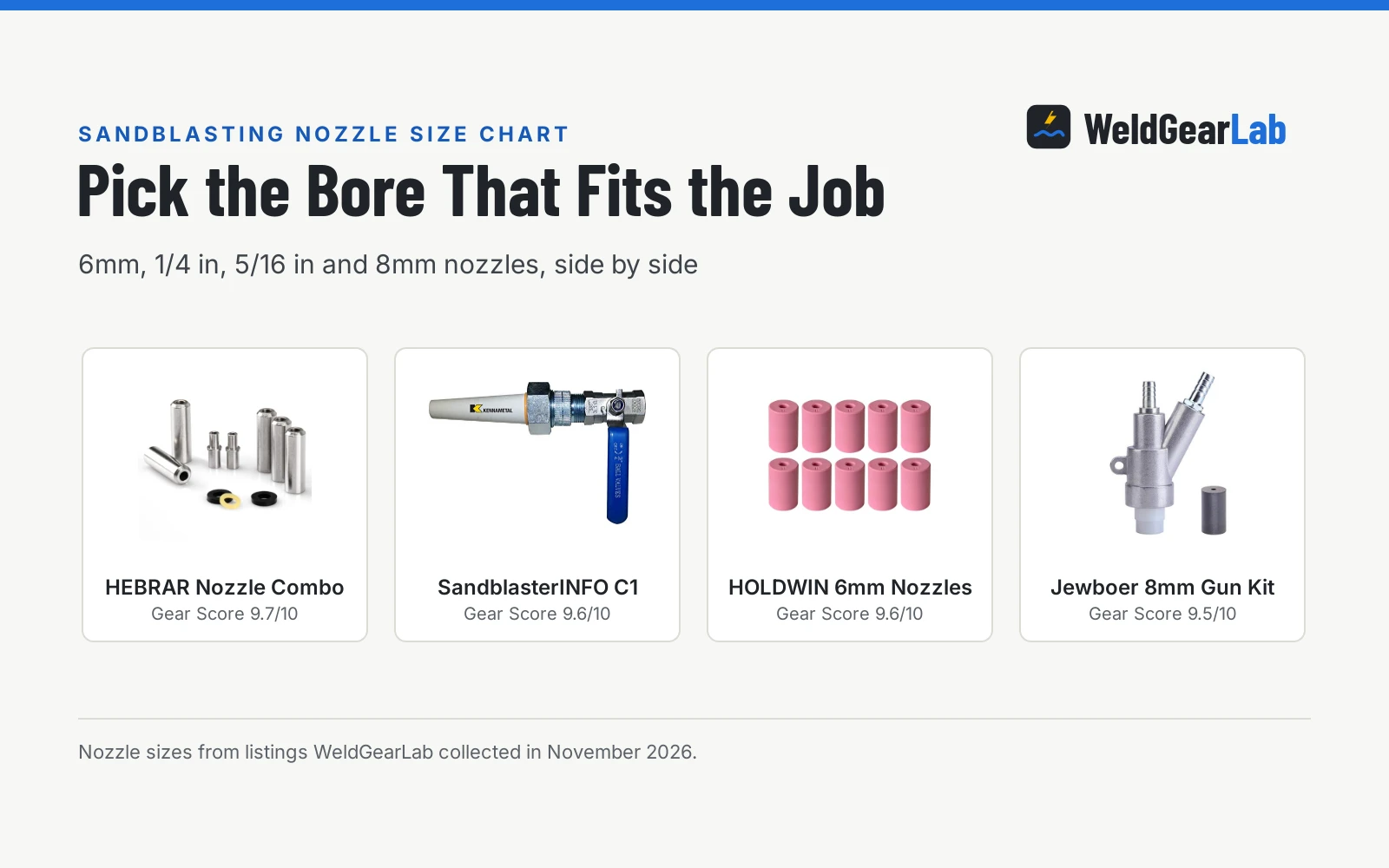
Ceramic is the most common liner in the listings here. HOLDWIN lists ceramic tips in a 6mm size in a 10-piece set, ERETOW lists ceramic tips in 2mm, 2.5mm, 3mm and 3.5mm sizes with 2 units per size in an 8-piece kit, and Mjeppludh lists ceramic tips in 2.4mm, 2.7mm, 3.2mm, 3.6mm and 5mm sizes in a 5-piece kit. SHUNJIE lists ceramic nozzles in a 1/8 inch inside diameter in a 5-piece set, and HOLDWIN lists ceramic tips in a 1/8 inch inside diameter with a brass ball valve and a 1/2 inch connector. SandblasterINFO lists a large ceramic assembly with a C1 tip in a 5/16 inch inside diameter, a 3/4 inch stainless steel ball valve and a holder, with the tip measuring 3-3/4 inches long.
Ceramic suits engraving, rust removal and paint stripping. HOLDWIN lists deep engraving, surface rust removal and paint stripping on glass, marble and metal parts, and the listings name garnet, corundum, walnut shells, soda, beads, silica sand, glass beads and aluminum oxide as media. Smaller bores suit detailed blasting, while the 5mm tip suits larger-area work such as rust removal, paint stripping and surface preparation, per the Mjeppludh listing. The large SandblasterINFO assembly (on Amazon) suits larger pressure pot systems, or converting smaller garage style pot systems such as Clarke and Harbor Freight, per the listing.
Steel nozzles
Steel nozzles in the listings are siphon gun tips sold as combo packs. The HEBRAR nozzles (on Amazon) are case hardened, per the listing. HEBRAR lists steel nozzles 1.56 inches long with a 1/2 inch diameter and a 1/4 inch inside diameter, and ETZ lists a medium steel nozzle combo pack for siphon-style guns. Each combo pack includes 5 steel nozzles, 2 air jets, 2 air jet gaskets and 1 nozzle gasket, and each listing states the nozzles fit most siphon blasters.
The listings state the same air supply: an air flow of 10 to 15 CFM and an operating pressure of 60 to 100 PSI. Each listing states each nozzle lasts about 1 to 2 hours. The HEBRAR listing states that after 1 to 2 hours the orifice becomes enlarged to the next size and the nozzle should be changed. After 2 to 3 nozzles, the air jet and gasket should be replaced, per the HEBRAR listing. The HEBRAR listing also states the air jet must match the nozzle size, and that the nozzle and the air jet need changing on a regular basis to keep a cabinet in good working order.
Boron carbide nozzles
Boron carbide appears in the Jewboer listing here: the gun kit for a blast cabinet, with a boron carbide nozzle in an 8mm size. The listing states the nozzle accelerates the air and abrasive as the mixture exits the end of the hose, and that the taper and length of the inlet and outlet decide the pattern and velocity of the abrasive leaving the nozzle. The kit suits box manual and box type automatic sandblasting machines, for sanding glass, sandblasting, surface polishing and machinery parts.
How to pick the bore size
Start from the job, then match the bore the listings state. Fine detail work suits the small ceramic tips: ERETOW lists 2mm, 2.5mm, 3mm and 3.5mm tips, and Mjeppludh lists 2.4mm, 2.7mm, 3.2mm and 3.6mm tips. Larger-area work such as rust removal, paint stripping and surface preparation suits the 5mm tip, per the Mjeppludh listing. The 6mm HOLDWIN tip is listed for deep engraving, surface rust removal and paint stripping. The large SandblasterINFO assembly with a 5/16 inch inside diameter tip suits larger pressure pot systems, or converting smaller garage style pot systems such as Clarke and Harbor Freight, per the listing.
Check the gun the nozzle fits before ordering. The HEBRAR and ETZ steel (on Amazon) nozzles fit most siphon blasters, the Jewboer kit (on Amazon) fits a blast cabinet, and the ERETOW ceramic tips (on Amazon) fit a portable sand blasting gun and cabinet. The air jet must match the nozzle size, so a combo pack that includes air jets and gaskets keeps the matched parts together.
How to tell when a nozzle is worn out
A nozzle wears from the inside, and the bore grows as the media passes through it. The HEBRAR listing states each steel nozzle lasts about 1 to 2 hours, after which the orifice becomes enlarged to the next size and the nozzle should be changed. When the pattern widens or the cutting slows, check the bore against a fresh nozzle of the same size, and change the nozzle before the finish turns uneven.
Sandblasting dust and media. Blasting throws abrasive and dust back at the operator, so wear eye protection and gloves, and use a respirator and a cabinet or an outdoor spot away from other people. The best sandblasting gloves guide covers gloves for cabinet work.
FAQ for welders
What are sandblasting nozzles made of?
Ceramic, steel and boron carbide are the liner materials in the listings here. Ceramic tips come in the widest range of bore sizes, from 2mm to 6mm in metric sizes and in 1/8 and 5/16 inch sizes, while the steel nozzles here are 1/4 inch inside diameter and the boron carbide nozzle is 8mm.
What size sandblasting nozzle do I need?
Match the bore to the job. Small ceramic tips in 2mm, 2.5mm, 3mm, 3.5mm, 2.4mm, 2.7mm, 3.2mm and 3.6mm sizes suit detailed blasting, while the 5mm tip suits larger-area work such as rust removal, paint stripping and surface preparation, per the Mjeppludh listing. The 6mm HOLDWIN tip is listed for deep engraving, surface rust removal and paint stripping. The 5/16 inch SandblasterINFO assembly suits larger pressure pot systems.
How long does a sandblasting nozzle last?
The steel nozzle listings state about 1 to 2 hours per nozzle. The HEBRAR listing states that after 1 to 2 hours the orifice becomes enlarged to the next size and the nozzle should be changed. The ceramic and boron carbide listings here state no wear life. After 2 to 3 nozzles, replace the air jet and gasket as well, per the HEBRAR listing.
What air supply does a sandblasting nozzle need?
The steel siphon nozzle listings state an air flow of 10 to 15 CFM and an operating pressure of 60 to 100 PSI. The HEBRAR listing states the air jet must match the nozzle size. The ceramic and boron carbide listings here state no air supply figures, so check the gun manual for the supply it needs.
Can I use any nozzle in my sandblaster?
No. Check the fit first: the steel combo packs fit most siphon blasters, the Jewboer kit fits a blast cabinet, and the ERETOW ceramic tips fit a portable sand blasting gun and cabinet. Match the bore size, the connector, such as the 1/2 inch connector on the HOLDWIN valve assembly, and the gun type before ordering.
Related: the best MIG nozzle for flux core welding guide. Also see the metal fab tools guides and how we pick.