Sandblasting Nozzle Tips and How to Choose
Sandblasting nozzle tips shape the abrasive stream, and the orifice size, material and air supply decide how fast the surface cleans and when the tip needs changing.

On this page
Top picks at a glance
As an Amazon Associate I earn from qualifying purchases.
- 1
 Jewboer Sand Blaster Gun Kit9.5/10View on Amazon
- 2
 Sandblaster Nozzle Combo Pack for Accessories9.7/10View on Amazon
- 3
 Large Ceramic Sandblaster Assembly: C19.6/10View on Amazon
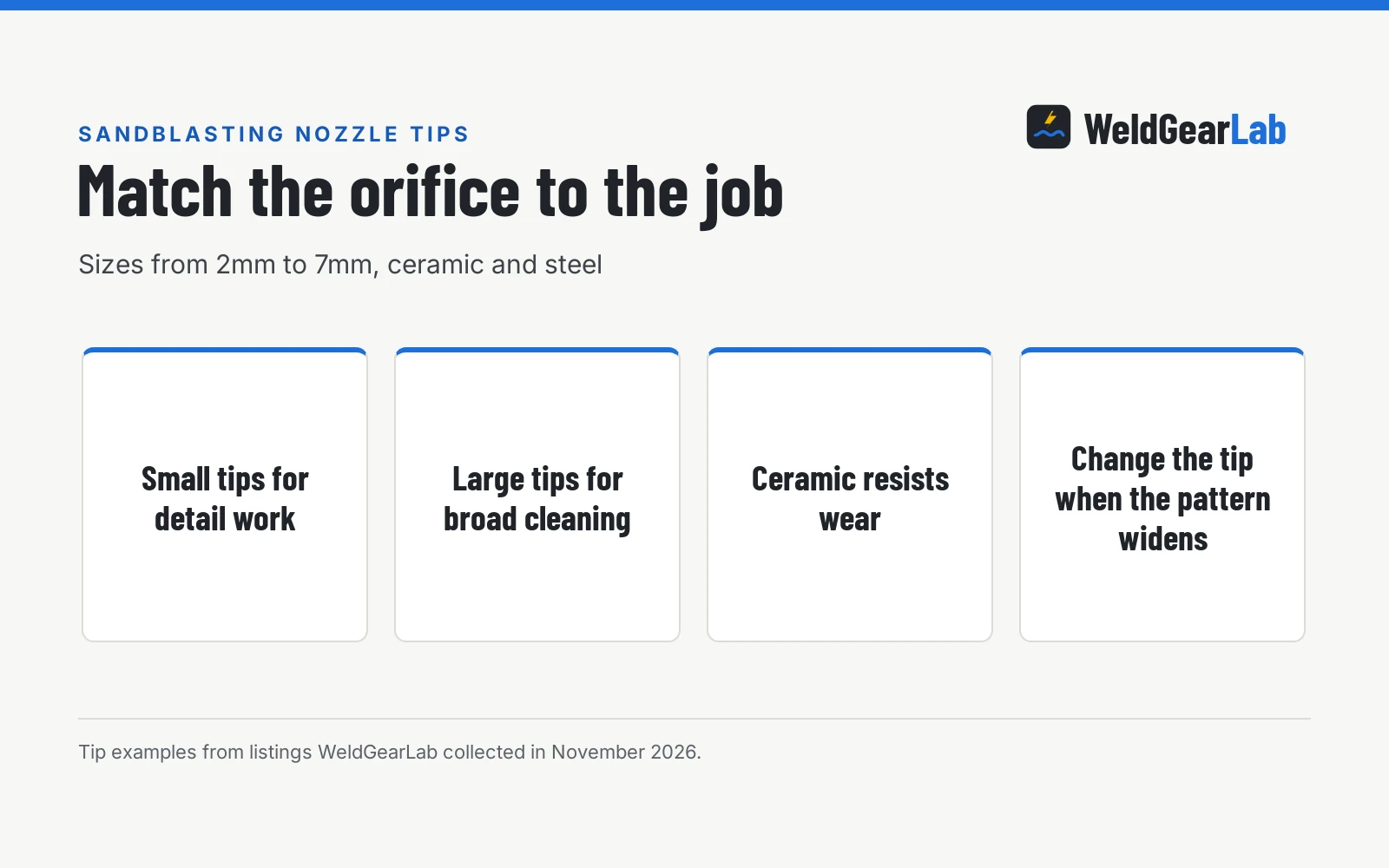
A sandblasting nozzle tip is the small ceramic or steel piece at the end of the gun that shapes the abrasive stream, and the orifice size decides how much media reaches the work and how fast the surface cleans. Sandblasting nozzle tips come in sizes from 2mm to 7mm, and the right tip matches the orifice to the job: a small tip for detail work, a large tip for broad rust removal. This guide explains the sizes, the materials and when to change the tip.
This guide links to our product roundups, where WeldGearLab gets a commission on purchases made through links on this page, and your price stays the same. Read our affiliate disclosure.
Sandblasting nozzle tips in one paragraph
The tip is a wear part: abrasive media passes through the orifice on every pass, and the hole grows with use until the pattern widens and the cleaning slows. Ceramic tips resist wear and suit most cabinet and gun work, while steel tips suit siphon guns. Match the orifice to the media and the air supply, check the fit on the gun before blasting, and change the tip when the pattern goes wide.
Side by side
| Small tip (2mm to 3.5mm) | Mid tip (4.5mm to 5mm) | Large tip (6mm to 7mm) | |
|---|---|---|---|
| Orifice | 2mm to 3.5mm | 4.5mm to 5mm | 6mm to 7mm |
| Suits | Fine sanding and detail work | Delicate processes, general cleaning and rust removal | Large-area rust removal and casting cleaning |
| Abrasive throughput | Lower | Moderate | Higher |
| Kits that list it | ERETOW, Mjeppludh | Lineshading, E-outstanding, Mjeppludh | Lineshading, E-outstanding |
The table above is about size alone. A tip that fits the gun and matches the media gives an even pattern; a tip that is too large for the air supply starves the stream.
When a small tip fits the job
- Detail work. Tips from 2mm to 3.5mm suit fine sanding and small parts, and the ERETOW kit (on Amazon) lists 2mm, 2.5mm, 3mm and 3.5mm tips, 2 of each size.
- Engraving and light cleaning. The Lineshading kit lists 4.5mm tips for light engraving and delicate processes, with 3 of each size in the kit.
- Tight spots. A small tip reaches into corners and small parts where a large tip would blast past the edge.
- Lower media use. A small orifice passes less media, so the cabinet stays cleaner between refills.
When a large tip fits the job
- Broad rust removal. Tips from 6mm to 7mm suit rust removal, stone carving and casting cleaning, and the Lineshading kit lists 6mm and 7mm tips.
- Large areas. The Mjeppludh kit lists a 5mm tip for larger-area tasks such as rust removal, paint stripping and surface preparation.
- Heavy media. A large orifice passes more abrasive, so the work goes faster on big surfaces.
- Air supply matters. Steel tips for siphon guns list 10 to 15 CFM and 60 to 100 PSI, so the compressor has to keep up with the tip.
How to pick the tip size
- Match the tip to the gun. Check the orifice diameter, outer diameter, length and equipment compatibility before fitting a new tip.
- Match the tip to the media. Small tips suit fine media and detail work; large tips suit heavy media and broad cleaning.
- Match the tip to the air supply. Steel siphon-gun tips list 10 to 15 CFM and 60 to 100 PSI, so check the compressor against those figures.
- Start small on a new job. A 2mm or 2.5mm tip removes less material per pass, so a mistake costs less surface.
- Check the fit before blasting. The tip should seat firmly on the gun, with no wobble and no leak at the joint.
Ceramic or steel
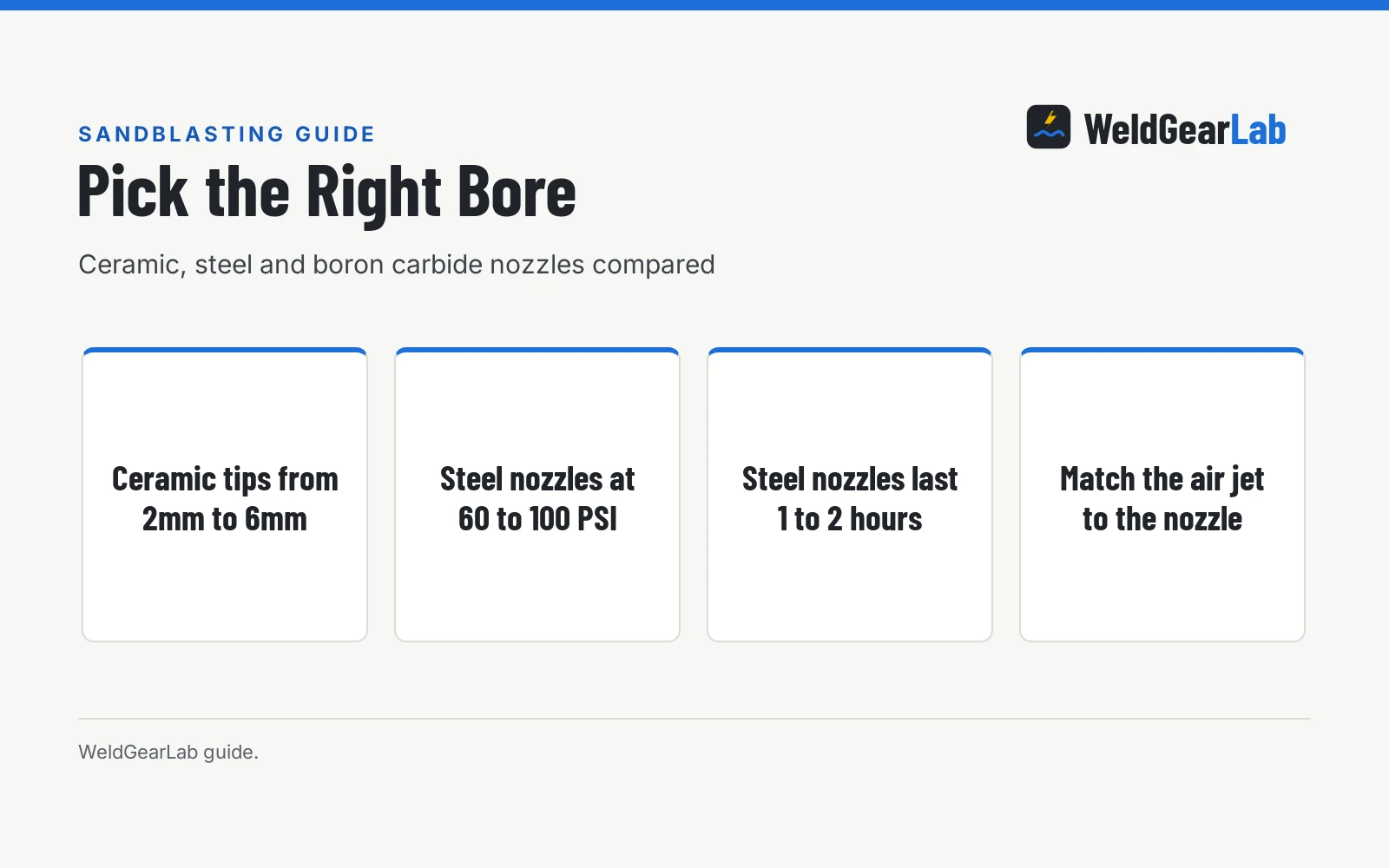
Ceramic tips are the common choice in the kits here: the ERETOW, Lineshading, Mjeppludh, E-outstanding and Jwn kits all list ceramic tips, and ceramic resists wear from common media such as glass beads and aluminum oxide. Steel tips suit siphon guns: the ETZ and Antrys steel (on Amazon) sets list 10 to 15 CFM and 60 to 100 PSI, with 5 steel nozzles, 2 air jets, 2 air jet gaskets and 1 nozzle gasket in the set. Steel tips give about 1 to 2 hours of consistent performance before the orifice widens, so keep spares on hand. For the media behind the tip, see our blasting media chart.
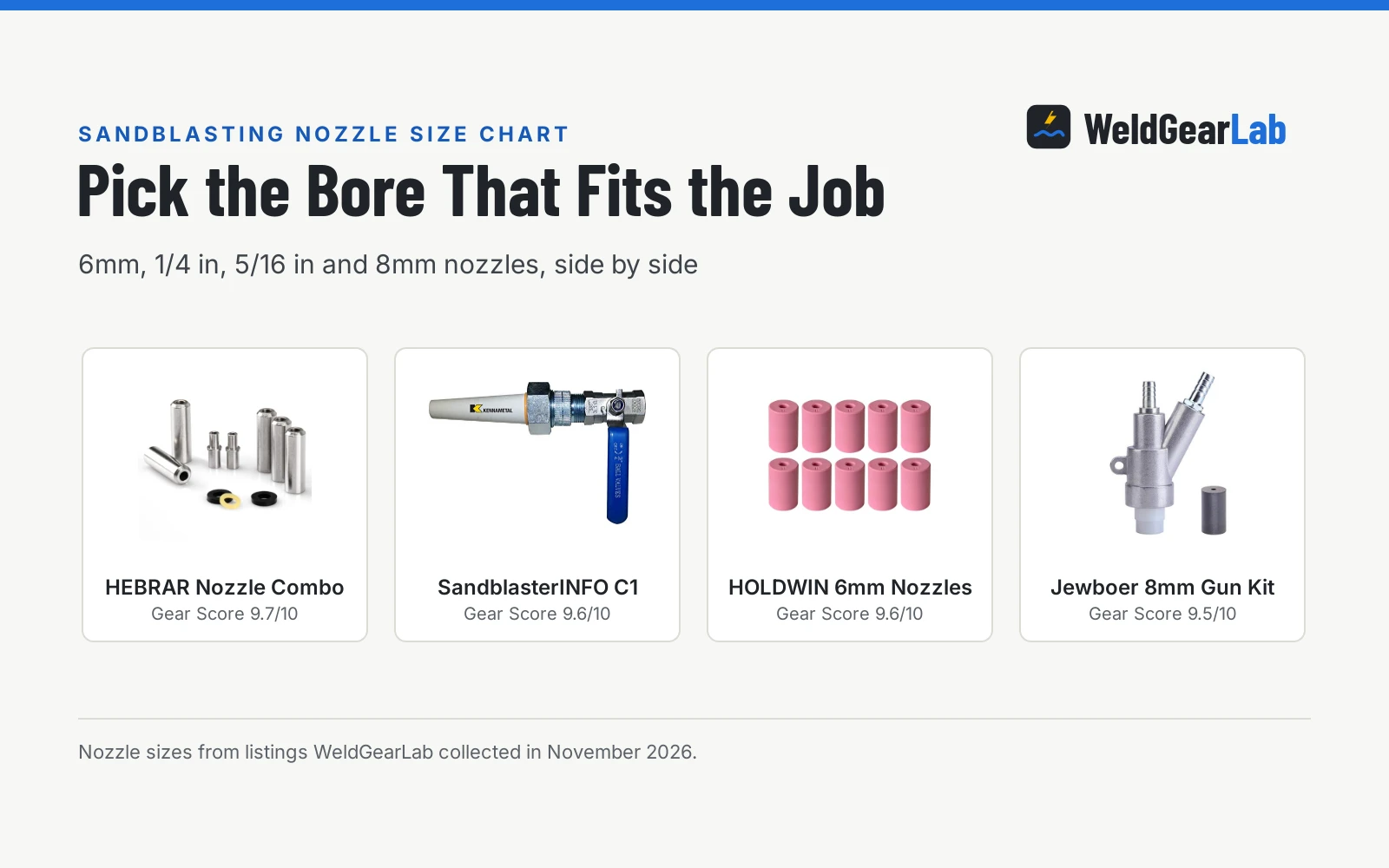
The SandblasterINFO C1 tip (on Amazon) shows the large end of ceramic: a 1/8 inch ID tip, 3-3/4 inches long, with a 1-1/8 inch OD tapered to 5/8 inch OD, made from aluminum oxide ceramic. A larger tip carries more material, so it lasts longer before the orifice wears wide.
When to change the tip
Change the tip when the pattern widens, the cleaning slows, or the finish turns uneven. Steel tips give about 1 to 2 hours of consistent performance before the orifice widens, and the ETZ and Antrys sets both state that range. Ceramic tips last longer, and a higher density ceramic lasts longer still. To change a tip, remove the worn nozzle and insert the new one, then check the orifice diameter, outer diameter, length and equipment compatibility before blasting again.
Sandblasting dust is a breathing hazard. Use a supplied-air or rated respirator, and do not use silica sand. Work with ventilation or outdoors with your head out of the plume, wear eye protection and gloves, and keep bystanders clear of the blast stream. See the OSHA silica rule, our best sandblasting gloves picks, and our Safety Disclaimer.
For more options, see our metal fab tools guides.
FAQ for welders
What size sandblasting nozzle tip do I need?
Match the orifice to the job: tips from 2mm to 3.5mm suit fine sanding and detail work, and tips from 6mm to 7mm suit broad rust removal and casting cleaning. The ERETOW kit lists 2mm, 2.5mm, 3mm and 3.5mm tips, and the Lineshading kit lists 4.5mm, 5mm, 6mm and 7mm tips. Check the orifice diameter, outer diameter, length and equipment compatibility before fitting a new tip.
Are ceramic or steel nozzle tips better?
Ceramic tips are the common choice and resist wear from glass beads and aluminum oxide. Steel tips suit siphon guns and list 10 to 15 CFM and 60 to 100 PSI, with about 1 to 2 hours of consistent performance before the orifice widens. Pick ceramic for cabinet work and steel for a siphon gun.
How long does a sandblasting nozzle tip last?
Steel tips give about 1 to 2 hours of consistent performance before the orifice widens and the finish turns uneven. Ceramic tips last longer, and a higher density ceramic lasts longer still. Change the tip when the pattern widens or the cleaning slows.
What air supply does a sandblasting nozzle need?
Steel siphon-gun tips list 10 to 15 CFM and 60 to 100 PSI, so the compressor has to keep up with the tip. A tip that is too large for the air supply starves the stream and cleans slowly. Check the compressor against the figures for the tip you own.
Can I use any nozzle tip on any sandblasting gun?
No. Check the orifice diameter, outer diameter, length and equipment compatibility before fitting a new tip. The E-outstanding tips (on Amazon) list an outer diameter of 15mm and a length of 38mm, and the Jwn tips (on Amazon) list a length of about 35mm with an outer diameter of about 15mm. A tip that does not fit the gun will not seal and will blast unevenly.
Related: sandblasting nozzle types, sandblasting nozzle size chart, blasting media chart, best large sandblasting cabinet, and the sandblasting hub.