Rent vs Buy a Welding Gas Cylinder: Which Fits Your Shop
Deciding whether to rent or buy a welding gas cylinder depends on your shop workload, tank size, refill access, and ongoing cylinder lease fees.

On this page
Top picks at a glance
As an Amazon Associate I earn from qualifying purchases.
- 1
 80 cu/ft 75% Argon 25% CO2 Welding Gas Cylinder Tank CGA 5809.6/10View on Amazon
- 2
 Pack of 29.5/10View on Amazon
When you set up a MIG or TIG machine on your welding cart to run clean beads on mild steel or sheet metal repairs, you need shielding gas to protect the molten puddle from atmosphere. Deciding whether to rent vs buy a welding gas cylinder comes down to how much arc time you log and how fast you burn through shielding gas. For hobbyists, home garages, and farm shops welding occasionally, buying your own cylinder is the better choice because you pay once upfront and never face recurring lease bills while the tank sits idle. For production shops and commercial fabricators running wire daily, leasing large industrial cylinders makes more sense because suppliers handle exchanges, maintenance, and recertification with zero capital tied up in bottles.
This guide links to our product roundups, where WeldGearLab gets a commission on purchases made through links on this page, and your price stays the same. Read our affiliate disclosure.
The difference in one paragraph
Buying a cylinder gives you full ownership of the steel bottle. You take it to a local compressed gas distributor to fill or exchange for a fresh tank, paying only for the gas inside and occasional recertification down the road. Renting or leasing means the gas supplier owns the cylinder. You pay an ongoing rental fee on an annual or monthly invoice, plus the cost of gas refills, and the distributor exchanges empty bottles for full ones from their commercial pool while managing all tank inspections and repairs.
Side by side
| Buying (customer owned) | Short-term rental | Long-term lease | |
|---|---|---|---|
| Upfront equipment cost | Full cylinder purchase price | Low initial deposit | Lease agreement fee |
| Ongoing fees | Zero recurring lease charges | Daily or monthly rental invoices | Annual or multi-year renewal fee |
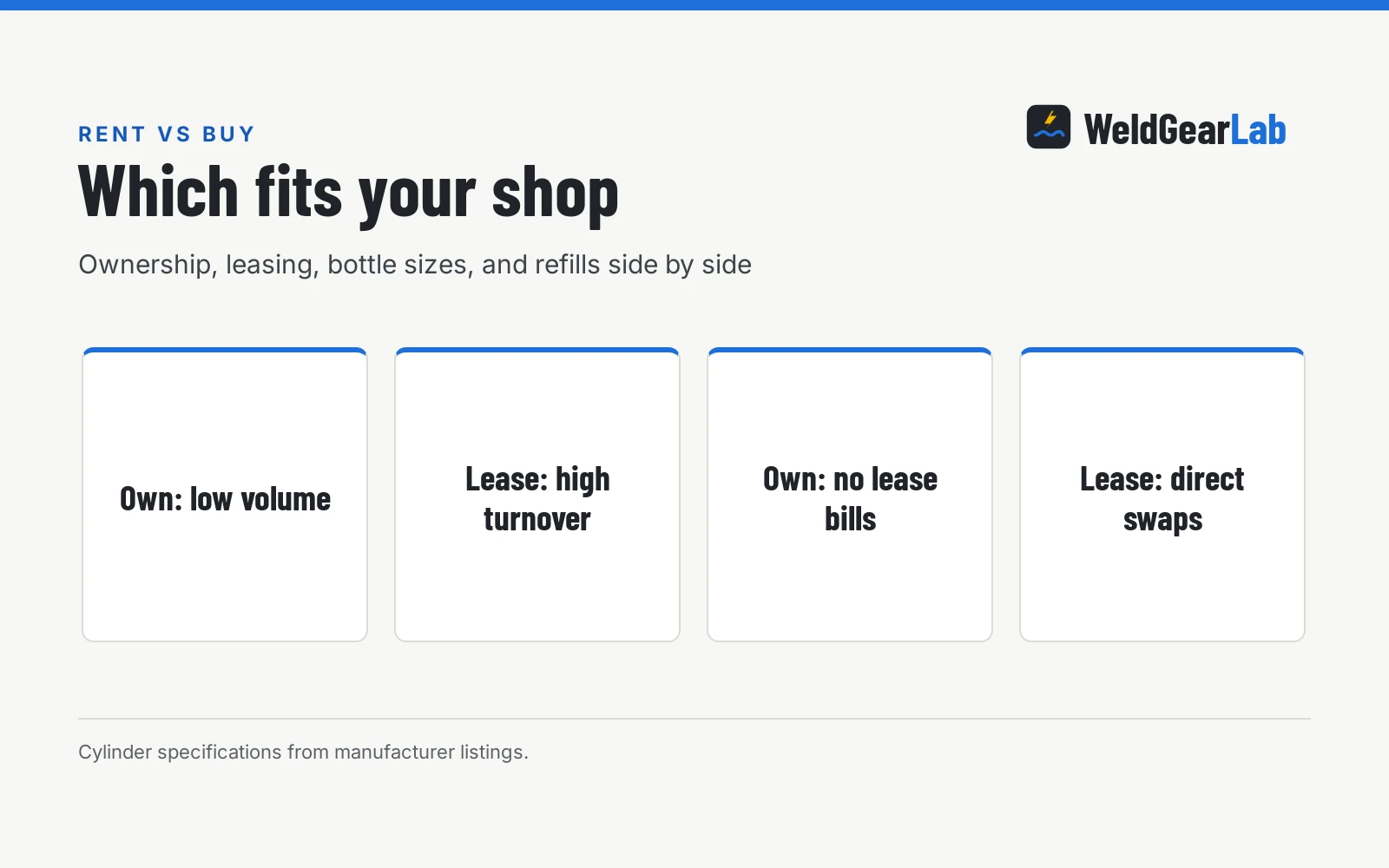
| Best shop fit | Hobbyists, weekend fabricators, low gas use | Temporary jobs and overflow projects | Production shops and heavy daily use |
| Common cylinder sizes | Portable tanks (20, 40, 80, 125 cu ft) | Mid to large cylinders | Large industrial high-capacity cylinders |
| Refill and exchange turnaround | Swap empty tank or wait for refill | Immediate exchange from supplier stock | Scheduled supplier dock deliveries |
| Idle periods on the cart | No penalties while sitting unused | Rental charges accumulate while parked | Lease invoices continue while idle |
| Maintenance and DOT qualification | Owner covers periodic recertification | Distributor manages all recertification | Distributor manages all recertification |
| Capacity flexibility | Fixed to your purchased cylinder size | Return cylinder when job wraps up | Easy to scale cylinder quantity as work grows |
Cylinder policies vary between regional gas distributors and local welding supply shops. Always check with your local gas supplier before ordering an empty cylinder online to confirm whether they fill customer-owned bottles on site or swap them for pre-filled tanks from their dock.
When buying a cylinder is the better choice
- Hobby, farm, and weekend projects. If a cylinder sits on your cart between repairs or small fabrication jobs, an owned bottle never generates ongoing rental invoices.
- Low to moderate gas consumption. An owned cylinder stays on your cart between repairs or small fabrication jobs, ready for the next job.
- Portable shop and mobile setups. Buying smaller portable cylinders makes moving between the garage, farm truck, or job site easier without tracking leased inventory.
- Independent equipment ownership. You own the physical asset outright, allowing you to keep shielding gas ready in your shop indefinitely without lease renewal deadlines or contract terms.
To see dedicated wire feed equipment that runs clean shielding gas, check our best 120V MIG welder guide for machines designed for small-shop setups.
When renting or leasing is the better choice
- High-volume production work. Fab shops running multiple shifts or laying long structural beads daily benefit from rapid cylinder swaps and volume gas pricing.
- Large industrial cylinder sizes. Many industrial gas suppliers lease their largest high-capacity cylinders rather than selling them to individuals.
- Zero maintenance overhead. The distributor handles all valve maintenance, hydrostatic recertification stamps, and cylinder repainting at their fill plant.
- Flexible fleet scaling. If a large contract demands extra arc stations, you can lease additional cylinders and return them when the job wraps up.
Rent vs buy a welding gas cylinder: cylinder sizes and ownership
Gas distributors typically structure ownership options around cylinder capacity. Smaller and mid-size tanks are widely available for customer purchase, whereas large industrial cylinders are frequently handled through distributor lease contracts:
- 20 cu ft cylinders. Ultra-portable bottles designed for mobile field jobs and tight spaces. For example, Varies lists a 20 cu ft steel cylinder with a 5.25 inch diameter by 18 inch height, a 13.67 lb tare weight, 16 pounds total weight, and a 2015 PSI service pressure.
- 40 cu ft cylinders. A compact option for garage hobbyists. Weldfabulous lists a 40 cu ft cylinder with an assembled diameter of 7 inches and a weight of 30 pounds.
- 80 cu ft cylinders. The sweet spot for home shops and fabrication tables. Varies lists an 80 cu ft cylinder measuring 7 inches in diameter by 31 inches in height with a 47 lb tare weight and a 2015 PSI service pressure, while Weldfabulous lists an 80 cu ft steel tank at 46 pounds.
- 125 cu ft cylinders. A high-capacity option for serious home fab shops and heavy garage welding. Kaplan Industries lists a 125 cu ft steel cylinder at 69 pounds with a maximum pressure listed at 3360 psi, while Weldfabulous also lists a 125 cu ft cylinder at 69 pounds.
DOT regulations require high-pressure cylinders to undergo periodic safety recertification. Reference listings from Weldfabulous and Kaplan Industries state that their steel cylinders carry a 10 year stamped date and ship within 2 years of that date. When you exchange an owned bottle, distributors verify that the cylinder remains within its active qualification period, while leased cylinders are inspected and recertified by the gas company as part of their fleet maintenance.
Which gas mix for your cylinder
Whether you rent or buy, the shielding gas inside the bottle depends on the metal and welding process. For MIG welding mild steel, the standard shop mix is 75% argon and 25% CO2, often designated as C25, which balances arc stability, puddle wet-out, and bead appearance. TIG welding on steel, stainless steel, or aluminum demands 100% argon to keep the tungsten electrode clean. Inert gas cylinders like those from Weldfabulous and Kaplan Industries utilize a standard CGA 580 valve connection, fitting argon, helium, and argon-mix regulators. To learn more about picking the right gas blend for your wire, read our guide on argon vs C25 gas for MIG welding and pair your bottle with a proper best gas regulator for MIG welding.
Can you swap gases on an owned cylinder?
Welders who switch between MIG and TIG often ask if they can exchange an owned C25 bottle for a pure argon bottle. Most gas suppliers allow gas swapping during routine cylinder exchanges, provided both gases share the same CGA 580 valve group and the replacement cylinder matches the capacity of your trade-in bottle. If the goal is a smaller owned bottle for occasional work, the listings include a 20 cu ft steel argon cylinder with a CGA 580 valve and a 2015 PSI service pressure, sized for small shops and mobile welders.
Compressed gas cylinder safety. High-pressure cylinders store shielding gas under significant force, such as the 2015 PSI service pressure specified by Varies. Always secure cylinders upright to a shop wall or welding cart with a safety chain so they cannot fall over. Keep threaded valve protection caps installed whenever rolling or transporting cylinders. Inspect hoses and connections for leaks using soapy water rather than flame, and keep cylinders away from sparks, open electrical ground leads, and direct shop heat.
FAQ for welders
How do I exchange an owned welding gas cylinder?
Most local welding supply distributors operate on a cylinder exchange system. The shop inspects the neck ring and stamped markings on your empty tank, then swaps it for a filled cylinder of matching capacity from their dock inventory while charging for the gas refill. If you prefer to keep your specific bottle, some suppliers offer on-site fills or send customer tanks to a regional fill plant.
Will welding supply shops fill cylinders bought online?
Most local welding suppliers will exchange or fill customer-owned cylinders as long as the cylinder has DOT approval stamped into the steel and carries a valid inspection date. Some regional suppliers only exchange customer bottles that have a blank collar without another distributor’s brand embossed on the neck ring. Check with your local supplier before ordering to verify their local policy.
What happens when an owned cylinder’s inspection date expires?
Steel gas cylinders carry a stamped inspection interval, such as the 10 year stamp stated on steel bottles in our reference data. When that stamped date passes, the distributor must perform hydrostatic recertification before refilling the cylinder. Most suppliers charge a small recertification fee during your exchange and swap your expired tank for a freshly certified bottle from their inventory.
Is it cheaper to rent or buy a cylinder long term?
Buying a cylinder is generally more economical for hobbyists, artists, and repair shops over several seasons of work. You pay the purchase price upfront and incur zero ongoing rental fees, meaning the tank costs nothing when idle. Renting adds ongoing lease invoices every billing cycle, which quickly adds up if you do not weld frequently enough to justify commercial cylinder turnover.
What cylinder size is best for a home welding shop?
An 80 cu ft or 125 cu ft cylinder offers an ideal balance of capacity and mobility for home garages and small shops. A 40 cu ft tank is easier to lift into a truck bed, while an 80 cu ft bottle provides substantially longer trigger time between refills without taking up excessive floor space on your welding cart. For more help selecting bottle dimensions, see our guide on what size gas bottle for home welding.
Related: welding cart setup, how to set gas flow rate for MIG welding, gas regulator for welder, and the welding consumables category. Also see our overview of argon gas regulators for TIG welding.