Pyrex Cup vs Ceramic Tig Cup: Which One Should You Buy?
Ceramic TIG cups are the everyday standard in sizes #4 to #12; pyrex cups offer a clear view of the puddle. Compare visibility, sizing, setup and cost.

On this page
Top picks at a glance
As an Amazon Associate I earn from qualifying purchases.
- 1
 #12 CeramicView on Amazon
- 2
 53pcs TIG Collets Bodies Alumina Cup Assorted Size Fit SR WPView on Amazon
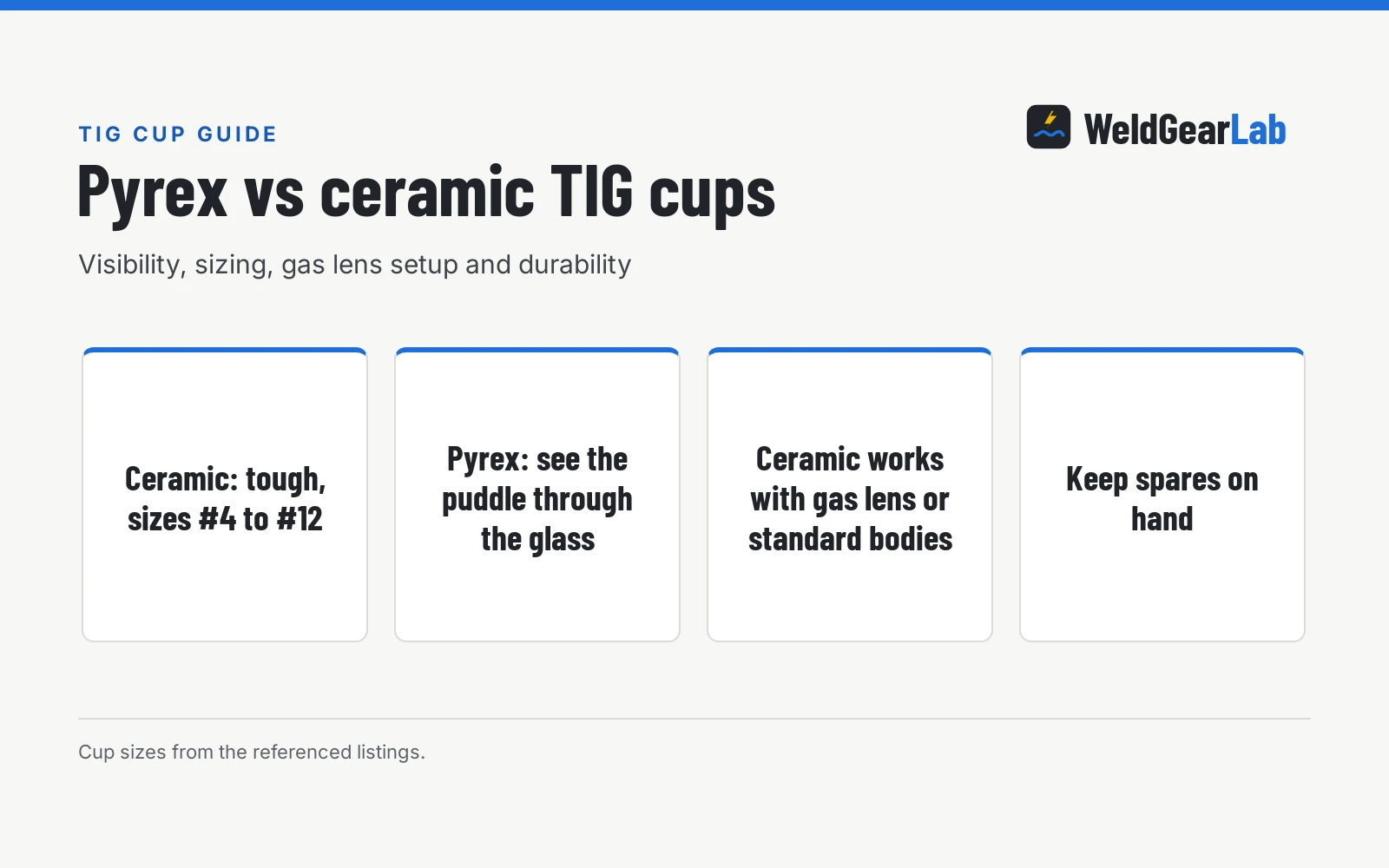
For pyrex cup vs ceramic TIG cup, the short answer is: ceramic for everyday TIG welding, pyrex when you need to see the puddle. A ceramic cup is the standard opaque alumina nozzle in these listings: tough and sold in sizes from #4 (1/4 inch) to #12 (3/4 inch) in the listings compared here. A pyrex cup is a clear glass cup that lets you watch the tungsten and the weld puddle through the wall of the cup, which helps in tight joints and awkward positions. It does not weld better by itself; it lets you see better.
Other welders and gear to compare
 #12 CeramicCheck price on Amazon
 53pcs TIG Collets Bodies Alumina Cup Assorted Size Fit SR WPCheck price on Amazon
This guide links to our product roundups, where WeldGearLab gets a commission on purchases made through links on this page, and your price stays the same. Read our affiliate disclosure.
The difference in one paragraph
A TIG cup shapes the shielding gas around the arc. Ceramic cups do it with an opaque alumina wall: you aim by feel and by the arc light at the cup mouth. Pyrex cups do it with a transparent glass wall: you see the tungsten stickout, the puddle and the joint edges without moving the torch. That visibility is the whole difference. Gas coverage and sizing are stated for the ceramic listings here, and neither cup fixes bad gas flow or the wrong tungsten.
Pyrex cup vs ceramic TIG cup: side by side
| Ceramic TIG cup | Pyrex cup | Notes | |
|---|---|---|---|
| Material | Alumina ceramic, opaque | Glass, transparent | Visibility is the core difference |
| Visibility | Aim by arc light at the cup mouth | See tungsten and puddle through the wall | Helps in tight joints |
| Sizes in listings | #4 (1/4 in) to #12 (3/4 in) | No pyrex figures in these listings | No pyrex figures stated |
| Toughness | Alumina ceramic, as listed | No pyrex figures in these listings | See pack sizes in these listings |
| Gas lens | Works with standard or gas lens setups | No pyrex figures in these listings | Lens straightens the gas column |
| Pack sizes in listings | 2, 4, 5 and 10 packs; 67-piece kits | No pyrex figures in these listings | Cups are consumables |
| Best for | Everyday welding, production, rough handling | Tight joints, walking the cup | Match to the work |
When a ceramic cup is the better choice
Most of the time. Ceramic is the default for production welding, tacking and outdoor work in these listings, which state alumina ceramic cups. The listings show how deep the bench runs: RIVERWELD kits cover #4 (1/4 inch) through #12 (3/4 inch) for WP 9, 17, 18, 20, 25 and 26 torches, in packs of 2, 4, 5 and 10 and 67-piece assorted kits, working with 3/32 inch tungsten and 45V series gas lens collet bodies. When a cup cracks or the orifice erodes, you grab another from the kit and keep welding.
When a pyrex cup is the better choice
When seeing matters most. The clear wall lets you watch the puddle form instead of guessing at it. Tight joints, tube work and walking the cup are the working cases, where the glass lets you track the joint edges without lifting the torch. Visibility is the advantage discussed for the clear glass cup in this comparison; no pyrex listing figures appear in these listings, so check a pyrex listing for its own handling notes before ordering.
Sizing: what the cup numbers mean
Cup numbers name the orifice in sixteenths of an inch: a #8 is 1/2 inch, a #10 is 5/8 inch and a #12 is 3/4 inch, straight from the RIVERWELD listings. A bigger cup spreads shielding gas over a wider area, which suits wider beads and reactive metals; a smaller cup concentrates gas and fits into tight joints. Match the cup to the tungsten and the joint, not to habit: the listings pair their cups with 3/32 inch tungsten. No pyrex figures appear in these listings, so check a pyrex listing for its own sizing before ordering.
Gas lens and setup
The ceramic listings here work with gas lens collet bodies. A gas lens straightens the shielding gas into a smooth column, which is what lets a big cup actually cover the puddle instead of stirring air into it. Ceramic cups work on standard collet bodies too, which is why they are the forgiving default. For pyrex, no pyrex listing figures appear in these listings, so check the pyrex listing for the setup it requires; see our gas lens vs standard collet body comparison.
Durability and cost
Ceramic cups here come in packs of 2, 4, 5 and 10 and 67-piece assorted kits, so spares come with the listed packs. No pyrex pricing or pack figures appear in these listings, so this guide makes no cost comparison between the two cup types. A ceramic cup with proper gas flow is the everyday option in these listings, and pyrex is discussed here only for its transparent wall.
FAQ for welders
Can I use a pyrex cup without a gas lens?
No pyrex listing figures appear in these listings, so check the pyrex listing for whether it requires a gas lens. The ceramic listings here work with gas lens collet bodies and standard collet bodies as stated.
What size ceramic cup should I start with?
The listings here cover #4 (1/4 inch) through #12 (3/4 inch), including a 54N series kit with #4, #5, #6, #7 and #8 cups, a 5-pack of #8 (1/2 inch) cups, a 10-pack of #10 (5/8 inch) cups and a 5-pack of #12 (3/4 inch) cups. Pick the orifice that matches the joint and the tungsten you run, and keep a spare size on either side once you know what you weld most.
Do pyrex cups make better welds?
No. The weld comes from gas coverage, tungsten and technique. This guide discusses pyrex only for its transparent wall, and no pyrex listing figures appear in these listings.
Will a pyrex cup fit my torch?
No pyrex listing figures appear in these listings. The ceramic listings here cover WP 9, 17, 18, 20, 25 and 26 torches; check the pyrex listing for the series match before ordering.
How long do ceramic cups last?
Until they crack or the orifice erodes and the gas pattern goes ragged. Keep a few spares from a multi-pack; the 10-packs in the listings reflect that cups are consumables.
Related: gas lens vs standard TIG collet body, best TIG gas lens kit, TIG welding settings for sheet metal and TIG welding gloves for small hands.