Gas Lens vs Standard Tig Collet Body: Which One Should You Buy?
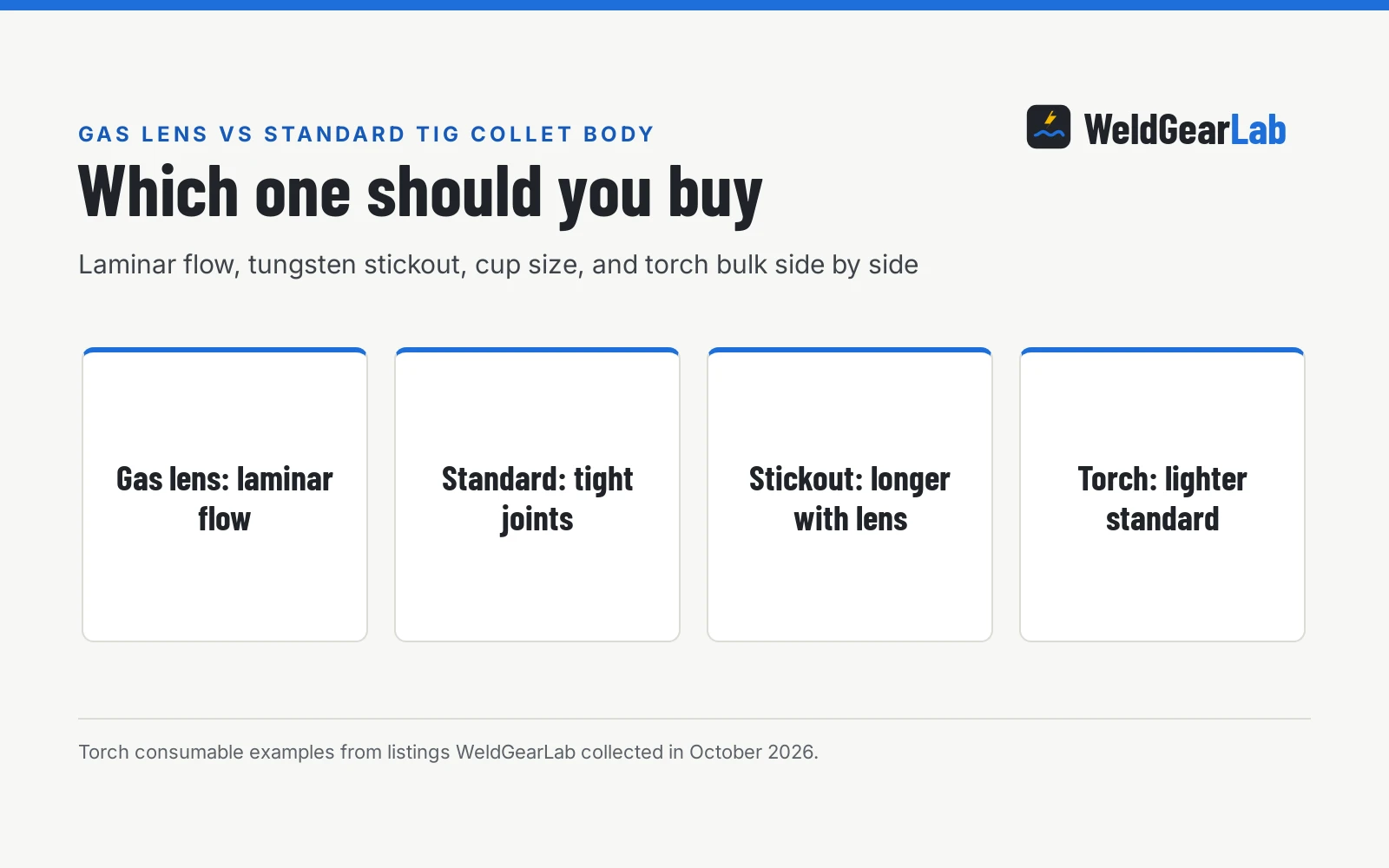
A gas lens uses fine mesh screens to deliver smooth laminar gas flow and wider shielding coverage than a standard collet body for cleaner TIG welds.

On this page
Top picks at a glance
As an Amazon Associate I earn from qualifying purchases.
- 1
 RIVERWELD TIG Gas Lens Collet Body Ceramic Cup 45V 10N 54N9.7/10View on Amazon
- 2
 RIVERWELD TIG Gas Lens Collet Bodies 995795 1/8“ & 3.2mmView on Amazon
- 3
 RIVERWELD TIG Gas Lens Collet Bodies 45V63 5/32“ & 4.0mmView on Amazon
- 4
 TIG Gas Lens Collet Body 45V44 13N23 3/32" & 2.4mm 10Pcs ForView on Amazon
- 5
 Large TIG Gas Lens Collet Body 995795 1/8"&3.2mm 10N25 7PcsView on Amazon
- 6
 TIG Gas Lens Collet Body 45V26 3/32" TIG Collet 10N24 7PcsView on Amazon
- 7
 TIG Gas Lens Collet Body 45V27 1/8" TIG Collet 10N25 7PcsView on Amazon
When you sit down at the welding bench to run clean TIG beads on stainless tube or mild steel brackets, choosing between a gas lens vs standard tig collet body comes down to gas flow quality and joint access. A gas lens is the better choice for most shop and hobby work because its internal mesh screens deliver smooth laminar shielding gas that protects the molten puddle and allows longer tungsten stickout. A standard TIG collet body produces turbulent gas flow that requires shorter stickout, but its narrower profile fits confined joints. This guide compares both consumable setups so you can decide which hardware matches your torch and projects.
Other welders and gear to compare
 RIVERWELD TIG Gas Lens Collet Bodies 995795 1/8“ & 3.2mmCheck price on Amazon
 RIVERWELD TIG Gas Lens Collet Bodies 45V63 5/32“ & 4.0mmCheck price on Amazon
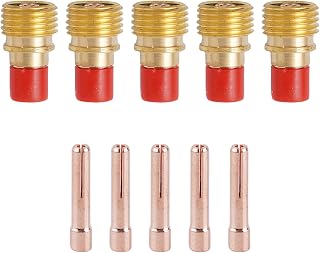 TIG Gas Lens Collet Body 45V44 13N23 3/32" & 2.4mm 10Pcs ForCheck price on Amazon
 Large TIG Gas Lens Collet Body 995795 1/8"&3.2mm 10N25 7PcsCheck price on Amazon
 TIG Gas Lens Collet Body 45V26 3/32" TIG Collet 10N24 7PcsCheck price on Amazon
 TIG Gas Lens Collet Body 45V27 1/8" TIG Collet 10N25 7PcsCheck price on Amazon
This guide links to our product roundups, where WeldGearLab gets a commission on purchases made through links on this page, and your price stays the same. Read our affiliate disclosure.
The difference in one paragraph
A standard collet body uses simple drilled holes to discharge shielding gas into the cup, creating an agitated swirl that mixes quickly with surrounding room air. A gas lens replaces those open discharge holes with stacked screens of fine mesh that straighten the gas stream into a smooth, coherent column. That laminar column blankets the molten puddle and shielding zone evenly without drawing in atmospheric oxygen or nitrogen. Because the gas column stays intact farther from the nozzle, you can extend the tungsten electrode farther out for clear puddle visibility without courting porosity.
Side by side
The table below summarizes how a standard TIG collet body, a standard gas lens, and a large diameter gas lens compare across gas delivery, hardware clearances, and everyday torch handling.
| Standard TIG collet body | Standard gas lens | Large diameter gas lens | |
|---|---|---|---|
| Gas flow pattern | Turbulent swirl with ambient air mixing | Smooth laminar column with minimal turbulence | Broad uniform laminar column with maximum coverage |
| Internal construction | Solid drilled body with open radial ports | Stacked fine mesh diffuser screens | Extra-wide multi-layer stainless mesh screens |
| Tungsten stickout | Short stickout required to avoid porosity | Moderate extended stickout for joint visibility | Maximum stickout for deep angles and tight joints |
| Draft tolerance | Easily disrupted by light room breezes | Resists mild shop air currents | Highest resistance to ambient air movement |
| Joint clearance | Slimmest cup profile for tight angles | Standard clearance for open joints and fillets | Bulky cup diameter limits confined access |
| Torch front weight | Lightest and nimblest torch balance | Moderate weight on torch head | Heaviest front end due to jumbo brass housing |
| Sensitive alloys | Higher risk of oxidation on stainless | Reliable clean shielding on stainless and chromoly | Maximum protection for titanium and exotic alloys |
| Consumable replacement cost | Lowest cost per body and uses standard cups | Moderate cost per body and uses gas lens cups | Higher cost per body and uses large series cups |
Consumable sizing must match your torch series and tungsten diameter. Always confirm that your collet, collet body, and ceramic cup share the same thread pattern and body diameter before assembling your torch front end.
When a gas lens is the better choice
- Welding stainless steel and reactive alloys. Stainless steel, titanium, and nickel alloys demand uninterrupted gas shielding while hot. A gas lens provides a broad protective envelope that prevents atmospheric contamination and discoloration.
- Deep grooves and bevels needing extended stickout. Deep V-grooves, pipe root passes, and recessed welds require extending the electrode beyond the nozzle rim to reach the joint root. A gas lens maintains coherent gas shielding across longer stickout distances without drawing in surrounding air.
- Mild shop drafts. Open shop doors or overhead fans can strip away gas from an ordinary nozzle. The laminar flow from a gas lens holds together better in circulating shop air.
- Reducing shielding gas turbulence. High gas flow rates through a standard collet body cause turbulent mixing that draws air into the arc. A gas lens smooths the gas stream across practical shop flow rates.
See our guide to the best TIG gas lens kit options for complete consumable sets that fit standard torch bodies.
When a standard collet body is the better choice
- Confined spaces and restricted joint clearances. Acute angles, tight tubing clusters, and cramped brackets where the larger cup diameter of a gas lens physically collides with adjacent metal. Standard collet bodies use narrower ceramic cups that access tight corners.
- General mild steel fabrication. Plain carbon steel with clean fit-up does not demand the absolute purity of coverage that stainless requires. A standard collet body handles everyday bench repairs and brackets reliably.
- Lower consumable replacement expense. Standard collet bodies and standard cups carry a lower purchase price. When running tack welds or rough shop jobs where spatter can ruin cups, standard hardware keeps consumable expenses down.
- Lighter torch balance. Because standard bodies use less brass and copper and skip the screen assembly, the torch head stays lighter and easier to maneuver during long welding sessions.
Gas lens vs standard tig collet body: torch setup and fit
TIG torches divide into distinct size classes, and consumable fit depends on your torch model. Common heavy torches include the air-cooled 17 and 26 series and the water-cooled 18 series. Compact torches include the air-cooled 9 series and water-cooled 20 and 25 series. Standard collet bodies and gas lens bodies are engineered specifically around these torch families.
For 17, 18, and 26 series torches, listings demonstrate how gas lens hardware scales with tungsten diameter. Mtsooning lists a 45V26 gas lens collet body designed for 3/32 inch (2.4 mm) tungsten electrodes, which pairs with 54N series ceramic cups. For heavier electrodes, RIVERWELD lists a 995795 jumbo gas lens collet body for 1/8 inch (3.2 mm) tungsten measuring 2 inches (50 mm) long, as well as a 45V63 jumbo body for 5/32 inch (4.0 mm) tungsten. Mtsooning lists its 45V27 gas lens body for 1/8 inch (3.2 mm) tungsten for 17, 18, and 26 series torches rated from 150A to 350A in air-cooled and water-cooled use. Mtsooning specifies 10N collets and 54N series ceramic cups for its 45V27 body, while RIVERWELD specifies 10N collets and 57N or 53N cups for its jumbo 995795 and 45V63 bodies.
For compact 9, 20, and 25 series torches, gas lens hardware is much smaller. Both Mtsooning and Welding Knight list the 45V44 gas lens collet body for 3/32 inch (2.4 mm) tungsten, which threads into 9, 20, and 25 torches and accepts 53N series ceramic cups. Welding Knight provides the 45V44 body paired with 13N23 collets alongside cup sizes including 4#, 5#, 6#, 7#, and 8#. In contrast, standard setups for these compact torches rely on open collet bodies, such as the 16 collet bodies Alffun packages in its 53-piece assortment for 9, 20, and 25 torches. Check our guide on TIG torch sizes explained to verify your torch series before ordering consumables.
Gas flow dynamics and shielding performance
The central mechanical advantage of a gas lens lies in fluid dynamics. When shielding gas exits the small radial ports of a standard collet body, the gas expands abruptly against the inside wall of the ceramic cup. That sudden expansion induces a swirling vortex. As this turbulent gas stream exits the nozzle, it creates shear friction against ambient air, pulling oxygen and moisture into the outer perimeter of the gas envelope. If you extend the tungsten electrode too far, the arc operates in this contaminated boundary zone, causing arc wander, tungsten oxidation, and weld bead contamination.
A gas lens forces incoming gas through multiple layers of woven stainless or brass wire cloth. These microscopic barriers break up large pressure differentials and distribute gas velocity uniformly across the entire cup cross section. The exiting gas forms a laminar column that travels forward in parallel layers without swirling. Because the gas stream remains coherent, the protective shield extends farther past the nozzle face. Welders working on stainless steel exhaust tubing or sanitary dairy tubing rely on this laminar column to keep the bead bright and silver; consult our best TIG rod for stainless steel review to select matching filler wire. For advice on balancing regulator output without creating turbulence, review our guide on TIG welding argon flow rate.
Torch handling, weight, and safety
Front-end weight and nozzle profile influence torch ergonomics during detailed bench work. Standard collet bodies are compact brass pieces that keep torch balance light and nimble. Gas lens bodies incorporate additional brass or copper structure to house mesh diffuser screens and wider cup threads. Listings reflect these physical differences in package weights: Welding Knight lists a 7-piece kit containing two 45V26 bodies and five collets at 1.76 ounces, while its 7-piece kit with two larger 995795 jumbo bodies and five collets reaches 5.3 ounces. Mtsooning lists a five-pack of 45V26 bodies at 6.7 ounces, compared to 1.58 ounces for a five-pack of smaller 45V44 bodies for 9 and 20 torches. For complete replacement sets, Alffun lists a 53-piece assortment containing 16 collet bodies, 16 collets, 16 cups, and four back caps at 10.2 ounces. While individual consumables add only small fractions of an ounce to the torch nose, large gas lens hardware increases front-end bulk during long welding sessions.
Shop safety requires disciplined handling of shielding gas cylinders and hot torch consumables. Always fasten shielding gas cylinders upright to a wall rack or welding cart using a solid safety chain. Turn off cylinder valves and bleed line pressure when leaving the bench. Gas lens cups and collet bodies absorb intense radiant heat during welding, especially on high-amperage joint passes. Never touch or change nozzles immediately after breaking the arc. Allow the torch to cool or wear protective goatskin gloves before replacing cups, collets, or electrodes.
FAQ for welders
Can I use standard ceramic cups on a gas lens collet body?
No. Gas lens collet bodies feature a significantly larger thread diameter to accommodate their internal screen housing. Standard ceramic cups have narrower threaded bases designed only for standard collet bodies. Attempting to force a standard cup onto a gas lens will strip the threads and create gas leaks.
Does a gas lens use more argon than a standard collet body?
It depends on the cup diameter. For standard cup sizes, a gas lens delivers effective shielding at similar or slightly lower flow rates because the coherent laminar column resists air mixing. However, large diameter or jumbo gas lenses require higher flow rates to properly purge their wider cup bore and maintain coverage across the expanded shielding zone.
Why are my TIG welds discolored even with a gas lens?
Discoloration usually points to contaminated base metal, inadequate post-flow time, or a draft pulling shielding gas away from the cooling puddle. Although a gas lens improves flow stability, the hot weld bead must remain shielded until it cools below oxidation temperatures. Check your torch seals, verify base metal cleanliness, and allow sufficient post-flow over the crater.
Can I use a standard collet with a gas lens collet body?
Yes, on standard gas lens setups. Full-size 17, 18, and 26 torches pair standard 10N collets with gas lens bodies like the 45V26 and 995795, while compact 9, 20, and 25 torches use standard 13N collets with 45V44 gas lens bodies. Only specialized stubby conversion kits require swapping to shorter collets and dedicated insulators.
Which setup is better for a beginner learning TIG welding?
A gas lens is generally more forgiving for beginners because it creates a broader shielding envelope and allows extended stickout for clearer puddle visibility. Seeing the puddle and tungsten clearly helps new welders maintain arc length without accidentally dipping the electrode. Standard collet bodies remain valuable for learning precise torch angles and close cup control on basic steel joints.
Related: best TIG gas lens kit, best TIG torch, TIG torch sizes explained, and TIG welding argon flow rate. Also see our guide on why TIG welds turn black.