Metal Lathe for Beginners: How to Choose
A first metal lathe comes down to swing, distance between centers, motor power and speed range, and this guide explains each one with figures from benchtop lathe listings.

On this page
Top picks at a glance
As an Amazon Associate I earn from qualifying purchases.
- 1
 Indexable Lathe Turning Tool 21Pcs Kit 3/8'' 10mm Shank 7Pcs9.7/10View on Amazon
- 2
 VEVOR 7"x14" Metal Lathe9.4/10View on Amazon
- 3
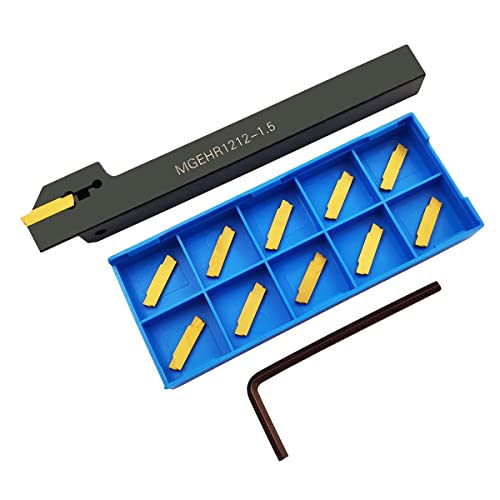 ASZLBYM Lathe Grooving Tool Holder Grooving Cut-Off Tool9.6/10View on Amazon
A round bar needs a shoulder turned down, a bore opened up, or a thread cut on the end, and a file and a drill press will not get you there. A metal lathe spins the work while a fixed cutter shapes it, and that one setup covers facing, turning, drilling, boring and threading in a home shop. This guide explains metal lathe for beginners: what the sizes mean, which specs matter on a first machine, and what to check before you buy.
This guide links to our product roundups, where WeldGearLab gets a commission on purchases made through links on this page, and your price stays the same. Read our affiliate disclosure.
Metal lathe for beginners: what size to buy
Lathe size is written as swing by length, and both numbers come from the listing. Swing over bed is the largest diameter that clears the bed, and distance between centers is the longest part that fits between the headstock and the tailstock. VEVOR lists a 7.09 inch swing over bed and 13.78 inch center distance on its 7 x 14 in lathe, and an 8.3 inch swing over bed with a 13.8 inch swing over cross slide on its 8 x 14 in lathe. Match the swing to the widest part you plan to turn and the center distance to the longest part, and leave room for the chuck and the tailstock center, which eat into the working length. Browse the metal fab tools hub for related guides.
Benchtop lathes in these listings run from a 7 by 12 in WEN with a 4-amp motor to an 8.3 by 29.5 in VEVOR with a 750W brushless motor. The longer bed suits longer parts while the shorter bed fits a smaller bench. The VEVOR 7 x 14 in lathe lists 103.0 pounds and the VEVOR 8.3 x 29.5 in lathe lists 197.0 pounds, so check that the bench under it holds the machine before it arrives.
Side by side: benchtop lathes from the listings
| VEVOR 7 x 16 in | VEVOR 8.3 x 29.5 in | WEN 7 by 12 in | |
|---|---|---|---|
| Size | 7 x 16 in | 8.3 x 29.5 in | 7 by 12 in |
| Motor | 800W brushless | 750W brushless | 4-amp |
| Speed range | 150 to 2500 RPM | 100 to 2500 RPM high gear, 50 to 1250 RPM low gear | 100 to 2500 RPM |
| Chuck | 3.9 in 3-jaw | Not stated | 3-jaw |
| Threading | 19 kinds, 9 metric 0.5 to 3 mm, 10 imperial 10 to 44 TPI | 24 kinds, 14 metric 0.3 to 3 mm, 10 imperial 10 to 44 TPI | 18 sizes, 12 to 52 TPI |
The table shows how size, motor and threading range move together. The VEVOR 7 x 16 in lathe lists 19 kinds of threads, 9 metric from 0.5 to 3 mm and 10 imperial from 10 to 44 TPI, while the VEVOR 8.3 x 29.5 in lathe lists 24 kinds, 14 metric from 0.3 to 3 mm and 10 imperial from 10 to 44 TPI. The WEN lists 18 thread sizes from 12 to 52 TPI with a threading dial indicator. If you plan to cut threads, pick a lathe that lists the pitch range you need.
Motor, speed and gears
Motor power in these listings runs from a 4-amp motor on the WEN 7 by 12 in lathe to an 800W brushless motor on the VEVOR 7 x 16 in lathe, with a 750W brushless motor on the VEVOR 8.3 x 29.5 in lathe. One VEVOR 7 x 14 in lathe lists a 550W motor. The VEVOR 7 x 16 in lathe lists a 150 to 2500 RPM range, the WEN lists 100 to 2500 RPM, and the VEVOR 8.3 x 29.5 in lathe lists a high gear of 100 to 2500 rpm and a low gear of 50 to 1250 rpm. Look for forward and reverse in the listing, since several of these lathes state both directions.
Gear material is worth checking. One VEVOR 7 x 14 in lathe lists metal gears instead of a nylon one, while one Furvveerr 7 x 14 in lathe lists nylon gears. A direct drive motor needs no belt changes, and the VEVOR 7 x 16 in lathe lists a direct drive motor with no belt drive. An emergency stop switch, overload protection, and a chuck cover power off switch are listed on the VEVOR 7 x 16 in and 8.3 x 29.5 in lathes, and those switches cut power when the cover opens or the motor overloads.
Chucks, tool posts and tailstocks
The chuck holds the work, and the listings here use 3-jaw chucks. One Furvveerr 7 x 14 in lathe lists a 3-jaw self-centering chuck. One VEVOR 7 x 14 in lathe lists a 4-inch 3-jaw chuck that handles square and round objects, and the VEVOR 7 x 16 in lathe lists a 3.9 inch 3-jaw chuck. A 4-way tool post holds 4 standard turning tools at the same time on the VEVOR 7 x 14 in lathe, and a quick-change tool post on the VEVOR 7 x 14 in milling module lathe improves tool switching efficiency. For tooling, see the best CNC lathe tools guide. The tailstock holds the other end of long work, and the WEN lists an MT3 spindle taper with an MT2 tailstock taper, while the VEVOR 8 x 14 in lathe lists an MT2 taper in the tailstock spindle. Check the spindle bore too: the VEVOR 8 x 14 in lathe lists a 0.8 inch spindle bore, which sets the largest bar that passes through the headstock.
What to check before you buy
Measure the bench first. One VEVOR 7 x 14 in lathe lists product dimensions of 34.1 inches by 13.6 inches by 17.7 inches, and the VEVOR 7 x 14 in milling module lathe lists 41.73 inches by 17.32 inches by 17.72 inches. Check the power too: the VEVOR 8 x 14 in lathe lists a 110V motor. Look at what comes in the box: a 3-jaw chuck, a tool post, and a tool box are listed across these lathes. A drill press handles holes in flat stock, so see the best drill press guide when you plan the bench. The WEN lathe (on Amazon) lists a two-year warranty; warranty terms on the other listings here are not stated.
Shop safety on a lathe
Eye and face protection, clamping the work, and guards in place are the basics on any lathe, and no gloves near rotating parts: a glove can catch and pull a hand in. Keep the chuck cover and splash guard fitted, keep the work clamped tight, and read the manual for the machine you buy before the first cut. See the OSHA machine guarding guidance and the safety glass standard for what eye protection should cover.
FAQ for welders
What size metal lathe should a beginner buy?
A 7 by 12 in lathe turns parts up to 12 inches in length or 7 inches in diameter, which covers small parts, models and repair work. Step up to a 7 x 16 in or 8.3 x 29.5 in lathe when the parts get longer. Match the swing and the center distance to the largest part you plan to turn.
What does swing over bed mean?
Swing over bed is the largest diameter that clears the bed of the lathe. One VEVOR 7 x 14 in lathe lists a 7.09 inch swing over bed, and the VEVOR 8 x 14 in lathe lists an 8.3 inch swing over bed. Measure the widest part you plan to turn and pick a swing larger than that diameter.
How much power does a beginner lathe need?
The listings here run from a 4-amp motor on the WEN 7 by 12 in lathe to 800W on the VEVOR 7 x 16 in lathe, with 550W and 750W in between. Power matters most on larger diameters and heavy cuts, and speed range and rigidity matter as much.
Can a mini lathe cut threads?
Yes, when the listing states a threading range. The VEVOR 7 x 16 in lathe lists 19 kinds of threads, and the WEN lists 18 thread sizes from 12 to 52 TPI with a threading dial indicator. Check the pitch range against the threads you plan to cut before you buy.
What should you check when the lathe arrives?
Check that the chuck, tool post, tailstock and guards are in the box and fitted, and that the emergency stop switch works. Read the manual for the machine you buy and follow its setup and alignment steps before the first cut.
Related: lathes and mills, best CNC lathe tools, best drill press, and the metal fab tools hub.