Machinist Square vs Combination Square: Which One Should You Buy?
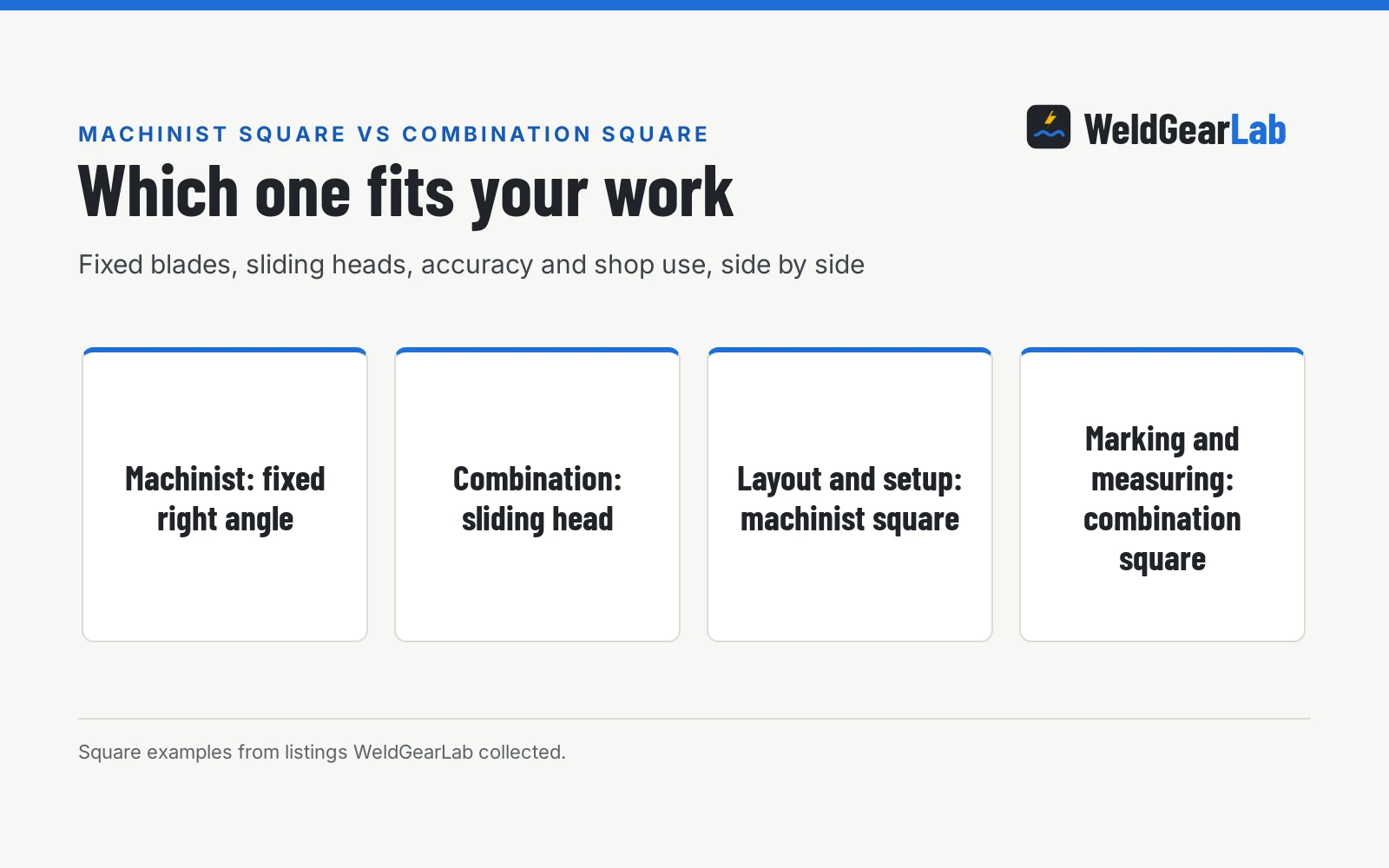
A machinist square holds a fixed right angle for layout and machine setup, while a combination square slides to mark, measure and check, and this guide compares them on accuracy, build and shop use.

On this page
Top picks at a glance
As an Amazon Associate I earn from qualifying purchases.
- 1
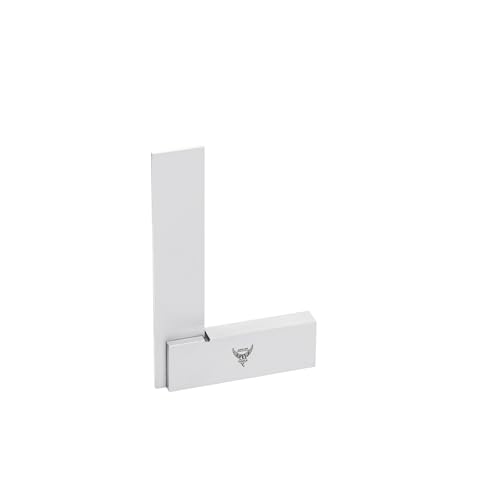 PEC Tools 3" Machinist Square High Precision Engineer Square9.7/10View on Amazon
- 2
 PEC Tools 12" Combination Square9.5/10View on Amazon
- 3
 Machinist Square Precision Engineer Wide Seat Square 90 Right9.6/10View on Amazon
- 4
 Boomgood Machinist Square Set Engineer Precision Mini WideView on Amazon
- 5
 Taytools 7464237 Machinist Engineer Solid Stainless SteelView on Amazon
- 6
 iGaging Machinist Square 90° Right Angle Precision EngineerView on Amazon
- 7
 IRWIN Combination SquareView on Amazon
- 8
 WORKPRO Aluminum Alloy Carpenter Square and Zinc-Alloy SquareView on Amazon
- 9
 iGaging Combination Square Premium 2-Piece 6" 4RView on Amazon
A weldment sits on the bench with a joint that has to land square, and the layout tool in hand decides whether the fit-up reads true or drifts out of square before the arc starts. Machinist square vs combination square is the question that follows, and the short answer is that a machinist square gives a fixed right angle for checking and layout, while a combination square gives a sliding head for marking, measuring and checking across varied jobs.
Other welders and gear to compare
 Boomgood Machinist Square Set Engineer Precision Mini WideCheck price on Amazon
 Taytools 7464237 Machinist Engineer Solid Stainless SteelCheck price on Amazon
 iGaging Machinist Square 90° Right Angle Precision EngineerCheck price on Amazon
 IRWIN Combination SquareCheck price on Amazon
 WORKPRO Aluminum Alloy Carpenter Square and Zinc-Alloy SquareCheck price on Amazon
 iGaging Combination Square Premium 2-Piece 6" 4RCheck price on Amazon
This guide links to our product roundups, where WeldGearLab gets a commission on purchases made through links on this page, and your price stays the same. Read our affiliate disclosure.
Machinist square vs combination square: the difference in one paragraph
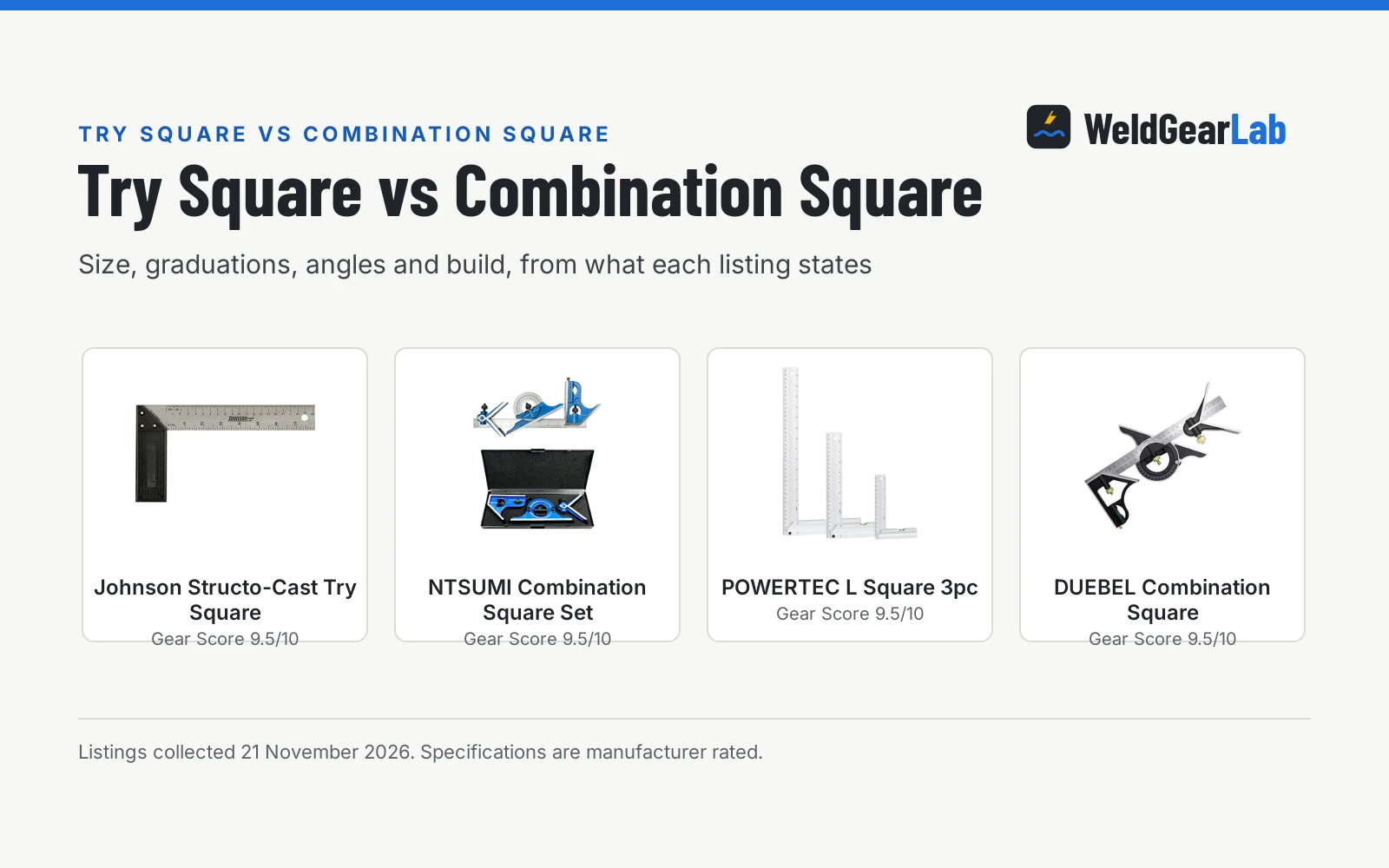
A machinist square is a solid square with the blade fixed to the beam at a right angle, so the angle cannot loosen or drift, and the maker lists true right angles on the inside and outside edges. A combination square carries a head that slides along a ruled blade and locks in place, so the same tool marks lines, measures depth and checks angles across varied jobs. The fixed square suits checking and setup where the angle must stay put, while the sliding square suits marking and measuring where the job changes from mark to mark.
Side by side
| Machinist square | Combination square | Shop use | |
|---|---|---|---|
| Design | Solid square with the blade fixed to the beam | Head slides along a ruled blade and locks in place | Fixed reference or varied marking |
| Right angle | True right angle on the inside and outside edges | Head locks at square and at an angled face | Checking square or marking angles |
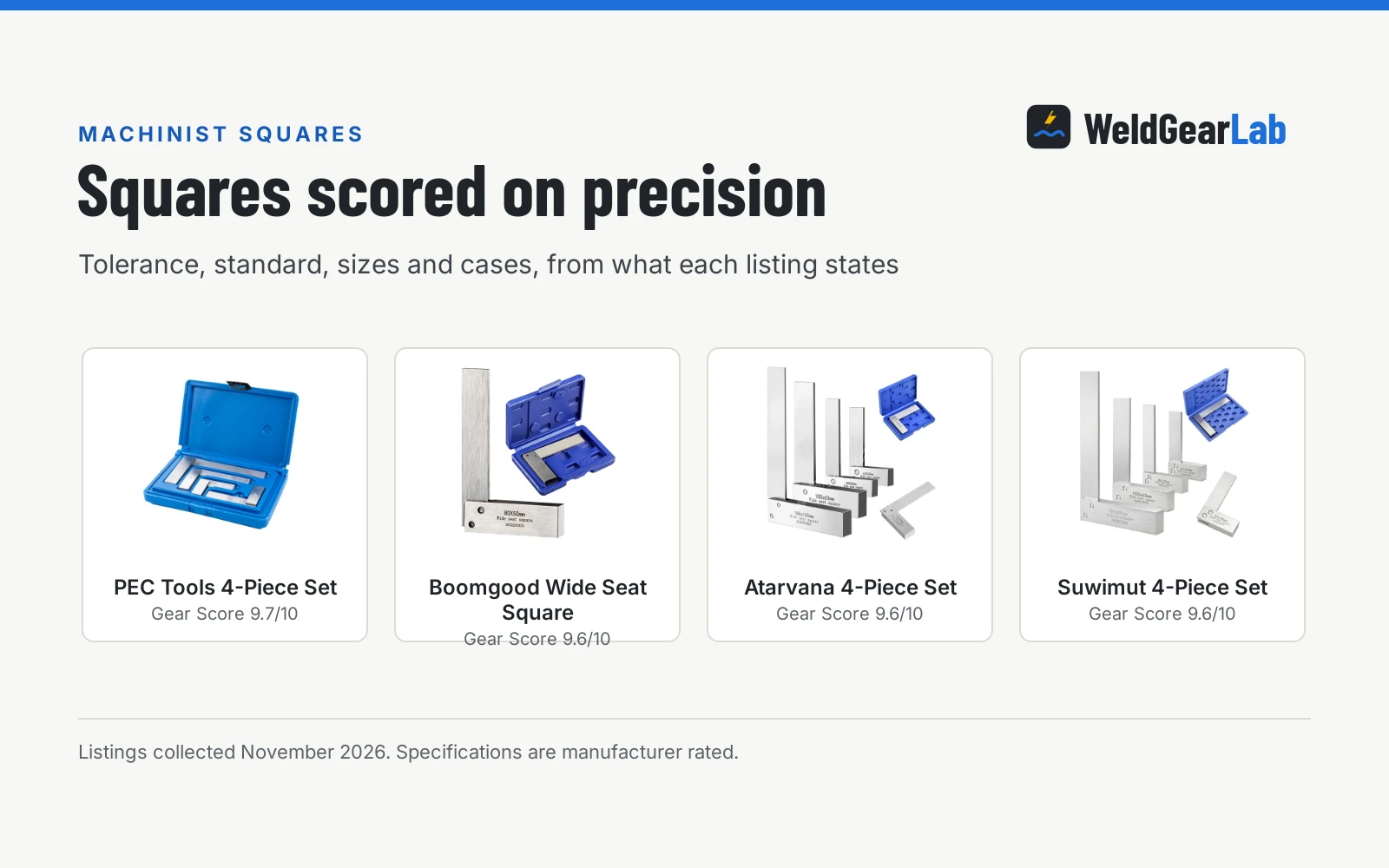
| Accuracy | PEC set lists 0.0006 inches; Boomgood lists DIN 875 Grade 1 | Varies with head and blade fit | Precision layout or general shop marking |
| Sizes in this guide | 2, 3, 4 and 6 inch sets; 3.2 x 2 inch; 4 x 2.8 inch | Not covered by the squares in this guide | Bench work, fence setup and inspection |
| Inside corner | Debris notch keeps dust and metal particles clear | Not stated | Clean reference corners |
| Steel | Hardened, tempered and polished steel, ground and polished | Not stated | Long service on the bench |
The table above sets the fixed square against the sliding square on design, accuracy and shop use. The squares in this guide are machinist squares, so the combination square column states what the sliding design offers, and the machinist square column states what the listings publish.
When a machinist square is the better choice
- Checking a right angle. The fixed blade holds a true right angle on the inside and outside edges, so a quick check against the work shows whether an edge or a joint sits square, with no head to shift and no setting to slip.
- Machine setup and inspection. The Boomgood squares list DIN 875 Grade 1 and suit precision layout, machine set-up and laboratory use, while the PEC set lists a tolerance of 0.0006 inches for reliable measurement.
- Bench work across sizes. A 4-piece set with 2, 3, 4 and 6 inch squares covers bench work, fence setup and inspection, and the set comes in a protective case.
- Small layout. A 3.2 x 2 inch square and a 4 x 2.8 inch square suit small parts and tight layout, with the blade length measured from the beam to the end of the blade.
The welding square vs combination square guide covers the same fixed-versus-sliding question for welding squares.
When a combination square is the better choice
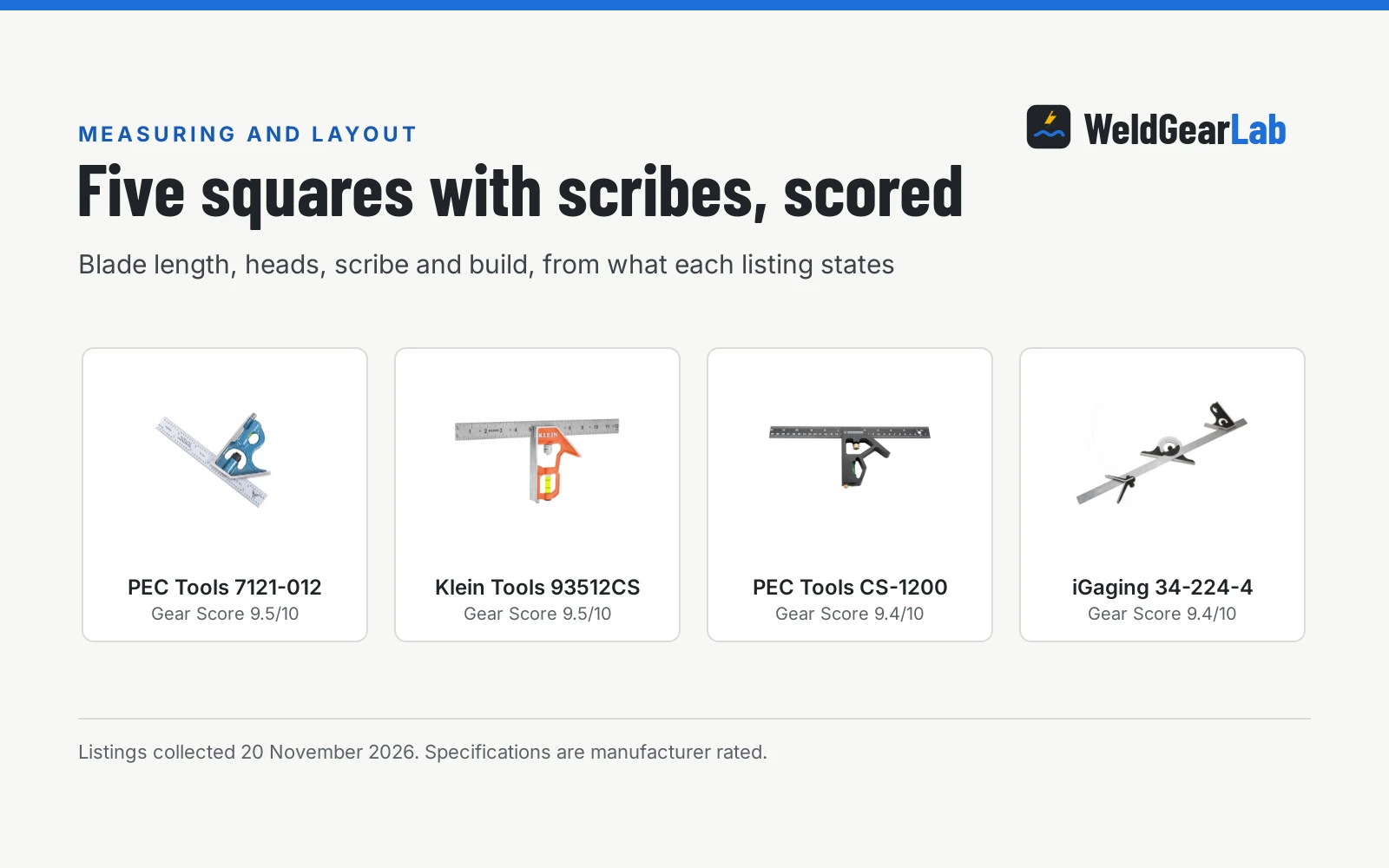
- Marking varied lines. The head slides along the blade and locks where the mark falls, so varied lines and repeated marks come from the same tool.
- Measuring and checking on the bench. The ruled blade reads lengths and depths while the head checks square, so the tool moves from marking to measuring without a tool change.
- Angles beyond square. The head locks at square and at an angled face, so a bevel at that angle takes shape with the same tool.
- Carrying a tool across jobs. A sliding head covers marking, measuring and checking in a tool that fits the bench and the job site, so the kit stays light.
How to tell what a square offers
Listings for machinist squares return to the same points across the set: a fixed blade, a stated tolerance or grade, ground steel and a notch at the inside corner. Look for these in the listing before ordering:
- Fixed blade. The PEC set and the Boomgood squares describe a solid square with the blade permanently fixed to the beam, so the angle cannot loosen or drift.
- Stated accuracy. The PEC set lists true right angles with a tolerance of 0.0006 inches, and the Boomgood squares list DIN 875 Grade 1 for precision layout and machine set-up.
- Ground and polished steel. The listings describe hardened, tempered and polished steel, with beams and blades ground and polished for parallelism.
- Debris notch. A small notch at the inside corner keeps dust and metal particles from collecting where the blade meets the beam, which keeps the reading true.
- Sizes and case. The PEC set and the Atarvana set each hold 2, 3, 4 and 6 inch squares, with a case for the set, while the 3.2 x 2 inch Boomgood square comes in a small plastic case.
For fine measurement beyond squares, see the dial indicator vs digital indicator guide.
Can one square do both jobs?
Yes, in part. A machinist square checks and lays out right angles with a fixed blade, and a combination square marks, measures and checks across varied jobs, so a shop that does layout and machine setup gains from a fixed square, while a shop that marks and measures all day gains from the sliding head. Owning a fixed square and a sliding square covers the bench better than stretching either tool past its design. Keep the square clean, keep the blade free of dust at the inside corner, and store the square in its case so the ground edges stay true.
Layout safety. Clamp the work before marking or checking, keep hands clear of sharp edges, and wear eye protection when brushing metal particles from the bench. A square with a chipped edge or a bent blade gives a false reading, so check the square against a known reference before trusting it on a fit-up.
FAQ for welders
Is a machinist square more accurate than a combination square?
A fixed square holds its angle because the blade stays fixed to the beam, with no head to shift and no setting to slip. The PEC set lists a tolerance of 0.0006 inches, and the Boomgood squares list DIN 875 Grade 1. A combination square relies on the head locking true on the blade, so its reading follows the fit of the head.
Can a combination square check a right angle?
Yes. The head locks square on the blade, and the blade then reads against the edge of the work. Check the head against a known reference first, since a loose head gives a false reading.
What size machinist square suits a small shop?
A 4-piece set with 2, 3, 4 and 6 inch squares covers bench work, fence setup and inspection, with a size for small parts and a size for larger layout. For small parts, a 3.2 x 2 inch square or a 4 x 2.8 inch square fits tight layout. Pick the size that fits the work.
What is the notch at the inside corner for?
The notch keeps dust and metal particles from collecting where the blade meets the beam. A particle trapped in the corner lifts the blade off the work and throws the reading off. Brush the corner clean before checking a right angle.
How should a machinist square be stored?
Store the square in its case, with the ground edges kept clean and free of dust. The PEC set and the Atarvana set come with a case, and the 3.2 x 2 inch Boomgood square comes in a small plastic case. Keep the square away from damp and from tools that can nick the edges.
Related: welding square vs combination square, dial indicator vs digital indicator, and metal scribe vs soapstone marker. Also see our best compact tape measure. Also see our measuring tape with all fractions. Also see our digital laser angle finder protractor tool. Also see our combination square scribe. Also see our l shaped measuring tool.