Inverter vs Transformer Plasma Cutter: Which One Should You Buy?
Inverter and transformer plasma cutters convert wall power differently, creating major trade-offs in weight, electrical efficiency, duty cycle and shop portability.

On this page
Top picks at a glance
As an Amazon Associate I earn from qualifying purchases.
- 1
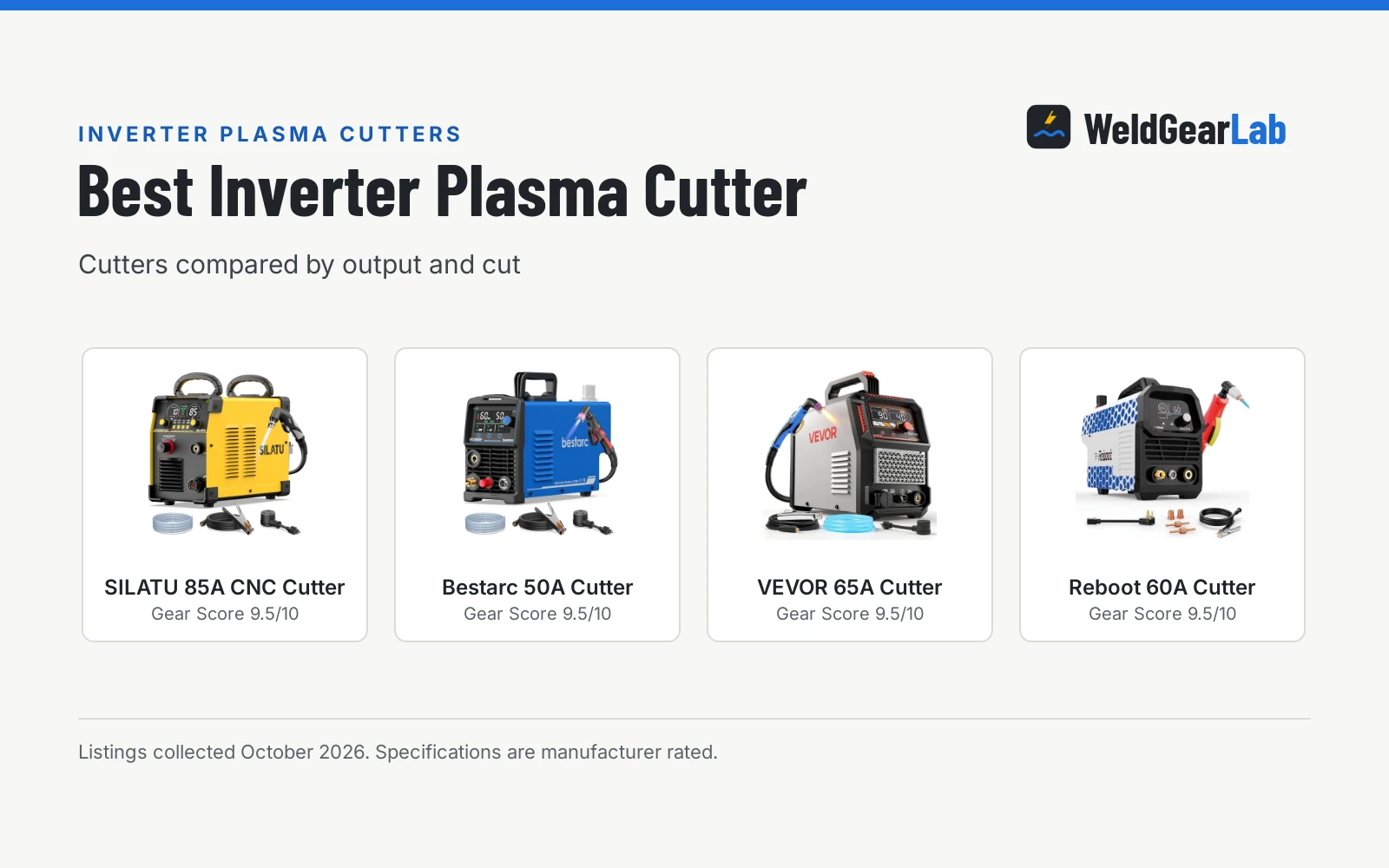
 SILATU 85A CNC Plasma Cutter Machine9.5/10View on Amazon
- 2
 ARCCAPTAIN iControl CUT60 Pro Plasma Cutter Machine9.8/10View on Amazon
- 3
 Reboot 60A Plasma Cutter9.5/10View on Amazon
- 4
 PrimeWeld 50A Air Inverter Plasma Cutter with Non-Touch PilotView on Amazon
- 5
 GZ GUOZHI Plasma CutterView on Amazon
- 6
 Amico CUT-50View on Amazon
- 7
 Everlast HATCHET 60 110V/220V 60 Amp Inverter Plasma CutterView on Amazon
- 8
 Bestarc 50A Plasma Cutter MachineView on Amazon
You have a sheet of steel on the fab table or a rusty bracket to slice off an equipment frame, and you need clean cuts without dragging out an oxy-fuel rig. Deciding between an inverter vs transformer plasma cutter comes down to power efficiency, weight, and how often you need to move the machine around the shop. For nearly every home shop, farm, and repair garage, an inverter plasma cutter is the superior choice because modern solid-state electronics deliver high cutting power at a fraction of the weight, while traditional transformer machines remain heavy and stationary. This guide explains how their internal designs work, compares their shop performance side by side, and helps you select the right machine for your bench.
Other welders and gear to compare
 PrimeWeld 50A Air Inverter Plasma Cutter with Non-Touch PilotCheck price on Amazon
 GZ GUOZHI Plasma CutterCheck price on Amazon
 Amico CUT-50Check price on Amazon
 Everlast HATCHET 60 110V/220V 60 Amp Inverter Plasma CutterCheck price on Amazon
 Bestarc 50A Plasma Cutter MachineCheck price on Amazon
This guide links to our product roundups, where WeldGearLab gets a commission on purchases made through links on this page, and your price stays the same. Read our affiliate disclosure.
The difference in one paragraph
Plasma cutters require direct current electrical power to create an electric arc that ionizes compressed air into cutting plasma. A transformer plasma cutter uses a massive copper-wound iron core operating at standard utility frequency to step down wall voltage into cutting voltage. An inverter plasma cutter rectifies incoming alternating current into direct current, switches it at high frequencies using solid-state transistors, and steps it down through a miniature transformer before rectifying it back into smooth cutting power. That high-frequency switching shrinks the necessary magnetic core, slashing machine weight and reducing electrical waste.
Inverter vs Transformer Plasma Cutter: Side by Side
| Inverter Plasma Cutter | Transformer Plasma Cutter | Advantage | |
|---|---|---|---|
| Internal power conversion | High-frequency solid-state transistors (IGBT) | Heavy copper-wound iron core transformer | Inverter |
| Machine weight | Lightweight, typically easy to carry by hand | Very heavy, often requiring wheels or shop cart | Inverter |
| Portability | Moves easily between bench, trailer, and job site | Stationary shop placement beside fab table | Inverter |
| Electrical efficiency | High efficiency with lower wall current draw | Not stated | Inverter |
| Dual-voltage capability | Common automatic switching between circuits | Not stated | Inverter |
| Arc stability and control | Solid-state electronic control with minimal dross | Analog magnetic output with steady heavy arc | Inverter |
| Shop space footprint | Compact benchtop size | Large floor cabinet | Inverter |
Duty cycle and cutting capacity reflect how each design converts power and dissipates heat. An inverter produces a tightly regulated direct current cutting arc with minimal electrical ripple, delivering clean cuts with less dross. A heavy transformer machine provides steady analog power through massive magnetic coils.
When an inverter plasma cutter is the better choice
- Portability around the shop and job site. An inverter machine is compact enough to carry with a shoulder strap or grab handle, making it easy to haul up onto a trailer deck or out to a fence line. For example, Reboot lists its RBC6000D MAX at only 10 lbs, and SILATU lists the STC550P at 12.57 lbs. Even industrial units remain manageable: Hobart lists its AirForce 40i with an XT40R torch at 26 pounds.
- Efficient power consumption and lower 240V breaker requirements. High-frequency inverters convert wall energy with minimal resistive heat loss. On 240V power, Reboot lists a 50% duty cycle on its RBC6000D cutting at 60A, while requiring only a 30A breaker. On 120V circuits at its maximum 35A output, the same Reboot machine recommends a 50A breaker because pulling high cutting wattage from low voltage demands heavy supply current.
- Dual-voltage versatility on shop and household circuits. Many inverter models feature dual-voltage circuitry. You can plug into a 120V outlet for light sheet metal jobs at lower amperage settings, or plug into a 240V shop outlet when slicing thick plate. SILATU lists cutting capacity reaching 1/2 inch on 110V power and 7/10 inch on 220V power for its STC550P.
- Crisp arc control and clean severance. Solid-state current control adjusts output smoothly as torch height varies, producing clean kerfs and less cleanup. High-amperage units deliver deep penetration: AWT lists clean cuts up to 3/4 inch and a maximum severance cut of 1 inch on 220V power for its CUT-65.
If you need a cutter that moves between your shop bench, garage, and job trailer, our guide to the best portable plasma cutter covers compact dual-voltage machines with real ratings.
When a transformer plasma cutter is the better choice
- Permanent station cutting. When a plasma cutter sits permanently bolted beside a dedicated fabrication table, physical mass becomes irrelevant. If the machine never leaves its corner of the shop, a heavy cabinet provides a stable workstation base.
For stationary fab tables and heavy farm equipment repairs, check our guide on the best plasma cutter for farm use to see which machines handle rough shop duty.
How to tell which design a machine uses
- Check total machine weight. Weight is the clearest physical indicator. Inverter machines weigh remarkably little for their amperage. Reboot lists its RBC6000D at 14.92 pounds in its specification table, and Bestarc lists its CUT55XP at 16.76 pounds.
- Look for solid-state terminology. Listings for modern inverter cutters explicitly highlight high-frequency switching technology. Terms like IGBT, inverter, high-frequency switching, digital display, and dual-voltage indicate an inverter circuit. Transformer machines mention heavy iron cores, tapped step settings, or copper windings.
- Examine voltage inputs and cabinet dimensions. Inverters frequently offer dual-voltage capability on 120V and 240V utility circuits within a small benchtop chassis. Bestarc lists cabinet dimensions of 12.01 x 5.12 x 7.48 inches for its CUT55XP.
Nearly all newly manufactured plasma cutters sold today rely on inverter technology. Transformer models are now primarily encountered on the used market or in older industrial facilities.
Air supply and shop power requirements
Both machine designs require clean, dry compressed air to clear molten metal from the kerf. An air compressor delivering sufficient volume is mandatory. For instance, Reboot recommends an air compressor supplying 90 PSI with a flow rate of 250 L/min for its RBC6000DL, and Bestarc specifies 65 PSI air pressure with a flow rate of 250 liters per minute for cutting on 220V power with the CUT55XP. Moisture in your air line degrades consumable life rapidly, causing premature nozzle wear and erratic arcs regardless of power supply design.
On the electrical side, power delivery differences are substantial. Inverters draw current more smoothly. Dual-voltage inverters allow running on household outlets for light cutting at reduced amperage, though heavy plate severance requires a dedicated higher voltage branch circuit. See our comparison on dual voltage vs 110v plasma cutter setups and our guide to the best air compressor for plasma cutter.
Which design should you choose for your shop?
For hobbyists, fabricators, and repair shops buying equipment today, an inverter plasma cutter is virtually always the correct purchase. You gain dramatic weight savings, lower electrical draw, cleaner arc initiation, and convenient dual-voltage operation. You can carry an inverter to wherever your metal sits rather than dragging heavy workpieces across the shop floor to a stationary machine. Manufacturer warranty terms also favor modern equipment: YESWELDER provides a 2-year warranty on its CUT-65DS PLUS, SILATU includes a 1-year warranty on the STC550P, and Hobart backs its AirForce 40i with its Hobart 5/3/1 warranty. Browse our scored picks in the best home hobby plasma cutter guide to compare reliable benchtop models.
A transformer cutter primarily makes sense if you already own a functioning unit or inherit one with a shop.
Plasma cutting safety. Plasma arcs generate intense heat, eye-damaging ultraviolet radiation, sparks, and airborne metal fumes. Always wear a shaded cutting face shield or welding helmet, heavy leather gloves, and flame-resistant shop clothing. Keep your face away from the plume and ensure adequate shop ventilation or exhaust filtration when cutting galvanized steel, aluminum, or oily plate. Disconnect input power before changing torch nozzles, swirl rings, or electrodes.
FAQ for welders
Can an inverter plasma cutter replace a heavy transformer machine?
Yes, modern inverter plasma cutters match or exceed the cutting output of old transformer units while consuming less electricity and taking up less bench space. Inverter circuitry delivers a smooth, responsive cutting arc that produces clean edges with minimal dross. An inverter is the modern shop standard.
Why are transformer plasma cutters so heavy?
Transformer machines rely on heavy iron cores and thick copper windings to step down mains voltage into cutting power. These bulky physical magnetic cores require substantial metal to handle cutting current without overheating. Modern inverters replace that heavy iron mass with solid-state transistors operating at high electrical frequencies.
Are inverter plasma cutters durable enough for farm and shop use?
Quality inverter plasma cutters feature protective coatings on internal circuit boards, overload safeguards, and rugged steel enclosures. While early inverters had sensitive electronics, modern IGBT designs handle dirty shop environments reliably when kept clear of grinding dust. Regular shop maintenance like blowing out metal shavings keeps inverter electronics running cleanly.
Can I run an inverter plasma cutter on a household electrical circuit?
Dual-voltage inverters can run on standard household wall outlets for light sheet metal cutting when the output amperage is kept low. However, pushing an inverter to maximum cutting capacity on a 120V circuit draws heavy current, which is why makers like Reboot specify a 50A breaker for maximum 120V output. For thicker plate metal cutting at higher amperage, plugging into a dedicated 240V shop outlet is required.
Do transformer plasma cutters last longer than inverter cutters?
However, replacement parts and torch consumables for aging transformer units are increasingly hard to source. Modern inverter machines use standard torch connections, readily available consumables, and active manufacturer technical support.
Related: what size plasma cutter do I need, best portable plasma cutter, best plasma cutter for farm use, and the plasma cutters hub. Also see our guide on what size air compressor do I need for a plasma cutter.