Cold Welding Machine vs Tig Welder: Which One Should You Buy?
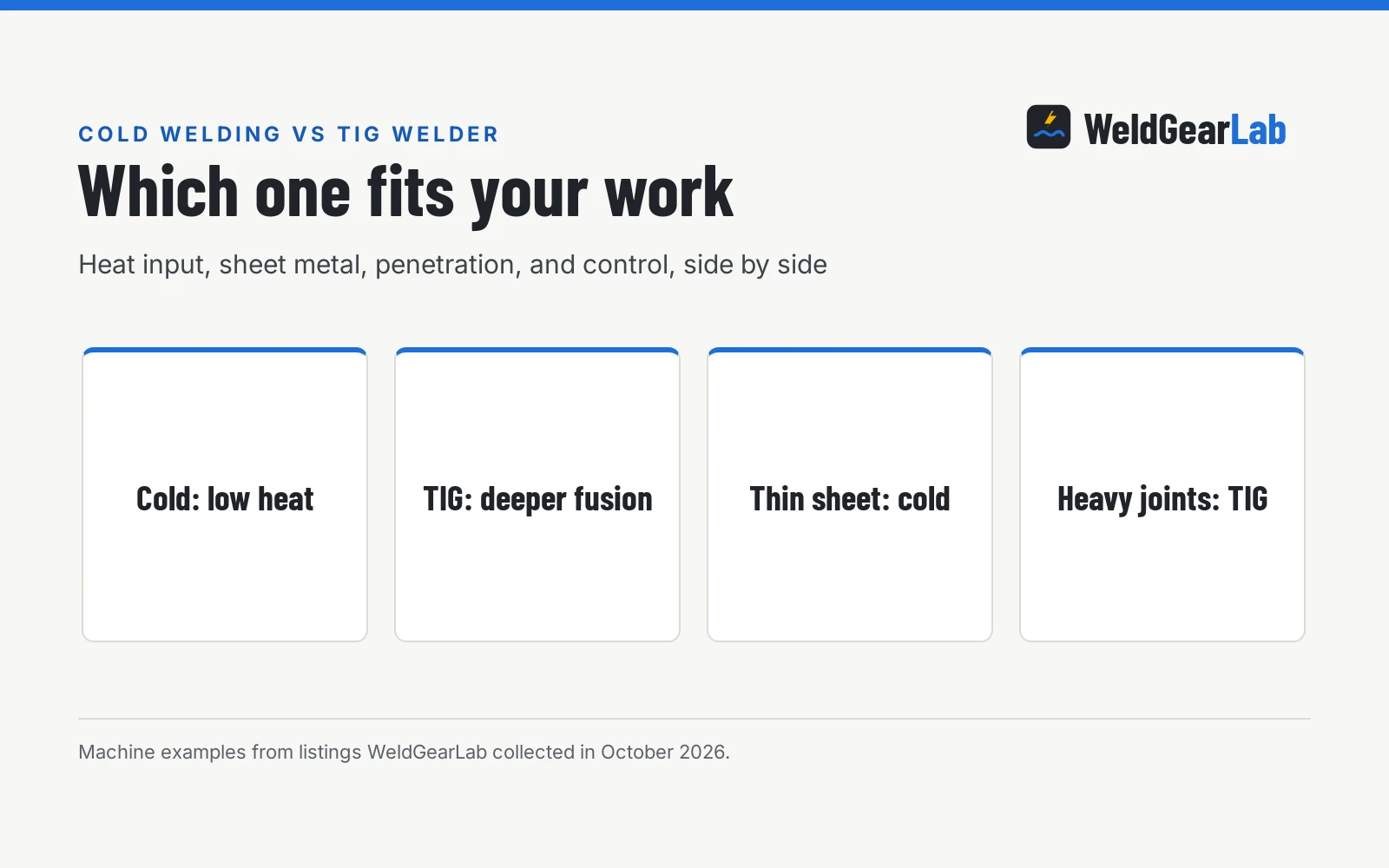
Cold welding machines use rapid millisecond pulses to minimize heat and distortion on thin metal, while standard TIG welders provide continuous arc control for deeper penetration on thicker joints.

On this page
Top picks at a glance
As an Amazon Associate I earn from qualifying purchases.
- 1
 PRIMEWELD TIG225X 225 Amp IGBT AC DC Tig/Stick Welder with9.6/10View on Amazon
- 2
 ANDELI TIG Welder Multifunctional Cold Welding Machine withView on Amazon
- 3
 ARCCAPTAIN Stick WelderView on Amazon
- 4
 ARCCAPTAIN 205A Stick WelderView on Amazon
- 5
 YESWELDER 205Amp Stick Welder ARC Welding Machine with LiftView on Amazon
- 6
 TOOLIOM 110/220V Dual Voltage 5-in-1 Welding Machine CUT/HFView on Amazon
- 7
 160A 4-in-1 Welding Machine: 110V/220V Dual Voltage MIGView on Amazon
When you are facing a stack of thin stainless sheet on the fab table, choosing between a cold welding machine vs tig welder determines whether you get clean joints or warped scrap. A cold welding machine discharges brief, millisecond pulses of arc energy that fuse metal without soaking heat into the workpiece, making it a specialized choice for delicate sheet metal where heat distortion and surface discoloration ruin the part. A standard TIG welder provides continuous arc current that allows an operator to establish a molten puddle, add filler rod, and achieve deep penetration across thicker joints, but it transfers substantial heat into the parent metal. This guide compares cold welding machines against standard TIG welders for shop and garage fabrication, showing where each process belongs and how to choose the right setup for your projects.
Other welders and gear to compare
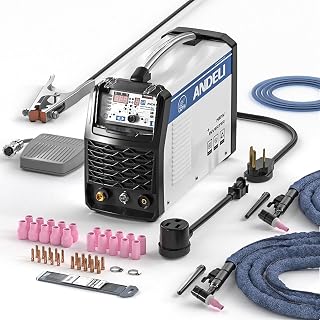 ANDELI TIG Welder Multifunctional Cold Welding Machine withCheck price on Amazon
 ARCCAPTAIN Stick WelderCheck price on Amazon
 ARCCAPTAIN 205A Stick WelderCheck price on Amazon
 YESWELDER 205Amp Stick Welder ARC Welding Machine with LiftCheck price on Amazon
 TOOLIOM 110/220V Dual Voltage 5-in-1 Welding Machine CUT/HFCheck price on Amazon
 160A 4-in-1 Welding Machine: 110V/220V Dual Voltage MIGCheck price on Amazon
This guide links to our product roundups, where WeldGearLab gets a commission on purchases made through links on this page, and your price stays the same. Read our affiliate disclosure.
The difference in one paragraph
Electric arc welding relies on heat to melt base metals together, but the rate of heat accumulation changes how the surrounding steel behaves. Standard TIG welding maintains a continuous electrical arc shielded by inert gas, giving the welder steady thermal energy to manipulate a molten pool, wash the puddle into sidewalls, and build structural weld throats. A cold welding machine, often called cold TIG, uses an inverter control circuit to release sudden, high-current electrical discharges lasting only tiny fractions of a second, followed by extended pauses. Because the electrical discharge happens so rapidly, the arc fuses the joint interface and extinguishes before heat can conduct into the adjacent metal. The result is a fusion weld completed with minimal heat-affected zone, preventing warpage, burn-through, and oxidation coloring on sensitive sheet metal.
Cold welding machine vs tig welder: side by side
| Cold welding machine (cold TIG) | Standard TIG welder | Application fit | |
|---|---|---|---|
| Arc delivery | Short pulsed discharge in milliseconds | Continuous arc stream | Cold for thin sheet, TIG for plate |
| Heat input into metal | Very low, minimal heat-affected zone | Continuous heat, larger heat-affected zone | Cold when warpage must be avoided |
| Thin sheet distortion | Minimal warpage and discoloration | Requires heat management to prevent warping | Cold preserves flat cosmetic panels |
| Joint penetration | Shallow fusion, best on thin stock | Deep fusion on medium and thick stock | Standard TIG for structural joints |
| Shielding gas | Pure argon required | Pure argon required | Both require pure argon cylinders |
| Electrode type | Non-consumable tungsten | Non-consumable tungsten | Both use tungsten electrodes |
| Arc control method | Timed millisecond pulse and interval settings | Continuous current modulation via pedal or torch | Cold for repeatability, TIG for feathering |
| Thick plate and structural work | Not suitable, lacks deep penetration | Standard choice for structural and pressure joints | Standard TIG for load-bearing welds |
| Post-weld cleanup on stainless | Silver-white bead with minimal cleanup | Discoloration requires wire brushing or pickling | Cold reduces post-weld finishing |
Both processes run shielding gas and non-consumable tungsten electrodes, but their operational goals differ. Cold welding prioritizes aesthetic cleanliness and minimal distortion on thin skins, while standard TIG welding provides structural strength, deep root fusion, and complete puddle manipulation on load-bearing assemblies.
When cold welding is the better choice
- Thin stainless steel and sheet metal. Enclosures, custom ductwork, backsplashes, and decorative paneling that warp under continuous arc heat benefit from instantaneous pulse discharge.
- Minimizing heat tint and discoloration. The rapid arc cycle leaves stainless steel welds with a clean silver-white appearance, cutting down post-weld wire brushing and chemical pickling.
- Preventing burn-through on delicate fit-ups. On thin outside corners and tight edge joints, cold pulse discharge fuses seams without blowing holes through the parent stock.
- Cosmetic and tack welding. Placing fast, uniform spot tacks without adding heat distortion keeps fabrication frames square and ready for final assembly.
For fabricators struggling with heat distortion on alloy sheet, our guide on how to TIG weld thin stainless without warping explains torch angles and heat sinking, while our roundup of the best welding machine for stainless steel covers versatile shop machines.
When standard TIG is the better choice
- Structural fabrication and pressure joints. Roll cages, suspension brackets, pressure piping, and structural frames require the deep root penetration and thorough sidewall fusion that only a continuous arc provides.
- Medium and heavy plate. When welding thick steel plate or solid round bar, cold pulse discharge cannot create a deep enough puddle to achieve a sound weld throat.
- Foot pedal puddle control. Standard TIG allows the operator to feather the current up and down with a foot pedal while watching the puddle wet into the joint, accommodating changing metal temperatures.
- Full puddle manipulation and bead washing. When bridging uneven fit-ups or feeding filler rod continuously into a bevel, standard TIG lets you establish a fluid puddle, wash the toes smoothly into both base metals, and maintain consistent reinforcement.
If your shop work involves varied metal thicknesses, check our recommendations for the best entry level TIG welder to see machines capable of continuous current control across steel and chromoly tubing.
How to tell what a machine supports
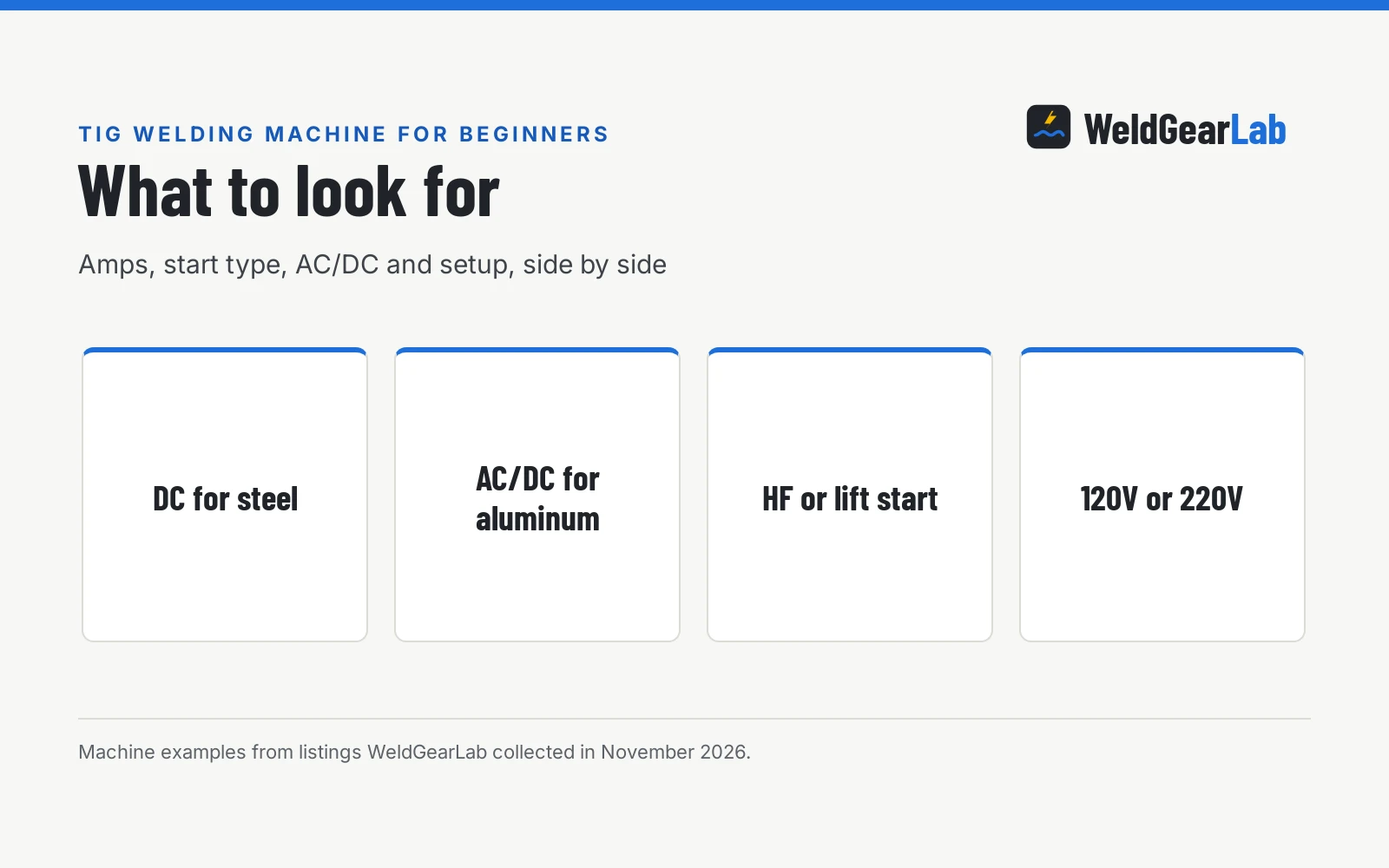
Not every machine labeled as a TIG welder includes specialized cold welding pulse circuitry, and many multi-process units combine several distinct modes under a single digital hood. When evaluating welder specifications, look for these specific indicators:
- Explicit cold or spot TIG modes. Multi-process listings identify cold welding capabilities directly in their mode descriptions. For example, AZZUNO lists its TIG-180L as a 5-in-1 unit rated at 180A with an item weight of 18.41 pounds, specifying modes for DC HF TIG, pulsed TIG, and cold TIG.
- Digital parameter memory and displays. Storing pulse and interval settings helps maintain consistency across repetitive jobs. AWT lists its 180A cold TIG unit with 2T/4T modes and memory storage for 5 sets of custom welding parameters. Similarly, ANDELI lists its 10-in-1 TIG-205 Pro at 205Amp with a 4.3 inch display and memory storage for 10 sets of parameters.
- Supplied torches and cables. Accessory packages differ in how they equip the welder. In its TIG-250MPL package, ANDELI lists a 30.1 pounds machine that supplies a 4m WP-9F cold torch alongside a 4m WP-17F standard TIG torch, giving operators distinct torches for thin sheet and continuous welding. Other multi-process models run all modes through a single supplied torch.
- Check included components carefully. Inverter listings vary widely in what they pack in the carton. AZZUNO specifies that its TIG-180L package contains no gas regulator and no tungsten electrode, meaning you must source these items before striking an arc.
Both ANDELI and AZZUNO list dual-voltage operation on 110V and 220V power circuits, allowing operators to run on common household outlets or step up to workshop receptacles for maximum output.
Shielding gas and torch requirements
Regardless of whether you fire high-speed cold pulses or run a continuous puddle, both processes depend on inert gas shielding to protect the molten joint from atmospheric contamination. Welder listings from ANDELI emphasize that pure argon gas is required for cold mode operation. Using mixed shielding gases or attempting to weld without gas causes immediate tungsten contamination, severe arc wandering, and porous beads.
Both processes operate with non-consumable tungsten electrodes and standard TIG torches. In many multi-mode setups, such as the unit listed by AWT, operators run cold TIG, pulsed TIG, and standard HF TIG through the same torch without changing hardware. When an accessory package includes multiple torch sizes, such as ANDELI providing a 4m WP-9F torch and a 4m WP-17F torch with its TIG-250MPL, the smaller torch body offers agile handling on delicate seams while the larger torch handles higher thermal loads. For advice on choosing torch sizes, cable flexibility, and gas lens hardware, see our guide to the best TIG torch for shop fabrication.
Can one machine do both?
Yes. Modern inverter technology allows manufacturers to pack multiple welding processes into a single power source. Listing specifications show multi-process units like the ANDELI 8 in 1 MIG-205DP offering a 205A maximum welding current, combining cold TIG and standard HF TIG alongside MIG, stick, and plasma cutting under a two-year warranty. These multi-mode machines allow an operator to tack and finish thin sheet enclosures in cold mode, then flip a digital switch to continuous TIG or MIG for structural framework.
Arc safety and compressed gas handling. High-frequency arc starting produces intense ultraviolet radiation that damages unprotected retinas and skin in seconds. Always wear an auto-darkening welding hood with appropriate shade ratings, flame-resistant goatskin gloves, and leather sleeves. For reliable eye protection across both cold pulse and continuous TIG modes, consult our review of the best welding helmet for TIG welding. Keep compressed argon cylinders securely chained upright to a wall or cart, inspect gas hoses for leaks, and maintain active ventilation to prevent argon buildup in confined spaces.
FAQ for welders
Is cold welding as strong as standard TIG welding?
Cold welding produces sound fusion on thin sheet metal, but it lacks the deep penetration required for structural or load-bearing joints. Because the pulse duration is brief, the weld nugget remains shallow. Standard continuous TIG produces significantly higher joint strength and deeper root penetration on structural tubing, heavy plate, and pressure vessels.
Can a cold welding machine weld aluminum?
Most entry-level cold welding machines are DC-only power sources, which cannot weld aluminum because direct current fails to scour away the tough refractory oxide layer on the metal surface. Welding aluminum requires an alternating current (AC) arc. While certain advanced inverters like the ANDELI TIG-205 Pro provide AC cold welding modes for aluminum sheet, standard continuous AC TIG remains the primary method for structural aluminum fabrication.
Do cold welding machines require shielding gas?
Yes. Cold welding is an electric arc process that uses a non-consumable tungsten electrode, meaning the molten puddle must be protected from oxygen and nitrogen in the surrounding air. Machine specifications explicitly state that pure argon shielding gas is required to prevent bead porosity and tungsten erosion.
Can a standard TIG welder perform cold welding?
A standard TIG welder without dedicated cold mode circuitry cannot replicate cold welding. Even machines with standard pulse TIG alternate between peak and background current, keeping a continuous arc burning that still adds cumulative heat. Cold welding machines discharge a brief millisecond arc that completely cuts out between pulses, allowing the puddle to solidify instantly without heat buildup.
Which process is easier for a beginner to learn?
Cold welding offers a flatter learning curve for joining thin stainless sheet because the machine controls arc duration automatically, reducing the risk of burning holes or warping panels. Standard TIG requires developing coordinated hand-eye skills to balance torch travel speed, arc gap, filler rod feeding, and foot pedal heat modulation simultaneously.
Related: what is pulse TIG welding, how to TIG weld thin stainless without warping, best entry level TIG welder, and the TIG welders hub. Also see our best welding machine for stainless steel.