Coal Forge vs Charcoal Forge: Which Should You Buy?
Coal forge vs charcoal forge compared through stated fuel and air examples, with bituminous coal chunks, a hand crank blower, weights and warranty covered.

On this page
Top picks at a glance
As an Amazon Associate I earn from qualifying purchases.
- 1
 Air Blower, Fire Blower with Hand Crank for Coal9.4/10View on Amazon
- 2
 Bituminous Coal 50lbs9.3/10View on Amazon
Verdict. Pick the coal forge side from these listings if your setup already has a forge body and you need stated fuel and hand controlled air to run it. Pick the charcoal forge side only with care, because the charcoal side has no dedicated listing here beyond a blower stated for charcoal grills, so charcoal forge fuel and build cannot be judged from these examples.
Heating steel at the forge, shaping parts at the anvil and keeping a steady fire through a work session all start with fuel and air. The choice in coal forge vs charcoal forge comes down to what fuel the forge burns and how air reaches the fire. This comparison uses the listings at hand as concrete examples, and the charcoal forge side has no dedicated listing in this comparison, so charcoal claims stay limited to what the blower example states.
WeldGearLab gets a commission on purchases made through links on this page, and your price stays the same. Read our affiliate disclosure.
The two listings
Air Blower, Fire Blower with Hand Crank for Coal
A hand crank forge blower with cast iron gear housing and steel shell, stated for coal forges and charcoal grills, at 2.87 pounds.
Pros
- Hand crank controls air amount and timing by hand
- Cast iron gear housing with thickened steel shell
- Stated for coal forges and charcoal grills
- Light stated weight at 2.87 pounds
Cons
- Hose is not included and must be added separately
- Air output figure is Not stated
- Air supply depends on steady hand cranking
- No warranty term is stated
Bituminous Coal 50lbs
Bituminous blacksmith coal in a 50lbs bag, crushed into 1-3" chunks, stated for coal forges, coal stoves and furnaces.
Pros
- Bituminous blacksmith coal crushed into 1-3" chunks
- Full 50lbs bag for forge, stove or furnace use
- Stated direct from the manufacturer
- Chunk size stated as 1-3 inches
Cons
- At 50.0 pounds the bag is heavy to move and store
- Fuel only, with no forge or blower included
- Chunk size spans a range of 1-3 inches
- No warranty term is stated
Side by side
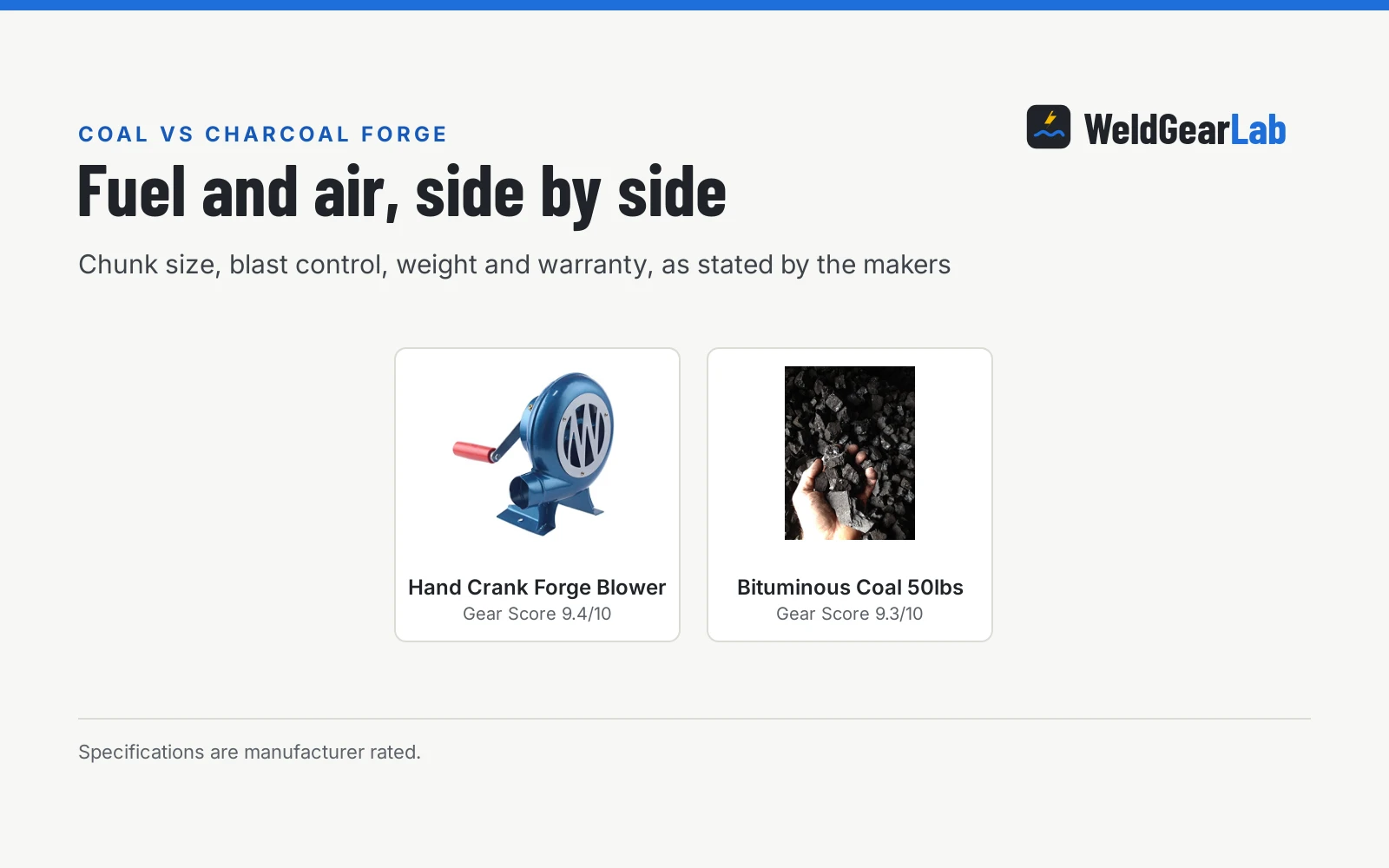
| Model | Gear Score | Side | Type | Weight | Warranty |
|---|---|---|---|---|---|
| Hand Crank Forge Blower | 9.4/10 | Coal forge | Hand crank blower | 2.87 pounds | Not stated |
| Bituminous Coal 50lbs | 9.3/10 | Coal forge | Bituminous coal fuel | 50.0 pounds | Not stated |
Specifications are manufacturer rated, as published by each maker and collected 21 November 2026. Neither example states a warranty term or a safety certification.
Choosing between coal forge vs charcoal forge
The coal forge side is covered here by fuel and air examples. The Bituminous Coal 50lbs example supplies bituminous blacksmith coal crushed into 1-3″ chunks, and the Hand Crank Forge Blower example supplies hand controlled air stated for coal forges. Together they describe the running side of a coal forge setup, while the forge body itself is not part of either example. The charcoal forge side has no fuel example and no forge example here. The blower example is also stated for charcoal grills, which covers air supply for a charcoal grill, but charcoal fuel type, chunk size and forge build are Not stated in these listings.
Fuel
Fuel is where the sides split. The Bituminous Coal 50lbs example is coal fuel in a 50lbs bag, crushed into 1-3″ chunks, and the maker states it can also be used in coal stoves and furnaces. That stated chunk range matters at the forge, since chunk size sets how the fire bed packs around the work. No charcoal fuel example is included, so charcoal chunk size, bag weight and burn behavior are Not stated here and cannot be scored against the coal example. Treat the coal figures as belonging to the coal example only, never as a general claim about every coal forge.
Air supply
Air supply is the shared ground. The Hand Crank Forge Blower example uses a hand crank to control air amount and timing, and the maker states it for coal forges and charcoal grills. Hand control suits a smith who wants to raise or ease the blast while the steel heats, and it needs no power supply beyond the crank. Air output is Not stated, so blast strength cannot be compared on numbers. An optional hose can be attached for blacksmithing, and the hose is not included, so hose fit needs confirming before the blower is matched to a forge body.
Weight and build
The Hand Crank Forge Blower example weighs 2.87 pounds, with a cast iron gear housing, a thickened steel shell and a cast aluminum handle stated by the maker. That build list describes a hand crank blower, and its stated weight is the weight of the tool itself. The Bituminous Coal 50lbs example weighs 50.0 pounds as a fuel bag, which is a storage and handling figure rather than a build figure. Weight therefore means different things on each card: blower weight for the tool, bag weight for the fuel. Keep those figures with their own examples when planning bench space and coal storage.
What is in the box
The blower example is the blower on its own, with the hose stated as not included. The coal example is the 50lbs bag of bituminous coal crushed into 1-3″ chunks. Neither example includes a forge body, an anvil or tools, so a working forge still needs a forge body matched to the fuel and air supply. For setup background, see our coal forge for beginners guide and our propane vs coal forge comparison.
Warranty
Neither example states a warranty term, so warranty scores nothing for both cards. That leaves the ranking to rest on stated build, stated weight and how clearly each example states its job. The blower example states housing materials and hand control, while the coal example states bag weight and chunk size. Where a figure reads Not stated in this guide, confirm it with the maker before ordering, especially hose fit for the blower and storage plans for a 50.0 pounds fuel bag.
Choose the coal forge if
- You have a forge body and need stated bituminous coal fuel in 1-3″ chunks.
- You want hand controlled air from a crank blower stated for coal forges.
- You can store a 50.0 pounds fuel bag near the forge.
- You can add a hose to the blower, since the hose is not included.
Choose the charcoal forge if
- You accept the blower as the only charcoal-related example here, since it is stated for charcoal grills.
- You already have charcoal fuel sorted, since no charcoal fuel example is included here.
- You accept that charcoal forge build and fuel figures are Not stated in these listings.
- You will confirm forge body and fuel fit with the maker before buying.
Before You Strike an Arc
- Run a forge outdoors or with strong ventilation, with a CO alarm in the space, following CPSC carbon monoxide guidance.
- Keep a fire extinguisher close, clear flammable material from the forge area, and never leave a lit forge unattended.
- Check hose fit on arrival, since the blower hose is not included, and confirm crank movement before the fire is lit.
- Store the coal bag dry and off the floor, and check chunk size against the fire bed before the session starts.
- Wear eye protection and leather gloves for hot work, and keep guards and shop rules in place, following OSHA machine guarding guidance.
FAQ for welders
Is a coal forge or charcoal forge better for beginners?
From these listings, the coal side is easier to judge because fuel and air are both stated: bituminous coal in 1-3″ chunks and a hand crank blower stated for coal forges. The charcoal side has no dedicated listing here, so a beginner choosing charcoal needs fuel and forge figures from the maker before buying.
Can the hand crank blower work with charcoal?
The maker states the blower for coal forges and charcoal grills, with the crank controlling air amount and timing. Air output is Not stated, so confirm blast needs with the maker for your setup.
What chunk size is the bituminous coal?
The maker states the coal is crushed into 1-3″ chunks, with chunk size stated as 1-3 inches, in a 50lbs bag at 50.0 pounds.
Does either example include a forge?
No. The blower example is air supply with the hose not included, and the coal example is fuel only. A forge body is a separate purchase for either side.
Related: our propane vs charcoal forge comparison, our coal forge for beginners guide, and the forges and anvils hub.
Scoring, line by line
Both examples are scored on performance, build, value, safety listing and warranty, with the weights published on our How We Pick page.
| Product | Gear Score | Perf. /35 | Build /25 | Value /25 | Safety /10 | Warranty /5 |
|---|---|---|---|---|---|---|
| Hand Crank Forge Blower | 9.4 | 23 | 20 | 18 | n/a | 0 |
| Bituminous Coal 50lbs | 9.3 | 21 | 15 | 18 | n/a | 0 |
A pick’s weighted total decides where it lands between a 9.2 floor and a 9.8 ceiling, and a bigger total never produces a smaller number. Unpowered items with no stated safety features skip the safety line, and their score comes from the 90 points that are left.