Bi-metal vs Carbide Reciprocating Saw Blade: Which One Should You Buy?
Bi-metal and carbide reciprocating saw blades compared for metal and wood cutting: tooth count, material, life claims and fit, with examples from each side.

On this page
Top picks at a glance
As an Amazon Associate I earn from qualifying purchases.
- 1
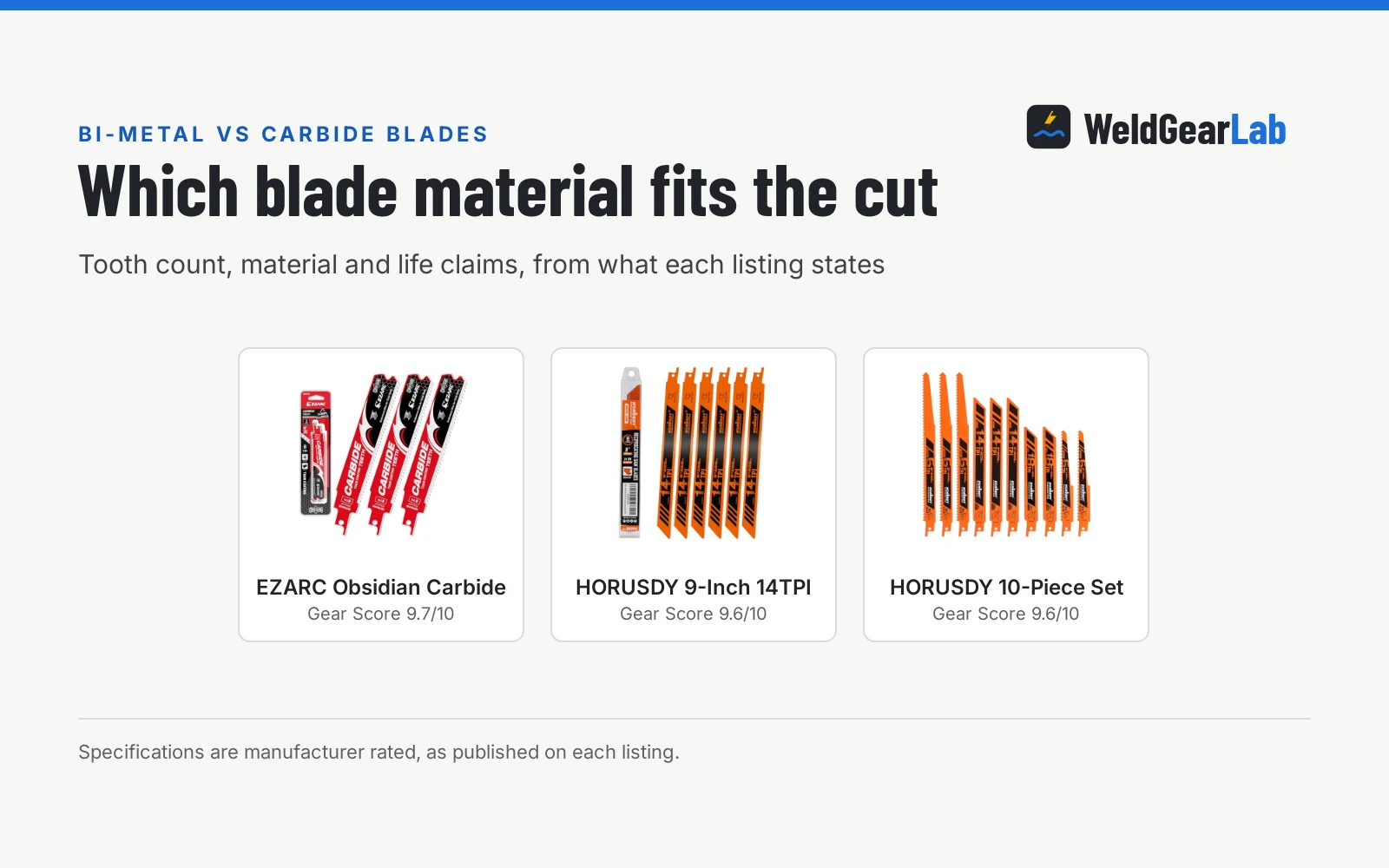
 EZARC Obsidian Carbide Reciprocating Saw Blades 6"9.7/10View on Amazon
- 2
 HORUSDY 6PCS 9-Inch 14TPI Bi-Metal Reciprocating9.6/10View on Amazon
- 3
 HORUSDY 10-Piece Reciprocating Saw Blades Set9.6/10View on Amazon
Verdict. In this bi-metal vs carbide reciprocating saw blade comparison, choose a bi-metal blade if the work mixes wood and metal, or if several blades for different jobs are wanted in one set. Choose a carbide blade if the work is thick metal cutting where the listing claims a much longer blade life, and a single purpose-built blade fits the job.
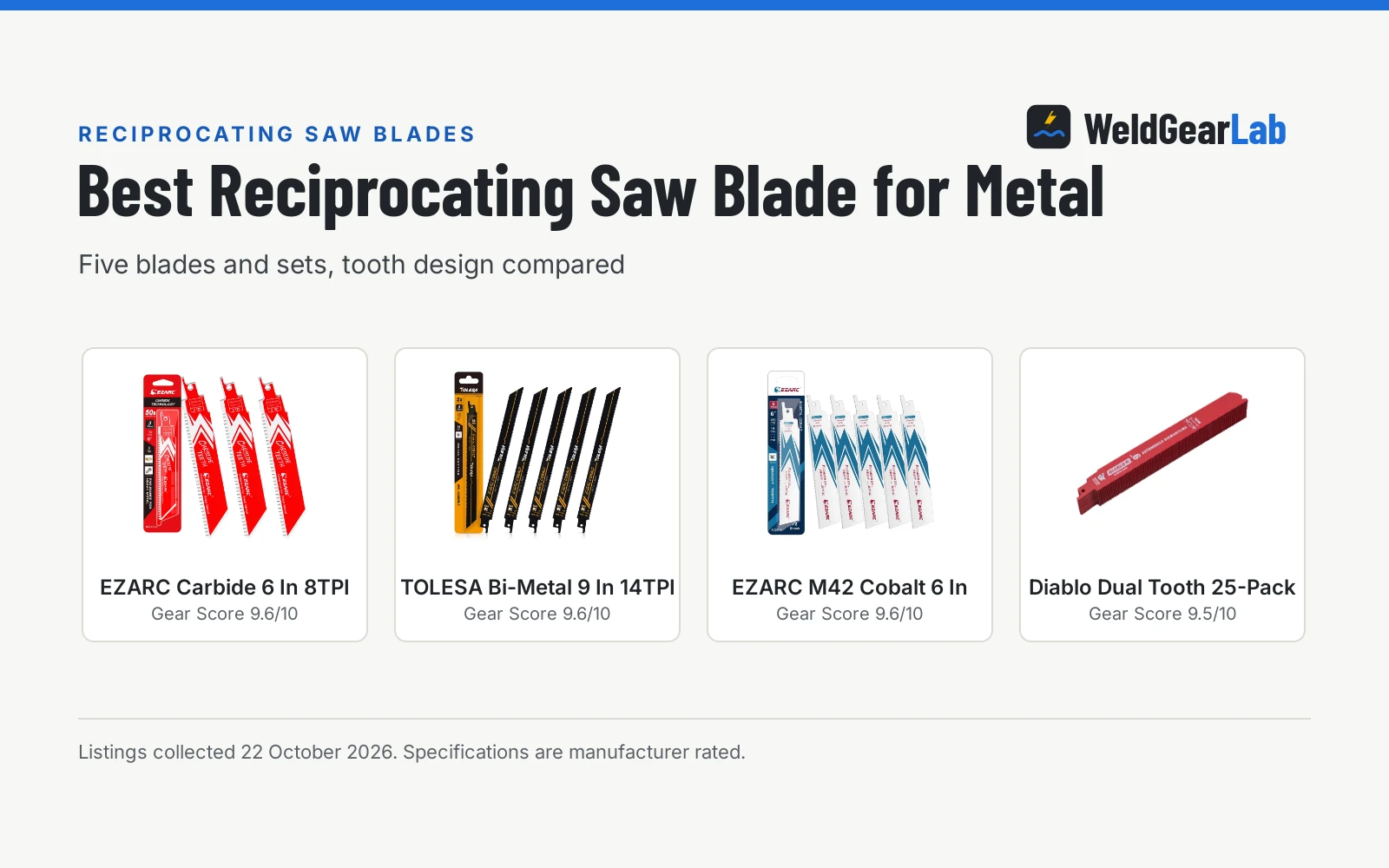
A reciprocating saw blade choice usually starts with a cut: a steel pipe, a length of rebar, a sheet of metal, or a board that needs trimming. Blade material affects how the edge holds up in metal and how long it keeps cutting, while tooth count affects how the blade behaves in the material. This comparison of bi-metal vs carbide reciprocating saw blade options uses the listings as concrete examples, with each figure describing only the listing that states it.
WeldGearLab gets a commission on purchases made through links on this page, and your price stays the same. Read our affiliate disclosure.
The blades
EZARC Obsidian Carbide Reciprocating Saw Blades 6"
A carbide blade with a TiAlN-coated tip and an 8TPI design, stated for thick metal cutting with a claimed longer life.
Pros
- TiAlN-coated carbide tip with an optimized 8TPI tooth design stated
- Stated for stainless steel, rebar and angle iron in thick metal work
- Claimed up to 100X longer life versus standard bi-metal blades
- 1/2-inch universal shank stated to fit major saw brands
Cons
- No warranty term is stated in the listing
- No storage case is stated in the listing
- Only one length is stated: 6-inch
- Life and efficiency claims are the maker's claims, with no measured comparison in the listing
HORUSDY 6PCS 9-Inch 14TPI Bi-Metal Reciprocating
A 6-piece set of 9-inch 14TPI bi-metal blades, stated for steel pipe, rebar and sheet metal.
Pros
- 6 pieces of 9-inch 14TPI bi-metal blades in one set
- Stated for steel pipe, rebar and thick metal sheets
- Standard 1/2-inch shank stated to fit most reciprocating saws
- Sturdy case stated for storage and portability
Cons
- No warranty term is stated in the listing
- Only one length is stated: 9-inch
- Only metal cutting is stated, with no wood blades included
- No life multiple is stated, unlike the carbide example
HORUSDY 10-Piece Reciprocating Saw Blades Set
A 10-piece mixed set with bi-metal metal blades and high carbon steel wood blades, in a plastic storage case.
Pros
- 10 pieces covering wood and metal cutting in one set
- Bi-metal blades for metal and high carbon steel blades for wood stated
- 3x 8-inch 14TPI and 2x 6-inch 18TPI bi-metal blades stated for metal
- Durable plastic storage case stated to keep blades arranged and protected
Cons
- No warranty term is stated in the listing
- No shank figure is stated in the listing
- Wood blade tooth count is stated only as 6TPI for the wood blades as a group
- No life multiple is stated, unlike the carbide example
Other welders and gear to compare
 Milwaukee 12 Piece Multi MaterialCheck price on Amazon
 25 Pack 6 inch 14/18 TPI Bi-Metal Auto Dismantling SawzallCheck price on Amazon
 DEWALT Bi-Metal Reciprocating Saw Blade Multi TPICheck price on Amazon
 EZARC Arc Edge Bi-Metal Reciprocating Saw BladeCheck price on Amazon
 MILWAUKEE'S 9" L Reciprocating Saw BladeCheck price on Amazon
 DEWALT Reciprocating Saw Blade Set for Metal and WoodcuttingCheck price on Amazon
Side by side
| Bi-metal examples | Carbide example | Note | |
|---|---|---|---|
| Material | Bi-metal, plus high carbon steel in the mixed set | TiAlN-coated carbide tip | Material is per listing |
| Lengths stated | 6-inch, 8-inch and 9-inch | 6-inch | Lengths are per listing |
| Tooth count | 14TPI and 18TPI for metal, 6TPI for wood | 8TPI for thick metal | Tooth count is per listing |
| Stated cutting range | Steel pipe, rebar, sheet metal, wood, PVC, plastic | Thick metal, 1/8 inch to 1/2 inch | Range is per listing |
| Shank | 1/2-inch stated on one set; not stated on the mixed set | 1/2-inch universal shank stated | Confirm fit where not stated |
| Pack size | 10-piece set and 6-piece set | 3-pack | Pack size is per listing |
| Life claim | Resistance to heat and wear stated, no multiple stated | Up to 100X longer life claimed, versus standard bi-metal | Life claim is the maker’s claim |
| Warranty | Not stated | Not stated | No warranty term is stated on any listing |
Ratings in this table are the makers’ own claims taken from each product page (29 October 2026).
bi-metal vs carbide reciprocating saw blade: tooth count and material
Tooth count and material are the two figures that separate these listings most clearly. The bi-metal examples state 14TPI and 18TPI for metal cutting, with 6TPI wood blades in the mixed set, while the carbide example states 8TPI for thick metal. A higher tooth count is stated for the bi-metal metal blades, and the carbide blade pairs a lower tooth count with a TiAlN-coated carbide tip and an optimized tooth design, stated for stable, heat-resistant performance in demanding thick metal applications. Neither side can be called better on tooth count alone from these listings, because tooth count is stated alongside different materials and different stated uses.
What each side cuts
The stated uses differ by side in a useful way. The bi-metal examples cover a wider range: the mixed set states wood and metal cutting, with bi-metal blades for metal and high carbon steel blades for wood, PVC and plastic, while the 6-piece set states steel pipe, rebar and sheet metal. The carbide example is narrower, focused on thick metal: it states stainless steel, rebar and angle iron, with a stated cutting range of 1/8 inch to 1/2 inch for thick metal. A buyer whose work is mostly thick metal should weigh the carbide example, while a buyer whose work mixes wood and metal should weigh the mixed bi-metal set.
Life and heat claims
Life claims are where the carbide listing makes its strongest case, and where the claims should be read as the maker’s claims. The EZARC listing claims up to 100X longer life compared to standard bi-metal reciprocating saw blades, and over 50% higher cutting efficiency than a standard bi-metal reciprocating blade. The bi-metal listings make no life-multiple claim; instead they state resistance to heat and wear when cutting metal, and a durable material for long-term use. Because only one side states a life multiple, the comparison on life is a claim from one listing against an unstated figure on the other side, not a measured side-by-side result in these listings.
Length, shank and sets
Length and pack size differ across the examples. The bi-metal examples state 6-inch, 8-inch and 9-inch blades, in a 10-piece mixed set and a 6-piece set of 9-inch blades. The carbide example is a 3-pack of 6-inch blades. Shank fit is stated on two listings: the 6-piece bi-metal set states a standard 1/2-inch shank that fits most reciprocating saws, and the carbide example states a 1/2-inch universal shank that fits major saw brands. The mixed set states no shank figure, so shank fit for that set should be confirmed before buying. Storage is stated on both bi-metal listings, with a plastic storage case on the mixed set and a sturdy case on the 6-piece set, while the carbide listing states no case.
Choose a bi-metal blade if
- The work mixes wood and metal in one set of jobs
- Several blade lengths are wanted in one purchase
- Steel pipe, rebar and sheet metal are the main metal work
- A storage case for the set matters
Choose a carbide blade if
- The work is thick metal cutting, including stainless steel and angle iron
- A longer claimed blade life matters more than a mixed set
- A 6-inch blade with a 1/2-inch universal shank fits the saw
- Heat-resistant performance in thick metal is the priority
Before You Strike an Arc
- Confirm the shank fits the saw: a 1/2-inch shank is stated on the 6-piece bi-metal set and the carbide example.
- Match tooth count to the material: 14TPI and 18TPI bi-metal blades are stated for metal, and 6TPI blades are stated for wood in the mixed set.
- Check blade length against the cut: 6-inch, 8-inch and 9-inch lengths are stated across the bi-metal examples, and 6-inch on the carbide example.
- Keep blades in the stated case where one is included, as stated for both bi-metal sets.
FAQ for welders
Is a carbide reciprocating saw blade better than bi-metal?
It depends on the work. The carbide example here claims a much longer life in thick metal, while the bi-metal examples cover a wider range of materials including wood. For thick metal only, the carbide claim is the stronger case in these listings; for mixed work, the bi-metal sets cover more jobs.
What TPI should I use for cutting metal?
In these listings, the bi-metal metal blades state 14TPI and 18TPI, while the carbide thick-metal blade states 8TPI. Match the blade to the material and thickness stated on its listing, rather than choosing a tooth count from another listing.
Do these blades fit any reciprocating saw?
Shank fit is stated on two listings: the 6-piece bi-metal set states a standard 1/2-inch shank that fits most reciprocating saws, and the carbide example states a 1/2-inch universal shank for major saw brands. The mixed set states no shank figure, so confirm fit for that set before buying.
How long does a carbide blade last compared to bi-metal?
The EZARC listing claims up to 100X longer life compared to standard bi-metal reciprocating saw blades. That is the maker’s claim in that listing; the bi-metal listings state resistance to heat and wear but give no life multiple, so no measured comparison figure is available from these listings.
Related: the best reciprocating saw blade for metal, the best reciprocating saw blade for pipe cutting, the bi-metal vs carbide band saw blade and the metal fab tools hub.
Scoring, line by line
Each blade is scored on performance, build, value, safety and warranty, with the weights published on the How We Pick page. A spec the listing does not publish scores nothing, and a warranty scores only where a concrete term is stated. None of these listings states a safety listing or a warranty term, so safety and warranty score nothing across the picks.
| Product | Gear Score | Perf. /35 | Build /25 | Value /25 | Safety /10 | Warranty /5 |
|---|---|---|---|---|---|---|
| EZARC Obsidian Carbide | 9.7 | 32 | 22 | 20 | n/a | 0 |
| HORUSDY 9-Inch 14TPI | 9.6 | 29 | 21 | 21 | n/a | 0 |
| HORUSDY 10-Piece Set | 9.6 | 28 | 20 | 21 | n/a | 0 |
The lowest score we show is 9.2 and the highest is 9.8; every point total is spread proportionally across that span, so extra points mean a higher figure. Safety is only scored for powered machines or when a listing names safety features; otherwise it drops out and the score is worked from the other 90 points.