Best Tool to Measure Hole Diameter (2026)
Five measuring tools for hole diameter, compared on range, resolution and material, from a digital caliper to taper gauges and a drill bit gauge.

On this page
Top picks at a glance
As an Amazon Associate I earn from qualifying purchases.
- 1
 Best OverallSCITOOLS Digital Caliper9.5/10View on Amazon
- 2
 Most Accurate StatedHIPULX Drill Bit Gauge9.5/10View on Amazon
- 3
 Best Taper GaugeMesee Taper Gauge 1-15 mm9.4/10View on Amazon
- 4
 Best for Hole SpacingSpriour Centerline Caliper 10-150 mm9.4/10View on Amazon
A drilled hole is only right when its diameter matches the bit, the bolt or the bore you planned, and guessing by eye wastes stock and time. The best tool to measure hole diameter depends on the hole itself: a caliper reads a bore directly, a taper gauge slides into small holes, and a drill bit gauge sizes bits by fit. This guide compares measuring tools on range, resolution and material, using only what each listing states, so you can match the tool to the holes you drill most.
WeldGearLab gets a commission on purchases made through links on this page, and your price stays the same. Read our affiliate disclosure.
Quick picks
- Best Overall SCITOOLS Digital Caliper: A 0 to 6 inch digital caliper with inside jaws for direct hole readings, 0.01 inch resolution and stated accuracy of plus or minus 0.01 inch. Check price on Amazon
- Most Accurate Stated HIPULX Drill Bit Gauge: 29 holes from 1/16 to 1/2 inch in 1/64 inch steps, with stated accuracy of plus or minus 0.001 inch. Check price on Amazon
- Best Taper Gauge Mesee Taper Gauge 1-15 mm: A stainless taper gauge covering 1 to 15 mm, or 1/32 to 5/8 inch, with etched inch and millimeter marks. Check price on Amazon
- Best for Hole Spacing Spriour Centerline Caliper 10-150 mm: A digital centerline caliper for hole center distance from 10 to 150 mm, with 0.01 mm resolution. Check price on Amazon
The machines
SCITOOLS Digital Caliper 0-6" Measuring Tool
A plastic carbon fiber digital caliper that reads inside diameter, outside diameter, depth and step from 0 to 6 inches, with inch and millimeter conversion and a zero button.
Pros
- Inside jaws read hole diameter directly, plus outside, depth and step
- Resolution of 0.01 inch or 0.1 mm, with stated accuracy of plus or minus 0.01 inch
- Switches between inches and millimeters and sets zero at any point
- Plastic jaws help avoid scratching the work, and the display shuts off after 5 minutes
Cons
- Low hardness plastic body, softer than a steel caliper
- Stated accuracy of plus or minus 0.2 mm suits home use, not high precision work
- No warranty term is stated in the listing
- 9.0 inch overall length is long for a pocket tool
HIPULX Drill Bit Gauge - 29 Hole Precision
A stainless steel plate with 29 holes from 1/16 to 1/2 inch in 1/64 inch steps, for sizing drill bits and bolts by fit, with stated accuracy of plus or minus 0.001 inch.
Pros
- Stated accuracy of plus or minus 0.001 inch, the finest stated accuracy here
- 29 holes cover 1/16 to 1/2 inch in 1/64 inch steps
- Etched fraction and decimal marks, with 0.062 inch shown for 1/16 inch
- Stainless steel plate, 0.15 lb, with a hanging hole for storage
Cons
- Only covers holes from 1/16 to 1/2 inch, so larger holes need another tool
- Sizes by fit, not by a direct digital reading
- No warranty term is stated in the listing
- A flat plate gives no depth reading and no inside jaw for bore work
Mesee Taper Gage 1-15mm Stainless Steel Taper
A stainless steel taper gauge that reads hole diameter from 1 to 15 mm, or 1/32 to 5/8 inch, with etched inch and millimeter marks for bores, holes and gaps.
Pros
- Reads hole diameter directly from 1 to 15 mm
- Inch and millimeter scales on one gauge, 1/32 to 5/8 inch
- Etched marks the maker says will not rub off
- Slim taper reaches into bores and gaps a caliper jaw cannot enter
Cons
- No stated accuracy figure, so the reading rests on the fit of the taper
- Reads one hole at a time by sliding the taper in, slower than a digital caliper
- No case or storage bag is stated in the listing
- No depth reading; it measures diameter at the point where the taper stops
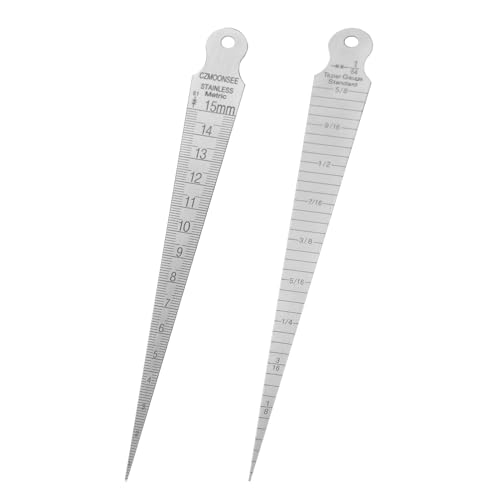
CZMOONSEE 1-15mm Stainless Steel Double Sided
A stainless steel taper gauge from 1 to 15 mm with laser marked inch and millimeter scales, a 2 mm thick body, and a storage bag in the box.
Pros
- Reads inner diameter of cylindrical holes from 1 to 15 mm
- Laser scale with clear marks, in inches and millimeters
- Stainless steel, 2 mm thick, with rust and corrosion resistance stated
- A storage bag is included for carrying
Cons
- No stated accuracy figure
- Same 1 to 15 mm range as the Mesee gauge, so it adds nothing on range
- A single gauge covers only small holes; larger bores need another tool
- A taper reads diameter at one point, so it cannot show whether a bore is out of round
Digital Offset Centerline Caliper Hole Distance
A digital centerline caliper that measures hole center distance from 10 to 150 mm with 0.01 mm resolution, for spacing between holes on the same or offset planes.
Pros
- Resolution of 0.01 mm, or 0.0005 inch, the finest digital resolution here
- Measures center distance between holes on the same or offset planes
- Stainless steel body with a clear digital display
- Buttons for on and off, zero setting and inch or millimeter conversion
Cons
- Measures center distance, not hole diameter, so it answers a different question
- Range starts at 10 mm, so close hole pairs under 10 mm are out of reach
- The listing states resolution but no accuracy figure
- Cone probes are made for center distance, so they do not read bore diameter
Spec sheet comparison
| Model | Gear Score | Range | Resolution or accuracy | Material | Type | Warranty |
|---|---|---|---|---|---|---|
| SCITOOLS Digital Caliper | 9.5/10 | 0 to 6 in | 0.01 in, ±0.01 in | Plastic carbon fiber | Digital caliper | None stated |
| HIPULX Drill Bit Gauge | 9.5/10 | 1/16 to 1/2 in | ±0.001 in | Stainless steel | Hole gauge plate | None stated |
| Mesee Taper Gauge 1-15 mm | 9.4/10 | 1 to 15 mm | Not stated | Stainless steel | Taper gauge | None stated |
| CZMOONSEE Taper Gauge 1-15 mm | 9.4/10 | 1 to 15 mm | Not stated | Stainless steel | Taper gauge | None stated |
| Spriour Centerline Caliper 10-150 mm | 9.4/10 | 10 to 150 mm | 0.01 mm resolution | Stainless steel | Centerline caliper | None stated |
These numbers are the manufacturer’s ratings exactly as each listing gives them, recorded on 22 November 2026.
Buying guide: choosing the best tool to measure hole diameter
Range first
Match the range to your holes. The digital caliper covers 0 to 6 inches, the taper gauges cover 1 to 15 mm, the drill bit gauge covers 1/16 to 1/2 inch, and the centerline caliper covers 10 to 150 mm. A tool that stops short of your largest hole leaves you guessing, and a tool that starts past your smallest hole cannot read it at all.
Resolution and stated accuracy
Resolution is the smallest step a tool can show. The SCITOOLS caliper shows 0.01 inch or 0.1 mm, the Spriour centerline caliper shows 0.01 mm or 0.0005 inch, and the HIPULX gauge states accuracy of plus or minus 0.001 inch. The two taper gauges state no accuracy figure, so their reading rests on the fit of the taper in the hole.
Direct reading or sizing by fit
A caliper and a taper gauge read the hole itself. A drill bit gauge works the other way: you find the hole that a bit or bolt fits, and the etched mark gives the size. Sizing by fit is fast for sorting bits, but for a bored hole you want a tool that reads the bore directly.
Material and marks
All but one of the tools here are stainless steel, which resists rust and holds etched or laser marks. The digital caliper is plastic carbon fiber, which will not scratch the work but is softer than steel. Etched marks stay readable after years of shop use, and the HIPULX gauge adds decimal marks beside the fractions, so 1/16 inch reads as 0.062 inch.
Inches and millimeters
Every tool here lists both inch and millimeter scales, so you can work in either unit without converting. The digital calipers switch units with a button, and the taper gauges carry both scales on the same blade.
Use as directed. Wear eye and face protection when you drill or grind, clamp the work before you measure or cut, keep gloves away from rotating parts, and keep guards in place. Measure a hole after the bit stops, and keep fingers clear of sharp edges on gauges and plates.
Before You Strike an Arc
- Check the zero on a digital caliper before you read a bore, and wipe the jaws clean of chips first.
- Match the tool to the hole: a taper gauge for small bores, a caliper for larger bores, a drill bit gauge for bits and bolts.
- Read the scale where the hole edge meets the taper, not where the gauge enters.
- Confirm the unit on the display, inches or millimeters, before you write the number down.
- Store gauges in the bag or on a hook so the marks stay legible.
FAQ for welders
What is the best tool to measure hole diameter?
A digital caliper with inside jaws is the most direct choice for most shop holes, because it reads the bore itself. The SCITOOLS caliper here reads from 0 to 6 inches with inside jaws, outside jaws, depth and step. For small bores, a taper gauge from 1 to 15 mm reads the hole directly without batteries.
How do you read a taper gauge?
Slide the taper into the bore until it stops, then read the diameter where the hole edge meets the scale. Both taper gauges here carry inch and millimeter scales, from 1 to 15 mm or 1/32 to 5/8 inch. The reading rests on a snug fit, so keep the gauge straight and the hole clean.
Can a drill bit gauge measure a drilled hole?
Not directly. A drill bit gauge sizes bits and bolts by fit, through 29 holes from 1/16 to 1/2 inch in 1/64 inch steps. To measure the hole itself, use a caliper with inside jaws or a taper gauge, and use the drill bit gauge to confirm the bit that cut it.
What resolution do I need for hole diameter?
It depends on the fit you need. The SCITOOLS caliper resolves 0.01 inch or 0.1 mm, the Spriour centerline caliper resolves 0.01 mm or 0.0005 inch, and the HIPULX gauge states accuracy of plus or minus 0.001 inch. Where a listing states no accuracy figure, treat the reading as a shop check rather than a precise figure.
Do these tools read in inches and millimeters?
Yes. Every tool here lists both scales: the digital calipers switch units with a button, and the taper gauges and the drill bit gauge carry inch and millimeter marks on the same tool. Pick the unit your drawings use and leave the tool set to it.
Related: blacksmithing, best measuring gauges for metalworking, best bore gauge, best telescoping bore gauge set, and best manual caliper. Also see our precision measuring hub.
Scoring, line by line
Each tool earns a Gear Score from performance, build, value, safety listing and warranty, with the weights explained in How we pick. Measuring tools carry no electrical safety listing, so every tool here scores zero on that criterion, and no listing states a warranty term, so every tool scores zero on warranty as well. The ranking comes from performance, build and value: range, resolution, material and how directly each tool reads a hole.
| Product | Gear Score | Perf. /35 | Build /25 | Value /25 | Safety /10 | Warranty /5 |
|---|---|---|---|---|---|---|
| SCITOOLS Digital Caliper | 9.5 | 30 | 21 | 21 | 0 | 0 |
| HIPULX Drill Bit Gauge | 9.5 | 29 | 22 | 20 | 0 | 0 |
| Mesee Taper Gauge 1-15 mm | 9.4 | 28 | 21 | 20 | 0 | 0 |
| CZMOONSEE Taper Gauge 1-15 mm | 9.4 | 27 | 21 | 20 | 0 | 0 |
| Spriour Centerline Caliper 10-150 mm | 9.4 | 26 | 21 | 19 | 0 | 0 |
Displayed scores fall between 9.2 and 9.8: the weighted point total is mapped onto that band in a straight line, so earning more points always lifts the score.