Best 6011 Welding Rod for Pipe Welding (2026): 4 Picks
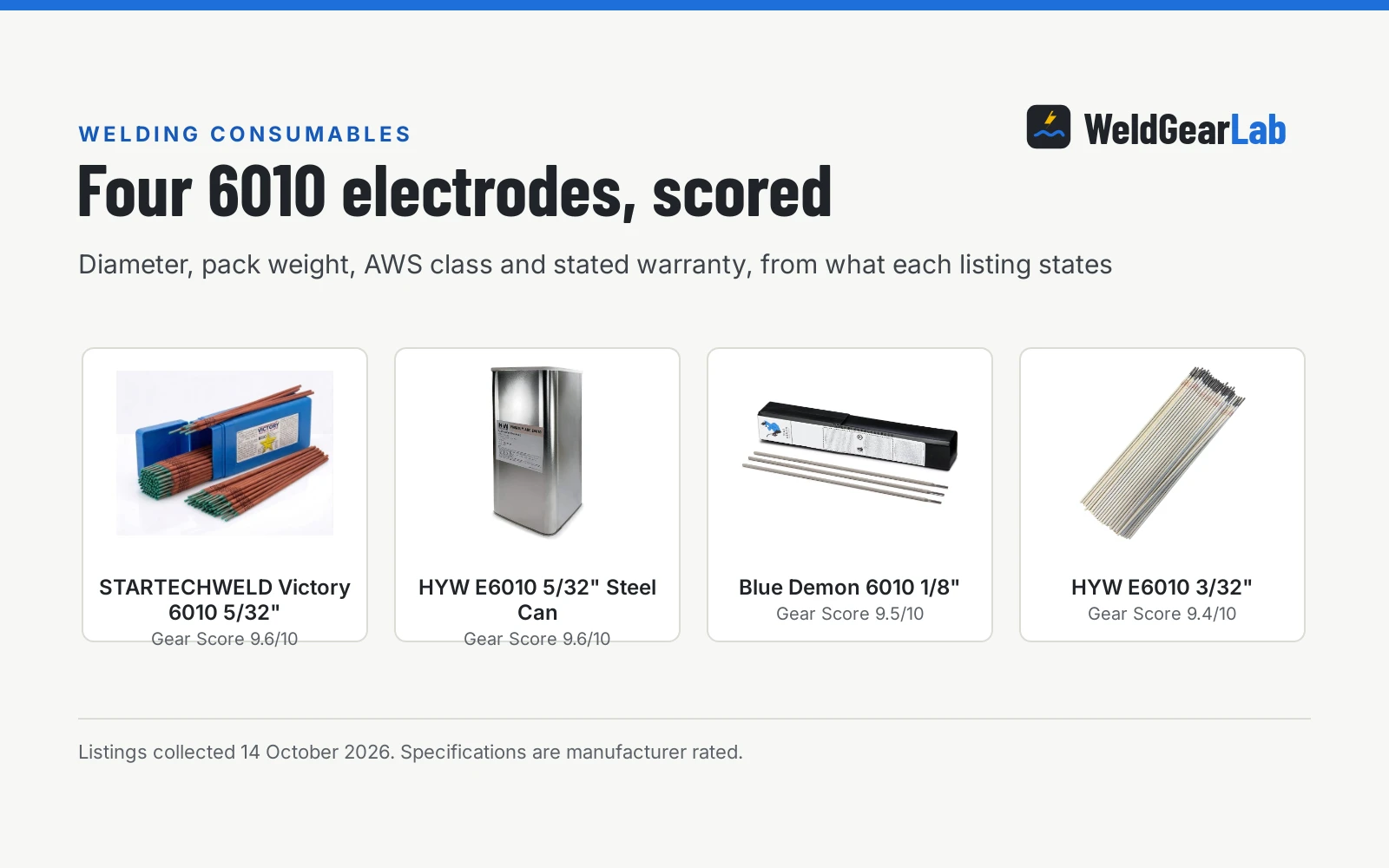
Four 6011 welding rods for pipe welding compared: 5/32 in shop packs, a 1/8 in repair pack and a 3/32 in thin rod, ranked by Gear Score.

On this page
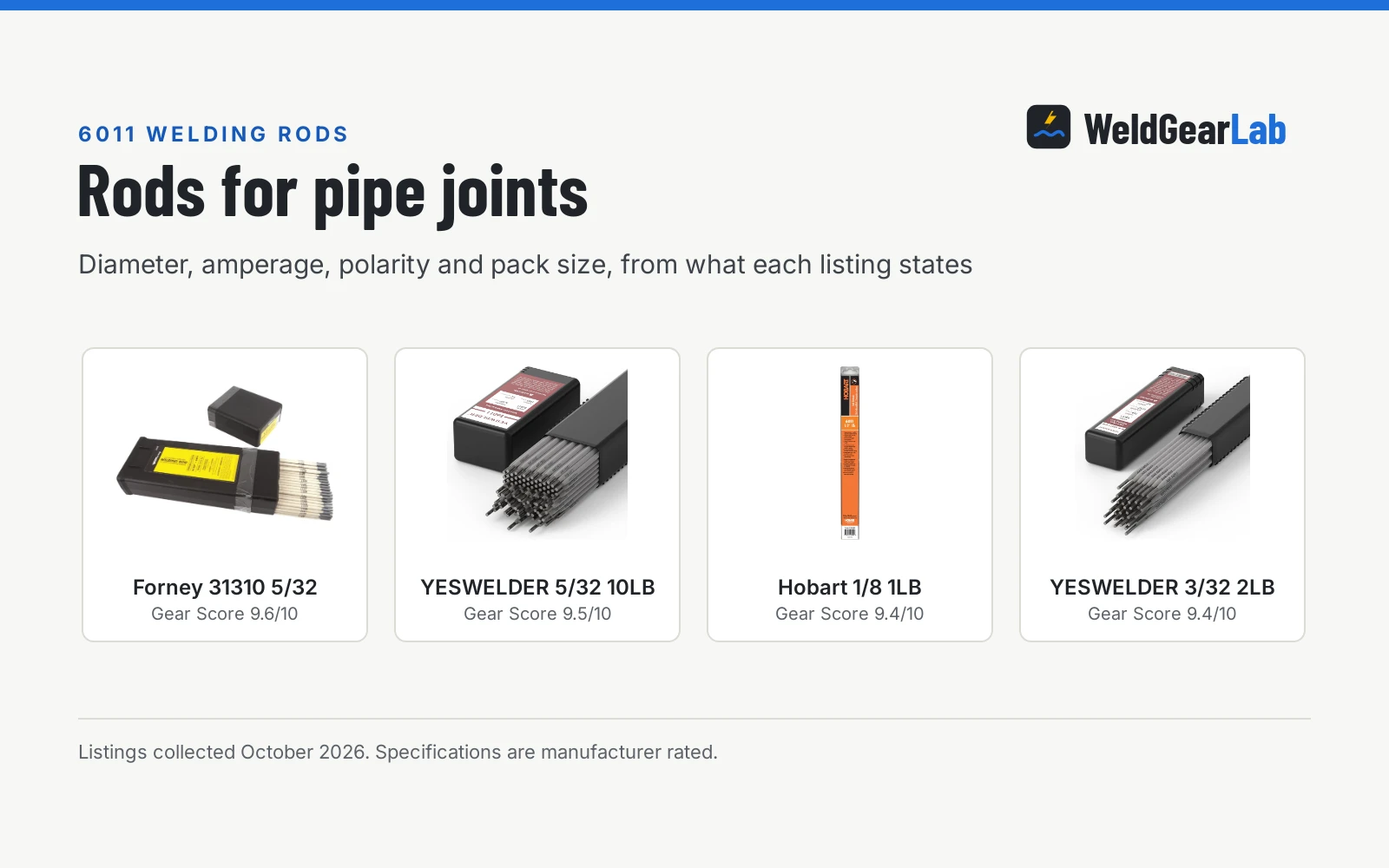
Top picks at a glance
As an Amazon Associate I earn from qualifying purchases.
- 1
 Best OverallForney 31310 5/329.6/10View on Amazon
- 2
 Best for Pipe WorkYESWELDER 5/32 10LB9.5/10View on Amazon
- 3
 Best Small PackHobart 1/8 1LB9.4/10View on Amazon
- 4
 Best Thin RodYESWELDER 3/32 2LB9.4/10View on Amazon
A pipe joint with a gap in it, rust on the outside and not much room to grind. That is the job the 6011 rod was made for: deep penetration, fast freezing, and an arc that burns through dirty metal. The best 6011 welding rod for pipe welding is an all-position rod that runs on your machine’s polarity and comes in the diameter your joint needs. We compared four 6011 listings on what each one states: the diameter, the amperage guidance, the polarity and the pack size.
WeldGearLab gets a commission on purchases made through links on this page, and your price stays the same. Read our affiliate disclosure.
Quick picks
- Best Overall Forney 31310 5/32: 5/32 in 10 lb with AC/DC operation and a 90-day warranty Check price on Amazon
- Best for Pipe Work YESWELDER 5/32 10LB: 5/32 in 10 lb at 110 to 170A, lists pressure pipes as an application Check price on Amazon
- Best Small Pack Hobart 1/8 1LB: 1/8 in 1 lb pack for carbon and galvanized steel Check price on Amazon
- Best Thin Rod YESWELDER 3/32 2LB: 3/32 in 2 lb for thinner wall, 110 to 170A Check price on Amazon
The machines
Forney 31310 E6011 Welding Rod, 5/32-Inch
A 5/32 in 10 lb 6011 rod for all-position welding, rated to 170A with 60,000 tensile strength, AC/DC operation and a 90-day warranty.
Pros
- 5/32 in 10 lb pack, the shop-size option
- Runs AC or DC+ per the listing
- 170A amperage capacity with 60,000 tensile strength
- 90-day warranty against manufacturer defects
Cons
- 10 lb is a lot of rod for a single repair
- No recommended amperage range is stated, only capacity
- 10.2 lb shipping weight to haul
- No safety certification is stated

YESWELDER E6011 5/32'' 10LB Welding Rods Stick
A 5/32 in 10 lb 6011 rod with a stated 110A to 170A range and 14 in length, naming pressure pipes among its applications.
Pros
- 5/32 in 10 lb with 14 in rod length stated
- 110A to 170A recommended range, the clearest here
- Pressure pipes named among the applications
- Deep penetration with low spatter per the listing
Cons
- Designed primarily for AC per the listing
- No warranty term is stated
- 10.19 lb to store and haul
- No tensile figure is stated in the listing

Hobart H112244-R01 1-Pound Plastic 6011 Stick
A 1/8 in 1 lb 6011 pack for carbon and galvanized steel, rated 60,000 PSI and running AC or DCEP, sized for single repairs.
Pros
- 1/8 in diameter for thinner work
- 1 lb pack, no leftover rod to store
- 60,000 PSI rating stated
- Runs AC or DCEP
Cons
- 1 lb runs out fast on big jobs; buy two for a fence line
- No amperage range is stated
- No warranty term is stated
- Thin listing with few details

YESWELDER E6011 3/32'' 2LB Welding Rods Stick
A 3/32 in 2 lb 6011 rod with a stated 110A to 170A range and 14 in length for thinner pipe wall and tight joints.
Pros
- 3/32 in diameter for thinner wall and tight joints
- 110A to 170A recommended range stated
- 14 in length stated
- 2 lb pack suits small jobs
Cons
- Designed primarily for AC per the listing
- No warranty term is stated
- No tensile figure is stated in the listing
Other welders and gear to compare
 Forney 31305 E6011 Welding RodCheck price on Amazon
 Victory Welding Alloys 6011 Welding Rod 1/8" E6011 1/82" 5Check price on Amazon
 E6011 3/32" 1/8" 5/32" Stick electrodes welding rod 10 lb 50Check price on Amazon
 E6011 Welding Rod 1/8″Check price on Amazon
 Forney 30301 E6013 Welding RodCheck price on Amazon
Spec sheet comparison
| Model | Gear Score | Diameter | Weight | Amperage | Polarity | Tensile | Warranty |
|---|---|---|---|---|---|---|---|
| Forney 31310 5/32 | 9.6/10 | 5/32 in | 10 lb | 170A capacity | AC or DC+ | 60,000 | 90 day |
| YESWELDER 5/32 10LB | 9.5/10 | 5/32 in | 10 lb | 110A to 170A | Primarily AC | Not stated | Not stated |
| Hobart 1/8 1LB | 9.4/10 | 1/8 in | 1 lb | Not stated | AC or DCEP | 60,000 PSI | Not stated |
| YESWELDER 3/32 2LB | 9.4/10 | 3/32 in | 2 lb | 110A to 170A | Primarily AC | Not stated | Not stated |
Treat the specs as maker ratings pulled straight from the listings; we gathered them on 21 October 2026. A figure from one listing describes that listing only.
Buying guide: best 6011 welding rod for pipe welding
Diameter first. Two of these are 5/32 in: the Forney and the larger YESWELDER are 5/32 in 10 lb packs, the Hobart is 1/8 in in a 1 lb pack, and the smaller YESWELDER is 3/32 in in a 2 lb pack. Thicker rod carries more metal per pass; thinner rod suits thinner wall and tighter joints. The listings state recommended amperages of 110A to 170A on the YESWELDER pair and an amperage capacity of 170A on the Forney.
Polarity next, because it decides whether the rod runs on your machine. The Forney runs AC or DC+, the Hobart runs AC or DCEP, and the YESWELDER listings describe the rod as designed primarily for AC power sources. Check the listing’s polarity against your machine before you buy.
Pipe welding is the use case, and one listing names it: the YESWELDER 5/32 in listing includes pressure pipes among its applications. The Forney listing aims at maintenance and repair on galvanized, rusty and oily steel with minimal surface preparation, which describes most farm pipe work. The Hobart names carbon and galvanized steel with a 60,000 PSI rating.
Pack size is the value question. The 10 lb packs suit a season of pipe work; the Hobart 1 lb pack suits a single repair without storing open rod. The smaller YESWELDER listing has a wrinkle worth flagging: the title says 2 lb while the spec table says 1 pound. Per our rule we trust the title and bullets, so 2 lb.
Storage is the quiet spec. The Forney and YESWELDER 10 lb packs are a season of work; once opened, rod picks up moisture, and damp 6011 runs rough. The Hobart 1 lb pack and the YESWELDER 2 lb pack sidestep the problem by being small enough to finish. Buy the pack you will burn through, not the pack that looks like a deal.
Tensile ratings are stated on two of these: 60,000 on the Forney and 60,000 PSI on the Hobart. The YESWELDER pair states no tensile figure, which is a gap, not a demerit; the rod class defines the baseline. What separates them in the listings is amperage guidance: the YESWELDER pair gives a 110A to 170A range, the Forney gives a 170A capacity, and the Hobart gives nothing. A stated range beats a stated maximum when you are dialing in.
Do not overthink the brand. All four listings describe the same rod class: mild steel, all-position, deep penetration, fast freezing. The differences that matter are the ones with numbers attached: diameter, amperage guidance, polarity and pack weight. Everything else is packaging.
Read the thin listings twice. The Hobart listing is the sparsest here: diameter, weight, polarity, a 60,000 PSI rating and not much else. That is enough for a 1 lb repair pack, but it means you are buying the brand name as much as the spec sheet. The YESWELDER listings are the most detailed, with amperage ranges, lengths and application lists; the Forney sits between them with capacity, tensile and polarity stated.
Length is a small detail the listings do state: both YESWELDER listings give a 14 in rod length. The Forney and Hobart listings state no length. Fourteen inches is the standard stick length, so the omission costs nothing, but stated beats unstated when you are comparing.
One more honest note: 6011 is not the prettiest rod. The listings promise deep penetration and fast freezing, not smooth beads; the Forney mentions flatter contour fillets and fast deposition, but none of these promises a show weld. For pipe that holds pressure, penetration and fusion matter more than looks, and that is the trade 6011 makes.
When in doubt, buy the diameter you already know how to run. A familiar 5/32 in rod on a joint you have welded before beats a new 3/32 in rod on a joint you have not.
Before You Strike an Arc
- Power supply: the Forney runs AC or DC+, the Hobart AC or DCEP, the YESWELDER pair primarily AC. Match the rod to the machine you own.
- Rod condition: 6011 is forgiving of dirty metal, but damp rod is not; store opened packs dry.
- Fit-up: the fast-freezing puddle suits gapped pipe joints, but tack the joint square first.
- What to check on arrival: diameter and weight against the listing, especially the 3/32 in YESWELDER where the title and spec table disagree.
FAQ for welders
Is 6011 good for pipe welding?
These listings say yes in their own words: all-position welding with deep penetration and fast freezing on dirty, rusty and painted materials. The YESWELDER 5/32 in listing names pressure pipes as an application, and the Forney aims at maintenance and repair on galvanized and rusty steel.
What diameter 6011 rod should I use?
These listings offer 5/32 in, 1/8 in and 3/32 in. The YESWELDER pair recommends 110A to 170A; the Forney lists a 170A amperage capacity. Match the diameter to the wall thickness and the joint, and stay inside the listing’s amperage figures.
Can 6011 run on AC?
Yes. The Forney runs AC or DC+, the Hobart AC or DCEP, and the YESWELDER listings describe the rod as designed primarily for AC power sources. That AC-first design is why 6011 is the classic farm rod: it runs on the buzz box in the barn.
Does 6011 work on rusty or galvanized pipe?
The Forney listing calls it excellent for galvanized steel and rusty or oily steel with minimal surface preparation. The Hobart names carbon and galvanized steel. Weld galvanized with ventilation and a respirator, and grind back to bright metal where you can.
How much rod do I need?
The Forney and larger YESWELDER come in 10 lb packs for ongoing work; the Hobart is a 1 lb pack and the smaller YESWELDER 2 lb for small jobs. Buy the pack that matches the job, not the shelf, and store opened rod dry.
Related: stick welder vs MIG welder for truck repairs, welding blanket vs fire blanket and brazing rods vs welding rods.
Scoring, line by line
Each rod is scored on performance, build, value, safety and warranty, with the weights published on our How We Pick page. None of these listings states a safety certification, so none earns safety points. Only the Forney states a warranty term, a 90-day warranty against manufacturer defects.
| Product | Gear Score | Perf. /35 | Build /25 | Value /25 | Safety /10 | Warranty /5 |
|---|---|---|---|---|---|---|
| Forney 31310 5/32 | 9.6 | 32 | 21 | 21 | 0 | 2 |
| YESWELDER 5/32 10LB | 9.5 | 32 | 21 | 21 | 0 | 0 |
| Hobart 1/8 1LB | 9.4 | 28 | 20 | 20 | 0 | 0 |
| YESWELDER 3/32 2LB | 9.4 | 28 | 20 | 20 | 0 | 0 |
Think of 9.2 as the bottom and 9.8 as the top. Totals are placed between them in proportion, which keeps the order intact: more points, higher score.