Brazing Rods vs Welding Rods (2026)
Brazing rods vs welding rods: four brazing rods compared by alloy, working temperature, rod size and pack, with guidance on when to braze and when to weld.

On this page
Top picks at a glance
As an Amazon Associate I earn from qualifying purchases.
- 1
 Aluminum Welding Rods Low Temp Flux-Cored Aluminum Brazing9.7/10View on Amazon
- 2
 12 pcs Brazing Rods AWS BCuP-5 15% Silver Solder Phos Copper9.7/10View on Amazon
- 3
 15% Silver Brazing Rods AWS BCuP-5 20 Sticks Silver Solder9.6/10View on Amazon
- 4
 Bernzomatic® Aluminum Brazing and Welding RodsView on Amazon
- 5
 Bernzomatic® Bronze Flux-Coated Brazing and Welding RodsView on Amazon
- 6
 Moxweyeni 40 Pcs Brass Rods 1.5/ 2 mm Brass Brazing RodsView on Amazon
- 7
 All Metal Brazing RodsView on Amazon
- 8
 Brazing RodsView on Amazon
- 9
 20pcs Copper Brazing Rods BCuP-2View on Amazon
Brazing rods vs welding rods comes down to this: brazing joins metal with a filler that melts below the base metal, while welding melts the base metal itself. Brazing rods themselves come in brass and 15% silver phos-copper forms for HVAC, plumbing and repair work.
Other welders and gear to compare
 Bernzomatic® Aluminum Brazing and Welding RodsCheck price on Amazon
 Bernzomatic® Bronze Flux-Coated Brazing and Welding RodsCheck price on Amazon
 Moxweyeni 40 Pcs Brass Rods 1.5/ 2 mm Brass Brazing RodsCheck price on Amazon
 All Metal Brazing RodsCheck price on Amazon
 Brazing RodsCheck price on Amazon
 20pcs Copper Brazing Rods BCuP-2Check price on Amazon
WeldGearLab gets a commission on purchases made through links on this page, and your price stays the same.
Brazing vs welding: the difference
Welding melts the edges of the base metal and fuses them, often with a filler rod of similar alloy. Brazing heats the joint to a lower temperature and flows a filler alloy into the gap by capillary action; the base metal never melts. The silver brazing rods here work between 1193°F and 1472°F, well below steel melting temperatures. Pick brazing for thin copper, dissimilar metals and repairs where warping matters; pick welding for structural joints in steel.
Spec sheet comparison
| Model | Alloy | Working temp | Rod size | Pack | Warranty |
|---|---|---|---|---|---|
| Tandefio 15% Silver | BCuP-5, 15% silver | 1193-1472°F | 0.050 in x 1/8 in x 10 in | 40 rods | Not stated |
| Iswanta 15% Silver | BCuP-5, 15% silver | 1193-1472°F | 0.050 in x 1/8 in x 10 in | 40 sticks | Not stated |
| CADHENA Brass 25-Pack | Brass, Cu 59-61% | 1634-1661°F | 1/16 in x 9.84 in | 25 rods | Not stated |
| Moxweyeni Brass 40-Pack | Brass | 2190°F melting | 1.5 mm x 25 cm | 40 rods | Not stated |
Treat the specs as maker ratings pulled straight from the listings; we gathered them on 21 October 2026.
The gear
Tandefio 15% Silver. 40 flat rods, 0.050 in by 1/8 in by 10 in, AWS BCuP-5 phos copper with 15% silver content (silver 15, Cu 80, P 5). Solidus 1193°F and liquidus 1472°F, self-fluxing on clean copper, flowing into 0.002 in to 0.006 in gaps. The listing states the silver content drops the working temperature below plain copper-phosphorus alloys.
Iswanta 15% Silver. 40 sticks of 15% silver brazing rods, AWS BCuP-5, 0.050 in by 1/8 in by 10 in, for air conditioning, refrigeration and HVAC units. The listing states a 1193°F to 1472°F thermal window with deep capillary penetration for full metal fusion.
CADHENA Brass 25-Pack. 25 brass brazing rods, 1/16 in by 9.84 in, with stated composition Cu 59% to 61%, Si 0.15% to 0.35% and Sn 0.8% to 1.2%. Brazing temperature range 1634 to 1661°F with 130N/mm² tensile strength. The listing warns that copper-zinc alloys are not suitable for argon arc welding and that zinc fumes require ventilation and a mask.
Moxweyeni Brass 40-Pack. 40 brass rods, 1.5 mm diameter by 25 cm (9.85 in) long, stated melting point 2190°F. Framed for craft uses like knife handle pins, model making and hardware pins.
Buying guide: brazing rods vs welding rods
When brazing wins
Braze when the base metal must not melt: thin-wall copper lines, refrigeration coils and dissimilar metals. The Tandefio listing notes thin-wall copper stays protected from warp, scale and heat damage. Silver BCuP-5 is self-fluxing on clean copper, so no extra paste is needed for copper-to-copper joints.
Silver vs brass filler
Silver BCuP-5 (Iswanta, Tandefio) works at 1193 to 1472°F with 15% silver for flow and strength in HVAC and refrigeration. Brass rods (Moxweyeni, CADHENA) work hotter: the CADHENA states 1634 to 1661°F with 130N/mm² tensile strength. The CADHENA listing warns to weld in open air or outdoors and wear a mask against zinc gas.
Rod size and form
The silver rods are flat 0.050 in by 1/8 in by 10 in sticks; the CADHENA brass rods are round 1/16 in by 9.84 in; the Moxweyeni rods are 1.5 mm by 25 cm. The Tandefio listing states its rods flow into 0.002 in to 0.006 in gaps, so tight fits are fine. Packs run 25 to 40 rods; the CADHENA ships in a PVC tube against moisture.
Choosing the right rod
Silver alloy vs brass
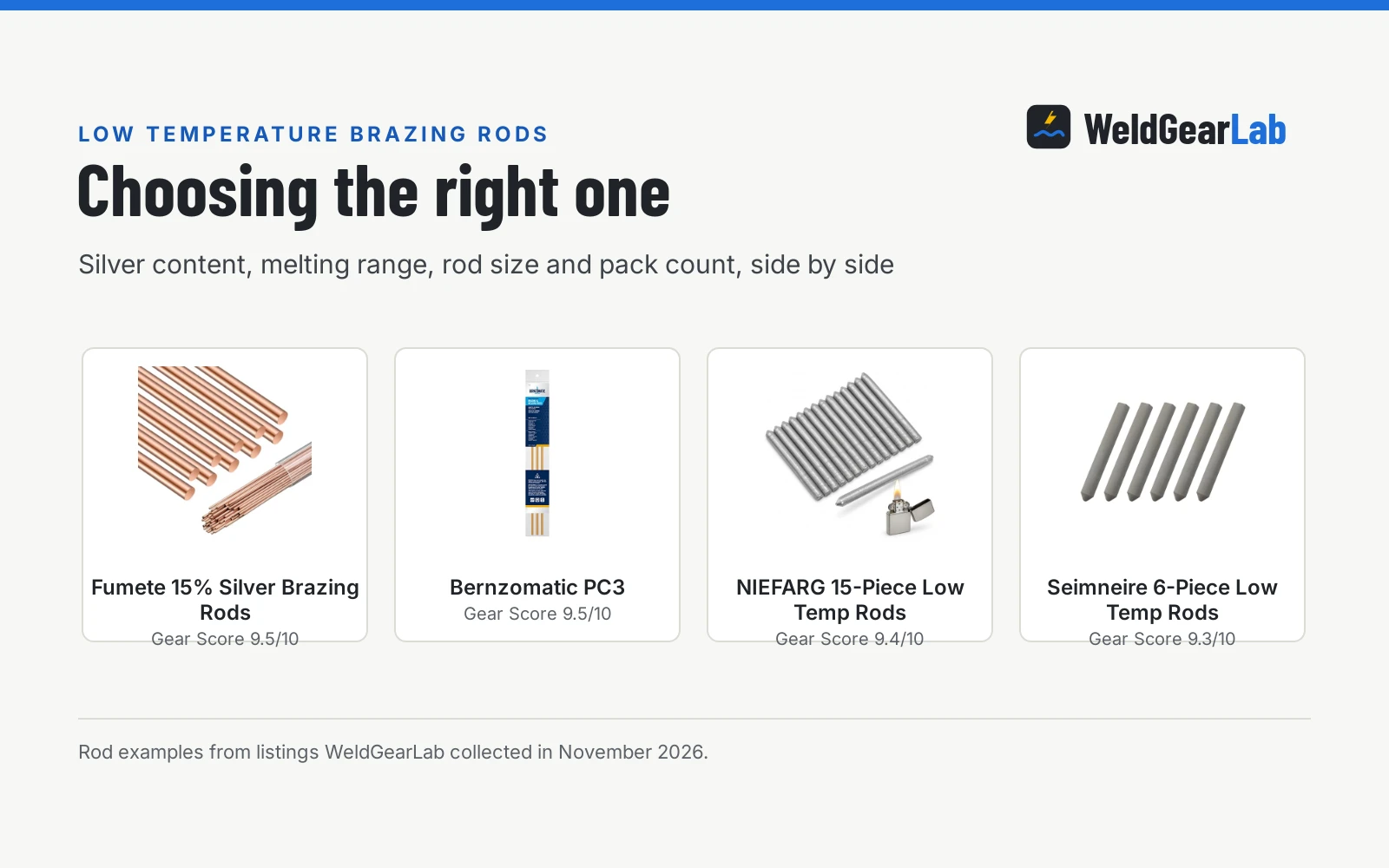
The silver rods here are AWS BCuP-5 with a real 15 percent silver content (silver 15, copper 80, phosphorus 5), sold by Iswanta and Tandefio as 40 flat sticks of 0.050 in by 1/8 in by 10 in. The brass rods are the Moxweyeni (40 rods of 1.5 mm by 25 cm, melting point 2190 degrees Fahrenheit) and the CADHENA (25 rods of 1/16 in by 9.84 in, Cu 59 to 61 percent with tin and silicon). Silver BCuP-5 is listed for HVAC and refrigeration work: the Iswanta listing states deep capillary penetration for full metal fusion, and the Tandefio listing states leak-tight joints. Brass suits copper alloy, carbon steel and alloy steel, plus craft uses like knife handle pins and model work.
Temperature windows
Silver BCuP-5 works at 1193 to 1472 degrees Fahrenheit (solidus 1193, liquidus 1472), which the Tandefio listing notes is well below plain copper-phosphorus alloys. Brass works hotter: the CADHENA states 1634 to 1661 degrees Fahrenheit with 130N/mm squared tensile strength. Lower heat protects thin-wall copper from warp, scale and heat damage, which matters on refrigeration coils and air conditioner line sets.
Flux or no flux
BCuP-5 is self-fluxing on clean copper: no extra paste is needed for copper-to-copper joints. When joining brass or steel, brush on brazing flux first. Before brazing, clean the joint area thoroughly and remove grease, oxides and other contaminants. The Tandefio listing states its rods flow into 0.002 in to 0.006 in gaps, so a tight, clean fit is the best prep you can do.
Ventilation and storage
The CADHENA listing warns against zinc fumes: weld in an open place or outdoors and wear a protective mask. Storage matters too: the CADHENA ships 25 rods in a PVC tube that reduces moisture. Rod weights run from 3.84 ounces (CADHENA) to 12.3 ounces (Iswanta), so a bigger pack is also a heavier one to keep dry.
[wgl_safety kind=”welder”]
FAQ for welders
Can I use brazing rods with a torch?
Yes: brazing rods are designed for torch work. Clean the joint first and remove grease and oxides, per the Tandefio listing.
Do silver brazing rods need flux?
On clean copper, no: BCuP-5 is self-fluxing. On brass or steel, the Tandefio listing says to brush on brazing flux first.
Are brazing rods as strong as welds?
The CADHENA listing states 130N/mm² tensile strength for its brass rods. Brazing suits non-structural joints; structural steel joints belong to welding.
Is brazing safe indoors?
Ventilate: the CADHENA listing warns against zinc fumes and says to work outdoors or in an open place with a mask.
Scoring, line by line
The silver BCuP-5 rods lead for stated alloy content and working temperatures; the brass rods follow with composition and tensile data where stated. All four listings are silent on warranty and certification, so none is counted.
| Product | Gear Score | Perf. /35 | Build /25 | Value /25 | Safety /10 | Warranty /5 |
|---|
Think of 9.2 as the bottom and 9.8 as the top. Totals are placed between them in proportion, which keeps the order intact: more points, higher score.