Bench Grinder Angle Guide: Sharpening Angles Explained
A bench grinder angle guide is the tool rest or jig that holds a blade at one set angle against the wheel, and this guide shows how to set it, check it, and match it to 6-inch and 8-inch bench grinders.

On this page
Top picks at a glance
As an Amazon Associate I earn from qualifying purchases.
- 1
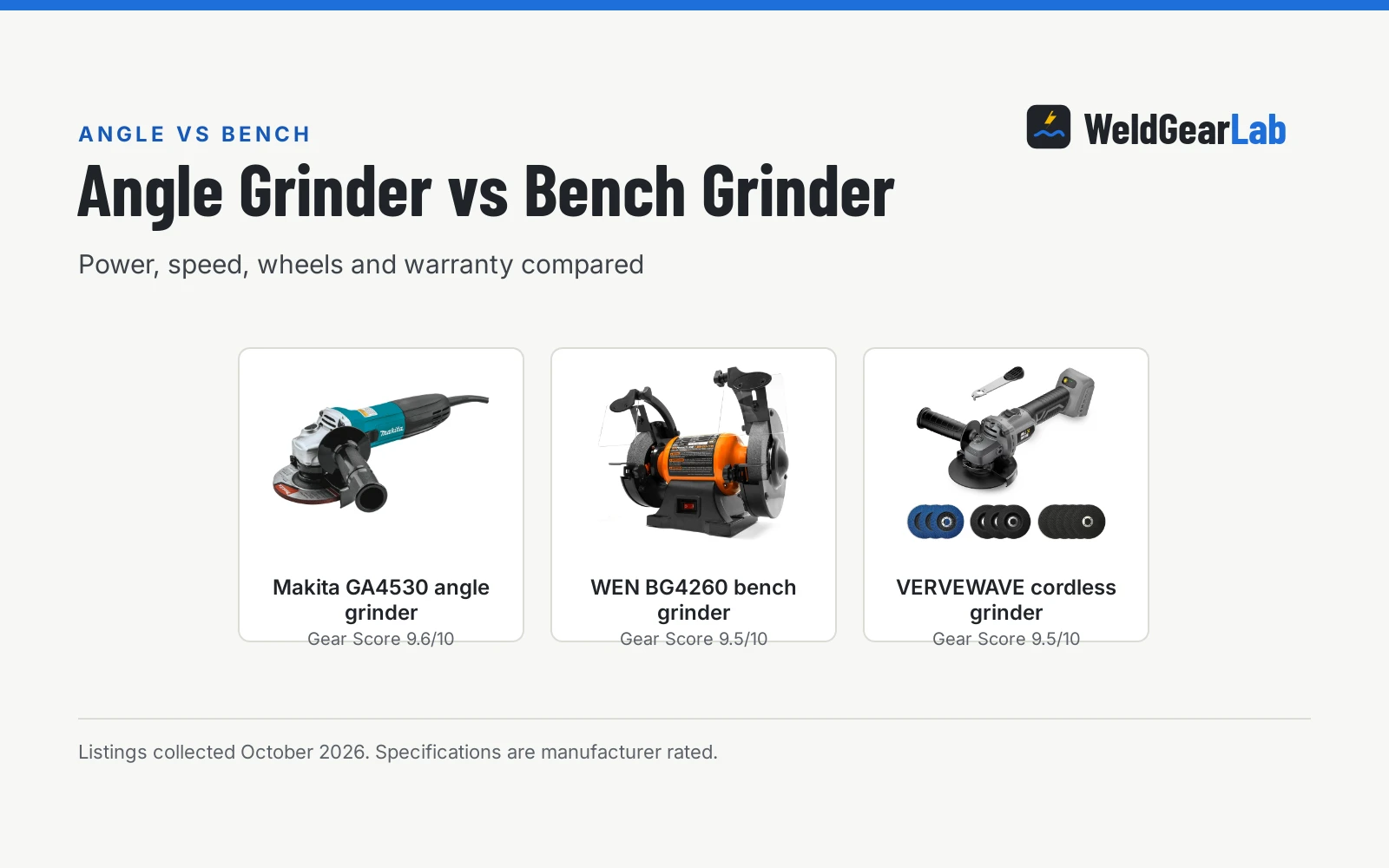
 Makita GA4530 4-1/2" Angle Grinder Corded Power Tools9.6/10View on Amazon
- 2
 WEN BG4260 2.1-Amp 6-Inch Single Speed Bench Grinder9.5/10View on Amazon
- 3
 Cordless Angle Grinder 4-1/2" Compatible with DEWALT 20V MAX9.5/10View on Amazon
A chisel that will not take an edge and a plane iron that tears the grain both often come back to the same thing: the bevel meets the wheel at the wrong angle, or at a different angle on each pass. A bench grinder angle guide is the tool rest or jig that holds the blade at one set angle against the wheel, so every pass grinds the same bevel. This guide explains how that angle gets set, how to check it, and which rest fits the grinder on the bench.
This guide links to our product roundups, where WeldGearLab gets a commission on purchases made through links on this page, and your price stays the same. Read our affiliate disclosure.
What a bench grinder angle guide is
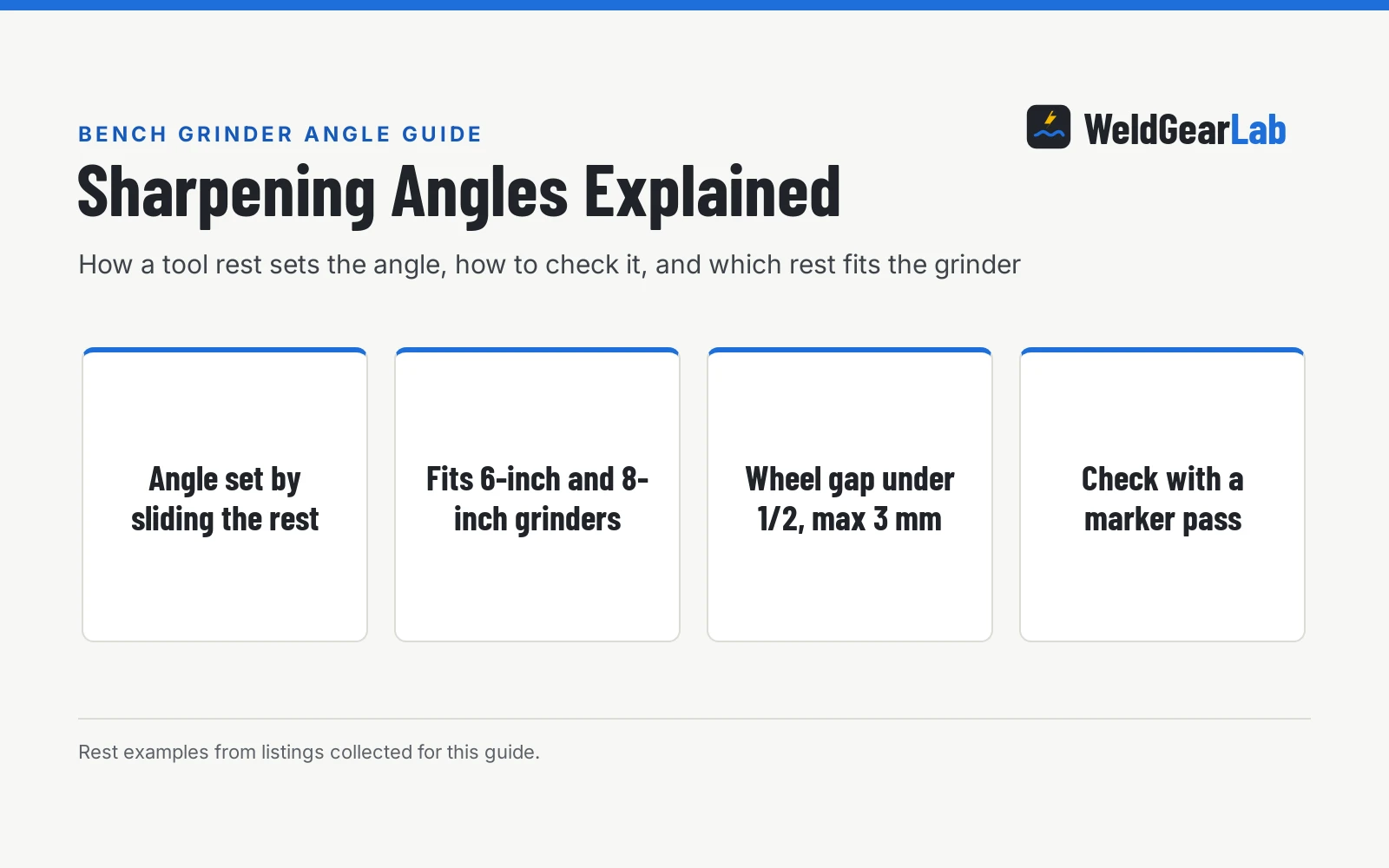
A bench grinder angle guide is a tool rest or sharpening jig that sits in front of the wheel and holds the blade at a fixed angle while the wheel turns. The angle is set by moving the rest: adjustable jigs slide forward and back, and the height of the rest sets how high the blade meets the wheel. A mounting set adds height and depth adjustment, so Tormek and KFMK sharpening jigs (on Amazon) can run on a bench grinder. A factory rest gives less adjustment, which is why the Peachtree jig is sold as a replacement for the factory rest that comes with many bench grinders, and it fits 6-inch and 8-inch bench grinders.
Side by side
| Adjustable sharpening jig | Mounting set for jigs | Replacement tool rest | |
|---|---|---|---|
| Angle adjustment | Slides forward and back to set the angle | Height and depth adjust for the jig angle | Slotted mount sets the rest position |
| Grinder size | 6-inch and 8-inch bench grinders | Fits different bench grinders | 150/200 type grinders |
| Blade width | 0 to 2.5 inches | Knives and woodworking tools | Supports the workpiece |
| Material | Aluminum alloy | Not stated | Carbon steel |
| Mounting | Track base on the bench | Hardware mounts to the grinder | Screws and gaskets included |
| Wheel clearance | Straddles wheels up to 1 inch wide | Not stated | Gap under 1/2 of the workpiece, max 3 mm |
The table above lines up the kinds of rest in the listings. A jig sets the angle by sliding, a mounting set carries a jig, and a replacement rest swaps in for the factory rest. Pick by grinder size and by what the rest must hold.
How to set the angle with a tool rest
Set the angle before the wheel spins, and lock the rest before you grind. The work runs in this order: mount the jig, set the angle, lock the rest, check the gap, and grind with the blade moving across the wheel.
- Mount the jig. The jig mounts to the bench in front of the grinder on a track style base. The Peachtree jig folds out of the way for freehand grinding when the jig is not needed, and it lifts off the track base by loosening the wing knob.
- Set the angle. Slide the rest forward or back until the bevel sits flat on the wheel. The UF-SHARP jig (on Amazon) slides forward or backward to set the angle, and its beveled sliding blade holder guides the blade while it moves.
- Lock the rest. Lock the rest in place before the blade touches the wheel. The Peachtree jig locks with ratcheting handles that move out of the way after locking, so nothing bumps them loose mid-pass.
- Keep the gap. The HARFINGTON rests state the distance between the grinding wheel and the rest should stay less than 1/2 of the smallest outside dimension of the workpiece, with a max of 3 mm. The neeki rests (on Amazon) use a slotted mount to hold the right spacing between the wheel and the rest, so check the gap again after every adjustment.
- Move the blade. Keep the blade moving side to side across the wheel instead of holding it in one spot. The Peachtree plate slides side to side, and the Iontravel jig (on Amazon) has a straight guide rail for left and right movement.
How to check the angle
Color the bevel with a marker, take a light pass on the wheel, and look at where the wheel removes the mark. When the mark comes off the full face of the bevel, the rest holds the angle the tool already has. When the mark comes off only near the edge or only near the heel, move the rest forward or back and take another light pass. A digital angle gauge reads the rest directly and shows whether the rest moved after locking.
The listings for these rests state no angle in degrees, so this guide gives no degree figure. The angle comes from the bevel already on the tool: set the rest until the wheel meets that bevel across its full face, then lock the rest and grind.
Which rest fits your grinder
Match the rest to the grinder size, the wheel width, and the blade width before ordering. The Peachtree, UF-SHARP, and Iontravel jigs state 6-inch and 8-inch bench grinders, and the Peachtree and Iontravel jigs also state use on belt sanders. The JINJUMEI rests (on Amazon) fit 150/200 type grinders.
Wheel width matters as much as grinder size. The Peachtree platform straddles wheels up to 1 inch wide, and the UF-SHARP jig fits grinding wheels 1 inch wide and smaller. Blade width matters too: the Iontravel jig takes blades and chisels from 0 to 2.5 inches wide on its flat miter slide, and the Peachtree plate is offset for short chisels.
Check the build before ordering. The neeki rests are 0.16-inch carbon steel, 5.7 inches long and 3.7 inches high, with a 1.33-inch support platform, and the listing asks the buyer to compare dimensions and mounting slot configuration with the original rest before purchase. The HARFINGTON rests measure 3.66 inches by 5.91 inches by 1.26 inches, with M6 thread on the 7.87-inch rest and M8 thread on the 9.84-inch rest, and each set includes 4 screws and 4 gaskets.
Grinder safety while you sharpen
Wear eye and face protection, clamp the work, keep guards in place, and keep gloves away from rotating parts. The wheel and the rest both sit close to the spin, so loose clothing and gloves have no place near the grinder while it runs.
Lock the rest before the wheel spins, and check the gap after every adjustment: the HARFINGTON rests state the gap should stay less than 1/2 of the smallest outside dimension of the workpiece, with a max of 3 mm. Let the wheel stop before you adjust the rest or change the blade, and keep the work area clear of anything the sparks can reach.
FAQ for welders
What angle should I sharpen a chisel at?
No degree figure is stated in the listings for these rests, so this guide gives none. Match the bevel already on the chisel: color the bevel, take a light pass, and move the rest until the wheel meets the full bevel. The rest holds the angle; the bevel on the tool sets it.
Can a bench grinder angle guide work on a belt sander?
Yes, for the jigs that state it. The Peachtree jig and the Iontravel jig both state use with 6-inch and 8-inch bench grinders and belt sanders. Check the listing for the jig you own before mounting it to a sander.
How close should the tool rest sit to the wheel?
The HARFINGTON rests state the gap should stay less than 1/2 of the smallest outside dimension of the workpiece, with a max of 3 mm. The neeki rests use a slotted mount to hold the right spacing between the wheel and the rest. Check the gap again after every adjustment.
Do I need a jig if my grinder already has a tool rest?
The factory rest holds the work, but it gives less adjustment than a jig. An adjustable jig slides forward and back to set the angle and locks there, so each pass grinds the same bevel. The Peachtree jig is sold as a replacement for the factory rest on many bench grinders.
What size grinder do these angle guides fit?
The Peachtree, UF-SHARP, and Iontravel jigs state 6-inch and 8-inch bench grinders. The JINJUMEI rests state 150/200 type grinders. The neeki rests ask the buyer to compare dimensions and mounting slot configuration with the original rest before purchase.
Related: bench grinder machine parts guide, how to sharpen drill bit edges, how to sharpen band saw blades, and air vs electric die grinder. Also see the bench grinder angle guide section for more metal fab tools.