Air Hammer Tips for Metal Work
Air hammer tips come in flat, pointed, cutting and punch shapes, and every shape suits a different job in the shop.

On this page
Top picks at a glance
As an Amazon Associate I earn from qualifying purchases.
- 1
 Ingersoll Rand 114GCQ EDGE Series 2 5/8" Stroke Air Hammer9.7/10View on Amazon
- 2
 Ingersoll Rand 123MAX 2 5/8" Stroke Long-Barrel Air Hammer9.7/10View on Amazon
- 3
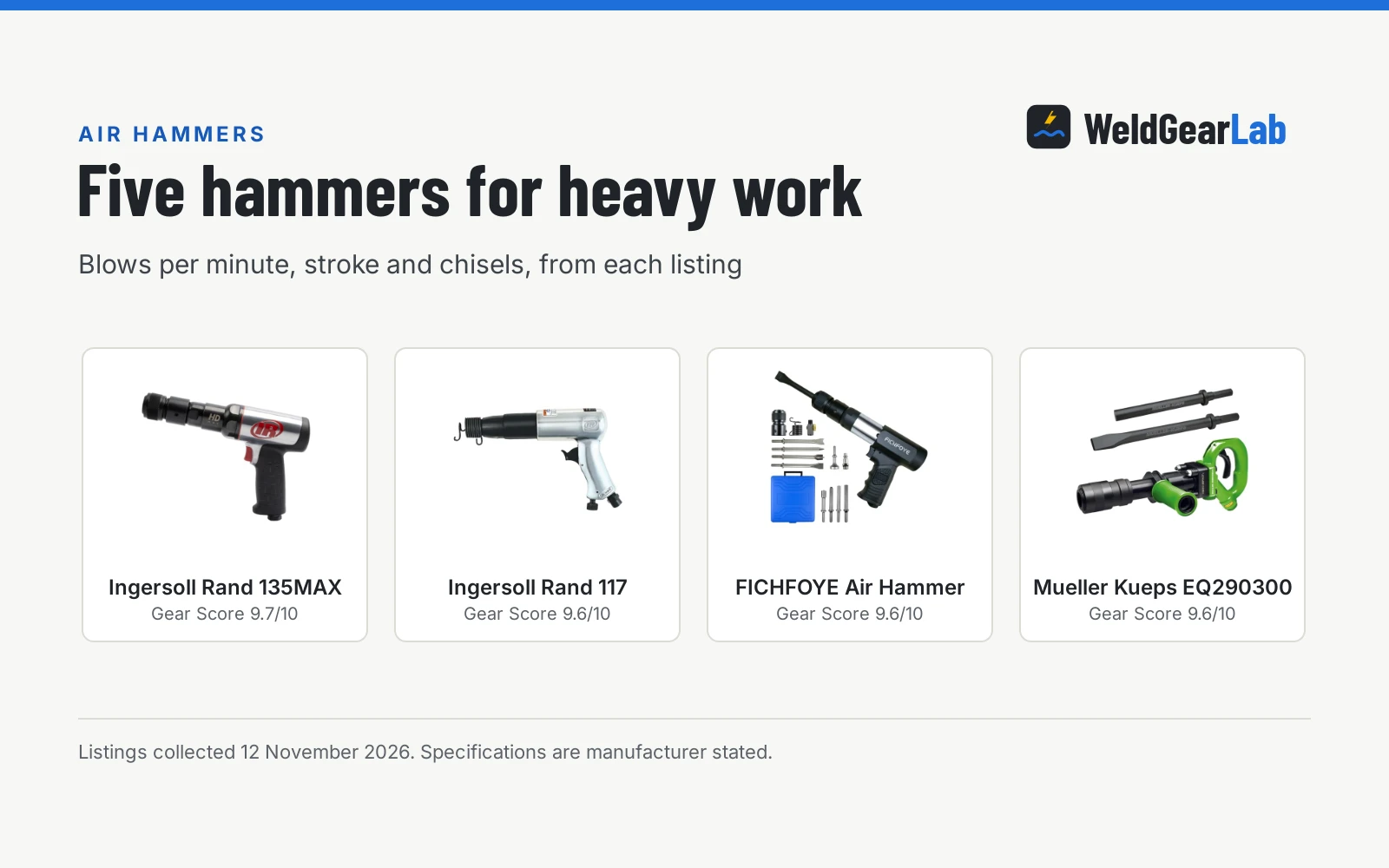
 Ingersoll Rand 135MAX 3" Stroke Long-Barrel Air Hammer9.7/10View on Amazon
A dented fender, a rusted exhaust flange, a spot weld that will not let go: each of these jobs asks the air hammer for a different kind of hit. The tool only does what the chisel on its nose does, so air hammer tips decide whether the work goes fast or turns into a mess. This guide walks through the shapes, the shanks that fit them, and the air they need, using the figures the makers publish.
This guide links to our product roundups, where WeldGearLab gets a commission on purchases made through links on this page, and your price stays the same. Read our affiliate disclosure.
What air hammer tips do
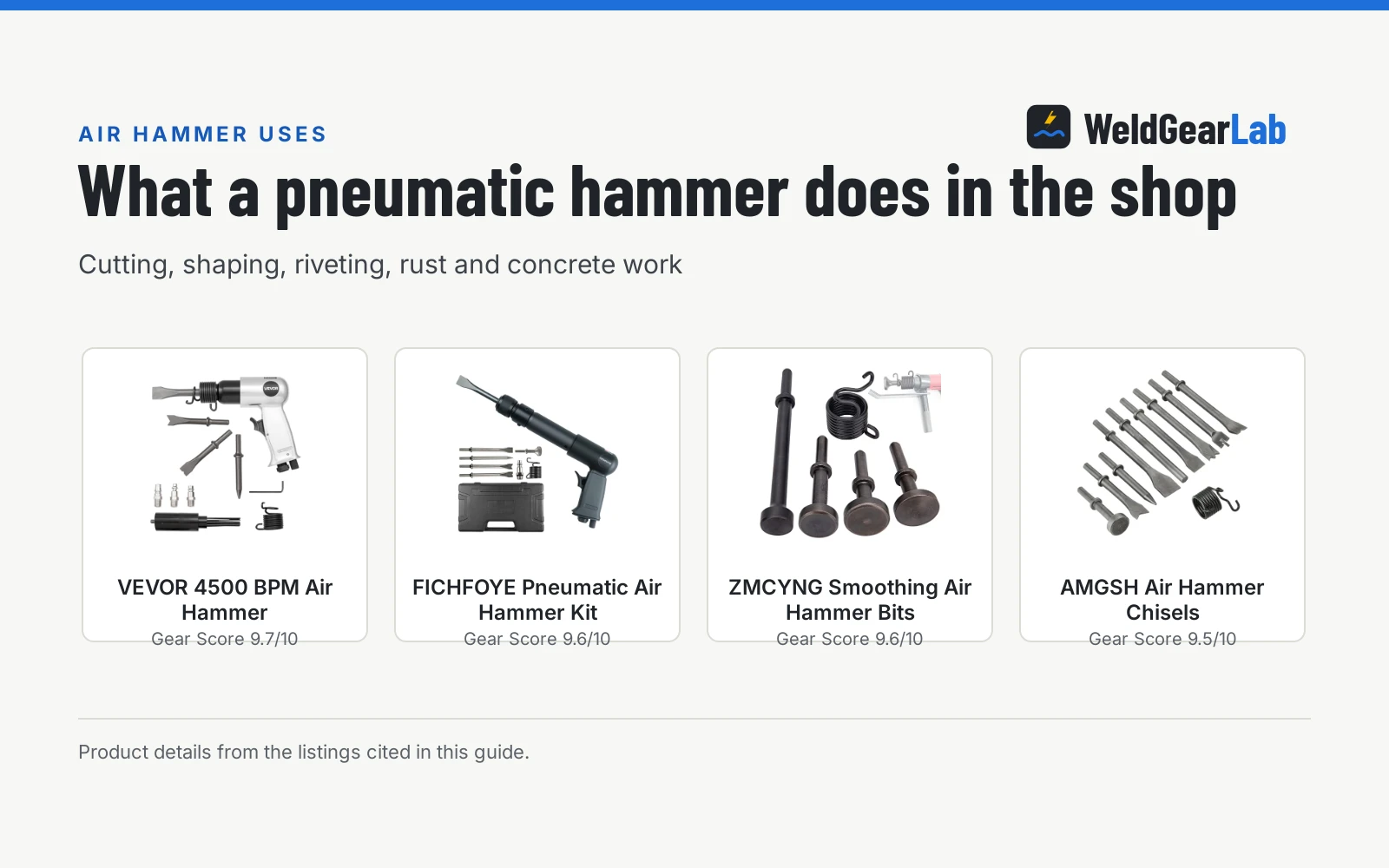
An air hammer drives its chisel forward in fast, short strokes, and the chisel shape turns that motion into cutting, scraping, punching or shaping. A flat chisel spreads the hit across an edge, a pointed chisel concentrates it on a point, and a panel cutter slices sheet metal along a line. The Chicago Pneumatic CP7111 (on Amazon) is rated at 3,000 BPM, and the AMGSH kit (on Amazon) at 4500 BPM, so the same shape can cycle faster or slower depending on the tool behind it.
Side by side
| Flat chisel | Pointed chisel | Panel cutter | Taper punch | |
|---|---|---|---|---|
| Main job | Scraping, splitting and shaping | Breaking hard material | Cutting sheet metal | Driving pins and aligning holes |
| How it hits | Spreads the blow across an edge | Focuses the blow on a point | Slices along a straight line | Pushes through a hole |
| Suits | Rust, scale and weld cleanup | Spot welds and stuck fasteners | Body panels and thin sheet | Exhaust work and pin driving |
| Keep in mind | Keep the edge flat to the work | Start light so the point stays put | Let the cutter track the line | Match the punch to the pin |
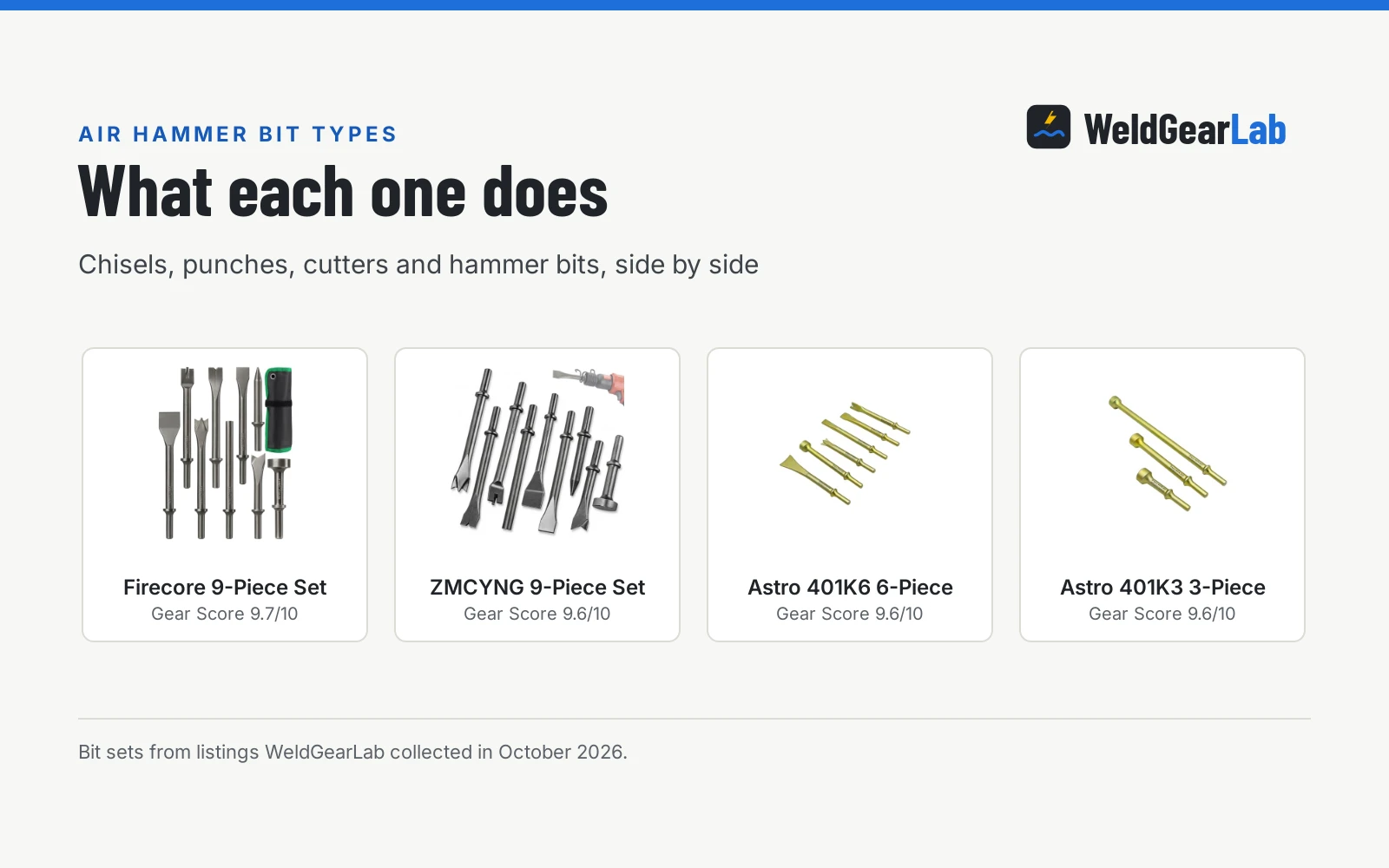
The table above covers four of the shapes the kits in this guide include. Match the shape to the job, then check the shank and the air the hammer needs.
When a flat or cutting chisel is the better choice
- Scraping rust and scale. A flat chisel can lift scale and old gasket material without digging into the metal below when it is kept flat to the surface.
- Cutting sheet metal. A panel cutter follows a line through thin sheet, which suits body panels and patch work.
- Separating spot welds. A spot weld chisel splits the weld so the panel comes free.
- Shaping edges. A flat chisel dresses a rough edge after a cut, ready for fit-up.
The best pneumatic air hammer under 150 roundup covers hammers for this kind of work.
When a punch or pointed chisel is the better choice
- Driving pins. A taper punch pushes a pin out of a hole.
- Breaking hard material. A pointed chisel starts a crack in scale, weld spatter or brittle deposits.
- Loosening fasteners. A pointed chisel can help shock a stuck nut or bolt free where a wrench alone slips.
- Grooving. A V-groove chisel forms a channel for a weld or a seal.
The best auto body hammer and dolly set guide covers hand hammers for panel work when the air hammer stays in the cabinet.
How to tell which shank your hammer takes
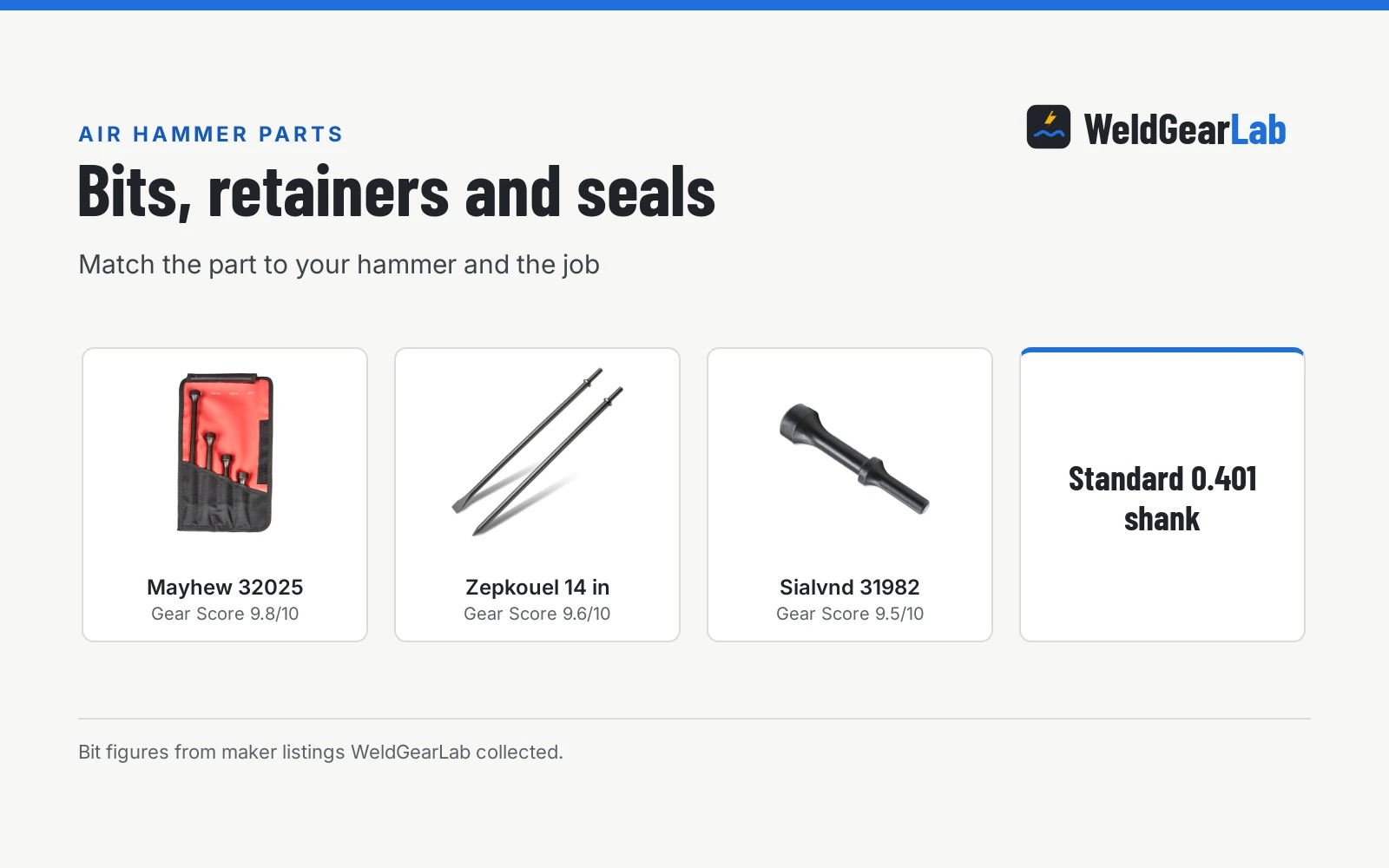
A chisel only fits a hammer with the same shank, so check the shank before ordering a set. The Chicago Pneumatic hammers (on Amazon) in this guide take a 0.401-inch round shank, while the Astro Tool hammer (on Amazon) takes a 0.498-inch shank. A quick-change retainer swaps chisels fast, and a spring retainer holds the chisel firm during steady work. Match the retainer to how often the job changes chisels.
- Round shank. The Chicago Pneumatic CP7150 and CP7111 list a 0.401-inch round shank, and the Astro Tool 498K lists a 0.498-inch shank.
- Stroke length. The Chicago Pneumatic CP7150 lists a 3.5-inch stroke at 2,300 BPM, and the CP7111 lists a 2.64-inch stroke at 3,000 BPM.
- Compact barrel. The AMGSH kit lists a 150mm (5.9-inch) piston stroke at up to 4500 BPM.
- Kit sets. The Ingersoll Rand 119MAXK kit lists up to 2,530 BPM with a 5-piece chisel set, and the Csttler 21-piece set holds 21 sets of kits for different work.
How much air the hammer needs
An air hammer is only as strong as the air behind it, so the compressor and hose matter as much as the tool. The Astro Tool hammer calls for 6.2 CFM, and the BOBOVAV kit (on Amazon) runs at 0.6 to 0.8 MPa. A hose that starves the tool shows up as weak hits and slow cutting, even when the hammer itself is rated for hard work.
Check the inlet and the hose before a long job. A swivel inlet keeps the hose from tangling, and an anti-slip grip steadies the tool. Some kits list a front-end exhaust that moves heat away from the hand.
Can the same hammer cover every job?
Partly. A hammer rated at up to 2,530 BPM with a 5-piece chisel set handles exhaust work, cutting, pin driving and body work, which covers most shop days. But a compact hammer rated at 4500 BPM suits panel cutting and spot weld work, while a long barrel hammer with a 3.5-inch stroke suits heavy chiseling and shaping. Pick the hammer for the job that fills most of the week, then add chisels for the rest.
Ear and eye protection on every job. Air hammers are loud, and chips fly when a chisel bites. Ear and eye protection belong on every air hammer job. Wear safety glasses when chipping, keep hands clear of the chisel, and check that the retainer is locked before pulling the trigger. Work with ventilation or outdoors.
FAQ for welders
What air hammer tip cuts sheet metal?
A panel cutter or cutting chisel. It slices along a straight line through thin sheet, which suits body panels and patch work. Keep the cutter tracking the line and let the hammer do the work.
What air hammer tip removes spot welds?
A spot weld chisel. It splits the weld so the panel comes free. A pointed chisel can start the separation where the weld is hard to reach.
Do air hammer chisels fit any air hammer?
No. A chisel only fits a hammer with the same shank, so check the shank before ordering a set. The Chicago Pneumatic hammers in this guide list a 0.401-inch round shank and the Astro Tool hammer lists a 0.498-inch shank, and those shanks do not mix.
How many blows per minute does an air hammer need?
It depends on the job. The hammers in this guide are rated at 2,300 BPM, 2,500 BPM, 2,530 BPM, 3,000 BPM, 3500 BPM and 4500 BPM, with panel work suiting the faster end and heavy chiseling suiting a longer stroke. Pick the rating for the job that fills most of the week.
What air supply does an air hammer need?
A steady supply that meets the hammer’s rating. A hammer in this guide calls for 6.2 CFM, and another runs at 0.6 to 0.8 MPa, so check the figures for the hammer being bought and size the compressor and hose to match.
Related: best pneumatic air hammer under 150, dead blow hammer uses, best tin snips for sheet metal, and the metal fab tools hub. Also see the best auto body hammer and dolly set.