How to Weld Cast Iron with a Stick Welder
Learn how to weld cast iron with a stick welder using nickel electrodes, proper groove prep, preheating, short stringer beads, and peening to prevent cracks.
 By WeldGearLab Editorial
Updated October 9, 2026
By WeldGearLab Editorial
Updated October 9, 2026
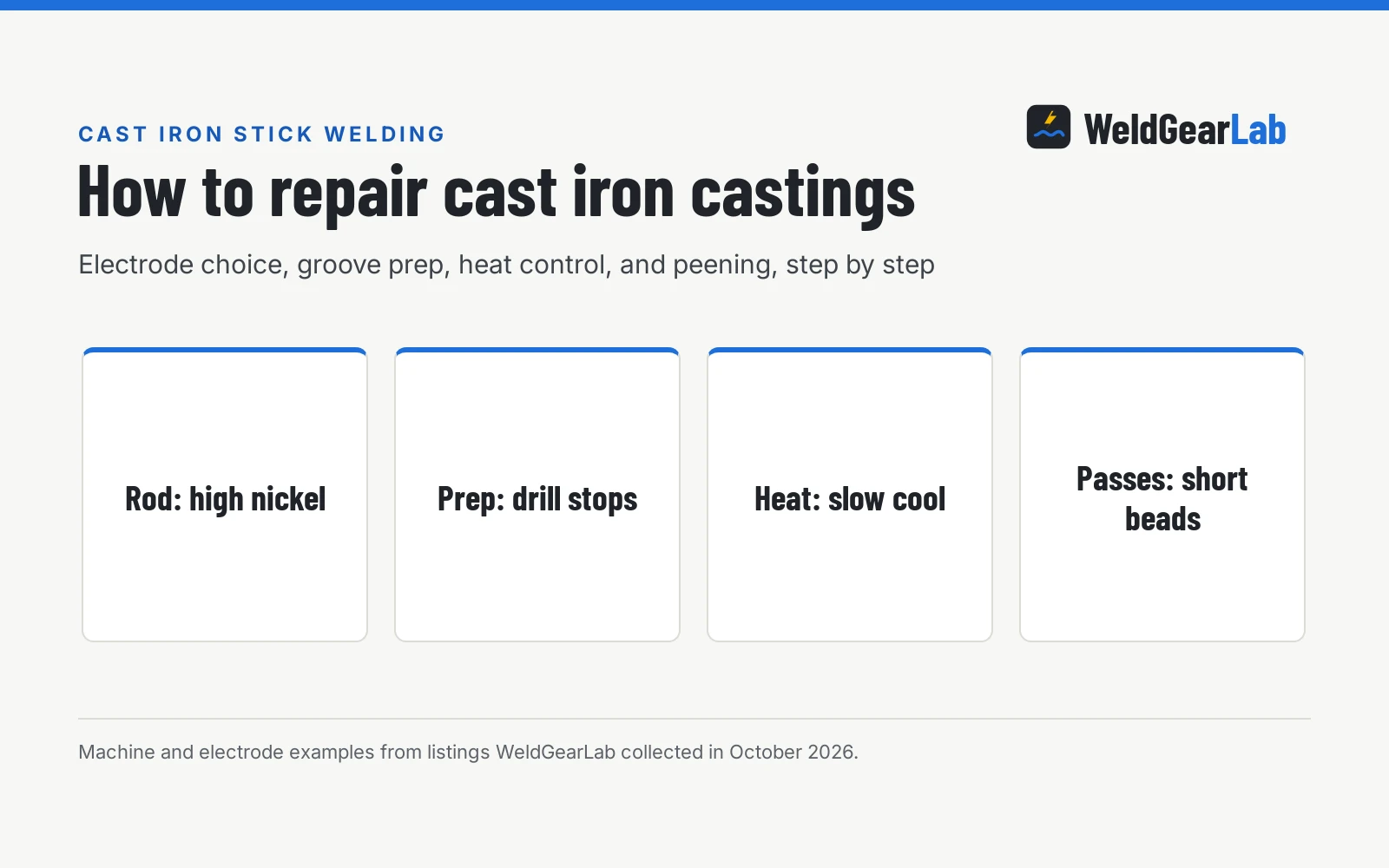
To know how to weld cast iron with a stick welder, you must control heat and expansion so the casting does not crack. Cast iron contains high carbon, which makes it brittle when heated and cooled quickly. The proven method uses a high-nickel stick electrode matched to machine polarity, bevels the crack into a rounded groove, manages heat through preheating or strict interpass cooling, and deposits short stringer beads. Peening each hot bead relieves cooling shrinkage stress, while controlled cooling protects the brittle heat-affected zone from cracking.
As an Amazon Associate I earn from qualifying purchases. This guide links to our product roundups, where WeldGearLab earns a commission when you buy through links, at no extra cost to you. Read our affiliate disclosure.
The metallurgy and cracking challenge
Welding cast iron is notoriously difficult because of how the metal responds to heat. Unlike mild structural steel, cast iron contains substantial carbon distributed throughout its matrix as graphite flakes or nodules. When an intense electric arc strikes the metal, the base iron melts and dissolves surrounding carbon. If that puddle cools rapidly, the dissolved carbon transforms into hard, brittle iron carbide and martensite along the fusion boundary, known as the heat-affected zone.
At the same time, molten metal shrinks as it cools and solidifies. Cast iron has virtually no ductility, meaning it cannot stretch to accommodate this contraction. If the weld deposit shrinks while the surrounding heavy iron remains cold and rigid, immense tensile stress concentrates at the brittle boundary. The result is an audible ping and a fresh crack running parallel to the new bead. Preventing that failure requires managing heat input, choosing compliant filler metal, and peening to counteract contraction.
Side by side: nickel electrode types
| ENi-CI (99% Nickel) | ENiFe-CI (55% Nickel) | Mild Steel (7018) | |
|---|---|---|---|
| Electrode standard | AWS A5.15 ENi-CI | AWS A5.15 ENiFe-CI | 7018 |
| Core composition | 99-Percent nickel | 55-Percent nickel, iron balance | Mild steel |
| Weld deposit ductility | Soft and easily machinable | Moderately ductile, stronger | Rigid, unmachinable on cast iron |
| Crack resistance on cast iron | High (ductile yield relieves stress) | Very high (resists solidification cracking) | Poor (forms brittle iron carbide) |
| Joining to steel | Possible on light sections | Designed to weld cast iron to steel | Standard for steel only |
| Recommended cast iron use | Normal grades, thin parts, machinable repairs | High strength gray and nodular cast irons | Not recommended for cast iron |
Electrode specifications follow standards like AWS A5.15. Fox Alloy lists 99-Percent nickel ENi-CI electrodes in 3/32” and 1/8” sizes designed for welding normal grades of cast iron and thin parts. Fox Alloy also lists 55-Percent nickel ENiFe-CI ferro-nickel rods in a 3/32” diameter conforming to AWS A5.15 ENiFe-CI for higher-strength gray and nodular cast iron or joining cast iron to steel. SÜA packages 3/32″ diameter ENiCl electrodes with 99% nickel content in packs of 5 sticks, designed for repairing engine blocks, machine bases, and gear housings. Standard steel electrodes like 7018 appear in general stick welding, but lack the nickel content needed to prevent cracking on cast iron. Choosing between nickel electrodes depends on whether the weld deposit needs machining and the structural loads on the finished part.
Joint preparation and crack arrest
Successful repairs start with thorough mechanical preparation. Never attempt to weld over a dirty, oily, or ungrooved crack. Follow these preparation principles before striking an arc:
- Drill crack stop holes. Locate the exact ends of the crack. Drill a small stop hole through the casting at each extremity to halt crack propagation. If you skip this, expansion stresses from welding will drive the crack deeper into sound iron.
- Bevel the joint. Grind out the crack to form a U-groove or wide V-groove with rounded roots. Sharp corners concentrate mechanical stress and invite cracking. An angle grinder fitted with a clean grinding wheel works well; see our best angle grinder for welding prep guide for recommended shop grinders.
- Remove surface contamination. Castings soak up oil, grease, paint, and coolant over years of service. Degrease the part thoroughly and grind down to bright, clean metal. Heating the joint gently with a torch can sweat out embedded oils before final grinding.
Preheating and heat control
Preheating is an effective way to prevent cracking when stick welding cast iron. Bringing the entire casting up to a uniform warm temperature reduces the thermal gradient between the weld zone and the surrounding iron. Slower cooling keeps the heat-affected zone softer and minimizes thermal shock.
For complex or heavy castings, heat the whole piece evenly in an oven or with a torch. If a casting cannot be preheated because of its size, position, or heat-sensitive seals, welders use cold welding practices. Cold welding keeps overall heat input minimal by depositing tiny stringer beads, skipping across the repair, and allowing the iron to cool between passes so the area never becomes too hot to touch with a gloved hand.
How to weld cast iron with a stick welder
Once the joint is beveled, cleaned, and set at your planned starting temperature, install a nickel electrode in your electrode holder. Proper arc control and bead placement are critical throughout the repair:
- Arc striking and polarity. Check the electrode packaging for the recommended polarity. Many nickel rods run on direct current electrode negative (DCEN) to minimize penetration and reduce base metal dilution, while others operate on direct current electrode positive (DCEP) or alternating current (AC). Strike the arc inside the prepared groove rather than on bare casting surface to prevent localized arc strikes. If your electrode tends to freeze, review how to strike an arc with a stick welder and our troubleshooting guide on why does my welding rod keep sticking.
- Deposit short stringer beads. Never weave a wide puddle across cast iron. Weaving pours excessive heat into the base metal and increases carbon pickup. Run narrow stringer beads, depositing only a short bead before breaking the arc. Keeping beads short limits localized thermal expansion.
- Skip welding and back-step technique. Do not weld continuously from one end of a crack to the other. Deposit a short bead near an end, skip to the opposite side, and then place another bead in the middle. Distributing heat evenly across the piece prevents severe localized expansion.
Peening each bead for stress relief
Immediately after breaking the arc on each short pass, chip the slag and peen the hot nickel bead with repeated, moderate blows from the rounded peen of a ball-peen hammer or chipping hammer.
Peening physically stretches the malleable nickel deposit, mechanically counteracting the shrinkage forces that develop as the filler metal cools. Because nickel is exceptionally ductile, moderate hammer blows deform the bead and relieve internal tensile stress before it can rip the brittle fusion line apart. Peen firmly along the bead, but avoid striking the adjacent cast iron, which could shatter under hammer impact.
Slow cooling and final inspection
Cooling is where many cast iron welds succeed or fail. Never expose a hot cast iron repair to cool drafts, cold shop air, or moisture. Rapid cooling promotes the formation of brittle martensite and invites immediate cracking.
Cooling practice depends on whether the piece was preheated or cold welded. For preheated castings, insulate the part immediately after the final pass is peened and cleaned. Bury small to medium castings in dry sand, powdered lime, or vermiculite so they cool over hours. For large assemblies that cannot be buried, wrap the workpiece tightly in an insulating blanket to trap heat; our roundup of the best welding blanket for home garage evaluates flame-resistant options for post-weld insulation. For cold-welded castings, allow the part to cool slowly in still shop air, keeping it sheltered from drafts until it reaches room temperature.
Stick welder selection for cast iron repairs
Repairing cast iron does not require industrial shop power, but it does demand smooth arc ignition and stable current delivery at lower amperage ranges. Because high-nickel electrodes run best at moderate amperage to avoid overheating the core wire, portable inverter stick machines are well suited for farm and home repairs.
Welders fixing farm equipment, engine brackets, or tractor housings can look at our roundup of the best stick welder for farm use to compare machines with reliable arc control. Inverter welders offer precise current adjustments that help match electrode recommendations from consumables manufacturers.
Machine listings illustrate typical power choices for shop repairs. Forney lists its 298 arc welder with a 90-amp output operating on a 120-volt input for residential stick welding. winbegin lists its ARC165 dual-voltage 110V/220V stick welder delivering up to 165A, an 80% duty cycle, and capacity for up to 5/32″ rods. PUWU lists its ARC-135PRO inverter stick welder with an output from 20A to 135A, a 20% duty cycle, and a 60V no-load voltage running on 110V power. bestarc lists its ARC200 stick welder with dual voltage 110V/220V, delivering 140A on 110V and up to 200A on 220V.
Frequently Asked Questions
Can you stick weld cast iron with regular 7018 or 6013 rods?
Mild steel electrodes like 7018 and 6013 mix with carbon from the cast iron during fusion to form hard, brittle iron carbide along the weld boundary. When the steel deposit shrinks as it cools, the brittle interface cannot stretch, causing severe cracking along the fusion line. High-nickel electrodes remain ductile and yield under cooling stresses, making them the proper choice for sound repairs.
Do you always need to preheat cast iron before stick welding?
Preheating is strongly recommended for heavy castings, complex shapes, or rigid assemblies because it narrows the temperature gap between the arc puddle and surrounding iron. Uniform warmth slows cooling and lowers shrinkage stress across the part. On small, unrestrained pieces, welders sometimes use cold welding methods with nickel rods, depositing very short beads and letting the metal cool between passes.
Why is nickel used for welding cast iron?
Nickel does not absorb carbon the way iron does, and it remains soft and malleable when deposited on cast iron. As the weld cools and contracts, the ductile nickel stretches to relieve stress instead of tearing away from the base metal. Nickel deposits also remain machinable, allowing holes to be drilled or surfaces to be planed after repair.
What causes cast iron to crack right next to the weld bead?
Cracking in the heat-affected zone happens because rapid heating and quenching create extremely hard, brittle martensite and iron carbides right at the fusion boundary. Cast iron has minimal tensile elasticity, so when the cooling bead pulls against the rigid base metal, the brittle zone fractures. Peening the hot bead and controlling cooling prevent this shrinkage stress from cracking the casting.
How can you tell gray cast iron from ductile cast iron?
Gray cast iron contains graphite in sharp flake form, which dampens vibration but produces a dull thud when struck and snaps with a dark gray, grainy fracture surface. Ductile cast iron contains graphite nodules that allow the metal to flex slightly, producing a clearer ringing sound when struck with a hammer. High-strength gray and ductile iron benefit from nickel-iron electrodes like ENiFe-CI, which offer greater tensile strength and crack resistance.
Related: best small inverter stick welders, best portable stick welder, how to strike an arc with a stick welder, and the stick welders category. Also see our guide on how to stick weld rusty metal.
About the author
WeldGearLab Editorial is the editorial team behind WeldGearLab. We research product listings, specifications, safety listings and warranty terms, score every pick with the published Gear Score method, and correct errors when readers report them. We do not run our own shop trials; see How We Pick for exactly how picks are made.