Types of Hardness Testers for Metal Shops
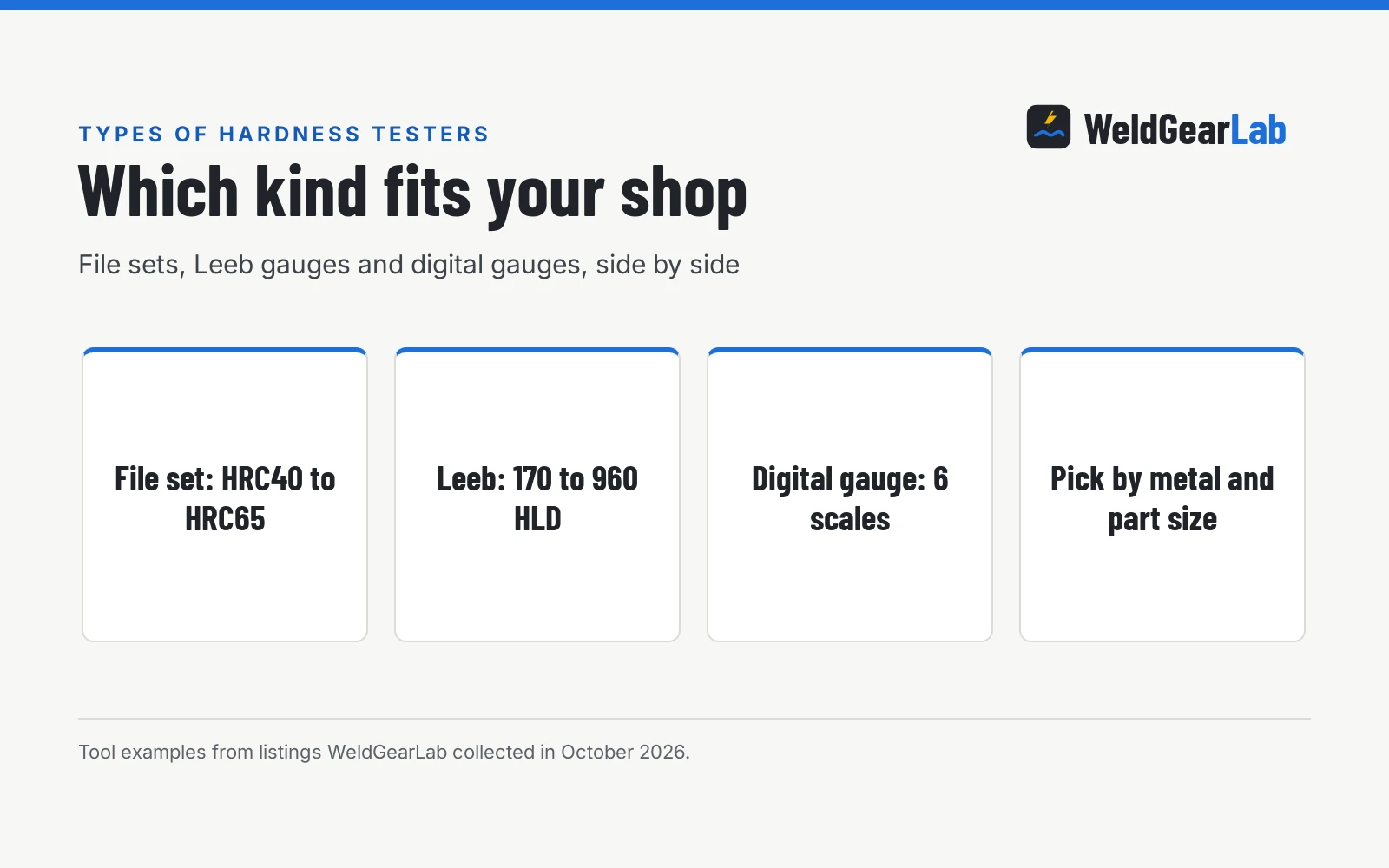
File sets, Leeb rebound gauges and digital gauges each read hardness a different way; here is what each kind covers and how to pick the right gauge for the metal in front of you.

On this page
Top picks at a glance
As an Amazon Associate I earn from qualifying purchases.
- 1
 WORKPRO 8-Inch Metal File Set9.7/10View on Amazon
- 2
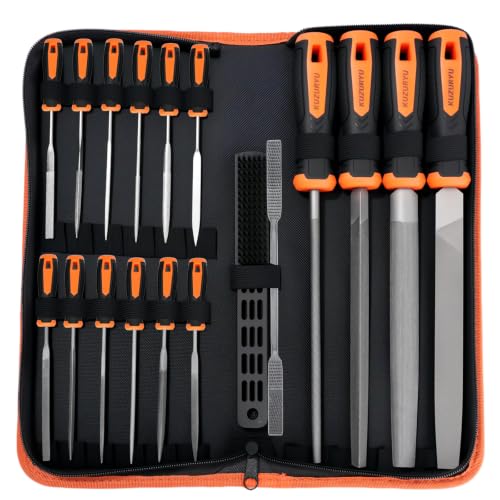 KUZURYU 31PCS Metal File Set9.7/10View on Amazon
- 3
 9pcs Air Hammer Chisel Set9.7/10View on Amazon
A weld that looks clean can still hide soft metal underneath, and a part that machines well can still wear out fast when the heat treat missed its mark. When the metal in front of you needs a hardness number before it goes into service, types of hardness testers give you that number without cutting the part open. This guide walks through the kinds a small shop meets most: file sets, Leeb rebound gauges, and digital gauges for soft metals, plus what each kind reads and where each kind fits.
This guide links to our product roundups, where WeldGearLab gets a commission on purchases made through links on this page, and your price stays the same. Read our affiliate disclosure.
Types of hardness testers at a glance
Hardness comes in scales, and each kind of gauge reads it in its own way. A file set gives a range, a Leeb gauge gives a number on a rebound scale, and a digital gauge gives a reading on the scales soft metals use. The table below lines them up; the sections after it fill in the details.
- File set: 6 color-coded files cover HRC40 to HRC65; the Leriton set’s files are 7.1 inches long (18 cm) with a storage bag that measures 20 by 5 by 3 cm.
- Leeb rebound gauge: reads 170 to 960 HLD, measures HL directly and converts it to 6 scales: HV, HB, HRC, HRB, HRA and HS.
- Digital gauge: reads 6 scales, HWA, HRE, HRF, HRB, HV and HB, and suits aluminum alloy, brass, copper and mild steel.
Side by side
| How it reads hardness | Scales and range | Where it fits | |
|---|---|---|---|
| File set | Files of known hardness scratch the metal; the file that bites marks the range | HRC40 to HRC65 across 6 files | Quick range checks on the shop floor |
| Leeb rebound gauge | A D-type probe strikes the surface and measures rebound | 170 to 960 HLD; measures HL, converts to 6 scales | Large parts and incoming checks across many materials |
| Digital eddy-current gauge | Eddy current induction reads the metal through a clamp-on head | HWA, HRE, HRF, HRB, HV, HB | Aluminum alloy, brass, copper and mild steel |
The ranges above come from the listings themselves. A file set gives a bracket, not a point reading, while a Leeb gauge gives a number that converts across scales.
Hardness file sets
A file set is the simplest way to put a bracket on hardness. Each file in the set has a known hardness, and the file that bites into the metal marks the top of the range while the file that skates across it marks the bottom. The Leriton set holds 6 color-coded files covering HRC40 to HRC65, each file 7.1 inches long (18 cm), with a black Oxford cloth storage bag that measures 20 by 5 by 3 cm. The maker builds the files from carbon steel and shapes the handles in different colors so the hardness level of each file is easy to spot at a glance. The TSUBOSAN set covers the same HRC40 to HRC65 range with 6 files in a multicolor set. File sets suit rough estimation on the shop floor, on parts where a bracket is enough to decide the next step, and on jobs where a gauge with a screen would be overkill.
Leeb rebound gauges
A Leeb gauge fires a small probe at the metal and measures how hard the probe bounces back. That rebound number is the Leeb hardness, shown as HL, and the gauge converts it to the scales a shop already knows. The AICEYI gauge (on Amazon) reads 170 to 960 HLD, measures HL directly and converts it to 6 scales: HV, HB, HRC, HRB, HRA and HS. Its conversion ranges run HV 83 to 976, HB 30 to 651, HRC 17.6 to 68.5, HRB 13.5 to 100, HRA 60 to 85.8 and HS 26.4 to 99.5. The maker lists indication error of plus or minus 6 HL at 760 HLD and plus or minus 10 HL at 530 HLD, with 6 HL repeatability and 1 HL resolution. The gauge shows readings on a 128 by 64 OLED screen and runs on a 3.7V 250mAh rechargeable battery with USB-C charging. It measures 148 by 34 by 24 mm and weighs 14.1 oz.
Leeb gauges need the part to meet a few conditions. The AICEYI listing states the workpiece should weigh at least 5 kg (11 lb) and measure at least 25 mm thick, with impact points at least 3 mm apart and 5 mm from any edge. Lighter or thinner parts need rigid coupling to a heavy support block, and a part held in the hand or resting on a wooden bench gives unreliable readings. The Helivivfy gauge covers 20 kinds of materials, from steel and cast steel and alloy tool steel through stainless steel, gray cast iron, ductile cast iron, cast aluminum alloy, brass, bronze, pure copper and forged steel, and it stores 48 to 350 groups of readings with 32 to 1 impacts per group. The Soonkoda gauge stores up to 500 groups and runs about 200 h on 2 AA batteries, while the GOYOJO gauge stores up to 350 groups. The Soonkoda and GOYOJO gauges work with 7 impact devices and switch between them without recalibration. A standard block comes with the Soonkoda and Helivivfy kits, while the AICEYI listing states the calibration block is not included and must be bought on its own.
Digital gauges for soft metals
The AMTAST AMT308 (on Amazon) reads soft metals with eddy current induction instead of a rebound probe. It covers 6 scales, HWA, HRE, HRF, HRB, HV and HB, and suits aluminum alloy, brass, copper and mild steel. The gauge has a digital display that shows the reading at a glance, and the maker builds it from special steel for long service in the shop. Use is simple: clamp the piece in the gauge and read the value straight off the screen. A portable box with a foam lining comes with it, so the gauge travels to the job instead of waiting on a bench.
How to pick the right gauge for your shop
Match the gauge to the metal and the part, not to the catalog. A file set is the pick when a bracket is enough and the range HRC40 to HRC65 covers the metal in question. A Leeb gauge is the pick when the job needs a number, when the part is large or fixed in place, or when the shop checks many materials: the Helivivfy gauge covers 20 kinds of materials, and Leeb gauges here show 7 scale readouts. A digital eddy-current gauge is the pick for aluminum alloy, brass, copper and mild steel, where it reads the HWA, HRE and HRF scales made for soft metals. Before buying, check the conditions the listing states: the AICEYI gauge wants a part of at least 5 kg and 25 mm thick, and a thin part needs a heavy support block. Also check what comes in the box: a standard block is part of some kits and missing from others, and the AICEYI gauge needs a block bought on its own. For more on choosing shop gear, see how to choose a MIG welder and the metal fab tools hub.
FAQ for welders
What is the simplest way to check hardness in a small shop?
A file set is the simplest route. The Leriton and TSUBOSAN sets each hold 6 files covering HRC40 to HRC65, and the file that bites marks the range. It gives a bracket, not a point reading, so it suits a quick go or no-go call on the shop floor, not a certificate value.
What does a Leeb reading of 170 to 960 HLD cover?
That is the measuring range the Helivivfy gauge states for the standard D-type probe, and the AICEYI gauge states the same 170 to 960 HLD span. A reading inside that span converts to 6 scales, including HV 83 to 976 and HRC 17.6 to 68.5, with HL as the direct reading. A reading outside the span falls past what the probe can measure, so the gauge cannot give a sound number there.
Can a Leeb gauge measure thin sheet?
Not on its own. The AICEYI listing states the part should be at least 25 mm thick and weigh at least 5 kg, with impact points at least 3 mm apart and 5 mm from any edge. A thin part needs rigid coupling to a heavy support block before the gauge can give a sound reading.
Does a file set give an exact hardness number?
No. A file set gives a range, such as HRC40 to HRC65 across 6 files, and the answer is the bracket the files mark. When the job needs an exact number, a Leeb gauge or a digital gauge is the right call, since those give a reading on a scale.
Related: metal fab tools, best welder for beginners, best MIG welder under 500, and how to choose a MIG welder.