Tig vs Stick for Farm Repairs: Which Welder to Buy
TIG and stick compared for farm repairs: setup, wind, rusty steel, thin metal and cleanup, plus four machines that list both TIG and stick, ranked by their listings.

On this page
Top picks at a glance
As an Amazon Associate I earn from qualifying purchases.
- 1
 YESWELDER 110V Tungsten Electrode Sharpener9.7/10View on Amazon
- 2
 LOTOS LTPDC2000D 3-in-1 50A Plasma Cutter 200A TIG StickView on Amazon
- 3
 135A 110V 2-in-1 Mini Stick Welder/Lift TIG Welder PortableView on Amazon
- 4
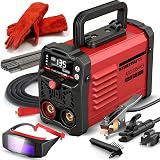 MMA-135PRO Stick Welder 110VView on Amazon
- 5
 VEVOR TIG WelderView on Amazon
- 6
 Stick Welder Welding Machine 125A 110V IGBT MMA Arc WelderView on Amazon
- 7
 145A MIG WelderView on Amazon
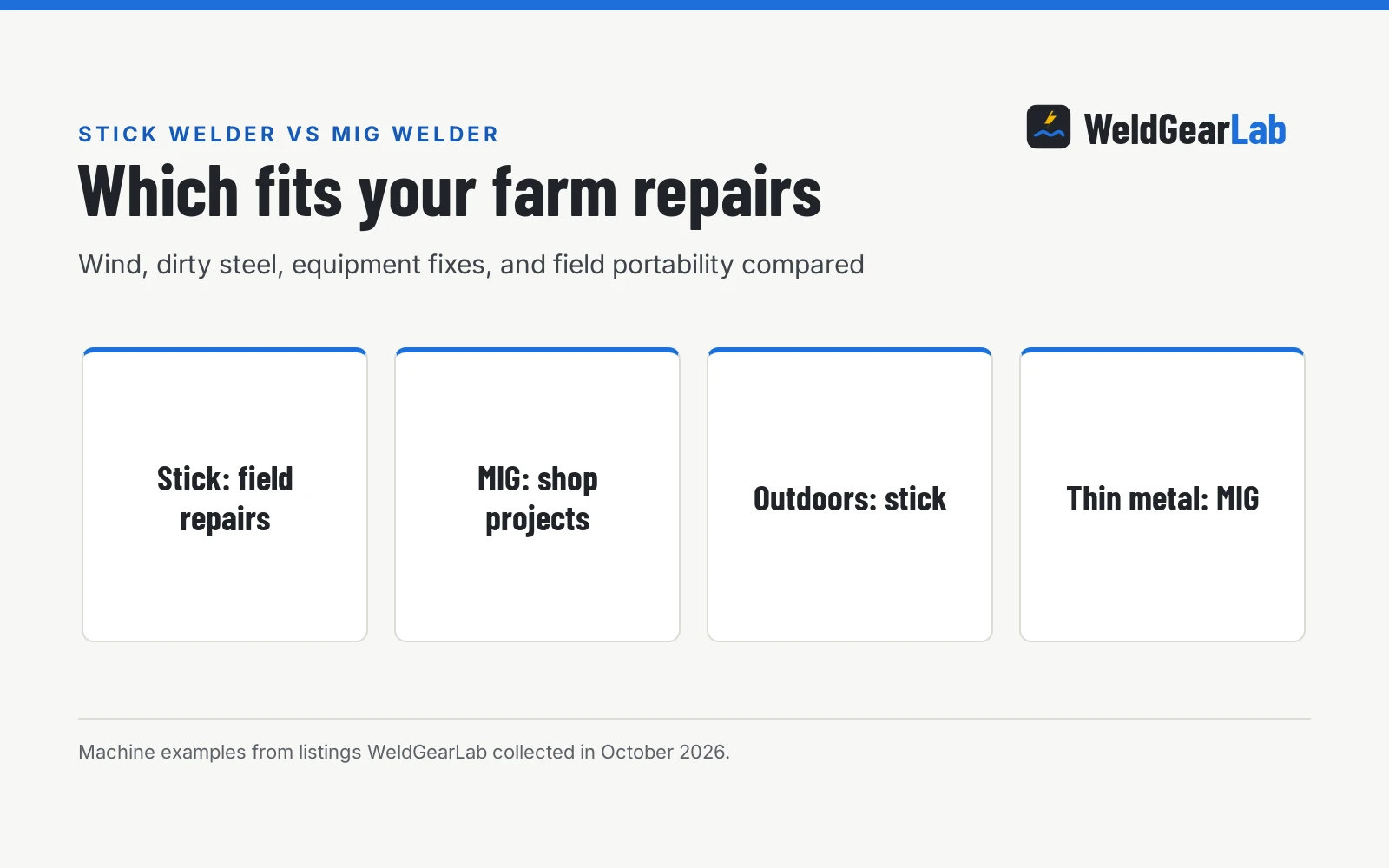
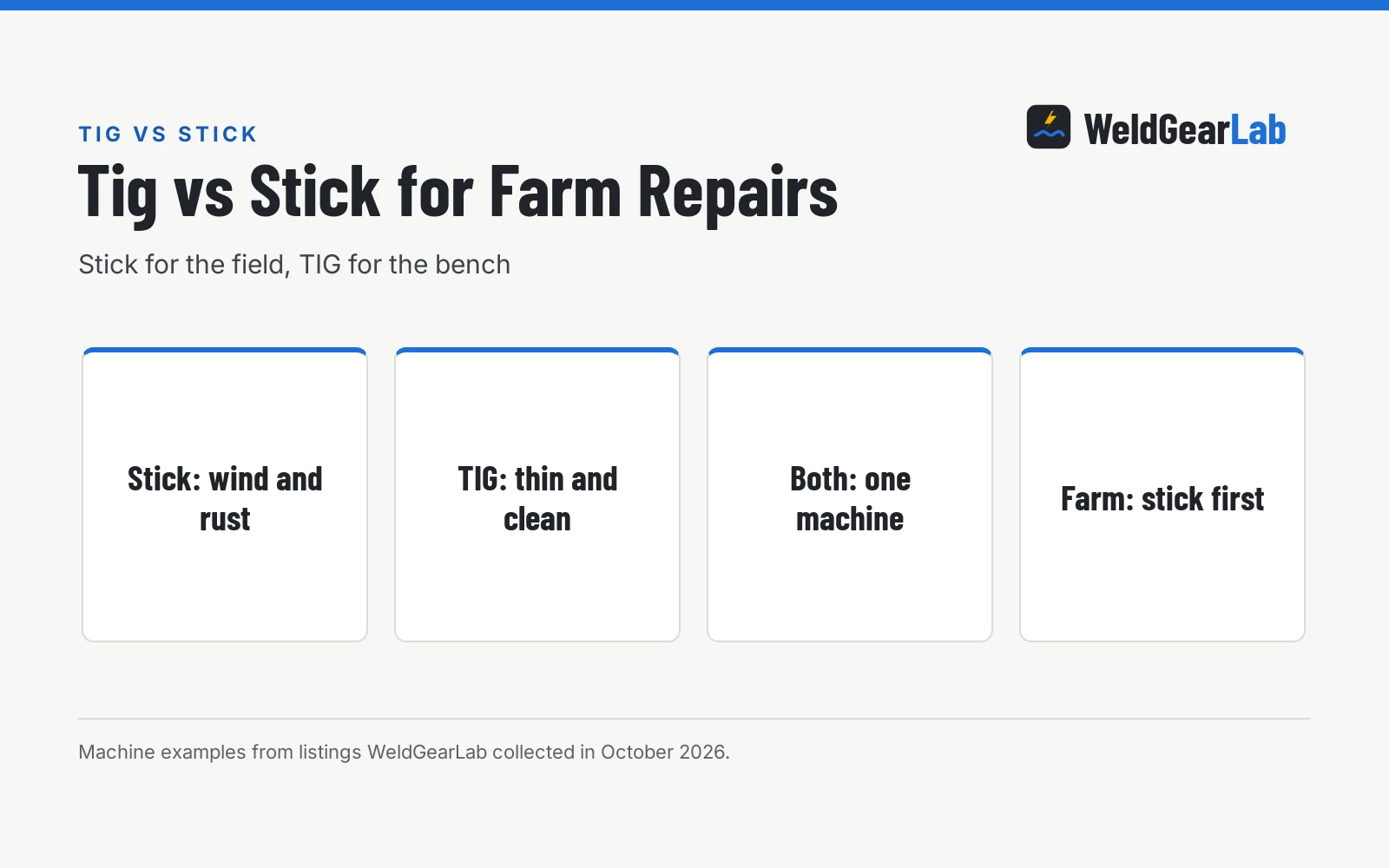
For most farm repairs, stick is the practical answer: it runs outdoors in the wind, tolerates rusty metal and needs no gas cylinder. TIG earns its place on thin stainless and precise work where the bead will show. This guide compares tig vs stick for farm repairs on setup, weather, metal and cleanup, and ranks machines whose listings cover both processes.
Other welders and gear to compare
 LOTOS LTPDC2000D 3-in-1 50A Plasma Cutter 200A TIG StickCheck price on Amazon
 135A 110V 2-in-1 Mini Stick Welder/Lift TIG Welder PortableCheck price on Amazon
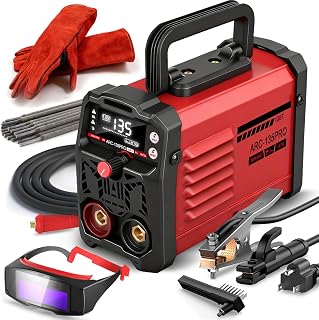 MMA-135PRO Stick Welder 110VCheck price on Amazon
 VEVOR TIG WelderCheck price on Amazon
 Stick Welder Welding Machine 125A 110V IGBT MMA Arc WelderCheck price on Amazon
 145A MIG WelderCheck price on Amazon
This guide links to our product roundups, where WeldGearLab gets a commission on purchases made through links on this page, and your price stays the same. Read our affiliate disclosure.
The difference in one paragraph
Stick welding burns a flux-coated rod: the flux makes its own shielding gas and leaves slag on the bead. TIG feeds a separate filler rod into an arc from a tungsten electrode, shielded by gas from a cylinder. One process needs a rod and a clamp; the other needs a torch, tungsten, filler, gas and a regulator.
Side by side
| TIG | Stick | Farm take | |
|---|---|---|---|
| Shielding | Gas from a cylinder | Flux coating on the rod | No gas: stick |
| Gear beyond the welder | TIG torch, tungsten, filler rod, gas cylinder | Electrode holder and rods | Less gear: stick |
| Wind and outdoor work | Gas blows away, needs shelter | Tolerates wind and weather | Outdoors: stick |
| Dirty or rusty steel | Needs clean metal | More forgiving on rust and paint | Rusty steel: stick |
| Thin sheet | Precise, low heat, clean beads | More heat, risk of burn through | Thin sheet: TIG |
| Thick farm steel | Slow on thick sections | Deep penetration, fast | Thick steel: stick |
| Spatter and cleanup | No slag, little spatter | Slag to chip, more spatter | Cleanup: TIG |
| Learning curve | Slower to learn, both hands busy | Easier to start | Beginner: stick |
Amperage ranges differ by machine; always follow the duty cycle and rod sizes the listing states for the unit you buy.
When stick is the better choice
- Outdoor repairs. Fences, gates, trailers and equipment in the field. Wind that ruins TIG shielding barely affects stick.
- Rusty or painted steel. Stick tolerates less than perfect prep better than TIG.
- No cylinder. You avoid buying or leasing gas, and there is nothing to refill.
- Thick sections. Stick digs in deeper at a given amperage, which helps on heavy farm steel.
Our TIG vs stick for thin metal guide covers where the balance tips the other way.
When TIG is the better choice
- Thin stainless and precise work. Low heat and a focused arc make small beads easier with less burn through.
- Looks and cleanup. No slag to chip and less spatter to grind, which matters on visible repairs.
- Shop work. Calm air and a bench let TIG do its best work.
- Dissimilar or tricky joints. A separate filler rod gives more control over the puddle.
tig vs stick for farm repairs: the farm verdict
For a working farm, stick does most of the repairs: gates, hinges, brackets and broken implements, outdoors and on dirty metal. TIG is the second process, for the stainless tank fitting or the visible bracket where the bead matters. A machine that runs both covers the whole farm.
Gear that covers both processes
The four machines here each list both TIG and stick modes, ranked by what their listings state. Two add a third process: the LOTOS adds a 50A plasma cutter, and the TORQBEAST adds flux MIG. The LOTOS LTPDC2000D leads with 200A TIG and 200A stick plus a 50A plasma cutter, dual 110V/220V input and a 60% duty cycle at 50A, and its title names farm maintenance outright. The PUWU ARC-135PRO is a 4.9 pound 110V unit with 135A output, digital control from 20A to 135A and a 20% duty cycle, plus hot start, arc force and anti-stick. The Ppizkk MMA-135PRO matches 135A on 110V in a 3.5 pound body per its title (its spec table says 7.54 pounds, so check the listing) and ships with 20 rods, goggles, gloves and a brush. The TORQBEAST adds flux MIG to its stick and lift TIG modes, listed at 145A output, in a 7.16 pound unit per its bullets (its spec table says 12.19 pounds) with a helmet in the box.
What to check on a machine listing
Look for these before you buy:
- TIG torch included. The LOTOS and PUWU include one; the Ppizkk listing says the lift TIG torch is sold separately.
- Rod sizes. The PUWU runs 6010, 6011, 6013 and 7018; the Ppizkk runs E6013, E6011, E6010 and E308 from 1/16 inch to 1/8 inch.
- Duty cycle with amps. The LOTOS states 60% at 50A; the PUWU states a 20% duty cycle. Match the rating to how long your beads run.
- Input voltage. All four run on 110V; the LOTOS also lists 220V input.
Welding fumes and arc flash. Stick makes more smoke and fumes than TIG, and both processes throw arc flash that burns eyes and skin. Weld with ventilation or outdoors with your head out of the plume, wear a proper helmet and cover exposed skin, and clear dry grass and anything flammable from the area.
FAQ for welders
Can one machine weld both TIG and stick?
Yes. All four machines here list both TIG and stick modes: the LOTOS runs 200A TIG and 200A stick, the PUWU and Ppizkk run 135A stick with lift TIG, and the TORQBEAST is listed at 145A output and runs stick and lift TIG plus flux MIG. One machine that runs both covers most farm repairs.
Is TIG or stick better for rusty farm equipment?
Stick. Its flux handles rust, paint and mill scale better than TIG, which wants clean metal. Grind the joint when you can, but stick forgives a rushed prep on a broken gate or hinge.
Do I need gas for lift TIG?
Yes. Lift TIG still shields the puddle with gas from a cylinder; only the arc start differs from high-frequency TIG. Stick needs no gas at all, which is one reason it suits field repairs.
What rods do these machines run?
The PUWU listing names 6010, 6011, 6013 and 7018 rods. The Ppizkk listing names E6013, E6011, E6010 and E308 rods from 1/16 inch to 1/8 inch, and includes 20 rods in the box.
Can a 110V welder handle farm repairs?
For light repair, yes: the 135A and 145A machines here run on 110V and suit brackets, hinges and thin sections. For heavier steel, the LOTOS adds 220V input and 200A output. Match the machine to the thickest metal you weld.
Related: TIG vs stick for stainless steel, TIG vs stick for aluminum, best MIG wire for thick steel, and the welders hub.