Single Phase vs 3 Phase Welder: Which One Should You Buy?
Single phase vs 3 phase welder: the difference is the wall wiring, not the welder. Two 3-phase listings compared, with the single-phase side explained.

On this page
Top picks at a glance
As an Amazon Associate I earn from qualifying purchases.
- 1
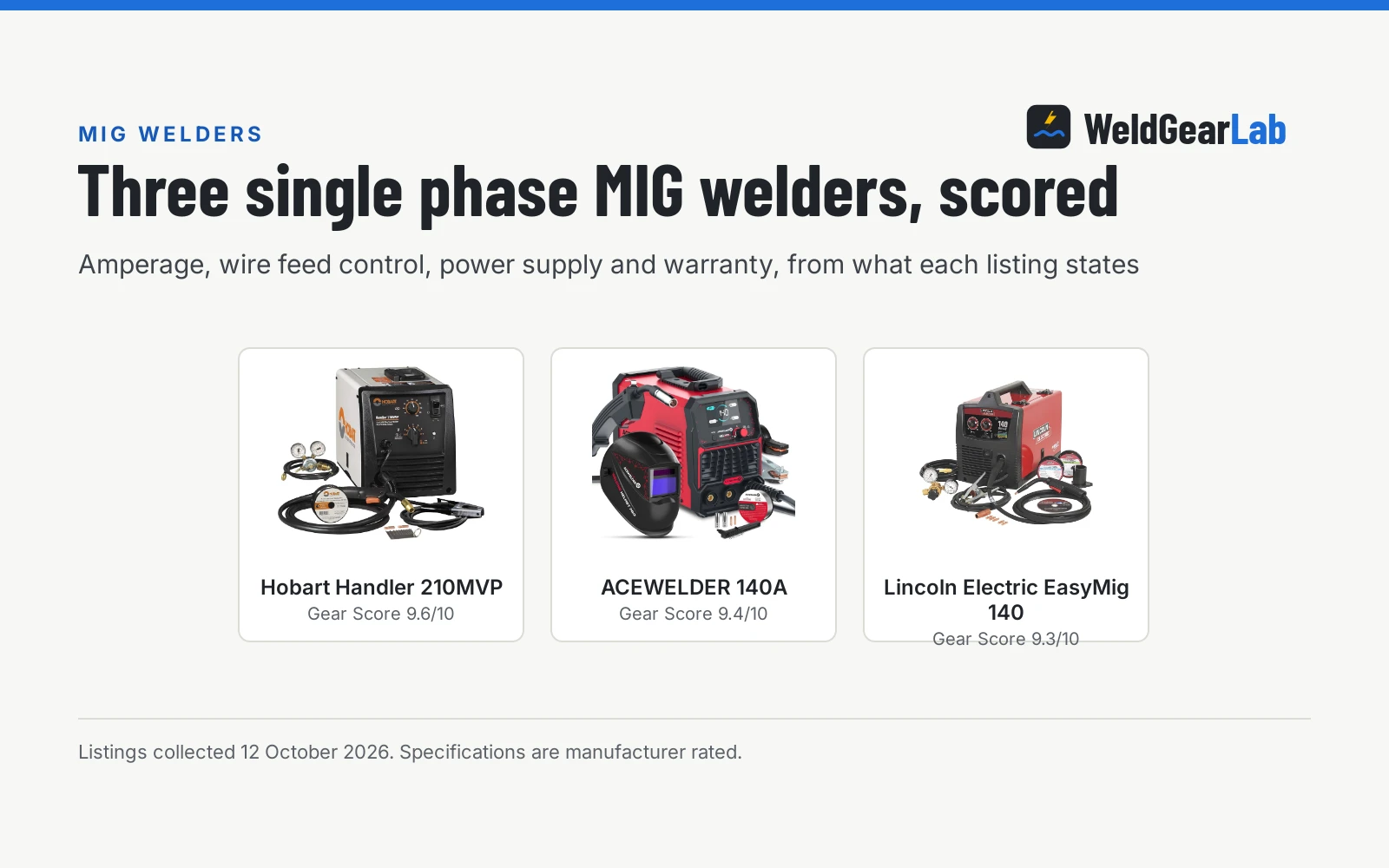
 Hobart Handler 210MVP MIG Welder9.6/10View on Amazon
- 2
 ACEWELDER 140A MIG Welder9.4/10View on Amazon
- 3
 EasyMig 140 Wire Welder9.3/10View on Amazon
- 4
 DPS Digital Phase Converter 2HP My-PS-2View on Amazon
- 5
 ATO 5hp VFDView on Amazon
- 6
 Single Phase to 3 Phase Converter,10HP 220V 3 PhaseView on Amazon
Single phase vs 3 phase welder verdict: pick a single-phase welder if your shop has standard 220V wall power and you weld alone; pick a 3-phase welder if your shop is wired for three-phase and you run industrial machines. The Everlast PowerTIG 250EX below actually bridges both: its title says 1 or 3 phase 220V, with 250A of AC/DC TIG and stick output at 65 lb.
Other welders and gear to compare
 DPS Digital Phase Converter 2HP My-PS-2Check price on Amazon
 ATO 5hp VFDCheck price on Amazon
 Single Phase to 3 Phase Converter,10HP 220V 3 PhaseCheck price on Amazon
WeldGearLab gets a commission on purchases made through links on this page, and your price stays the same. Read our affiliate disclosure.
Single phase vs 3 phase welder: side by side
[wgl-compare]
| Single phase | 3 phase | |
|---|---|---|
| Power supply | Standard shop 220V wall outlet | Three-phase shop wiring |
| Typical use | Home shops, garages, one welder at a time | Industrial shops, multiple machines |
| Listed examples | None tagged to this side in the listings | Everlast PowerTIG 250EX (250A, 1 or 3 phase 220V, 65 lb); ESAB HandyArc 1/8 in stick welder (6.3 lb) |
| Output range | Varies by machine | Varies by machine; the Everlast lists 250A |
These numbers are the manufacturer’s ratings exactly as each listing gives them, recorded on 19 October 2026. A figure from one listing describes that listing only.
Power and output
The listings do not state output for a single-phase machine, so no side wins on output here. On the 3-phase side, the Everlast PowerTIG 250EX lists 250A with AC/DC TIG and stick, pulse up to 500Hz, and a low 5A start for TIG in AC and DC modes. The ESAB HandyArc lists a 1/8 in stick capacity with 6013 electrodes. The Everlast’s title says it runs on 1 or 3 phase 220V, which makes it the flexible pick for a shop that might upgrade its wiring later.
What separates the two sides
The separation is the wall, not the welder. A single-phase welder plugs into the 220V circuit a home shop already has. A 3-phase welder needs three-phase service. That is why the single-phase side suits garages and home shops, and the 3-phase side suits industrial shops already wired for it. Neither listing states anything that changes this: it is a property of the building, not the machine.
Weight and build
The Everlast example weighs 65 lb at 22 by 9 by 17 inches, with IGBT power modules and a 12 ft water-cooled TIG torch with DINSE connectors. The ESAB example weighs 6.3 lb at 10.3 by 7.1 by 4.5 inches, a carry-it-anywhere inverter stick welder. Do not read a side win into this: the weights describe two different machines, not the two power types. A 3-phase welder is not heavier than a single-phase welder as a rule.
What is in the box
The Everlast listing names a TIG welding accessories kit with the 12 ft water-cooled torch. The ESAB listing names quality welding accessories included. Neither listing details the full box contents, so check the listing before you buy.
Warranty
Neither listing states a warranty term in the extracted data. For machines at these prices, ask the seller about coverage before you buy.
Choose the single-phase side if
You weld in a home shop or garage with standard 220V wall power, you run one welder at a time, and you do not want to pay for three-phase service. See our single-phase MIG welders guide for machines on this side.
Choose the 3-phase side if
Your shop is already wired for three-phase, or you are outfitting an industrial space where three-phase is standard. The Everlast PowerTIG 250EX is the capable pick with 250A and AC/DC TIG; the ESAB HandyArc is the portable pick for light stick work at 6.3 lb.
The two machines
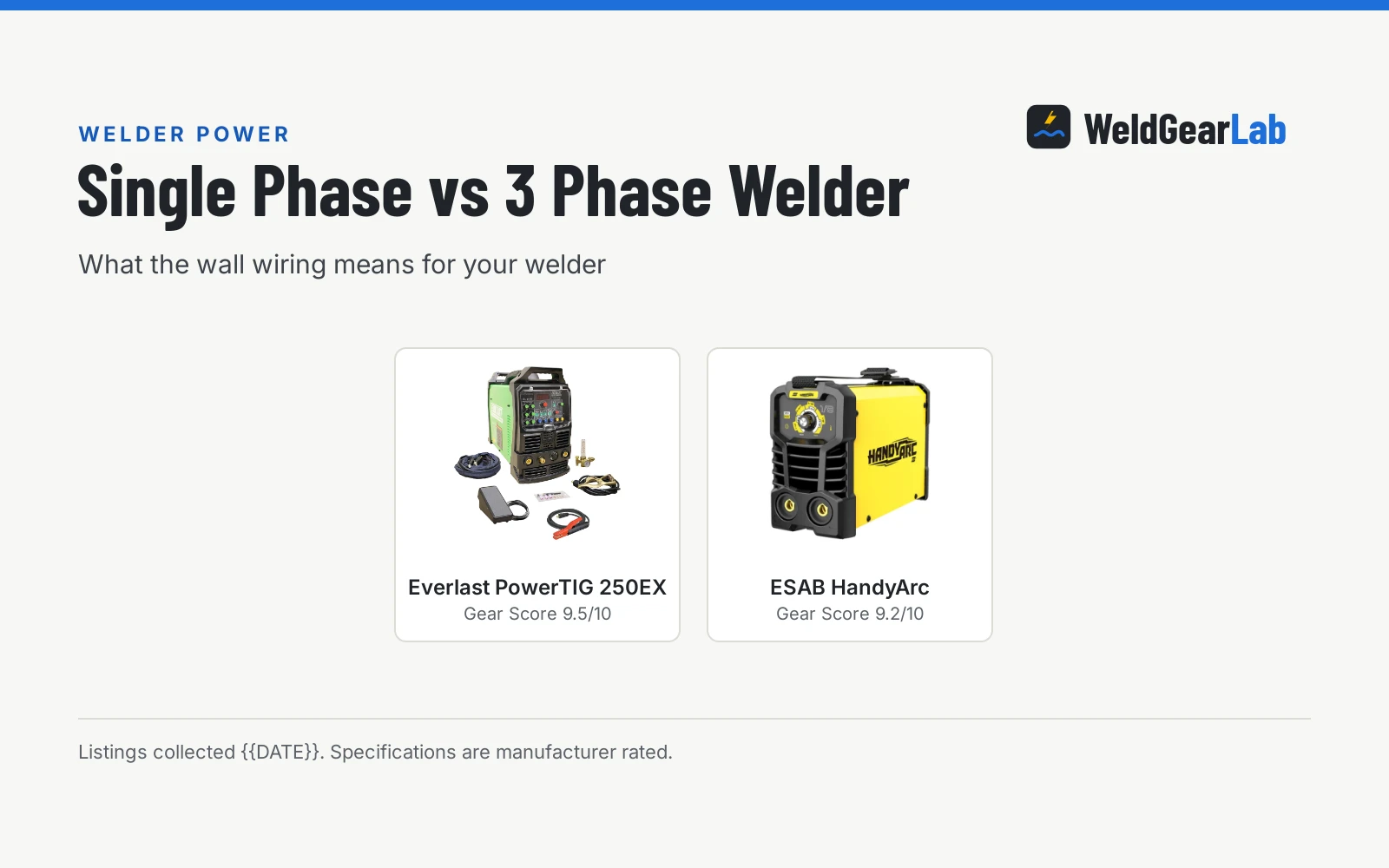
The two machines are the listings compared here: a full-featured TIG and stick machine, and a light portable stick welder.
Buying advice: power, processes and portability
Check your wall power first
The phase question is answered at the breaker panel, not the welder. A single-phase welder plugs into the 220V circuit most home shops already have. A 3-phase welder needs three-phase service. Before shopping, find out what your building supplies: if it is single-phase 220V, your shortlist is single-phase machines plus dual-rated ones like the Everlast PowerTIG 250EX, whose title states 1 or 3 phase 220V. If the shop already has three-phase, either side works.
Match the process to the work
Phase and process are different choices. The Everlast listing states AC/DC TIG and stick with pulse up to 500Hz and a low 5A start for TIG, which suits aluminum TIG work and precise thin-metal welding. The ESAB listing states 1/8 inch stick capacity with 6013 electrodes, which suits quick repairs and outdoor work where wind blows shielding gas away. Decide what you weld first, then check which phase your shop supports, not the other way around.
Weigh portability against capability
The two listings show the spread: the ESAB at 6.3 lb and 10.3 by 7.1 by 4.5 inches goes anywhere in a tool bag, while the Everlast at 65 lb and 22 by 9 by 17 inches is a shop machine with a 12 ft water-cooled torch. A portable stick welder handles field repairs; a full-featured TIG machine stays on the bench. Buy the weight you will actually carry.
Read the input specs literally
The Everlast title states 1 or 3 phase 220V, which is unusual flexibility: it runs on either supply. Most welders are one or the other, so read the input line on the listing before assuming. A 3-phase-only welder on single-phase power needs a phase converter, which is a separate purchase with its own sizing rules. See our rotary phase converter vs VFD guide if that is your situation.
Ask about the warranty
Neither listing states a warranty term in the extracted data. For machines with inverter boards and, on the Everlast, a water-cooled torch with DINSE connectors, ask the seller what coverage exists before you buy. A stated term on the electronics is worth more than a vague promise.
FAQ for welders
Can I run a 3-phase welder on single-phase power?
Only if the welder supports it. The Everlast PowerTIG 250EX title says 1 or 3 phase 220V, so it runs on either. Most 3-phase welders cannot run on single-phase without a converter.
Is 3-phase better for welding?
Not as a rule. Three-phase suits industrial shops with the wiring for it; single-phase suits home shops. The weld quality comes from the machine and the operator, not the phase count.
Which side is cheaper to set up?
The listings do not state setup costs. The Everlast title states 1 or 3 phase 220V, so it runs on a standard 220V circuit as well as three-phase.
Do either of these have a warranty?
Neither listing states a warranty term in the extracted data. Ask the seller before you buy.
What electrodes does the ESAB run?
The listing states 6013 type electrodes with a 1/8 in stick capacity.
Scoring, line by line
We scored each machine on performance, build, value, safety and warranty, from the listing figures. No listing states a safety certification or a warranty term, so those scores are zero across the board. The Everlast leads on output and process range; the ESAB follows as the light portable pick.
More welding guides
See our single-phase MIG welders guide.