Dual Voltage vs Single Voltage Welder: Which One Should You Buy?
Dual voltage and single voltage welders differ in power flexibility, output, and shop mobility, deciding whether you can weld anywhere or need dedicated 240V.

On this page
Top picks at a glance
As an Amazon Associate I earn from qualifying purchases.
- 1
 160A 4-in-1 Welding Machine: 110V/220V Dual Voltage MIGView on Amazon
- 2
 Sunstac 5-in-1 Multiprocess WelderView on Amazon
- 3
 SOARFLY Stick WelderView on Amazon
- 4
 Sunstac 200A Stick WelderView on Amazon
- 5
 New Everlast PowerTIG 200DV 110/220 Dual Voltage 200amp PulseView on Amazon
- 6
 TOOLIOM 110/220V Dual Voltage 5-in-1 Welding Machine CUT/HFView on Amazon
When you have broken equipment on the bench or a trailer frame needing fresh beads in the driveway, choosing between a dual voltage vs single voltage welder comes down to where you plug in and how much penetration you need. A dual voltage welder gives you the flexibility to run off a standard 110V wall outlet or plug into a 220V shop circuit for full output. A single voltage welder locks you into a fixed power supply, trading that plug flexibility for a simpler design that suits a permanent bench. This guide breaks down output differences, duty cycle limits, and shop electrical needs so you can pick the right power setup for your projects.
Other welders and gear to compare
 160A 4-in-1 Welding Machine: 110V/220V Dual Voltage MIGCheck price on Amazon
 Sunstac 5-in-1 Multiprocess WelderCheck price on Amazon
 SOARFLY Stick WelderCheck price on Amazon
 Sunstac 200A Stick WelderCheck price on Amazon
 New Everlast PowerTIG 200DV 110/220 Dual Voltage 200amp PulseCheck price on Amazon
 TOOLIOM 110/220V Dual Voltage 5-in-1 Welding Machine CUT/HFCheck price on Amazon
This guide links to our product roundups, where WeldGearLab gets a commission on purchases made through links on this page, and your price stays the same. Read our affiliate disclosure.
The difference in one paragraph
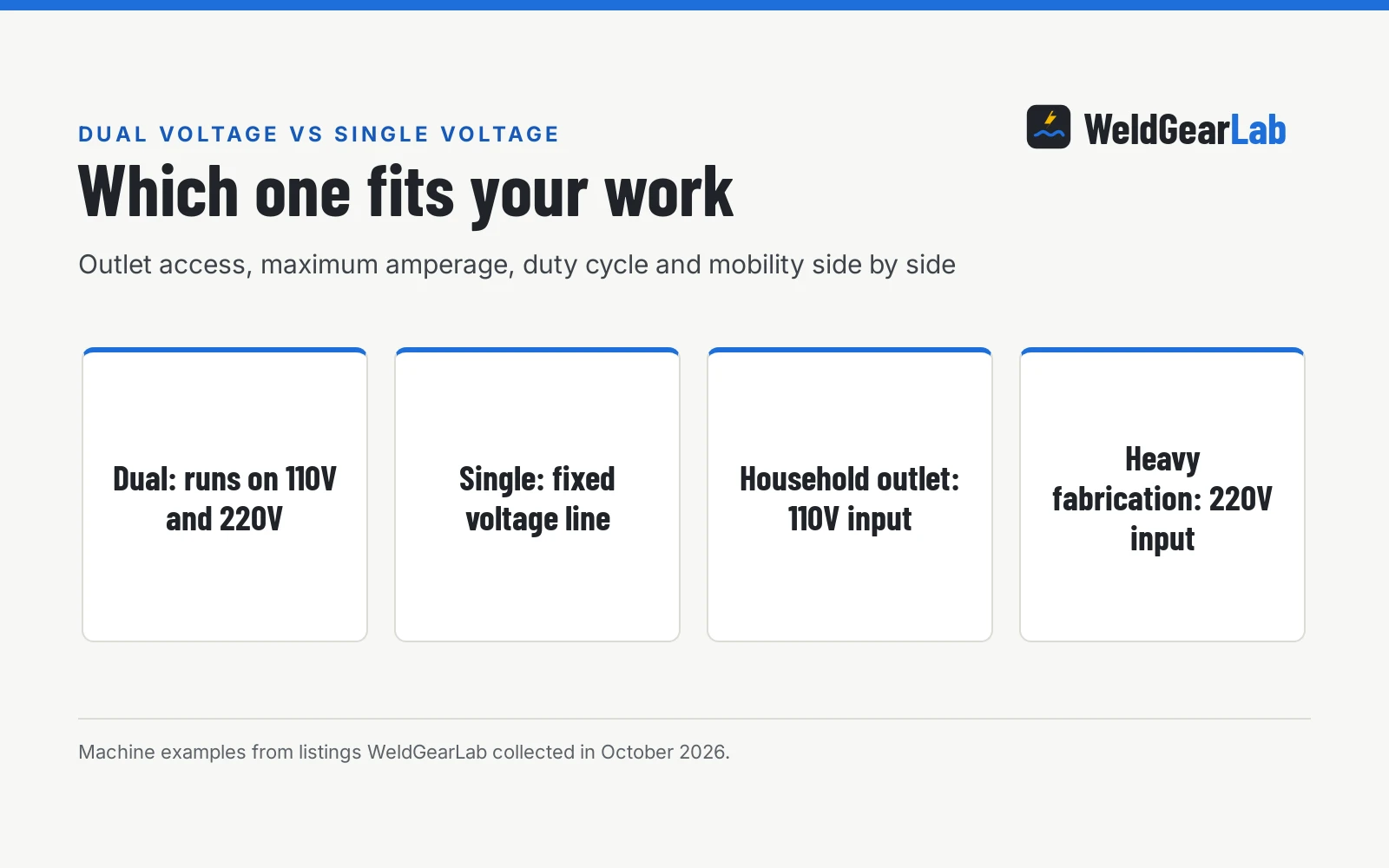
The core difference between these machines is the input circuitry inside the cabinet. A dual-voltage welder features sensing circuitry that automatically detects or accepts an incoming supply of either 110V or 220V (also referenced as 120v or 240v lines). When plugged into household current, the machine steps down its ceiling output to protect the branch circuit from tripping. When connected to a dedicated high-voltage receptacle, the inverter unlocks maximum amperage and longer duty cycles. A single-voltage welder is wired for a dedicated input rating: a 110V-only machine cannot tap into heavy shop power, while a 220V-only machine cannot run from a common household receptacle without tripping breakers or refusing to arc.
Side by side
| Feature | Dual-voltage welder | 110V single-voltage | 220V single-voltage |
|---|---|---|---|
| Input power options | 110V and 220V dual input | 110V household power only | 220V dedicated circuit only |
| Household outlet use | Can run on a household outlet | Plugs directly into wall outlet | Cannot plug into household outlet |
| Maximum welding output | Higher output on 220V lines | Limited to light amperage | Full rated machine amperage |
| Duty cycle performance | Higher duty cycle on 220V | Lower duty cycle rating | Higher duty cycle rating |
| Mobility and versatility | High: moves across any shop or site | Moderate: limited to light jobs | Low: tied to 220V power drops |
| Adapter cords | Uses conversion pigtail cord | Single standard cord | Single dedicated heavy plug |
| Internal circuitry | Dual-sensing inverter circuitry | Single 110V power circuit | Single 220V power circuit |
| Heavy steel capability | Full penetration on 220V lines | Limited on thick material | Full penetration on thick plate |
Voltage ratings frequently appear as 110V/220V or 120v/240v on machine faceplates and spec sheets; both designations describe standard household single-phase power and high-voltage workshop circuits in North America. Always verify the input plug configuration and breaker requirements stated in the machine manual before striking an arc.
When dual voltage is the better choice
- Mobile repair and field work. Hauling a machine to a neighbor’s garage, a livestock gate, or a jobsite where utility power varies. You can plug into any standard wall outlet for quick tack welds and repairs.
- Home garages with future upgrade plans. If your garage currently features standard household receptacles but you plan to install a dedicated high-voltage circuit later, a dual-voltage unit lets you weld immediately and gain full output once your heavy circuit is wired.
- Generator operation. Running off portable generators that provide both standard utility plugs and high-voltage outlets.
- Balancing thin sheet and heavy steel. Dual-voltage machines give you low, controllable heat for sheet metal on household power, alongside the muscle needed for thicker plate when connected to high voltage.
Our best welder for beginners guide reviews several dual-voltage units with synergic controls that adjust settings automatically across both power supplies.
When single voltage is the better choice
- Dedicated fab shop placement. If your welder sits permanently beside a welding table with a dedicated 220V outlet, you never need the ability to drop down to household voltage.
- Exclusively light hobby welding. If your projects consist entirely of sheet metal art, exhaust tubing, or thin brackets, a dedicated 110V machine handles those tasks without carrying unused internal circuitry.
- Dedicated 120V field rigs. In service vans designed to plug exclusively into utility extension cords on job sites, dedicated 110V machines deliver straightforward operation without extra adapter pigtails to misplace.
- Simpler internal components. Machines dedicated to a single supply line avoid dual-voltage switching components, keeping internal circuitry focused on a single power pathway.
If you only plan to run on household outlets, our best 120V MIG welder roundup examines dedicated machines tailored for light fabrication.
Dual voltage vs single voltage welder: power and duty cycle
The practical difference on the welding bench appears in maximum amperage and duty cycle. Running a dual-voltage welder on 110V drops the maximum output to prevent drawing excessive current from standard household wiring. On 220V, the machine delivers its full rated capacity, producing hotter puddles, better penetration on heavy joints, and longer arc time before thermal protection cuts in.
Listing specifications show this power split clearly across different processes. AHP lists a 150 amp output on 120v and a full 225 amp output on 240v for its Alpha-TIG 225Xi. That extra headroom on high voltage allows the arc to dig into thick plate without overheating the torch or power components. S SIMDER lists 180A on 110V and 250A on 220V with a 60% duty cycle at 250A, stating 6 minutes of welding in every 10 minute cycle. Dropping to household voltage reduces both total current and continuous weld time.
Stick welding shows the same separation. Sunstac lists a stick welding output of 20-144A on 110V with 60% duty cycle at 144A, which rises to 20-180A on 220V with 60% duty cycle at 180A. If you try to burn heavy rods on household current, the restricted amperage struggles to maintain a stable puddle. For deeper background on how these ratings translate to shop time, read our guide on welding duty cycle explained.
How to tell what a machine supports
Welder listings can be confusing because makers frequently highlight multi-process capabilities alongside power input. When shopping, check these specific details:
- Voltage rating on the specification label. Dual-voltage machines explicitly state 110V/220V, 110/220V, or 120v/240v. A machine marked strictly 110 volts or 220 volts supports only that single input.
- Included adapter cords and ratings. Dual-voltage units typically include an adapter pigtail or conversion line in the carton. YESWELDER lists a 140 Amp output with 110V/220V dual voltage capability on its MIG-140DS PRO, while TOOLIOM lists a 135A output on its ARC-135 PRO stick welder with 110V/220V input.
- Weight and cabinet size. Modern inverter technology keeps dual-voltage machines compact. Prostormer lists an item weight of 7.7 pounds for its stick machine, while TASKZOOM lists an overall weight of 11.3 lbs for its multi-process unit. Even full-featured machines like the Sunstac multi-process combo remain portable at 42.6 pounds.
For mobile work where low weight matters, check our best portable stick welder recommendations.
Plugs, adapters, and circuit requirements
Connecting a welder requires matching the machine plug to your shop electrical service. Dual-voltage welders typically arrive fitted with a high-voltage plug designed for 220V outlets, along with a short adapter pigtail that adapts the prongs to a standard grounded 110V household plug.
When running on household outlets, the welder pulls substantial current on high settings. Striking an arc on a shared circuit often trips household breakers if lights or power tools share the same line. Dedicated circuits provide cleaner power and reduce nuisance trips. For detailed requirements on household circuits, see our guide on whether you can run a welder on a 15 amp circuit.
Electrical safety and supply lines. Never alter plug prongs or bypass grounding pins to force a connection into an improper outlet. Ensure the workshop breaker matches the machine manual specifications. When running from a generator on remote jobs, confirm the generator delivers stable, clean power with sufficient continuous wattage to prevent damaging sensitive inverter boards. Learn more in our guide on what size generator to run a welder.
Can one machine cover every job?
For most home fabricators, farmers, and hobbyists, a dual-voltage multi-process welder represents a practical investment. Having the ability to weld sheet metal inside a garage on 110V, then carry the machine out to a barn or implement shed with 220V to repair heavy equipment, eliminates the need for separate machines. If you want a versatile unit capable of tackling diverse fabrication tasks, explore our best multi-process welder guide.
However, if your welding takes place exclusively at a fixed shop bench with heavy power already installed, a 220V unit delivers reliable power without paying extra for portability features you will not use. Read our detailed comparison of 120V vs 240V welder performance to weigh the electrical trade-offs for your shop.
FAQ for welders
Can a dual-voltage welder run on a standard household outlet?
Yes, dual-voltage welders can plug into standard household wall outlets using the adapter cord included with the machine. Operating on household power lowers the machine maximum amperage and duty cycle, making it ideal for thinner materials and light repair work.
Does a dual-voltage welder automatically switch voltages?
Most modern inverter dual-voltage welders feature auto-sensing circuitry that detects whether the incoming power is 110V or 220V without requiring manual switches. Some models require checking the connection or letting the machine cool briefly when switching supply lines, so always consult the manufacturer instructions.
Is a 220V single-voltage welder stronger than a dual-voltage welder?
Not necessarily. When plugged into a matching 220V circuit, a dual-voltage welder produces equivalent arc force, heat, and penetration to a single-voltage machine of the same amperage rating. The difference lies in internal flexibility rather than raw power output.
Can you use an extension cord with a dual-voltage welder?
Yes, but you must use a heavy-gauge, industrial-rated extension cord sized to handle the machine current draw without voltage drop. Undersized household cords overheat quickly and can starve the inverter of voltage, causing erratic arcs and tripping breakers.
Why do welders produce lower amperage on 110V?
Standard household circuits provide limited electrical current compared to dedicated high-voltage lines. Welder circuitry restricts maximum output on 110V to prevent overloading residential wiring, keeping current draw within safe limits for standard wall receptacles.
Related: 120V vs 240V welder, welding duty cycle explained, best 120V MIG welder, and the welders hub. Also see our guide on running a welder on a 15 amp circuit.