Oxygen Regulator for Welding Tank: 5 Shop Picks Scored (2026)
Five oxygen regulators for welding tank setups, compared on delivery pressure range, inlet and outlet fittings, body material, and stated manufacturer warranty.

On this page
Top picks at a glance
As an Amazon Associate I earn from qualifying purchases.
- 1
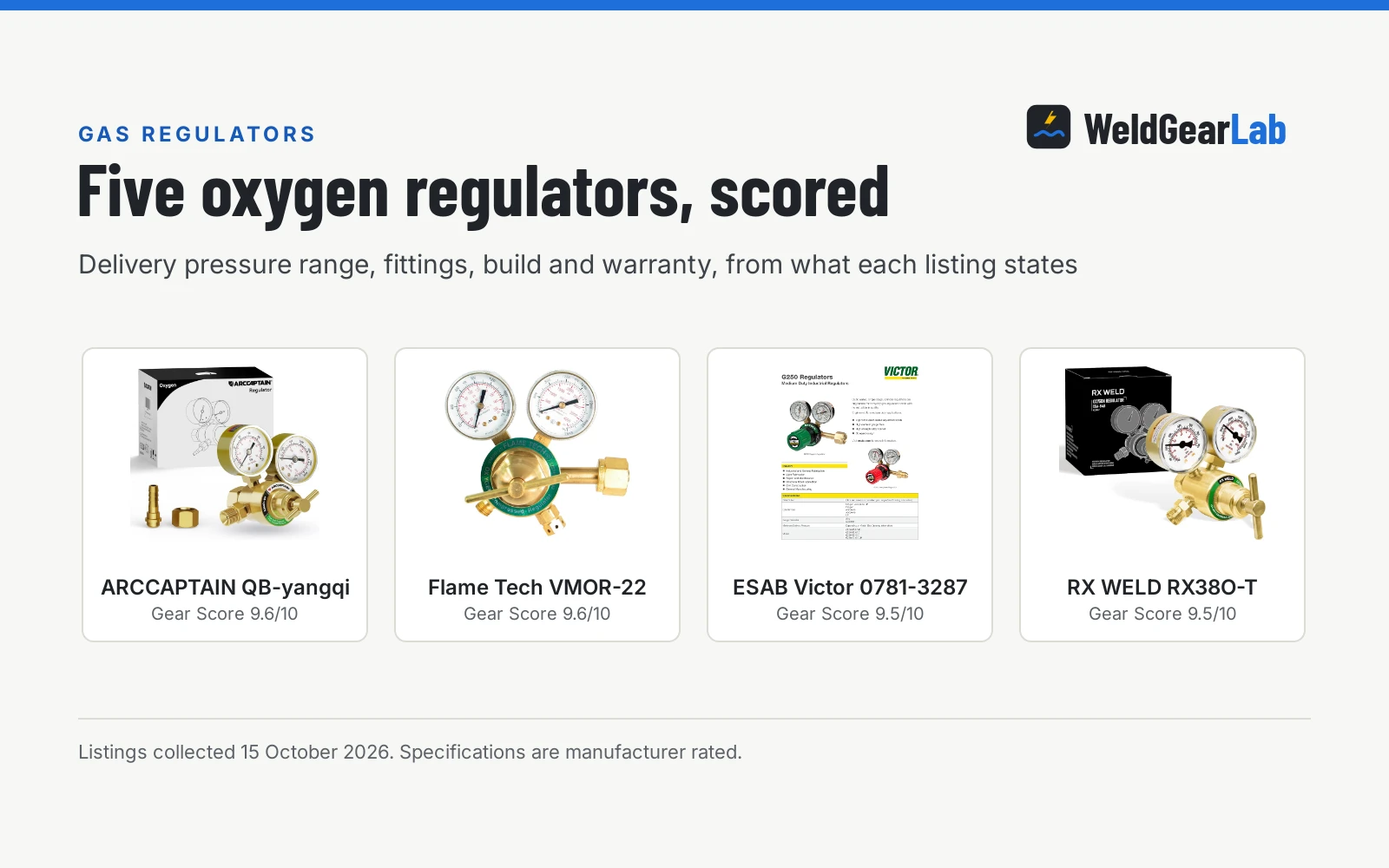
 Best OverallARCCAPTAIN QB-yangqi9.6/10View on Amazon
- 2
 Heaviest BuildFlame Tech VMOR-229.6/10View on Amazon
- 3
 Longest WarrantyESAB Victor 0781-32879.5/10View on Amazon
- 4
 Standard Torch ReplacementRX WELD RX38O-T9.5/10View on Amazon
Hooking up an oxy-fuel cutting torch or brazing rig starts at the bottle valve, where an oxygen regulator for welding tank setups controls high cylinder pressure down to safe working pressure. Whether you are slicing rusty plate or sweating copper, having steady delivery pressure keeps your flame neutral and your cut clean. This guide compares five oxygen regulators on stated delivery pressure, fitting specs, metal build, and warranty terms.
WeldGearLab gets a commission on purchases made through links on this page, and your price stays the same. Read our affiliate disclosure.
Quick picks
- Best Overall ARCCAPTAIN QB-yangqi: A brass regulator with 0-100 PSI delivery, sintered inlet filter, pressure relief valve, included 1/4 inch hose barb, and a 1 year warranty. Check price on Amazon
- Heaviest Build Flame Tech VMOR-22: A 3.8 lb forged brass body and bonnet, 5-125 PSI delivery, sintered inlet filter, safety relief valve, and Victor compatibility. Check price on Amazon
- Longest Warranty ESAB Victor 0781-3287: A dual regulator set with high contrast gauge faces, color-coded adjustment knobs, and a stated 2 year manufacturer warranty. Check price on Amazon
- Standard Torch Replacement RX WELD RX38O-T: A 1.7 lb brass regulator with CGA-540 inlet, 9/16-18 B outlet, 0-100 PSI delivery, and 2 inch gauges for V-style torches. Check price on Amazon
The machines


ARCCAPTAIN Oxygen Regulator Gauge for Gas Welding
A brass oxygen regulator with 0-100 PSI delivery, sintered inlet filter, pressure relief valve, 1/4 inch hose barb, and a 1 year warranty.
Pros
- Inlet filter and pressure relief valve stated in the listing
- Includes both 9/16-18RH connection and 1/4 inch hose barb
- Brass regulator body weighing 1.83 pounds
- 1 Year warranty description stated in the spec table
Cons
- Delivery pressure tops out at 100 PSI
- Listing first appeared in April 2024
- Gauge diameter is not stated
- Package includes only the oxygen regulator and barb, no acetylene unit
Flame Tech Oxygen Regulator, Medium Duty
A heavy 3.8 lb forged brass oxygen regulator with forged bonnet, 5-125 PSI delivery, sintered metal filter, and Victor compatibility.
Pros
- Forged brass body and bonnet stated in bullets
- Sintered metal inlet filter and safety relief valve included
- Heaviest stated weight here at 3.8 lbs
- Stated delivery pressure up to 125 PSI with Victor compatibility
Cons
- No warranty term is stated
- Single oxygen regulator with no acetylene regulator included
- No hose barb included in the package
- Listing does not state maximum inlet pressure

Set of Victor G350 Oxygen & Acetylene Regulators
A dual regulator set with high contrast gauges, color-coded knobs, and the longest stated warranty here at 2 years.
Pros
- Includes both G250-150-540 oxygen and G250-15-510 acetylene regulators
- 2 Year Manufacturer warranty stated in the spec table
- Color-coded adjustment knobs and high contrast gauge faces
- Combined package weight of 6.59 pounds
Cons
- Inlet and delivery pressure ranges are not stated
- Body material is not stated in the listing
- Gauge diameters are not stated

RX WELD Oxygen Regulator CGA 540 Inlet
A brass single oxygen regulator with 0-100 PSI delivery, 2 inch dual-unit dials, T-handle adjustment, and CGA-540 inlet.
Pros
- Brass regulator body weighing 1.7 pounds
- Dual dials with kPa and psi units up to 100 PSI delivery
- Stated 2 inch diameter gauges with T-handle style
- Standard CGA-540 inlet and 9/16-18 B outlet for twin welding hose
Cons
- No warranty term is stated
- Does not state an internal inlet filter or relief valve
- Single oxygen regulator, no acetylene unit included
- Delivery pressure limited to 100 PSI

RX WELD Oxygen Acetylene Regulator Set
A medium-duty two-regulator set offering up to 200 PSI oxygen delivery, CGA-540 and CGA-510 fittings, and T-handle controls.
Pros
- Includes both CGA-540 oxygen and CGA-510 acetylene regulators
- Oxygen delivery pressure rated up to 200 PSI
- T-handle style with outlet hose connector nuts included
- Rated for medium duty gas welding and cutting kits
Cons
- No warranty term is stated
- Internal filter and relief valve are not stated
- Item weight listed as 2.4 kg for the pair
Other welders and gear to compare
 RX WELD Oxy Acetylene Regulator SetCheck price on Amazon
 CDL LX65 Medium Duty Oxygen Regulator CGA540Check price on Amazon
 Oxygen Acetylene Regulator SetCheck price on Amazon
 2pcs Dual Welding Gas RegulatorsCheck price on Amazon
 BETOOLL Argon/CO2 Mig Tig Flow Meter Gas Regulator GaugeCheck price on Amazon
 SPARC Argon Regulator & Flow MeterCheck price on Amazon
Spec sheet comparison
| Model | Gear Score | Inlet connection | Delivery pressure | Body material | Item weight | Type | Warranty |
|---|---|---|---|---|---|---|---|
| ARCCAPTAIN QB-yangqi | 9.6/10 | CGA-540 | 0-100 PSI | Brass | 1.83 lb | Single regulator | 1 year |
| Flame Tech VMOR-22 | 9.6/10 | CGA-540 | 5-125 PSI | Forged brass | 3.8 lb | Single regulator | None stated |
| ESAB Victor 0781-3287 | 9.5/10 | CGA-540 & CGA-510 | Not stated | Not stated | 6.59 lb | Two-regulator set | 2 years |
| RX WELD RX38O-T | 9.5/10 | CGA-540 | 0-100 PSI | Brass | 1.7 lb | Single regulator | None stated |
| RX WELD RX75OA-T Set | 9.5/10 | CGA-540 & CGA-510 | 0-200 PSI oxy | Not specified | 2.4 kg | Two-regulator set | None stated |
Treat the specs as maker ratings pulled straight from the listings; we gathered them on 14 October 2026.
Buying guide: choosing an oxygen regulator for welding tank setups
Inlet and cylinder compatibility
In North America, industrial oxygen cylinders use a standard CGA-540 valve connection with right-hand external threads. Never attempt to adapt an oxygen regulator to a fuel gas bottle or an inert gas bottle. Each gas family uses distinct CGA thread sizes to prevent catastrophic gas contamination.
Delivery pressure range
Cutting attachments and heating nozzles require different operating pressures depending on metal thickness. Always consult your torch manual or tip chart for the recommended operating pressure. Regulators delivering 0-100 PSI or 5-125 PSI, or 0-200 PSI on heavy-duty models, provide ample headroom for shop cutting and heating tasks.
Body construction and filter protection
Regulator bodies take repeated pressure cycles whenever a cylinder valve is cracked open. Forged brass bodies and bonnets offer greater structural density and resistance to accidental impacts than cast metals. In addition, an internal sintered bronze or mesh filter in the inlet stem traps cylinder scale and debris before it can damage delicate internal valve seats.
Hose connections and fittings
Torch hoses in welding shops typically use B-size 9/16-18 threads, with right-hand threads reserved for oxygen and left-hand grooved nuts reserved for fuel gases. Some regulators also bundle a 1/4-inch hose barb, which allows direct connection to flexible lines when threaded nuts are not used.
Single regulators vs dual sets
If your existing acetylene regulator is working well, buying a dedicated single oxygen regulator saves money and bench space. However, if both of your regulators are aging, leaking, or creeping under static pressure, a matched two-regulator set provides fresh diaphragms and consistent gauge visibility across both gas lines.
Safe cylinder handling. Always chain cylinders upright to a sturdy cart or shop wall before removing safety caps or attaching regulators. Never allow oil, grease, or petroleum-based lubricants to contact oxygen valves, regulators, or cylinder threads, because high-pressure oxygen reacts explosively with hydrocarbons. Stand to the side of regulator gauge faces when opening cylinder valves, and always open the oxygen valve slowly and fully to seat the back-seating valve. See our welding consumables hub for related shop setup guides.
Before You Strike an Arc
- Confirm cylinder connection: verify your oxygen bottle has standard CGA-540 right-hand threads before tightening the inlet nut with a proper cylinder wrench.
- Check inlet filter cleanliness: inspect the inlet nipple on arrival to ensure the sintered filter or screen is clean and free of shop dust or thread sealant.
- Inspect hose threads: ensure your green oxygen hose matches the stated 9/16-18 right-hand B-fitting or fits the provided 1/4-inch hose barb adapter.
- Back off the adjustment knob: loosen the regulator T-handle or adjustment knob completely counterclockwise before opening the cylinder valve so high pressure does not slam the low-pressure diaphragm.
- Perform a leak check: apply an approved, oil-free gas leak detection solution to the cylinder joint and hose nuts to confirm tight seals before lighting the torch.
FAQ for welders
What is a gas regulator for welding?
A welding gas regulator reduces high storage pressure inside a compressed gas cylinder down to a stable, lower delivery pressure for torches or welding machines. It uses internal diaphragms and springs to keep output pressure steady as tank pressure drops during work. Dual-gauge models show both remaining cylinder pressure and working line pressure.
What inlet fitting does an oxygen welding tank use?
Standard compressed oxygen cylinders in North America use a CGA-540 inlet fitting with right-hand threads. Fuel gas cylinders like acetylene use different fittings, such as CGA-510 with left-hand threads, to prevent accidental cross-connections. Always verify that your regulator inlet matches the valve stamped on your oxygen bottle.
Can I use an oxygen regulator for propane or acetylene?
No, oxygen regulators are built and threaded specifically for oxygen service and must never be used for fuel gases like propane or acetylene. Oxygen equipment uses right-hand threads, while fuel gas regulators use left-hand grooved nuts to prevent dangerous mix-ups. Regulators exposed to fuel gases or oil can create an explosion hazard if subsequently connected to pure oxygen.
What is the difference between single-stage and two-stage regulators?
Single-stage regulators drop cylinder pressure down to delivery pressure in one step, which can cause slight delivery pressure rise as the tank empties. Two-stage regulators drop pressure in two steps, delivering constant working pressure across the life of the cylinder. Most shop cutting and brazing rigs use single-stage regulators, which handle daily fabrication tasks well.
How do I know what delivery pressure to set for cutting?
Check the cutting tip chart from your torch manufacturer for the exact operating pressure recommended for your tip size and metal thickness. The regulators here deliver working pressure 0-100 PSI or 5-125 PSI, and one model delivers 0-200 PSI, providing headroom for heating and cutting setups. Never exceed the recommended pressure for your torch tip.
Related: welding consumables hub, best gas regulator for MIG welding, gas regulator for welder, plasma cutter vs oxy acetylene torch, what size gas bottle for home welding, and rent vs buy a welding gas cylinder.
Scoring, line by line
Each regulator is scored on performance, build, value, safety listing and warranty, with the weights published on our How We Pick page. Gas regulators have no electrical safety listing to state, so every regulator here scores zero on that criterion; the ranking comes from the other four.
| Product | Gear Score | Perf. /35 | Build /25 | Value /25 | Safety /10 | Warranty /5 |
|---|---|---|---|---|---|---|
| ARCCAPTAIN QB-yangqi | 9.6 | 29 | 20 | 21 | n/a | 2 |
| Flame Tech VMOR-22 | 9.6 | 32 | 24 | 20 | n/a | 0 |
| ESAB Victor 0781-3287 | 9.5 | 24 | 19 | 20 | n/a | 3 |
| RX WELD RX38O-T | 9.5 | 28 | 19 | 20 | n/a | 0 |
| RX WELD RX75OA-T Set | 9.5 | 27 | 16 | 20 | n/a | 0 |
Think of 9.2 as the bottom and 9.8 as the top. Totals are placed between them in proportion, which keeps the order intact: more points, higher score. Where safety does not apply (unpowered gear with no listed safety features), it is left out and the remaining 90 points make up the score.