Oscillating Tool vs Angle Grinder: Which One Should You Buy?
An oscillating tool and an angle grinder cut in completely different ways; this guide matches each tool to the job and ranks four cordless oscillating tools from what their listings state.

On this page
Top picks at a glance
As an Amazon Associate I earn from qualifying purchases.
- 1
 AMZWEI 28PCS Oscillating Saw Blades9.7/10View on Amazon
- 2
 DEWALT Angle Grinder Tool9.7/10View on Amazon
- 3
 BLACK+DECKER Angle Grinder ToolView on Amazon
- 4
 DEWALT Angle GrinderView on Amazon
- 5
 DEWALT FLEXVOLT ADVANTAGE 20V MAX* Angle GrinderView on Amazon
- 6
 CRAFTSMAN Small Angle Grinder Tool 4-1/2 inchView on Amazon
- 7
 CRAFTSMAN V20* Angle GrinderView on Amazon
- 8
 DEWALT Angle Grinder ToolView on Amazon
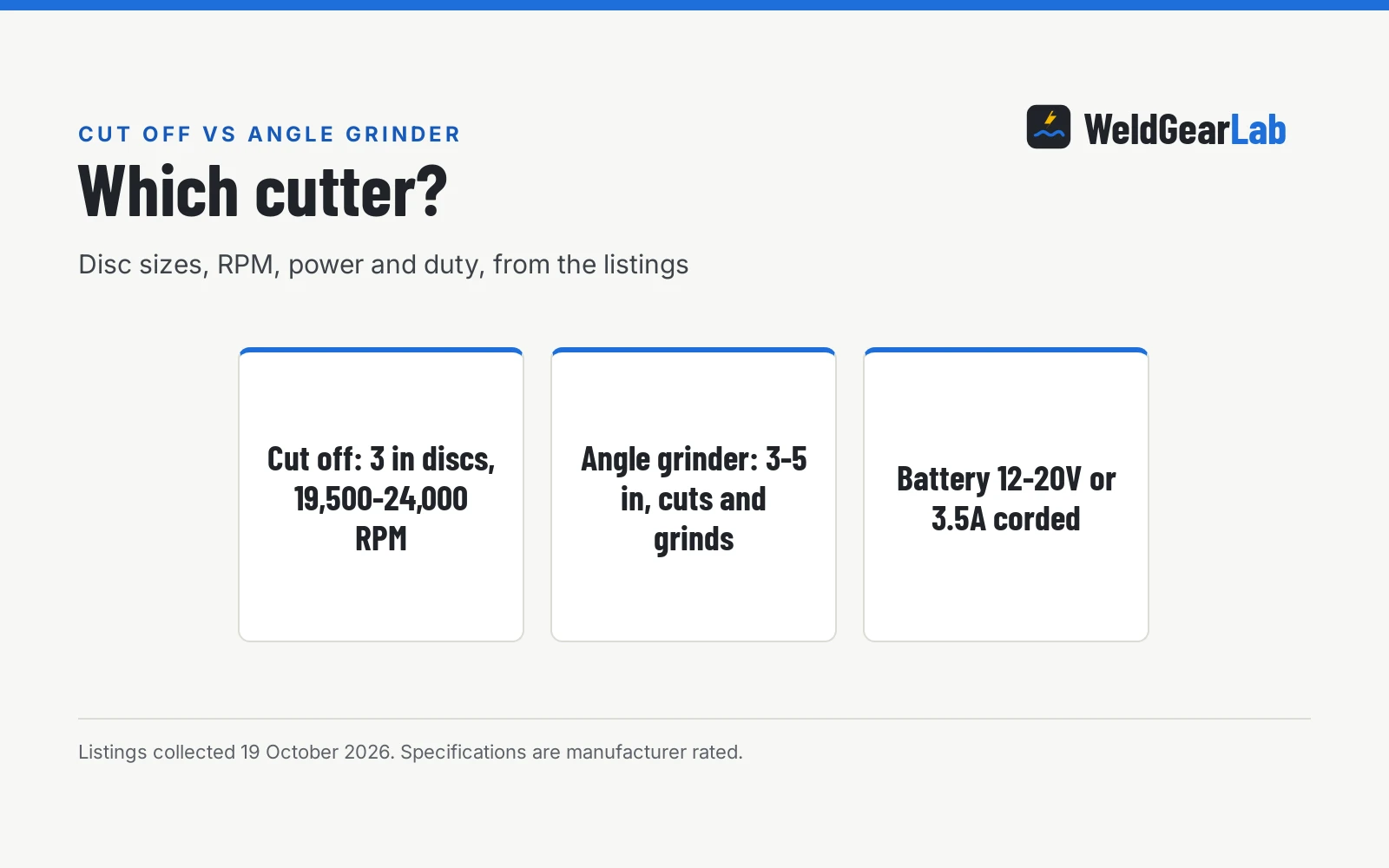
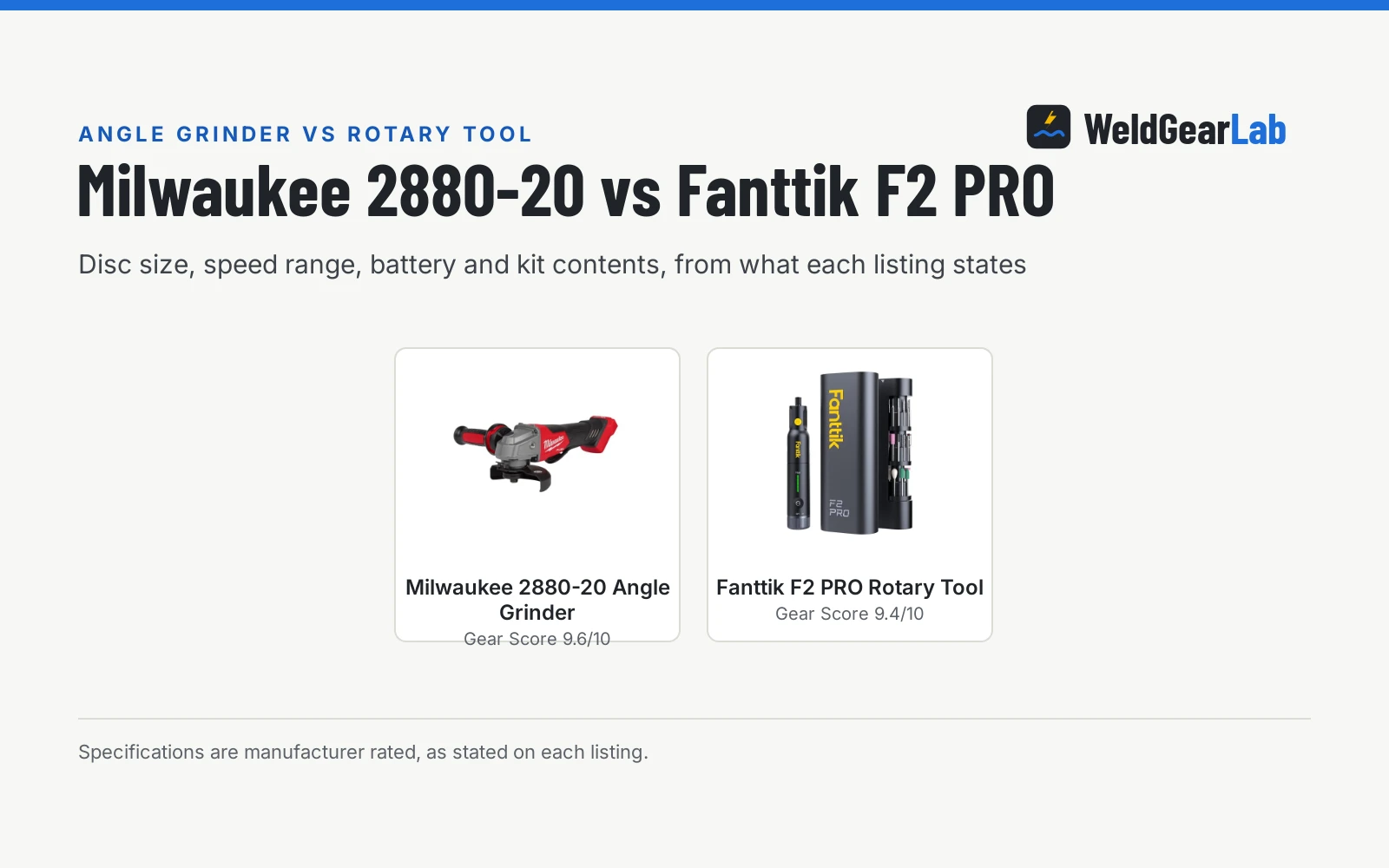
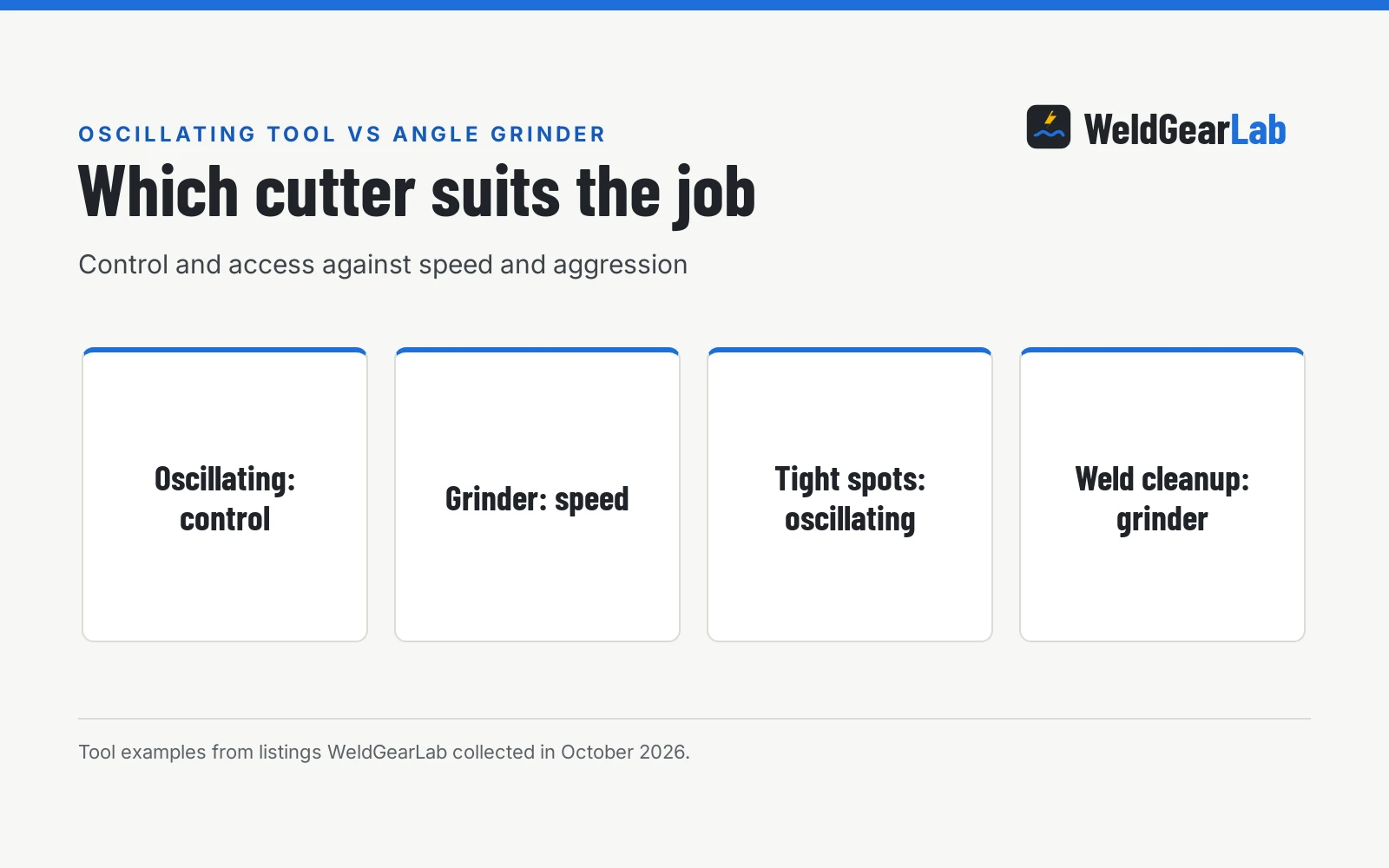
A rusted bolt in a tight corner, a weld that needs cleaning up, a patch panel to trim. Oscillating tool vs angle grinder is the question of which cutter suits the job on the bench. Pick the oscillating tool for controlled, detailed cuts in tight spots: plunge cuts, flush cuts, sanding and scraping without the sparks. Pick the angle grinder for fast metal removal: cutting steel, grinding welds and stripping rust at speed. One is a scalpel, the other is a cleaver, and a shop that does both kinds of work ends up owning both.
Other welders and gear to compare
 BLACK+DECKER Angle Grinder ToolCheck price on Amazon
 DEWALT Angle GrinderCheck price on Amazon
 DEWALT FLEXVOLT ADVANTAGE 20V MAX* Angle GrinderCheck price on Amazon
 CRAFTSMAN Small Angle Grinder Tool 4-1/2 inchCheck price on Amazon
 CRAFTSMAN V20* Angle GrinderCheck price on Amazon
 DEWALT Angle Grinder ToolCheck price on Amazon
This guide links to our product roundups, where WeldGearLab gets a commission on purchases made through links on this page, and your price stays the same. Read our affiliate disclosure.
Oscillating tool vs angle grinder in one paragraph
An oscillating tool drives a small blade in rapid side-to-side strokes, which makes it easy to steer for plunge cuts and flush cuts against a surface. An angle grinder spins a disc at high speed, which removes metal fast but throws sparks and needs two hands. The oscillating tool wins on control and access; the angle grinder wins on speed and aggression. Match the tool to the cut, not the other way around.
Side by side
| Oscillating tool | Angle grinder | Takeaway | |
|---|---|---|---|
| Cutting action | Short side-to-side strokes | Spinning disc | Stroke against spin |
| Starting a cut | Plunge cuts anywhere on the panel | Plunge cuts possible but risky | Oscillating plunges cleanly |
| Metal removal speed | Slow and controlled | Fast and aggressive | Grinder is faster |
| Detail work | Flush cuts, corners, sanding | Poor in tight spots | Oscillating for detail |
| Sparks and dust | Few sparks, light dust | Sparks and heavy dust | Oscillating is cleaner |
| Handling | One hand, easy to steer | Two hands, kickback risk | Oscillating is easier to steer |
| Accessories | Blades, sanding pads, scrapers | Discs, wheels, wire brushes | Different accessory families |
| Learning curve | Quieter, beginner friendly | Loud, demands respect | Oscillating is friendlier |
The table states the trade in plain terms. If the job is precise and close quarters, the oscillating tool is the pick. If the job is heavy and fast, the angle grinder is the pick.
When the oscillating tool is the better choice
- Plunge cuts in the middle of a panel. Starting a cut mid-panel with a spinning disc risks kickback; an oscillating blade drops straight in.
- Flush cuts against a surface. Trim a bolt, dowel or jamb level with the surface it sits in.
- Sanding and scraping without a tool change. The listings here bundle sanding pads and multi-use blades, so one tool finishes the job.
- Grout removal in tight joints. The compact head reaches joints a grinder head struggles to enter.
- Work where sparks are unwelcome. Indoors, near finished surfaces, or around anything flammable, the oscillating tool keeps the drama down.
When the angle grinder is the better choice
- Cutting steel bar, tube and sheet at speed. Nothing in the oscillating class keeps up with a spinning disc on stock removal.
- Grinding weld beads flush. Beveling edges for fit-up and smoothing beads is grinder work, full stop.
- Stripping rust, paint and mill scale. A wire wheel or flap disc on a grinder strips rust, paint and mill scale.
- Notching and slotting. A thin cutting disc slices narrow slots faster than an oscillating blade.
- Heavy cleanup. When the job is measured in square feet of rust, bring the aggressive tool.
The gear
This section covers cordless oscillating tools on what their listings state: speed control, weight, what comes in the box and warranty. The angle grinder side of the question is covered by the comparison above; for grinder picks see the best angle grinder roundup.
DEWALT 20V MAX XR DCS356D1 is the only complete kit here: a 2 Ah battery and DCB107 charger come in the box, the only listing of the four that includes both. The brushless motor is stated to deliver up to 57% more runtime over brushed, with a 3-speed selector and a dual-grip variable speed trigger for control. A universal accessory adapter fits most brands’ blades, the quick-change system swaps blades without wrenches, and a bright LED lights the cut. At 2.3 lb with a 3 yr warranty on material and workmanship, it is the ready-to-work pick.
Milwaukee M18 2626-20 is the speed-control pick: 12 speed settings from 11,000 to 18,000 OPM per the bullets. Note the listing contradicts itself here: the spec table lists an 8,000 rpm minimum speed, which does not match the bullets, and the bullets win on the listing’s own detail. An all-metal gear case, rubberized handle and an LED panel on the head suit jobsite use, and REDLINK lets the battery ease off power when the tool nears overheating. It is 11-7/8 in long and 2.9 lb, battery not included, with a 5-year tool warranty.
Makita 18V LXT XMT03Z is the aggressive-cut pick: a 3.2° oscillation angle stated for faster, more aggressive cutting and sanding, with a variable speed dial from 6,000 to 20,000 OPM and a slide switch with lock-on for long passes. The 2-3/8 in barrel grip suits smaller hands, and included adapters fit most competitive accessories. At 4 lb it is the heaviest of the four, tool only, with a 3-year limited warranty.
Milwaukee M12 2426-20 is the compact pick: a 12V tool at 10-1/4 in long and 1.63 lb per the bullets, the lowest weight here. Twelve speed settings run 5,000 to 20,000 OPM, a universal adaptor takes competitive accessories, and the onboard fuel gauge shows remaining charge in 25% increments. The listing states it cuts, grinds, sands and scrapes, and includes a sanding head with pads. Note another listing contradiction: the spec table lists 1.1 lb, which does not match the bullets’ 1.63 lb tool weight, and the bullets win. Battery not included, with a 5-year warranty.
Can one tool do both jobs?
Not really. An oscillating tool cannot replace a grinder for weld cleanup or fast steel cutting, and an angle grinder is the wrong tool for a plunge cut in a finished panel or sanding a tight corner. Shops that do both kinds of work keep both tools on the cart. If the budget covers one, buy the one that matches the next job, then add the other when the work asks for it.
Sparks, kickback and dust. An angle grinder throws sparks and can kick back if a disc binds, so clamp the work, keep the guard fitted and wear eye protection. Grinding dust calls for a respirator in still air. Oscillating tools are milder but still throw chips on a cut, so glasses stay on for them too. Pull the battery before swapping blades or discs. See the Safety Disclaimer.
FAQ for welders
Can an oscillating tool replace an angle grinder for metal work?
For light cuts yes, for heavy work no. An oscillating tool handles thin stock and detail cuts with control, but it cannot match a grinder for weld cleanup, beveling or fast steel cutting. Pair an oscillating tool with a grinder when the job turns heavy. That is the whole point of the comparison above.
What do the OPM figures on the listings mean?
OPM is orbits per minute, the speed of the blade’s side-to-side stroke. The listings here state 5,000 to 20,000 OPM on the Milwaukee M12, 6,000 to 20,000 OPM on the Makita dial, 11,000 to 18,000 OPM on the Milwaukee M18 and a 3-speed selector on the DEWALT. Lower speeds suit delicate work like sanding, while higher speeds cut faster. Match the speed to the accessory and the material.
Battery included or tool only: what am I actually buying?
Only the DEWALT DCS356D1 here includes a battery and charger: a 2 Ah battery and DCB107 charger in the box. The Milwaukee M18, the Makita and the Milwaukee M12 are all tool only, battery not included. If you already own the matching battery platform, tool only is the way to add another tool. If not, the DEWALT kit is the complete package.
Can I use one brand’s blades on another oscillating tool?
Usually yes with these four. The DEWALT, Makita and Milwaukee M12 listings all state a universal adapter or adaptor that fits most competitive accessories. The Milwaukee M18 lists an adapter in the box as well. Blade fit still varies by brand, so check the adapter the listing names before stocking up.
Which one is the better first buy for a new shop?
The oscillating tool is the friendlier first buy: easier to control, no sparks, and useful for cuts, sanding and scraping around the house and shop. The angle grinder demands more respect, with kickback and sparks to manage. Start with the oscillating tool and add the grinder when metal work picks up.
Related: the best angle grinder roundup, flap disc vs grinding wheel, cut off wheel vs grinding wheel and the best die grinder picks.