Ingersoll Rand 3101G Review: Specs, Pros, Cons and Who It Suits
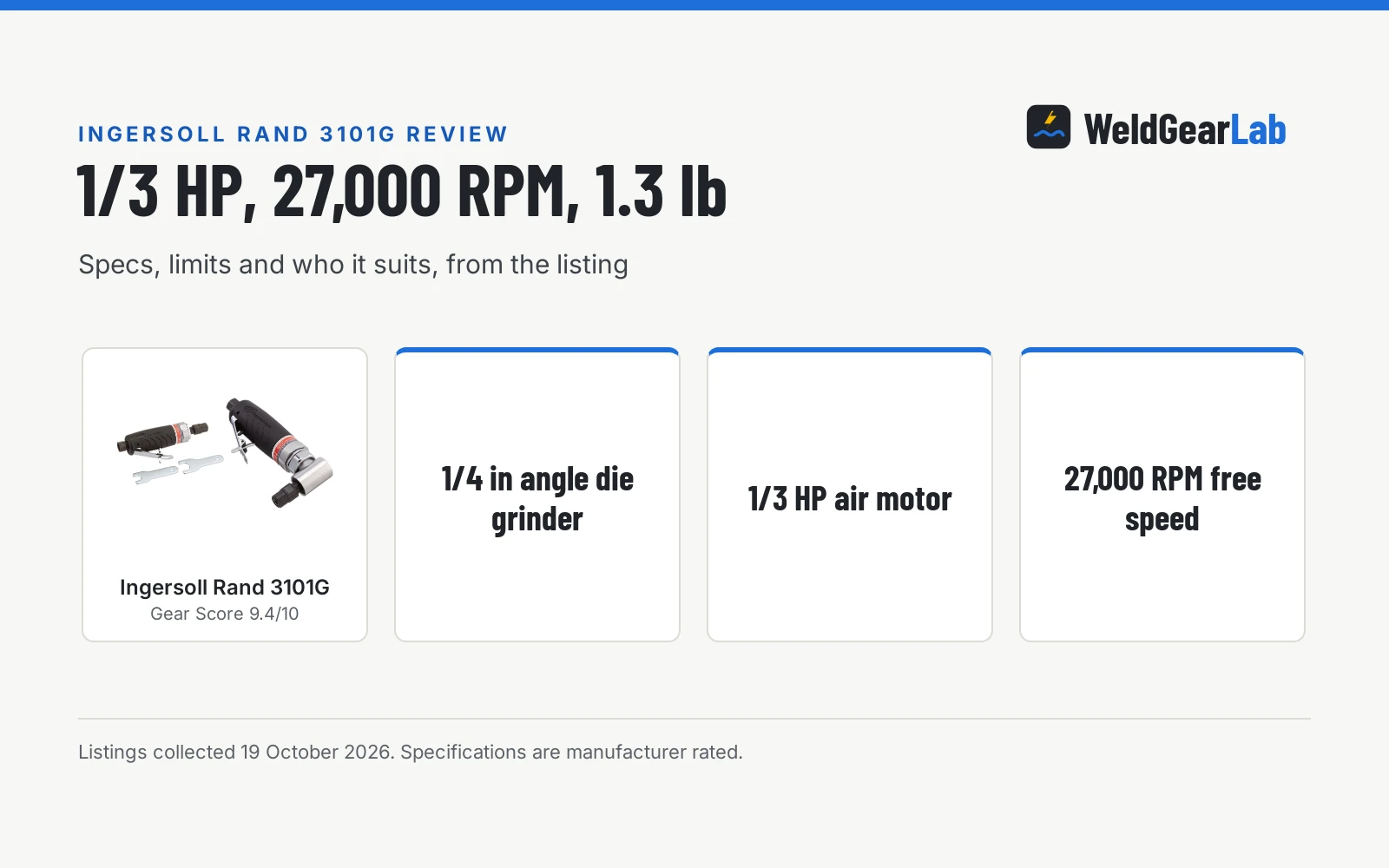
An Ingersoll Rand 3101G review from the listing: a 1/4 in heavy-duty angle die grinder with a 1/3 HP motor and 27,000 RPM free speed, and the listing's 3101G/3107G mix-up.

On this page
Deburring a weld, cleaning a plasma-cut edge, or opening up a bolt hole usually ends with a die grinder in your hand. This ingersoll rand 3101g review looks at Ingersoll Rand’s 1/4 in heavy-duty angle die grinder from its Amazon listing: a 1/3 HP air motor spinning 27,000 RPM free speed in a 1.3 lb composite body. We have not used this grinder ourselves; this review is based on the listing’s stated specs, and the listing itself needs some untangling before you trust it.
As an Amazon Associate I earn from qualifying purchases. WeldGearLab gets a commission on purchases made through links on this page, and your price stays the same. Read our affiliate disclosure.
The grinder

Ingersoll Rand 3101G 1/4 in Heavy Duty Angle Die
A 1/4 in heavy-duty angle die grinder with a 1/3 HP air motor, 27,000 RPM free speed and ball bearing construction in a 1.3 lb composite body.
Pros
- 1/3 HP air motor with 27,000 RPM free speed
- Ball bearing construction
- Light 1.3 lb composite body with ergonomic grip
- Angle head suits tight spots a straight grinder cannot reach
Cons
- No air consumption (CFM) figure stated
- No warranty term stated
- No noise figure stated
Ingersoll Rand 3101G review: the short verdict
The 3101G is a pneumatic angle die grinder: shop air drives a 1/3 HP motor to 27,000 RPM free speed, and the angle head aims the 1/4 in tool where a straight grinder points the wrong way. The listing’s headline specs are straightforward: ball bearing construction, a composite body with an ergonomic grip, and a 1.3 lb weight that keeps wrist fatigue down on long deburring sessions.
The catch is the listing, not the tool. The title names both the 3101G and the 3107G, the bullets read like two product descriptions stitched together under “Product 1” and “Product 2” headings, and the spec table lists the model number as “3101G, 3107G”. The specs are consistent across the merged text: the spec table states 0.33 HP and 27,000 RPM, the Product 1 bullets claim the 1/3 HP motor and the Product 2 bullets claim the 27,000 RPM free speed, with ball bearing construction and the composite body in both. But confirm with the seller which model actually ships before you order.
What the listing leaves out matters too. There is no air consumption figure, no noise rating and no warranty term stated anywhere in the bullets or the spec table. Those are standard questions before buying any air tool, and here you have to ask the seller directly.
Key specs
| Spec | Ingersoll Rand 3101G |
|---|---|
| Model number | 3101G (listing also names 3107G) |
| Type | 1/4 in heavy-duty angle die grinder |
| Power source | Air |
| Motor | 1/3 HP (0.33 hp) |
| Free speed | 27,000 RPM |
| Bearings | Ball bearing construction |
| Body | Composite, ergonomic grip |
| Weight | 1.3 lb |
| Color | Black |
| Air consumption | Not stated |
| Noise | Not stated |
| Warranty | Not stated |
All specs here repeat what the maker rates and the listing prints, copied down 19 October 2026. Free speed is the RPM with no load; the wheel slows under load, so treat 27,000 RPM as the ceiling, not the working speed. The listing states no air consumption, so the CFM your compressor must deliver is a question for the seller.
What the 3101G does well
Power and speed for the class
A 1/3 HP motor at 27,000 RPM free speed is solid for a 1/4 in angle die grinder. That combination suits deburring, port work, weld cleanup and rust removal, the jobs where a die grinder earns its keep in a fab shop. Ball bearing construction is the durability note the listing leans on, and bearings are the right place to look on an air tool that lives at high RPM.
Light in the hand
At 1.3 lb with a composite body and an ergonomic grip, this is a grinder you can run overhead or inside a fender without your forearm quitting first. Die grinder work is often one-handed and out of position, so weight is not a footnote here; it decides whether you finish the job or hand it off. The composite body keeps the tool light without giving up the housing.
Angle head for tight work
The angle head gets the bit into corners, inside tubing and behind flanges where a straight die grinder points the wrong way. For weld cleanup in tight fit-up and for dressing the back side of a joint, that angle is the reason to pick this shape over the inline style.
Limitations
- Two models in one listing: the title, bullets and spec table mix the 3101G and the 3107G. The specs agree, but confirm which model you are buying before you order.
- No air consumption stated: no CFM or operating pressure range appears on the listing. Size your compressor by asking the seller, and plan for a filter and dryer in the line.
- No warranty stated: no warranty term appears in the bullets or the spec table. If a written warranty matters to you, confirm it with the seller first.
- No noise figure: the listing states no dBA rating. Air die grinders run loud; keep hearing protection in the shop regardless of the number.
- Bits are on you: the listing names no included accessories, so plan on supplying your own 1/4 in shank burrs and mounted points.
How we scored it
| Product | Gear Score | Perf. /35 | Build /25 | Value /25 | Safety /10 | Warranty /5 |
|---|---|---|---|---|---|---|
| Ingersoll Rand 3101G | 9.4 | 28 | 20 | 20 | 0 | 0 |
A pick’s weighted total decides where it lands between a 9.2 floor and a 9.8 ceiling, and a bigger total never produces a smaller number.
The Gear Score weighs performance, build, value, safety and warranty. The 3101G scores on performance for its stated 1/3 HP and 27,000 RPM free speed, and on build for ball bearing construction and the composite body. Value is held back because the listing’s 3101G/3107G mix-up makes it hard to know exactly what ships. Safety and warranty score zero because the listing states no safety certification, no safety features and no warranty term.
Who should buy the Ingersoll Rand 3101G, and who should skip it
Buy it if
- You want a name-brand 1/4 in angle die grinder for deburring, weld cleanup and port work.
- Light weight matters: 1.3 lb with a composite body and an ergonomic grip.
- You already run shop air and own 1/4 in shank bits and burrs.
- You can confirm with the seller that the 3101G is the model that ships.
Skip it if
- You need stated air consumption or a noise rating on paper before you buy.
- You want a written warranty term in the listing.
- You need a straight die grinder instead; see our best straight air die grinder picks.
Before You Strike an Arc
- Check the model on arrival: the listing mixes the 3101G and the 3107G, so confirm the tool in the box matches what you ordered.
- Feed it clean, dry, regulated shop air, and oil the motor per the maker’s instructions before the first run.
- Match the bit to the collet: the listing calls this a 1/4 in grinder, so use 1/4 in shank burrs and check the collet seats the shank fully.
- Wear eye and hearing protection; die grinders throw debris and run loud, and the listing states no noise figure to plan around.
Alternatives
- Straight shape: our best straight air die grinder roundup covers pneumatic picks in the inline shape.
- Angle vs straight: the die grinder vs angle grinder guide sorts out which tool fits the job.
FAQ for welders
What is the Ingersoll Rand 3101G?
It is a 1/4 in heavy-duty angle die grinder: an air-powered rotary tool with a 1/3 HP motor, 27,000 RPM free speed and ball bearing construction in a 1.3 lb composite body. The angle head suits tight spots in metal fab and repair work. If you are new to the tool, our what is a die grinder guide covers types and uses.
What is the difference between the 3101G and the 3107G?
The listing names both models in the title and the spec table, and the bullets read as two merged product descriptions. It does not explain the difference between them, so confirm with the seller which model ships before you buy.
How much air does the 3101G need?
The listing states no air consumption figure. Ask the seller for the CFM requirement, and run the grinder on clean, dry, regulated shop air with a filter in the line.
Does the 3101G come with a warranty?
No warranty term appears on the listing. If a written warranty matters to you, confirm it with the seller before ordering.
Related: best die grinder cut off wheels, die grinder vs angle grinder, and the metal fab tools hub.