What Is Die Grinder: Types, Uses, and Shop Guide
A die grinder is a high-speed rotary tool built for deburring, weld cleanup, porting, and detailed metal fabrication where larger angle grinders cannot fit.

On this page
Top picks at a glance
As an Amazon Associate I earn from qualifying purchases.
- 1
 BHA 3 x 1/32 x 3/8 Cut Off Wheels for Die Grinders9.7/10View on Amazon
- 2
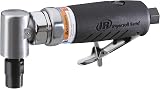 Ingersoll Rand 3101G 1/4" Collet Air Die Grinder Max free9.7/10View on Amazon
- 3
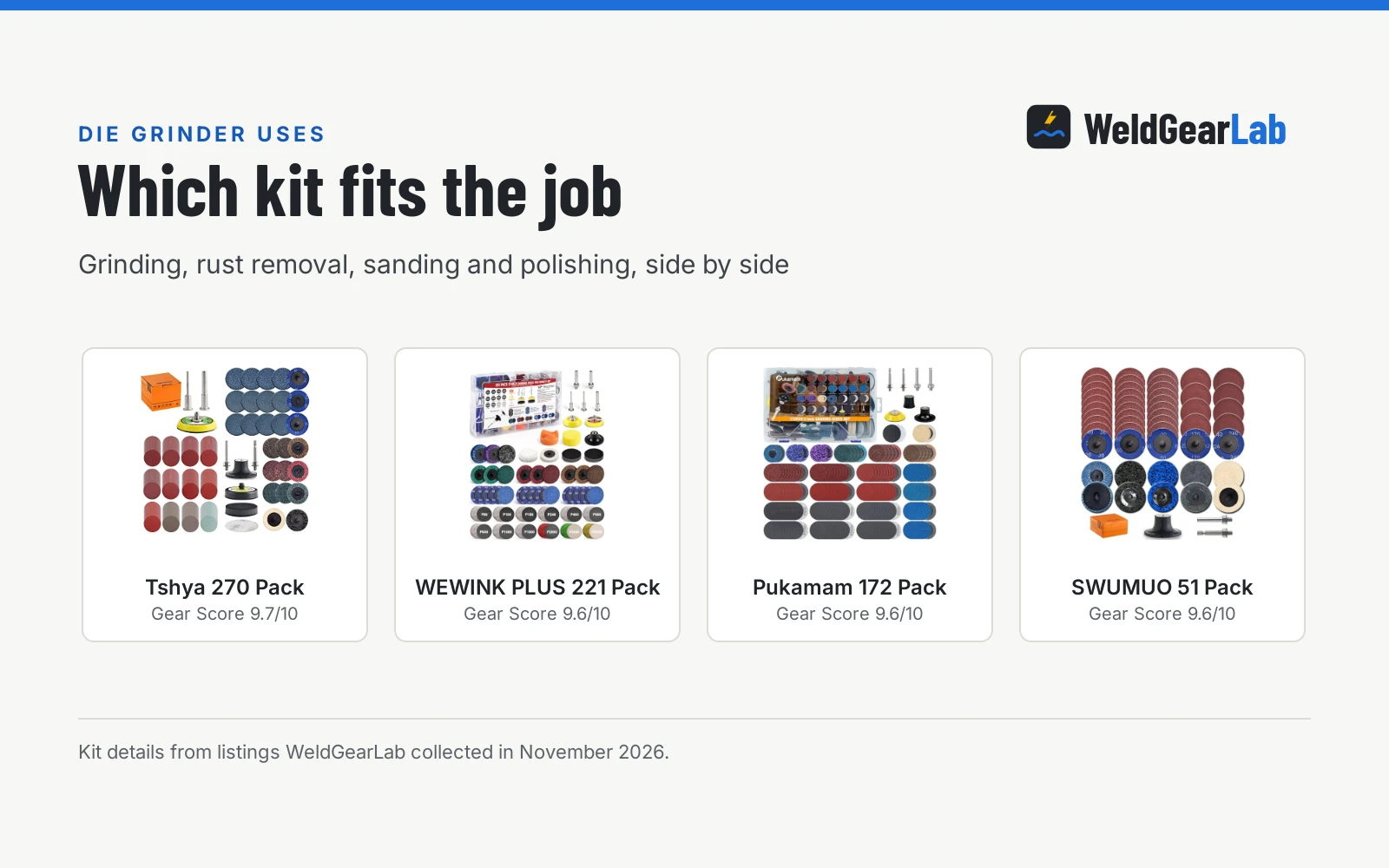
 Tshya 270Pack 2inch Sanding Discs Pad Variety Kit for Drill9.7/10View on Amazon
When you finish laying a bead inside an awkward corner bracket or fitting up square tubing with burrs on the cut edges, a standard angle grinder is often too bulky to reach the seam. That is where a die grinder comes into play. What is die grinder tooling? A die grinder is a compact, handheld rotary power tool designed to spin mounted accessories like carbide burrs, mounted stones, sanding cartridges, and cut-off wheels at high rotational speeds to grind, deburr, carve, and finish metal in tight spaces. While an angle grinder uses a broad abrasive disc mounted on an arbor for heavy stock removal across wide surfaces, a die grinder turns a compact accessory inline with or at a right angle to the tool body, giving you pinpoint control over delicate joint cleanup and internal contours.
This guide links to our product roundups, where WeldGearLab gets a commission on purchases made through links on this page, and your price stays the same. Read our affiliate disclosure.
What is die grinder tooling and purpose
To understand what does die grinder operation accomplish on raw steel, look at how the tool transfers motor power to the workpiece. Instead of using a threaded arbor and flange nuts like a cut-off saw or disc grinder, a die grinder uses a collet system that clamps directly onto the shank of a rotating bit. The motor drives the collet spindle at high velocity, allowing small-diameter cutting heads to achieve the surface speed necessary to carve steel smoothly without bogging down or chattering across the joint.
Welders frequently ask what is a die grinder when stepping up from bulky angle grinders to more detailed metal prep. The tool takes its name from tool-and-die shops, where machinists used high-speed rotary spindles with mounted stones to polish stamping dies and deburr machined cavity corners. In modern welding and fabrication shops, straight and right-angle models are die grinder configurations built for narrow weldments, pipe interiors, gusset corners, and sheet metal edge preparation. Knowing what is a die grinder for helps welders select the proper rotary tooling for seam prep rather than forcing an oversized grinding wheel into a confined gap.
Side by side
| Pneumatic (Air) | Cordless Battery | Corded Electric | |
|---|---|---|---|
| Power supply | Compressed air line and compressor | Rechargeable lithium-ion battery pack | Standard electrical wall outlet |
| Portability | Tethered to air hose and compressor | Complete mobility anywhere in shop or field | Tethered to power extension cord |
| Body weight and profile | Lightest and slimmest barrel housing | Moderate weight with attached battery pack | Heavier motor housing |
| Runtime limits | Limited by compressor air delivery and tank volume | Limited by individual battery pack charge capacity | Continuous corded power, limited by motor heat under heavy load |
| Common shop role | Production benches and weld cleanup booths | Mobile repair, field service, and odd angles | Bench fabrication without shop air lines |
| Setup gear | Requires air compressor, regulator, and hose | Requires battery charger and spare battery packs | Requires nearby grounded power receptacle |
| Thermal management | Exhaust air flow cools the tool housing | Motor and battery warm under sustained load | Motor vents heat through housing exhaust |
Choosing between pneumatic, cordless, and corded drive platforms depends on where you work and how long each grinding session lasts. Production fab shops with plumbed air lines prioritize pneumatic tools for continuous duty, while mobile repair trucks rely on battery systems for cord-free flexibility.
When pneumatic is the better choice
Understanding why use a die grinder powered by compressed air comes down to tool weight, motor size, and heat dissipation:
- Low tool weight and compact grip. Air motors contain few moving parts and carry no heavy battery packs or copper motor windings. For example, Ingersoll Rand lists its 307B straight air die grinder at 0.73 pounds with a 0.25 hp motor, and its 3101G right-angle air model at 1.3 pounds with a 0.33 hp motor.
- Continuous duty cycle. An air tool can run continuously without overheating because expanding compressed air naturally cools the aluminum housing. Ingersoll Rand lists its 409 pneumatic model with a 0.5 hp rated motor delivering 27,000 rpm for continuous shop tasks.
- Stated speeds. Ingersoll Rand rates the 307B at 28,000 rpm, while AEROPRO lists its AP17314 mini straight air grinder at 22,000 rpm.
Air consumption depends on the tool size and workload. For example, AEROPRO lists its AP17314 mini grinder with an average air consumption of 4.5 cfm and suggests a 1.5 hp air compressor. Larger industrial pneumatic grinders demand even higher air delivery to prevent the tool from losing velocity under sustained shop use. See our roundup of the best straight air die grinder models for dedicated shop air picks.
When cordless or corded electric is the better choice
Electric die grinders eliminate the need for an air compressor and air hoses, making them ideal for field service, mobile trailer repair, and garages without heavy-duty air plumbing:
- Cordless jobsite mobility. Battery-powered die grinders let you walk onto a jobsite or climb onto a trailer without dragging air hoses or power cords. Milwaukee lists its 2486-20 straight die grinder on a 12-volt battery system with a 0.3 hp motor output delivering up to 24,500 rpm at 1.2 pounds bare tool weight. PropeLannt lists an 18-volt cordless brushless model delivering 25,000 rpm with built-in power protection.
- Speed settings for varied materials. Corded electric models often include variable speed dials. VEVOR lists a 120-volt corded grinder rated at 225 watts and 1.1 hp featuring 6 speed settings ranging from 10000 to 28000 rpm at a tool weight of 4.3 pounds. SENCAN lists a corded 120-volt model with a 600-watt, 5.5-amp motor delivering 6 speed settings from 10000 to 33000 rpm at 3.7 pounds.
- Worklight visibility in tight spaces. Cordless housings often incorporate forward lighting. Milwaukee lists its 3485-20 right-angle 12-volt die grinder at 1.7 pounds with a shadowless LED work light and a spindle lock for fast accessory changes.
- No compressor maintenance. Electric grinders avoid the moisture draining, oiling, and hose management inherent to pneumatic systems.
Review our best die grinder guide to compare cordless and corded picks scored across metal fabrication tasks.
Collet sizes and accessory mounting
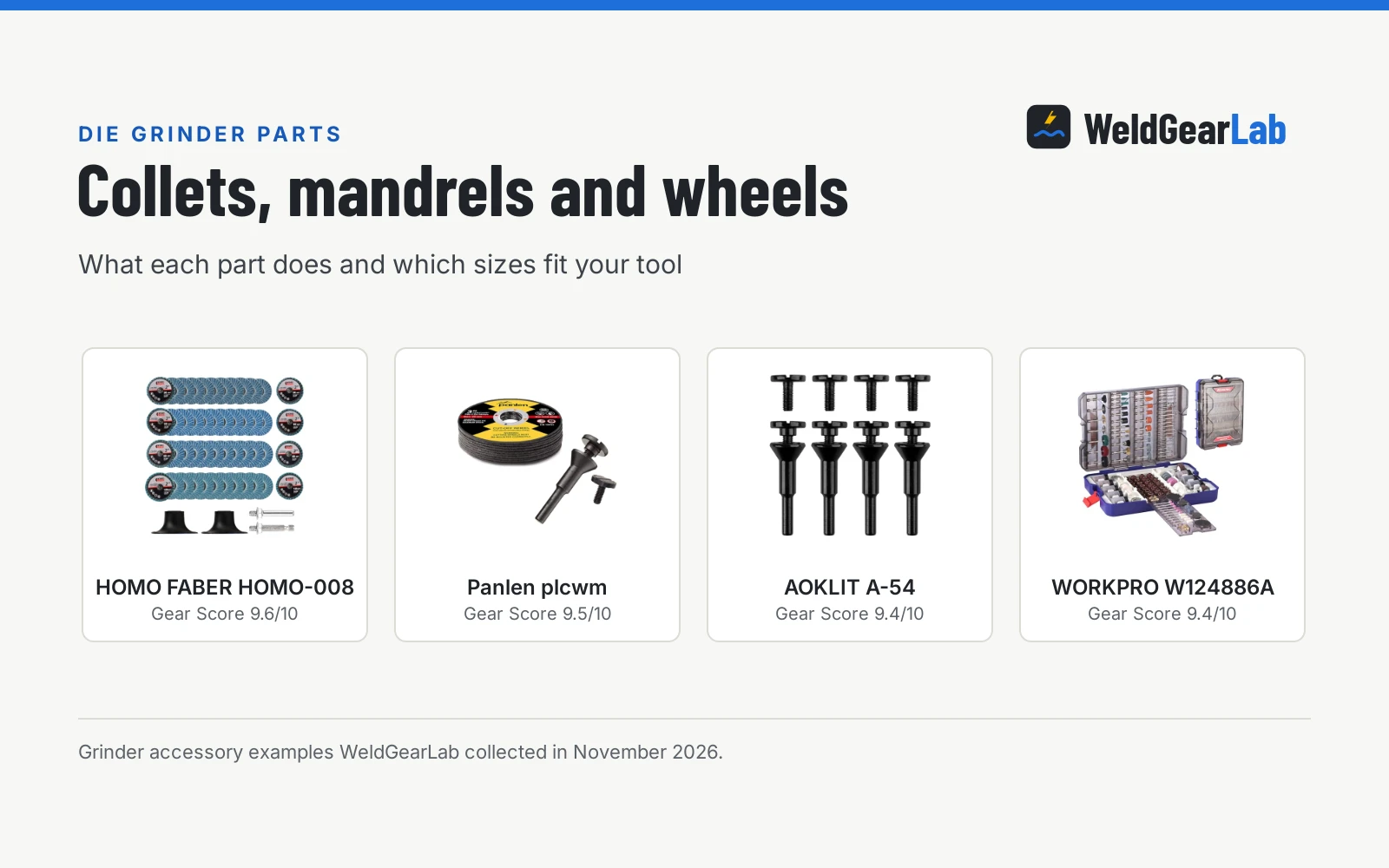
Examining what is die grinder good for requires understanding how bits seat into the collet. A collet is a slotted metal sleeve that contracts evenly around a cylindrical bit shank as the collet nut is tightened with open-end wrenches. The shank must match the collet diameter precisely:
- 1/4-inch collets. The standard industrial size in US metal fabrication. Ingersoll Rand, Milwaukee, SENCAN, VEVOR, PropeLannt, and AEROPRO all equip their tools with a 1/4-inch collet. Standard 1/4-inch shanks accept heavy carbide burrs, flap wheels, wire brushes, and cut-off wheel arbors. SENCAN lists its standard 1/4-inch collet with a stated 6.35 mm capacity.
- 1/8-inch collets. Used for delicate deburring, small porting burrs, and engraving. AEROPRO lists both 1/4-inch and 1/8-inch collet compatibility for its AP17314, and VEVOR includes both a 1/4-inch collet and a 1/8-inch collet in the box.
- 6mm collets. Common on metric accessories. Ingersoll Rand includes a 6mm collet alongside its 1/4-inch hardware on the 307B and 409 models.
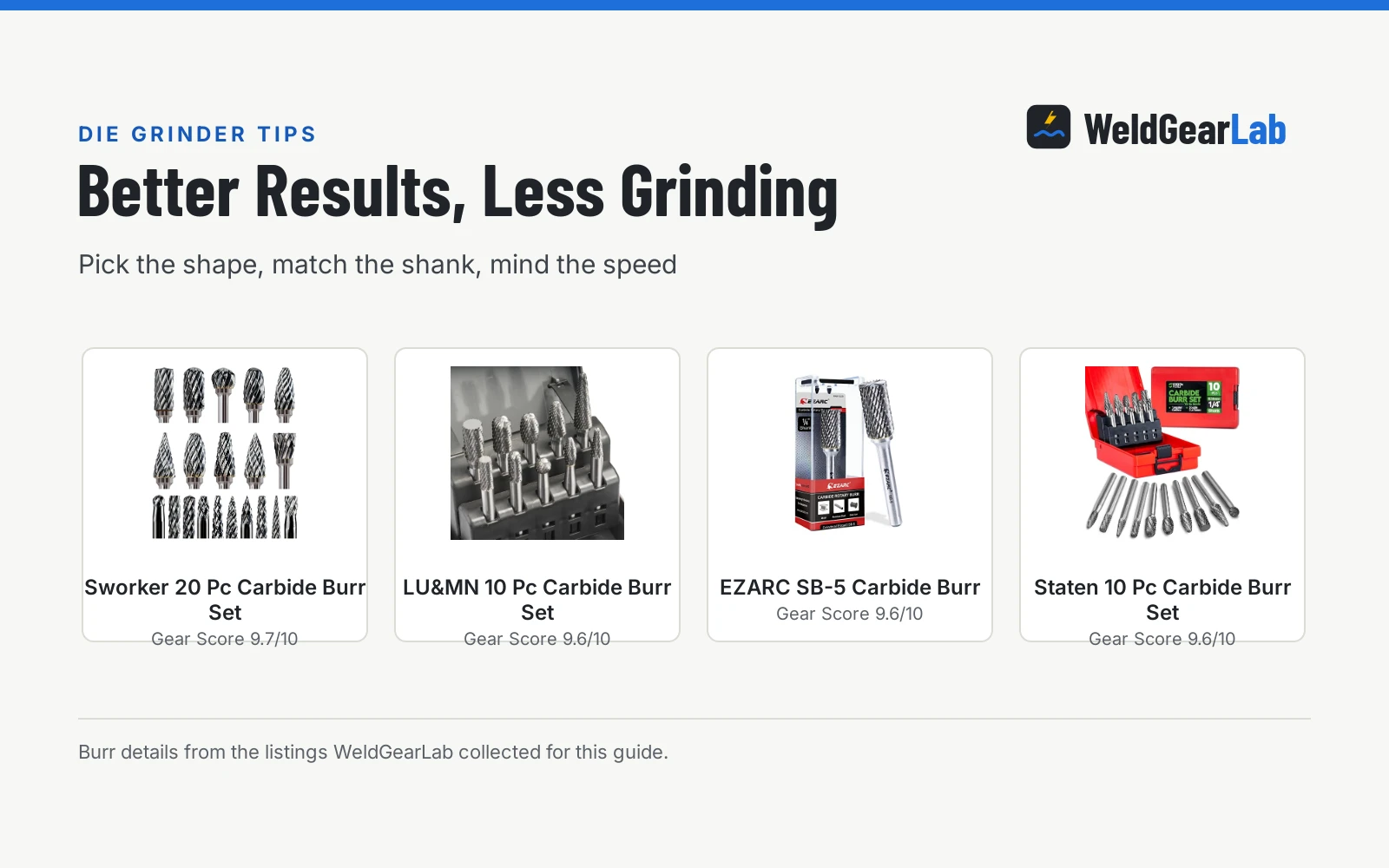
Common accessories include double-cut tungsten carbide burrs for carving steel, cross-buff pads for blending scratches, wire wheels for scale removal, and abrasive cut-off discs. When slicing sheet metal or bracket tabs in confined areas, pairing your tool with quality abrasive wheels is critical; see our guide to the best die grinder cut off wheels.
Die grinder vs angle grinder on the bench
Welders frequently compare die grinders and angle grinders when setting up a fab table. An angle grinder turns a wide abrasive disc mounted on a perpendicular arbor. It is designed for aggressive stock removal, beveling thick plate, flattening weld crowns, and cutting structural tube. However, its broad disc guard and wide gearhead make it difficult or impossible to reach inside small tubing, cope joints, or tight interior corners.
A die grinder sacrifices bulk material removal in exchange for precision and access. Its narrow profile allows you to clean up the root pass inside an open root joint, feather a tack weld without gouging adjacent plate, and deburr drilled holes cleanly. Many welders rely on an angle grinder for initial prep and use a die grinder for final fit-up and detailed cleanup; see our guide to the best angle grinder and our tutorial on how to remove mill scale before welding.
Rotational safety and eye protection. Die grinders operate at extreme rotational speeds where accessory failure or flying metal burrs present serious hazards. Always wear impact-rated safety glasses under a face shield, clamp your workpiece securely to avoid snagging, ensure every mounted burr or wheel is rated for the tool’s maximum speed, and never exceed manufacturer speed ratings. Avoid loose clothing or frayed gloves near rotating collets. See the OSHA welding overview and our Safety Disclaimer.
FAQ for welders
What is a die grinder used for in welding?
In welding shops, a die grinder is used to clean joint roots, remove spatter in confined seams, feather tack welds, and deburr cut edges before fit-up. It allows a welder to grind out porosity or slag inclusions inside narrow joint grooves where a standard angle grinder disc cannot reach. It also prepares pipe and tubing bevels for clean root passes.
Can you use a die grinder to cut metal?
Yes, a die grinder can cut metal when equipped with a small cut-off wheel mounted on a dedicated shank arbor. This setup allows precise cutting of rusted bolts, sheet metal patches, and small bracket tabs in confined engine bays or fabrication assemblies. Always ensure the cut-off wheel speed rating meets or exceeds the grinder speed before cutting.
What is the difference between straight and right-angle die grinders?
A straight die grinder has its spindle inline with the motor body, making it ideal for reaching down into pipes, deep holes, or long channels. A right-angle die grinder places the collet at a right angle to the body, providing better leverage, visibility, and control when working on flat panels, gasket surfaces, or tight vertical corners.
Can you put standard drill bits in a die grinder collet?
No, standard drill bits must never be mounted in a die grinder. High-speed steel drill bits are engineered for drilling at low speeds and will bend, chatter, or shatter violently under die grinder rotational speeds. Only use accessories explicitly rated for die grinder velocities, such as carbide burrs, mounted abrasive stones, and rated cut-off wheels.
Why use a die grinder instead of an angle grinder?
You should reach for a die grinder when precision, detail, or joint access matters more than high material removal rates. A die grinder cleans inside tubing, smooths tight fillet weld joints, and ports manifold passages where large angle grinder discs cause accidental gouging and cannot fit.
Related: best die grinder, best straight air die grinder, best die grinder cut off wheels, and the metal fab tools hub. Also see our guide to the best angle grinder for welding prep.