How to Use a Vertical Band Saw
A practical guide to using a vertical band saw for metal cutting, covering machine setup, blade speed selection, guide adjustments, curved cuts, and workshop safety.

On this page
Top picks at a glance
As an Amazon Associate I earn from qualifying purchases.
- 1
 JET 5" x 6" Metal Cutting Horizontal/Vertical Band Saw9.6/10View on Amazon
- 2
 MAXXT Band Saw with Lightweight Aluminum Base9.7/10View on Amazon
- 3
 Makita XBP03Z 18V LXT Lithium-Ion Cordless Compact Band Saw9.7/10View on Amazon
When you are fitting up gussets, trimming bracket tabs, or cutting curved profiles for a welding project, learning how to use a vertical band saw gives you clean, accurate cuts right at the bench. To use a vertical band saw, you mark your cut line on the workpiece, set the blade speed for your metal, drop the upper guide bracket close to the stock, switch on the motor, and feed the metal steadily across the table into the teeth. Keeping your hands clear of the blade path and letting the teeth cut without forcing produces smooth edges with minimal cleanup.
This guide links to our product roundups, where WeldGearLab gets a commission on purchases made through links on this page, and your price stays the same. Read our affiliate disclosure.
How to use a vertical band saw step by step
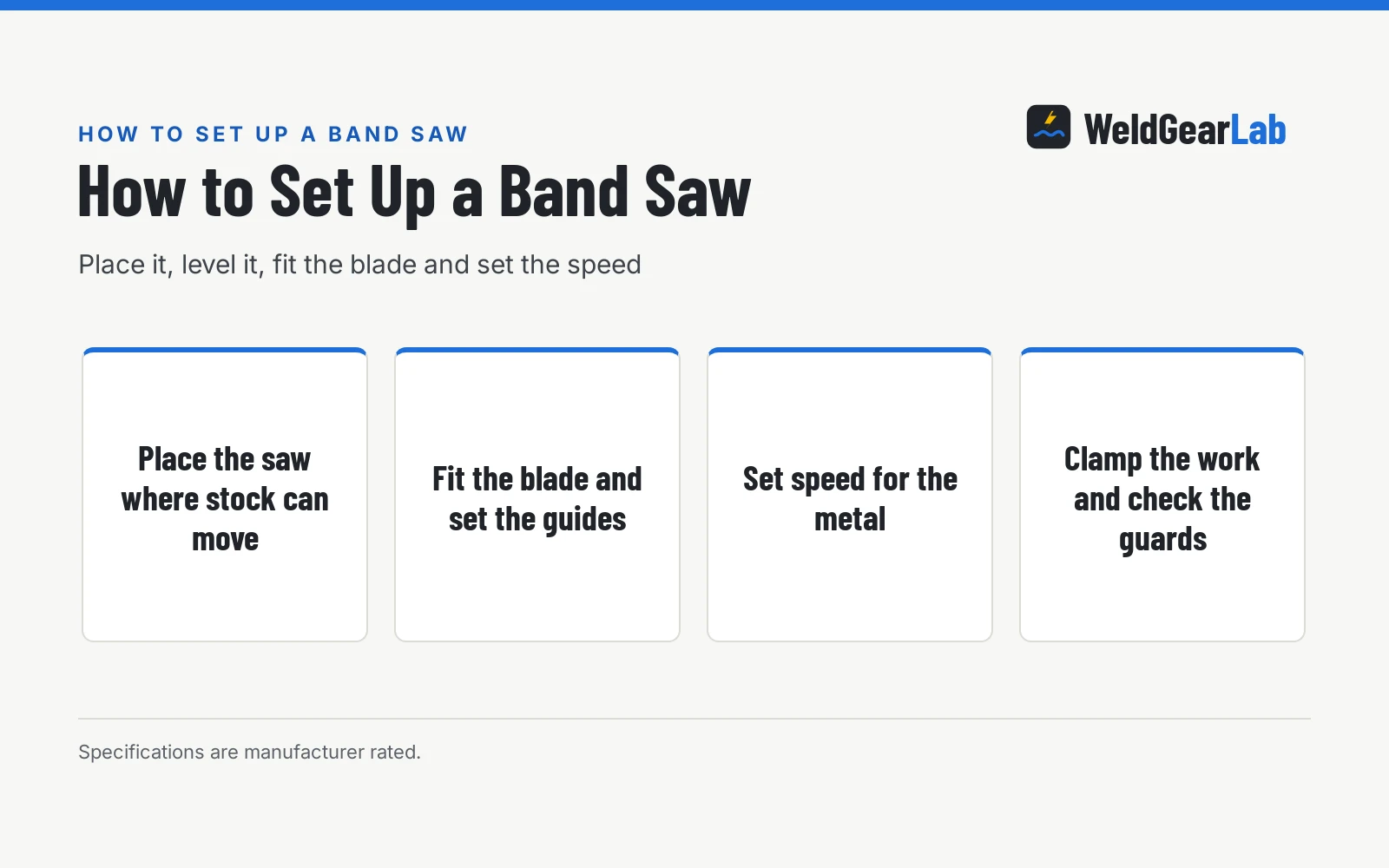
Operating a vertical band saw requires proper machine setup before the blade touches metal. Setting guides and supporting the workpiece prevents blade twist, tooth stripping, and wandering cuts.
- Layout and stock prep. Clean grease and mill scale off the metal, then scribe your cut line. Ensure the bottom face sits flat on the table plate so it cannot rock during feed.
- Adjust the upper guide bracket. Lower the upper guide assembly until it sits just above the workpiece surface. Minimizing exposed blade prevents the band from flexing sideways under feed pressure.
- Inspect tracking and tension. Check that the blade tracks properly on the wheels and tension the band taut. Low tension causes blade wander, while overtensioning strains wheel shaft bearings.
- Set blade speed. Use low speeds for steels to prevent overheating tooth tips. Moderate speeds suit aluminum, while plastics require controlled speeds to prevent melting.
- Start before contact. Switch on the motor and let the blade reach full operating speed before contacting metal. Starting against stock can catch teeth or kick the piece back.
- Feed steadily. Keep hands flat on the workpiece to the sides of the cut line. Push forward with smooth, uniform pressure along the mark, letting teeth cut without forcing.
- Use push blocks. Guide narrow tabs, small brackets, or cut ends with a wooden push block or notched stick instead of fingers.
- Make relief cuts on curves. Saw straight relief cuts from the scrap edge into the layout line before following a curve. Waste segments fall away so the blade does not bind.
- Shut down and clear swarf. Move cut parts clear, switch off the motor, and wait for the blade to stop before brushing chips off the table.
Side by side
Comparing machine specifications shows how cutting capacity and table options scale from benchtop units to convertible shop saws.
| Specification | KFMK Tabletop MBS125V | JET 5″ x 6″ HVBS-56 | JET 7″ x 12″ HVBS-712D |
|---|---|---|---|
| Motor power | 10A (1200 watts) | 1/2 HP | 3/4 HP (15A circuit) |
| Cutting capacity | 5-inch | 5″ x 6″ | 7″ x 12″ (4-1/2″ round at 45 degrees) |
| Blade speed | 137 to 472 FPM | 200 feet per minute (3 speed) | Not stated |
| Blade length and teeth | Not stated | 65 inches (24 teeth) | 93 inches (24 teeth) |
| Operating voltage | Not stated | 115 volts or 230 volts | 115 volts or 230 volts |
| Machine weight | 16.96 kg | 115 pounds | 374 pounds |
| Vertical cutting table | Liftable worktable | Vertical cutting plate | 9″ x 12″ infeed table assembly |
| Coolant system | Not stated | Not stated | 2.5-gal. (9 L) flood |
| Certification | Not stated | CSA | CSA/CUS |
| Warranty term | Not stated | 2 Year | 2 Year |
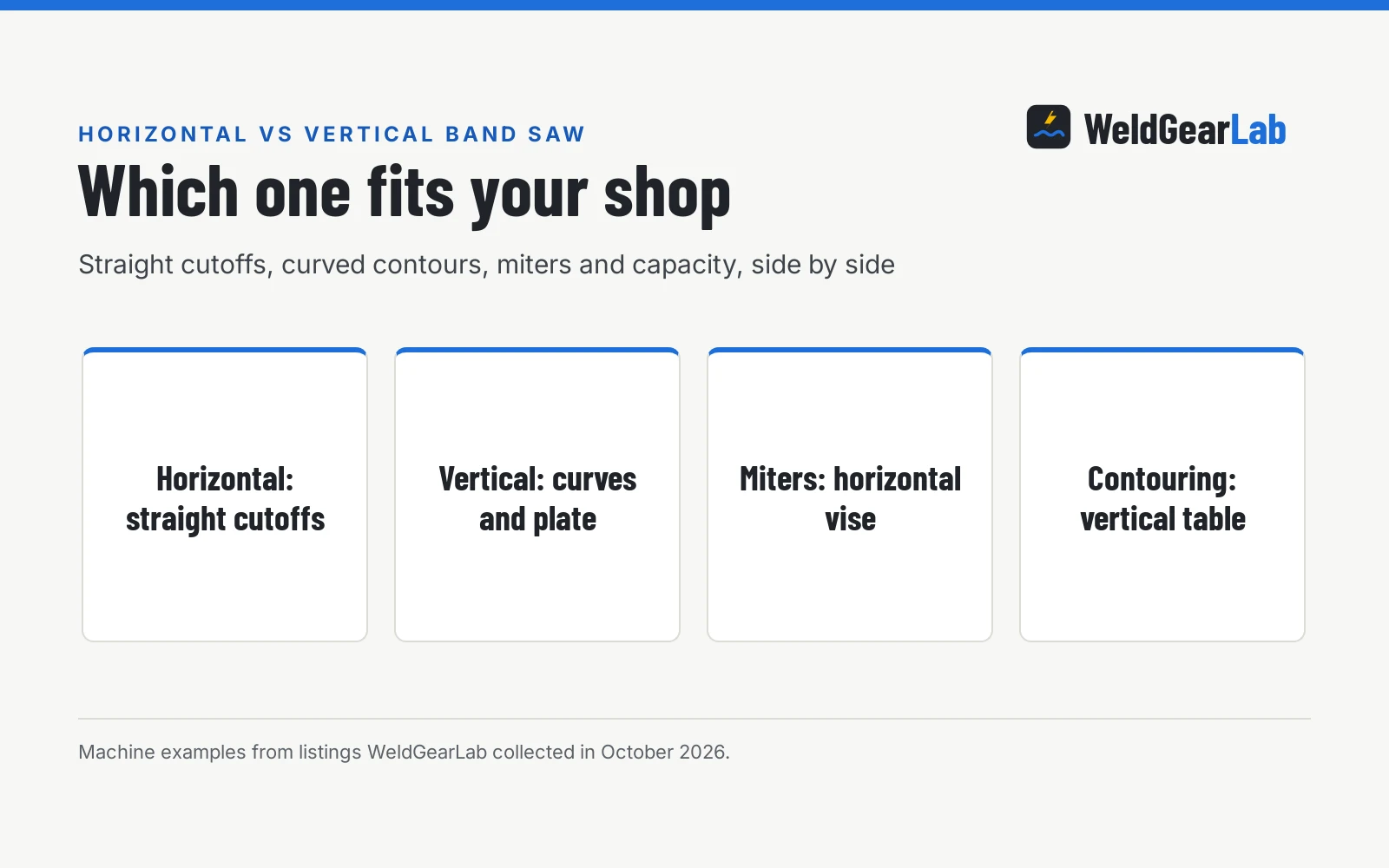
Vertical and horizontal modes serve different fabrication tasks. A vertical band saw functions as a contouring tool where you steer metal across a table plate to cut curves, notches, and gussets. A horizontal band saw clamps stock in a vise while gravity lowers the bow for square cutoff work.
When vertical cutting is the better choice
- Curved contours. Cutting circular gussets, rounded tabs, and irregular sheet profiles that cannot be clamped in a vise.
- Notching and coping. Trimming notches into angle, channel, or tubing for weld fit-up.
- Small brackets. Profiling small tabs and baseplates that are unsafe to hold in a horizontal vise.
- Visual line steering. Guiding intricate cuts directly along scribed layout marks.
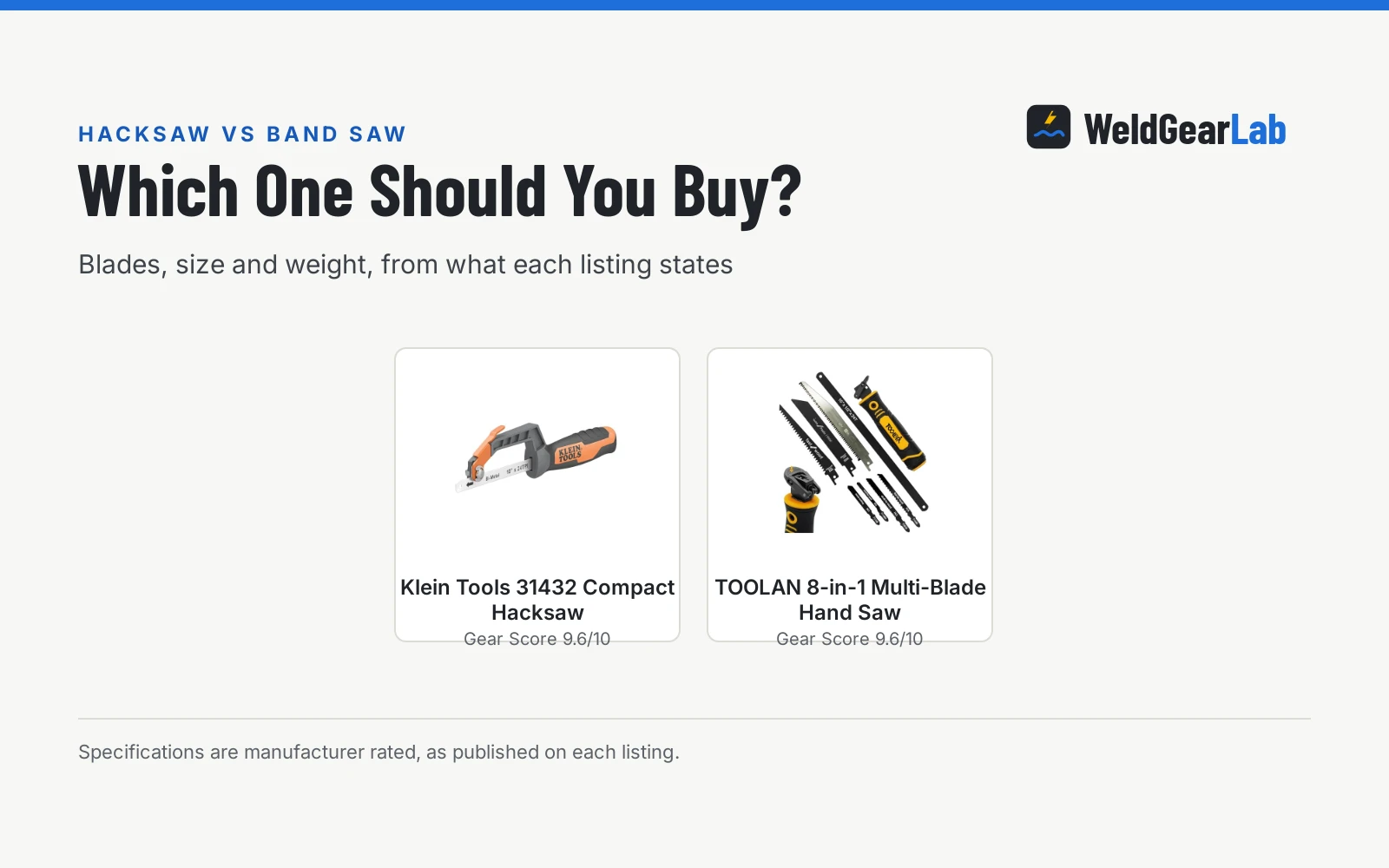
For jobsite work, see our roundup of the best portable band saw for metal.
When horizontal cutting is the better choice
- Repetitive square cutoffs. Slicing tubing, solid bar, and pipe to length with square faces ready for fit-up.
- Heavy solid stock. Clamping bar securely so the pivoting bow supplies continuous downfeed pressure.
- Miter cuts. Setting the vise to specific angles for clean frame corners.
- Auto shut-off. Walking away while the saw cuts and powers down automatically.
If you primarily chop structural stock, see our best horizontal band saw guide and cold saw vs band saw comparison.
How to tell what a machine supports
Published specifications highlight how power, capacity, and table hardware differ across machine tiers:
- Tabletop variable-speed saws. KFMK lists a 10A motor (1200 watts), an adjustable speed range from 137 to 472 FPM, a 5-inch cutting capacity, an item weight of 16.96 kg, and a liftable worktable with dual workbench design on its benchtop saw.
- Shop convertible saws. Jet lists a 1/2 HP motor on 115 volts or 230 volts with a 3 speed drive on its 5″ x 6″ model. Jet publishes a 200 feet per minute speed, a 65 inches blade with 24 teeth, a 14-gauge steel stand, 115 pounds weight, and a 2 Year warranty with CSA certification.
- Deluxe production saws. Jet specifies a 7″ x 12″ capacity, 3/4 HP motor on a 15A circuit (115 volts or 230 volts), a 93 inches blade with 24 teeth, a 9″ x 12″ infeed table assembly, 4-1/2″ round capacity at 45 degrees, 374 pounds weight, Four 8-inch rubber wheels, 15, 30, and 45 degrees mitering, a 2.5-gal. (9 L) flood coolant system, and a 2 Year warranty with CSA/CUS certification.
Check whether the table plate and vertical guide brackets are included before setting up a convertible frame for vertical work.
Which blade speed for metal cutting
Blade speed is measured in feet per minute (FPM) and directly impacts tooth wear and cutting heat:
- Steels. Steels need low speeds to prevent tooth tips from overheating and dulling prematurely.
- Aluminum. Non-ferrous alloys cut efficiently at moderate speeds. See our guide on horizontal band saw for aluminum for details.
- Plastics and wood. Wood tolerates the upper 137 to 472 FPM range listed on the KFMK tabletop saw, but plastics require controlled speeds to prevent melting.
- Tooth pitch. Keep multiple teeth engaged across the stock thickness. Finer blades, like the 24 teeth blades listed on Jet saws, prevent thin walls from snagging and stripping teeth.
Can one machine do both?
Yes. Convertible saws combine cutoff capacity and vertical contouring in one footprint. On models like the Jet 5″ x 6″ and 7″ x 12″ units, you lock the bow upright and bolt a table plate over the blade opening to cut brackets and curves. For tubing or bar cutoff, unbolt the table and lower the bow horizontally.
Band saw safety. Always wear safety glasses with side shields and hearing protection. Never wear gloves, loose sleeves, or jewelry near a running blade, because teeth can snag fabric and pull hands inward. Clear swarf with a brush rather than bare hands, and never reach past a moving blade. Ensure machine guards remain secured. See the OSHA welding overview and our Safety Disclaimer.
FAQ for welders
How close should the upper blade guide be to the metal?
Set the upper guide bracket as close to the workpiece surface as possible without dragging. Keeping the guide low minimizes unsupported blade length, preventing twist and wander under feed pressure.
Why does a vertical band saw blade wander off the layout line?
Wander typically stems from excessive feed force, a dull blade, or loose tension. Raising the upper guide too high also lets the blade flex sideways offline.
Can you cut curves on a vertical band saw?
Yes, contour cutting is the main purpose of a vertical band saw. Cutting straight relief cuts from the scrap edge into tight curves lets waste drop away without binding the blade.
How do you cut thin sheet metal without stripping blade teeth?
Select a fine tooth pitch, such as the 24 teeth blades listed on Jet saws, so multiple teeth engage the edge. Supporting sheet between scrap wood also prevents chatter and snagging.
Do you need cutting fluid when using a vertical band saw?
Manual vertical cutting on steel and aluminum is usually run dry or with a wax stick lubricant. While the Jet HVBS-712D (on Amazon) includes a 2.5-gal. (9 L) flood coolant system, flood fluid is designed for horizontal cutoff work rather than open vertical tables.
Related: best horizontal band saw, best portable band saw for metal, cold saw vs band saw, and the metal fabrication tools hub. Also see our guide on horizontal band saw for aluminum.