How Does a Hydraulic Press Work in the Metal Shop
A hydraulic press turns pump pressure into steady pressing force, and this guide explains the pump, cylinder, ram and frame with the shop presses that put them to work.

On this page
Top picks at a glance
As an Amazon Associate I earn from qualifying purchases.
- 1
 MAXSA 20T Hydraulic Press9.5/10View on Amazon
- 2
 VEVOR 20 Ton Shop Press, Pneumatic/Manual9.5/10View on Amazon
- 3
 VEVOR 20 Ton Hydraulic Shop Press9.5/10View on Amazon
- 4
 Dragway Tools 6-Ton Benchtop Hydraulic A-Frame9.4/10View on Amazon
A bearing that will not move, a bracket bent out of shape, a bushing pressed tight into its bore. That is the work that calls for a press, and the question behind it is how does a hydraulic press work. A pump pushes oil into a cylinder, the cylinder turns that pressure into force, and a ram carries that force into the work. The rest of this guide walks through each part, then shows the shop presses that put the idea to work.
This guide links to our product roundups, where WeldGearLab gets a commission on purchases made through links on this page, and your price stays the same. Read our affiliate disclosure.
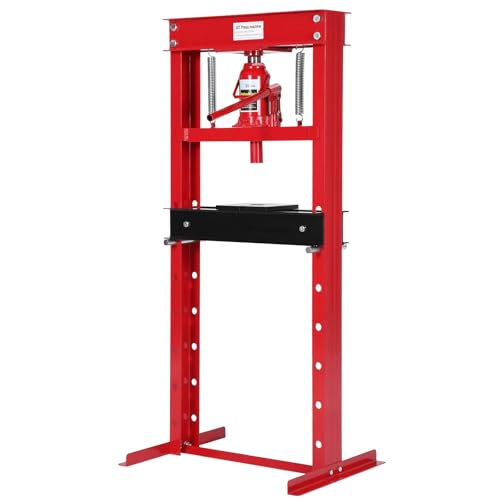
MAXSA 20T Hydraulic Press
A 20 ton H-frame press with an 8-position worktable, 2 movable plates and a built-in relief valve for bearing and bushing work.
Pros
- Built-in relief valve engages if pressure exceeds 20 tons
- 8-position worktable sets the working level for different jobs
- 2 sturdy pressure plates for load-bearing
- Powder-coated steel resists rust and scratches
Cons
- 8-position table against 9 height settings on the VEVOR presses
- No punch set comes in the box
- No pressure gauge to read while pressing
- 108.03 lb frame still needs floor space at 26.5 by 18.0 by 54.5 in
VEVOR 20 Ton Shop Press, Pneumatic/Manual
A 20 ton H-frame press with manual and pneumatic operation, a foot pedal and a 9 punch set for bearings, U-joints and bushings.
Pros
- Manual and pneumatic operation with a foot pedal for hands-free pressing
- 9 punch set from Ø10 mm to Ø48 mm for different workpieces
- 9 height settings from 0.4 to 38.6 in for different workpiece sizes
- H-frame carbon steel build with a reinforced triangular base
Cons
- No warranty term is stated
- 198.42 lb frame needs a set spot on the shop floor
- Needs an air compressor for pneumatic operation
- 64.17 in tall frame needs clear headroom
VEVOR 20 Ton Hydraulic Shop Press
A 20 ton H-frame press with a pressure gauge, manual and pneumatic operation and 9 height settings for bending, straightening and pressing.
Pros
- Hydraulic gauge shows pressure in real time while pressing
- Manual and pneumatic operation with an extended handle
- 9 height settings from 2.56 to 40.5 in for different workpieces
- 48 mm punch for stable pressing
Cons
- 191.8 lb frame needs a set spot on the shop floor
- Needs an air compressor for pneumatic operation
- 48 mm punch suits wide work, with no small punch for tight bores
- 69.69 in tall frame needs clear headroom
Dragway Tools 6-Ton Benchtop Hydraulic A-Frame
A 6 ton benchtop A-frame press with press plates for small pressure-fitted parts and light bending and straightening.
Pros
- Benchtop size at 21.0 by 11.25 by 7.0 in for a small shop
- 53.0 lb, the lowest weight here
- 5 in stroke with 2 in minimum and 4 in maximum operating distance
- Press plates included for pressure-fitted parts
Cons
- No warranty term is stated
- 6 ton capacity against 20 ton on the other presses
- Short 5 in stroke limits deep pressing work
- Operating distance tops out at 4 in
How does a hydraulic press work
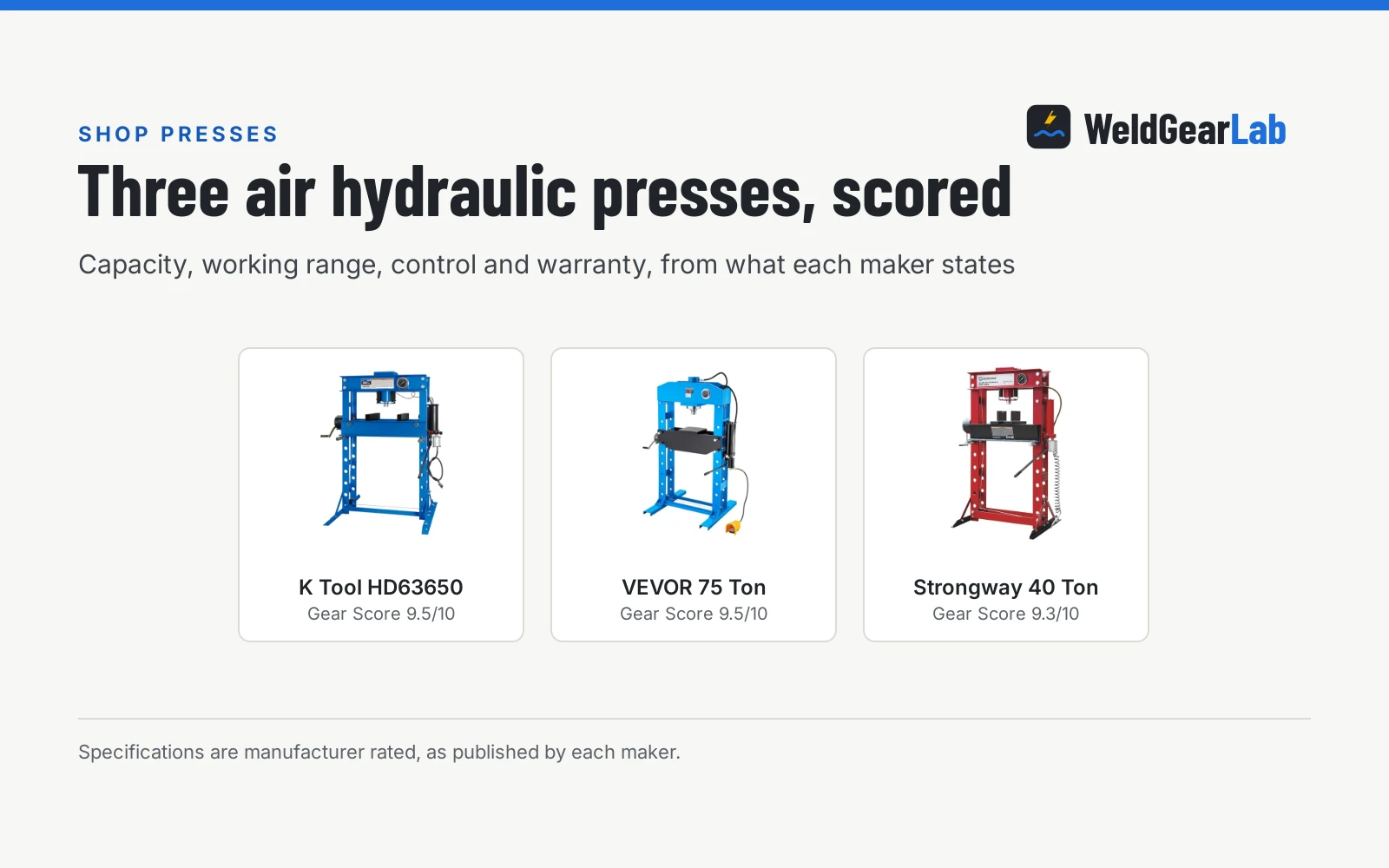
A hydraulic press works on oil that cannot be squeezed smaller, so pressure applied at one end shows up as force at the other. The pump moves oil into a cylinder, and the oil pushes a piston inside it. The piston drives the ram down onto the work, and the frame holds everything in line while the force builds. Release the pressure and the ram comes back, helped on some presses by springs that return the oil.
The force comes from the size of the piston, not from muscle. A small pump piston moves a little oil with each stroke, and a larger cylinder piston turns that oil pressure into a larger push. The gauge on a press shows the pressure while the ram moves, so the operator can see the pressure build as the ram meets resistance.
The parts that do the work
Each part has a job, and the press only works when all of them do theirs.
- Pump. The pump moves oil into the cylinder. The VEVOR presses run by hand with an extended handle or with air from a compressor, and the foot pedal model starts and stops the air press with a pedal.
- Cylinder and piston. The cylinder holds the oil pressure, and the piston inside turns it into the push on the ram.
- Ram and punch. The ram carries the force into the work, through a punch or a plate. The VEVOR gauge press uses a 48 mm punch, and the foot pedal VEVOR comes with a 9 punch set from Ø10 mm to Ø48 mm.
- Frame. The frame takes the load so the ram stays in line. Three of the presses here use an H-frame, and the Dragway uses an A-frame.
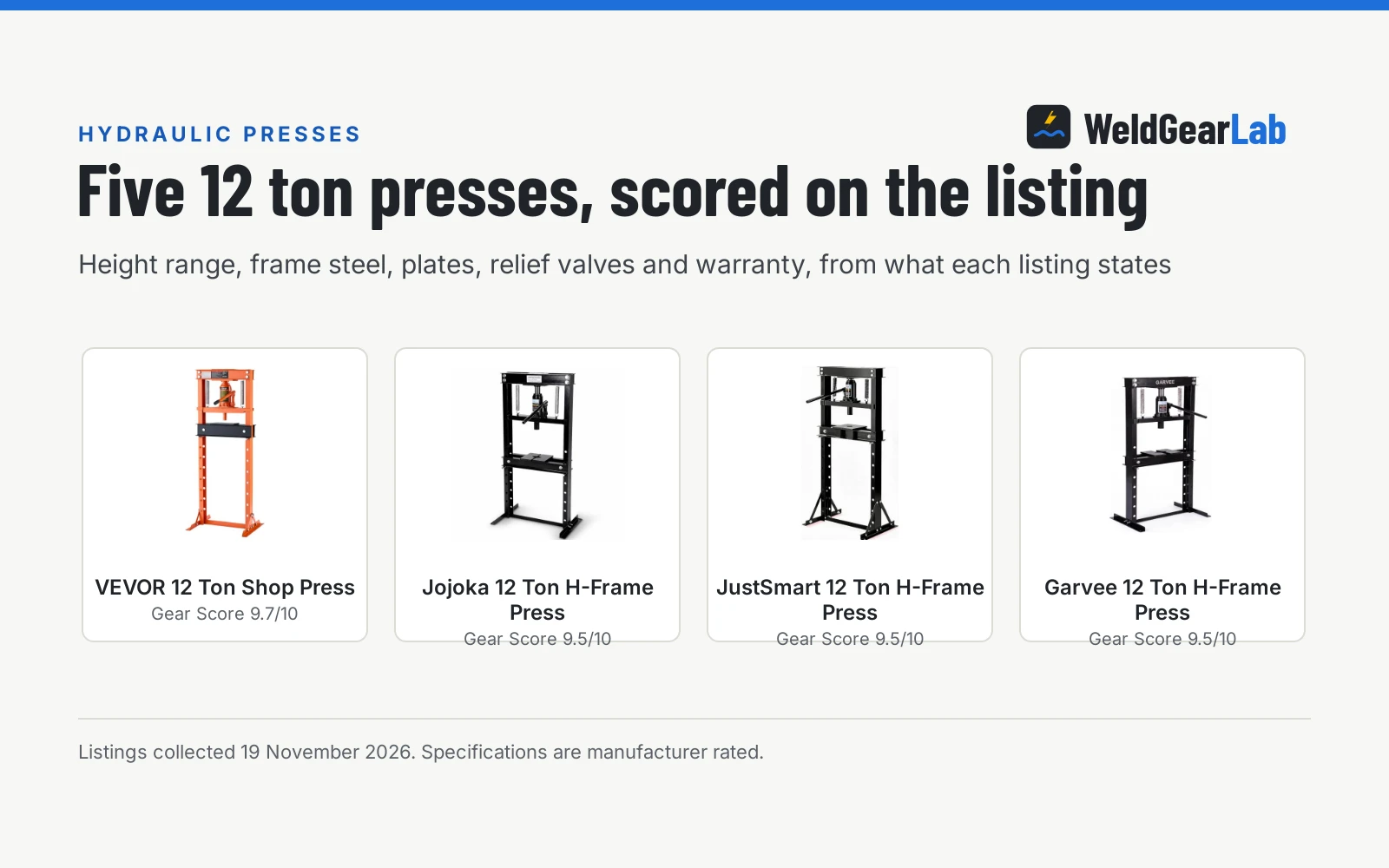
- Gauge and relief valve. The gauge shows pressure while pressing. The relief valve opens if pressure passes the rated load, and the MAXSA press has a built-in valve that engages if pressure exceeds 20 tons.
Height settings set the gap between the ram and the work. The VEVOR presses have 9 height settings and the MAXSA table has 8 positions, so the ram starts close to the work.
What a press does in the shop
In a metal shop the press bends, straightens and presses parts that fit tight. The presses here handle wheel bearings, U-joints, ball joints and control arm bushings, all parts that press in and out of a bore.
Force is the limit, not the goal. The 20 ton presses here handle the heavy press fits, while the 6 ton Dragway suits small parts on a bench. Stay inside the rated capacity, and never press a part that can slip or shatter under load. Clamp the work, wear eye protection, and keep hands clear of the ram while it moves. OSHA machine guarding rules cover this kind of work, and the manual for the press states its own limits.
Four shop presses for the pressing step
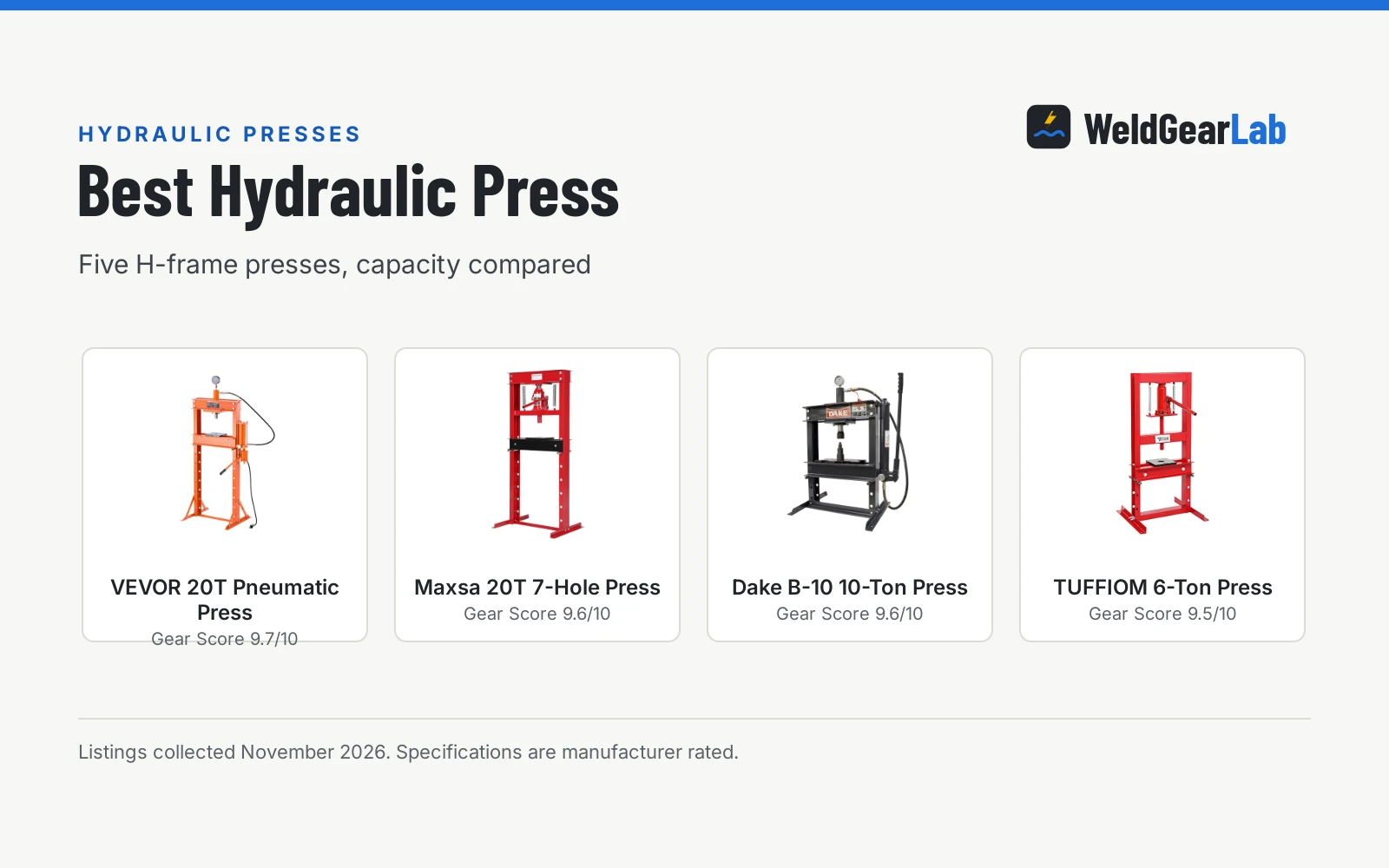
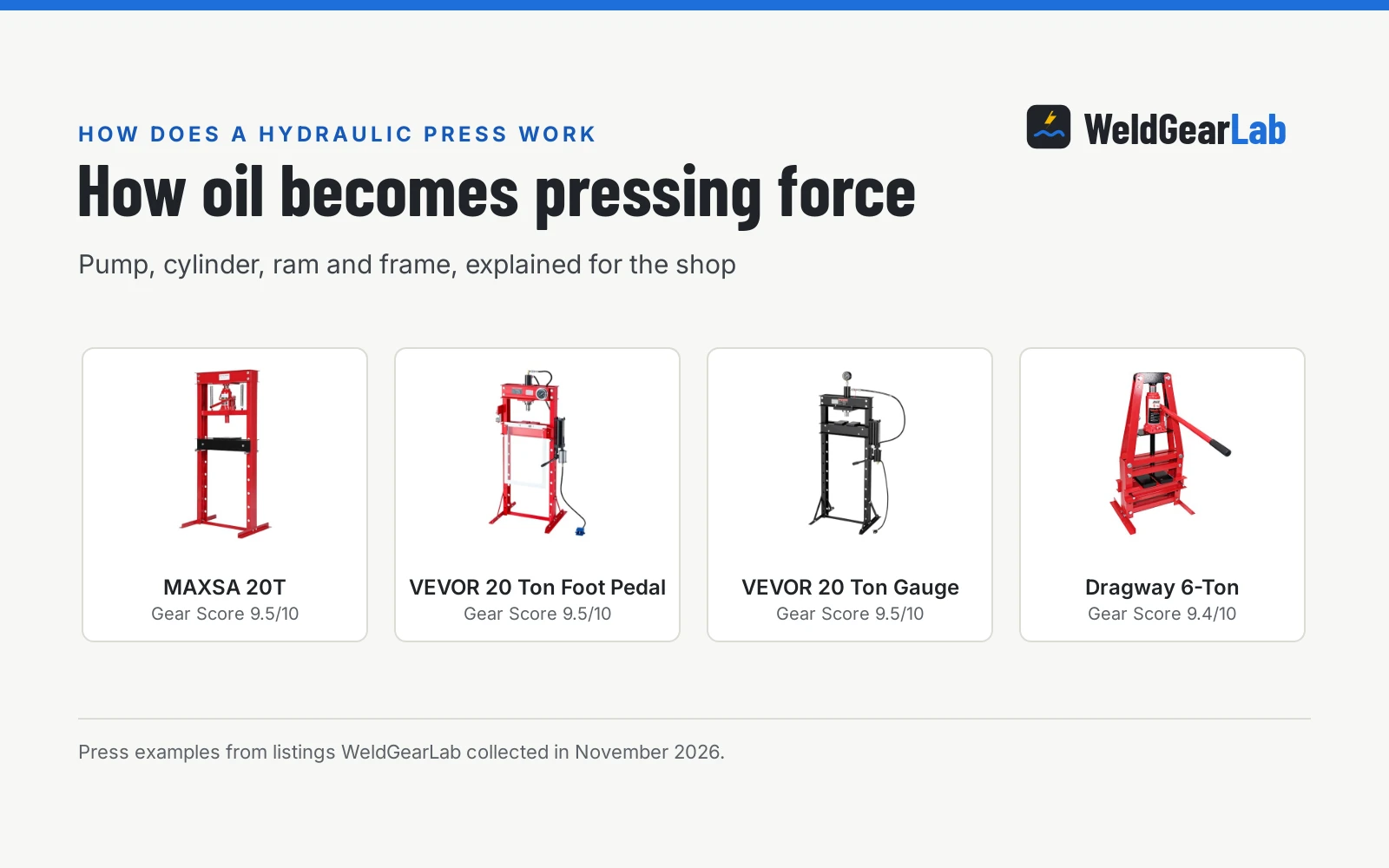
The pressing step needs the ram, the punch and the frame, and these four presses cover that step from a 6 ton benchtop to a 20 ton floor press.
The four presses side by side
| Capacity | Frame | Height settings | Weight | |
|---|---|---|---|---|
| VEVOR 20 Ton Foot Pedal | 20 ton (max load) | H-frame | 9 settings, 0.4 to 38.6 in | 198.42 lb |
| MAXSA 20T | 20 ton | H-frame | 8 positions | 108.03 lb |
| VEVOR 20 Ton Gauge | 20 ton (max load) | H-frame | 9 settings, 2.56 to 40.5 in | 191.8 lb |
| Dragway 6-Ton | 6 ton | A-frame | Not stated | 53.0 lb |
Capacity sets the class, and height settings set the fit. All three 20 ton presses handle the same heavy press fits, and the choice between them comes down to the gauge, the pedal and the relief valve.
FAQ for welders
How much force does a shop press need for wheel bearings?
The right force depends on the bearing and the fit, and no single figure covers every job. The three 20 ton presses in this guide cover the bearing, U-joint and bushing work, while the 6 ton Dragway suits small pressure-fitted parts.
What does the gauge on a hydraulic press tell you?
The gauge shows the pressure in the cylinder while the ram moves, and the reading climbs as the part presses in. On the VEVOR gauge press the gauge gives a real-time pressure display. A rising gauge with no movement means the part is resisting, so stop and check the setup instead of pushing harder.
Why does a hydraulic press need a relief valve?
The relief valve opens if pressure passes the rated load, which guards the press and the operator when a part will not move. The MAXSA press in this guide has a built-in relief valve that engages if pressure exceeds 20 tons.
How is the height set on a shop press?
Set the worktable so the punch starts close to the work, with the part seated square on the plate. The VEVOR presses have 9 height settings, the gauge model from 2.56 to 40.5 in and the foot pedal model from 0.4 to 38.6 in, while the MAXSA table has 8 positions.
Can a 6 ton press do the same work as a 20 ton press?
No, not on the same parts. A 6 ton press like the Dragway suits small pressure-fitted parts and light bending on a bench, while the 20 ton presses handle wheel bearings, U-joints and bushings.
Related: best shop press, best hydraulic press, shop press vs arbor press, and the metalworking machines hub. Also see arbor press uses.