Glass Lens Safety Glasses: Pros and Cons
Glass lens safety glasses stay clear and resist scratches, but they weigh more and can crack on a hard hit. How glass compares with polycarbonate, and three polycarbonate pairs for shop work.

On this page
Top picks at a glance
As an Amazon Associate I earn from qualifying purchases.
- 1
 NoCry ANSI Z87.1 Safety Glasses with Readers 1.59.7/10View on Amazon
- 2
 MAGID Y50 Safety Glasses for Construction9.7/10View on Amazon
- 3
 100 Pack Clear Safety Glasses for Men9.5/10View on Amazon
A grinder throws sparks, a cutoff wheel bites into angle iron, and the chips fly toward the eyes. Glass lens safety glasses answer a plain question: does a glass lens protect the eyes better than the plastic lenses on most shop glasses, and what does it give up to do it. This guide lays out the trade-offs, then shows three pairs that cover the same job with polycarbonate lenses.
This guide links to our product roundups, where WeldGearLab gets a commission on purchases made through links on this page, and your price stays the same. Read our affiliate disclosure.
| # | Product | Gear Score | Buy |
|---|---|---|---|
| 1 | NoCry ANSI Z87.1 Safety Glasses with Readers 1.5 | 9.7/10 | Buy on Amazon |
| 2 | MAGID Y50 Safety Glasses for Construction | 9.7/10 | Buy on Amazon |
| 3 | 100 Pack Clear Safety Glasses for Men | 9.5/10 | Buy on Amazon |
NoCry ANSI Z87.1 Safety Glasses with Readers 1.5
A full-lens 1.5 reader safety glass with ANSI Z87.1 impact rating, anti-fog and anti-scratch coatings, 100% UV385 lenses and a limited lifetime warranty.
Pros
- Full-lens 1.5 readers built in, with 2.0 and 2.5 also listed
- Meets ANSI Z87.1, with side shields and impact-resistant polycarbonate lenses
- Anti-fog and anti-scratch coatings with 100% UV385 lenses
- Metal-free hinges for work around electricity, plus a limited lifetime warranty
Cons
- Reader strength is fixed per pair, so one pair suits one wearer's eyes
- No frame dimensions are stated, so fit is a guess before buying
- No tinted lens option is stated for bright outdoor work
- The listing asks buyers to contact the maker within 30 days of delivery if unhappy, a short window for raising a problem
MAGID Y50 Safety Glasses for Construction
An amber-lens safety glass rated ANSI Z87.1+ for high impact, with anti-fog and scratch-resistant polycarbonate lenses, side shields and 99.9% UV protection.
Pros
- Meets ANSI Z87.1+ high-impact standard, plus CSA Z94.3
- Amber polycarbonate lenses with anti-fog and scratch-resistant coatings
- 99.9% UV protection with integrated side shields
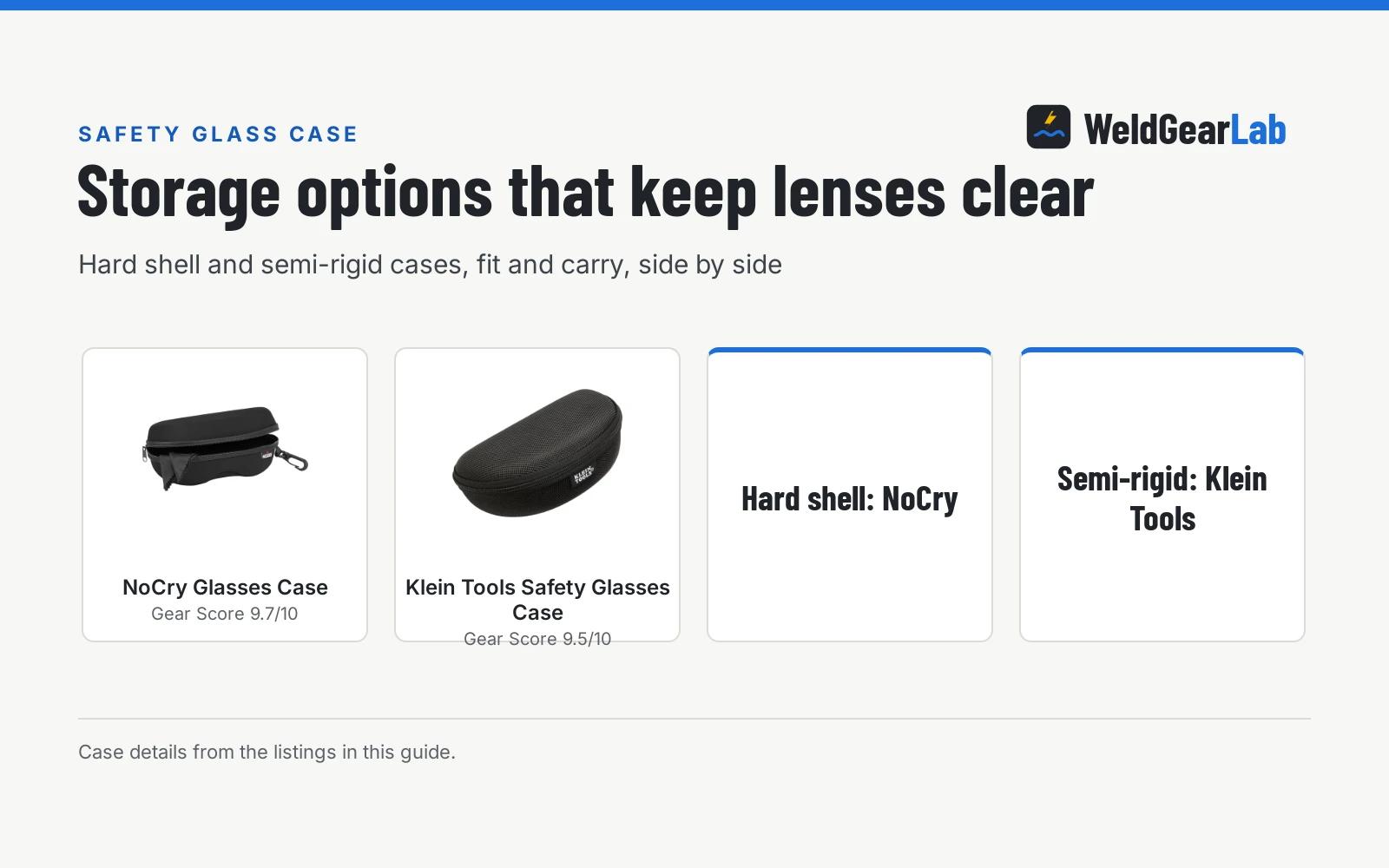
- Lightweight flexible nylon frame with soft temple pads, plus a wiper case
Cons
- No warranty term is stated in the listing
- Amber tint changes colour, so it is not a neutral lens for colour-critical work
- Sold as a single pair, so spares need another buy
- No reader version is stated for close work
100 Pack Clear Safety Glasses for Men
A 100-pair bulk pack of clear wrap-around safety glasses with scratch and impact-resistant polycarbonate lenses, weighing about 23 grams per pair.
Pros
- 100 pairs in the pack, so spares are always on hand
- Wrap-around lenses with full brow and side protection
- Scratch and impact-resistant polycarbonate lenses
- About 23 grams per pair, with anti-slip silicone temple tips
Cons
- No ANSI or other impact rating is stated in the listing
- No warranty is offered in the listing
- No anti-fog coating is stated
- No UV protection figure is stated
What glass lens safety glasses do well
Glass resists scratches. A glass lens keeps its view clear through repeated wiping of dust and grit off it, where a softer uncoated lens picks up fine scratches that haze the view over time. Glass also holds its shape in heat and does not yellow with age the way some plastics can. That is why glass still shows up where a clear, hard lens matters more than weight: reading fine marks and inspection work.
The trade is weight and breakage. Glass is heavier than polycarbonate, so it sits harder on the nose over a long shift, and a hard hit can crack or shatter a glass lens, where polycarbonate tends to bend rather than shatter. That is why the impact-rated glasses in this guide all use polycarbonate lenses. Any cracked lens, glass or polycarbonate, has to come out of service. Glass suits light duty and reading, where impact is not the main hazard; for grinding and cutting, the impact-rated pairs in this guide use polycarbonate.
How to pick between glass and polycarbonate
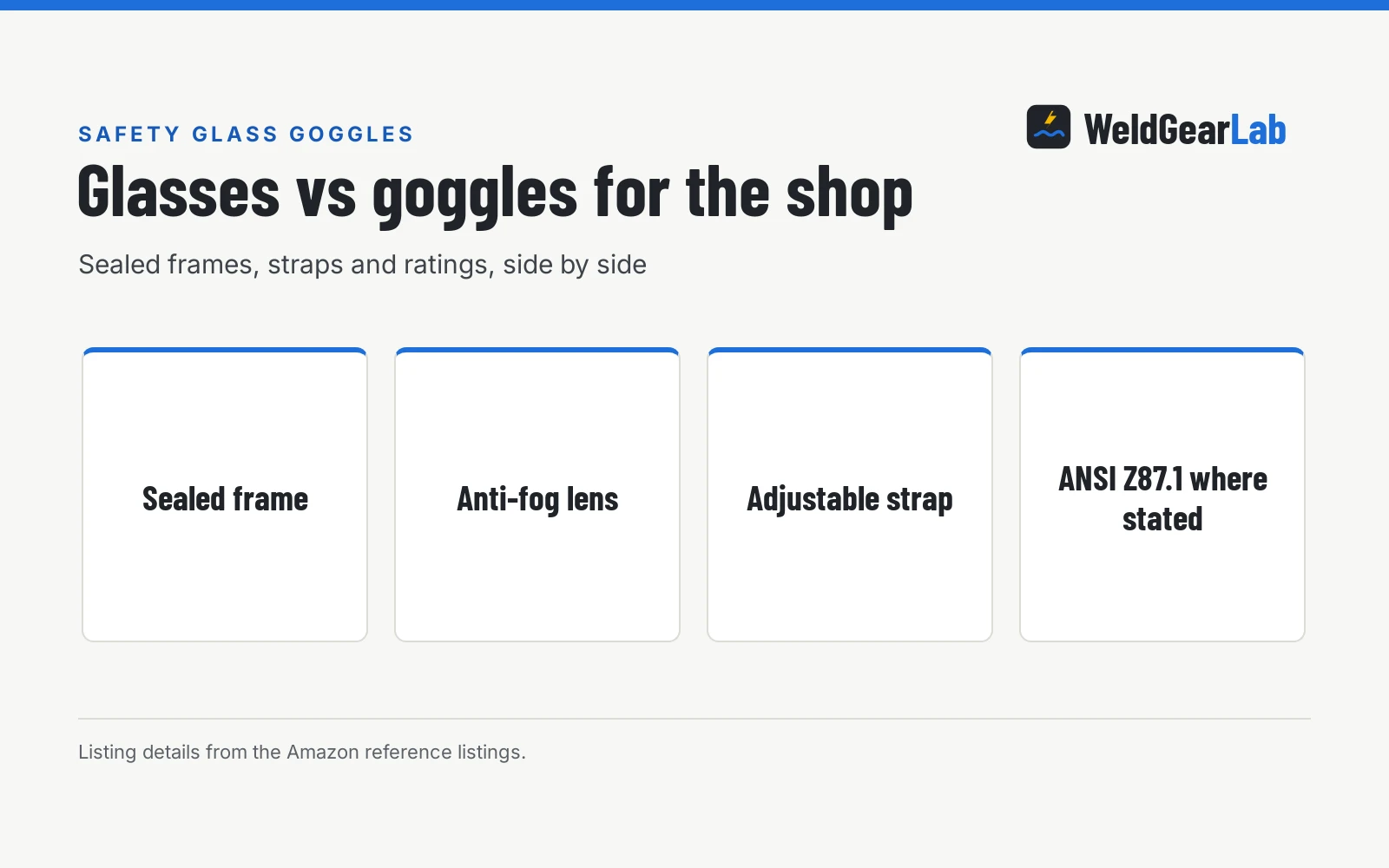
Start with the hazard. Grinding, cutting and chipping throw fast particles, and the listing should state an impact rating: the MAGID pair below meets the ANSI Z87.1+ high-impact standard, and the NoCry pair meets ANSI Z87.1. A lens with no stated rating leaves the question open, which is why the bulk pack below scores lower on safety even though its wrap-around shape covers the brow and sides. Next, check the lens: amber lifts contrast outdoors, clear suits indoor work, and a reader lens helps with small marks. Then check the fit: side shields and soft temple pads help keep chips out and the glasses on through a long shift.
Side by side
| Glasses | Lens | Rating | Readers | Side shields | UV protection | Warranty |
|---|---|---|---|---|---|---|
| NoCry SideArmor | Polycarbonate, clear | ANSI Z87.1 | 1.5 readers | Integrated | 100% UV385 | Limited lifetime |
| MAGID Y50 | Polycarbonate, amber | ANSI Z87.1+, CSA Z94.3 | Not stated | Integrated | 99.9% | Not stated |
| AstrivixDD AQYJ | Polycarbonate, clear | Not stated | Not stated | Full brow and side protection | Not stated | None |
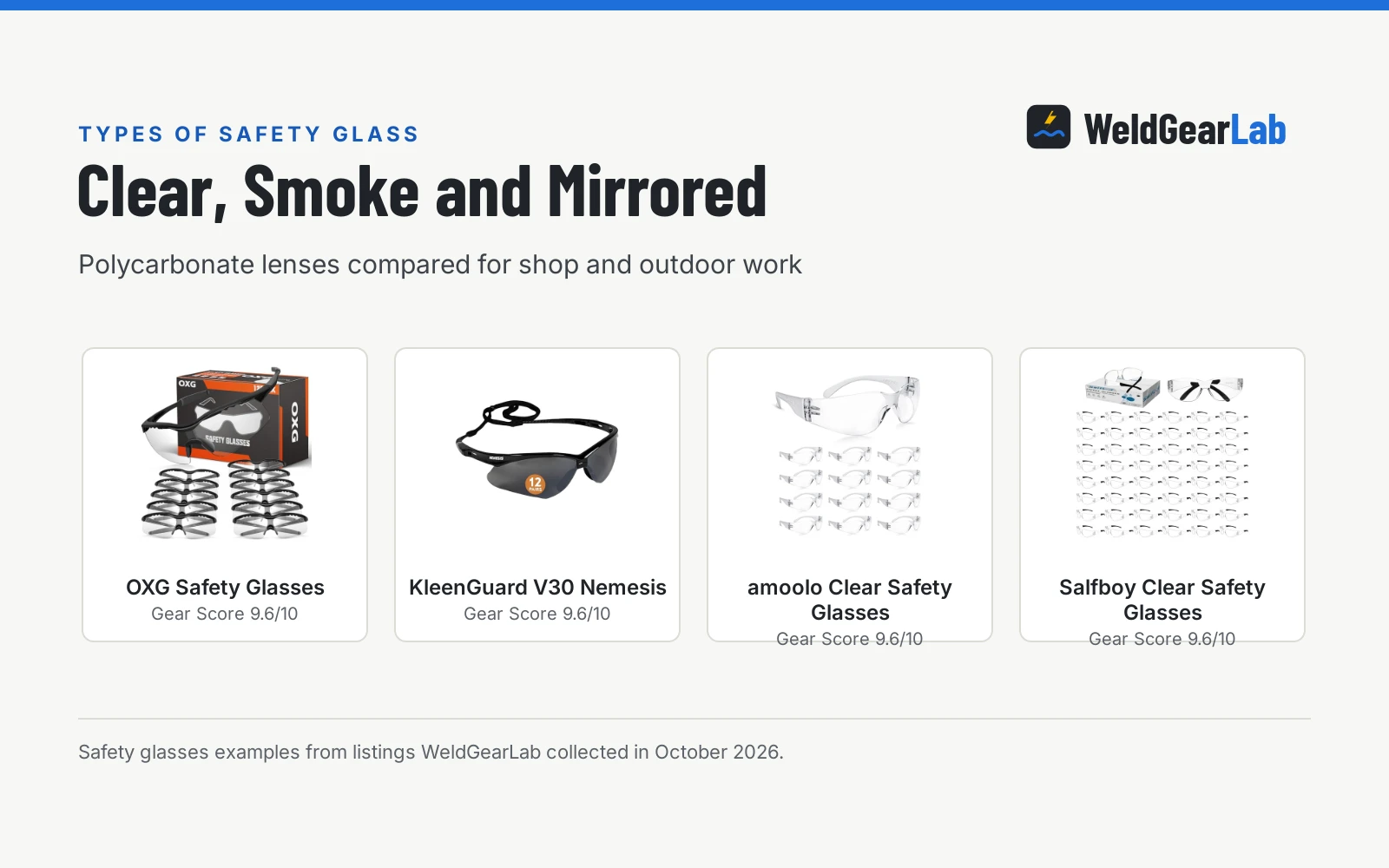
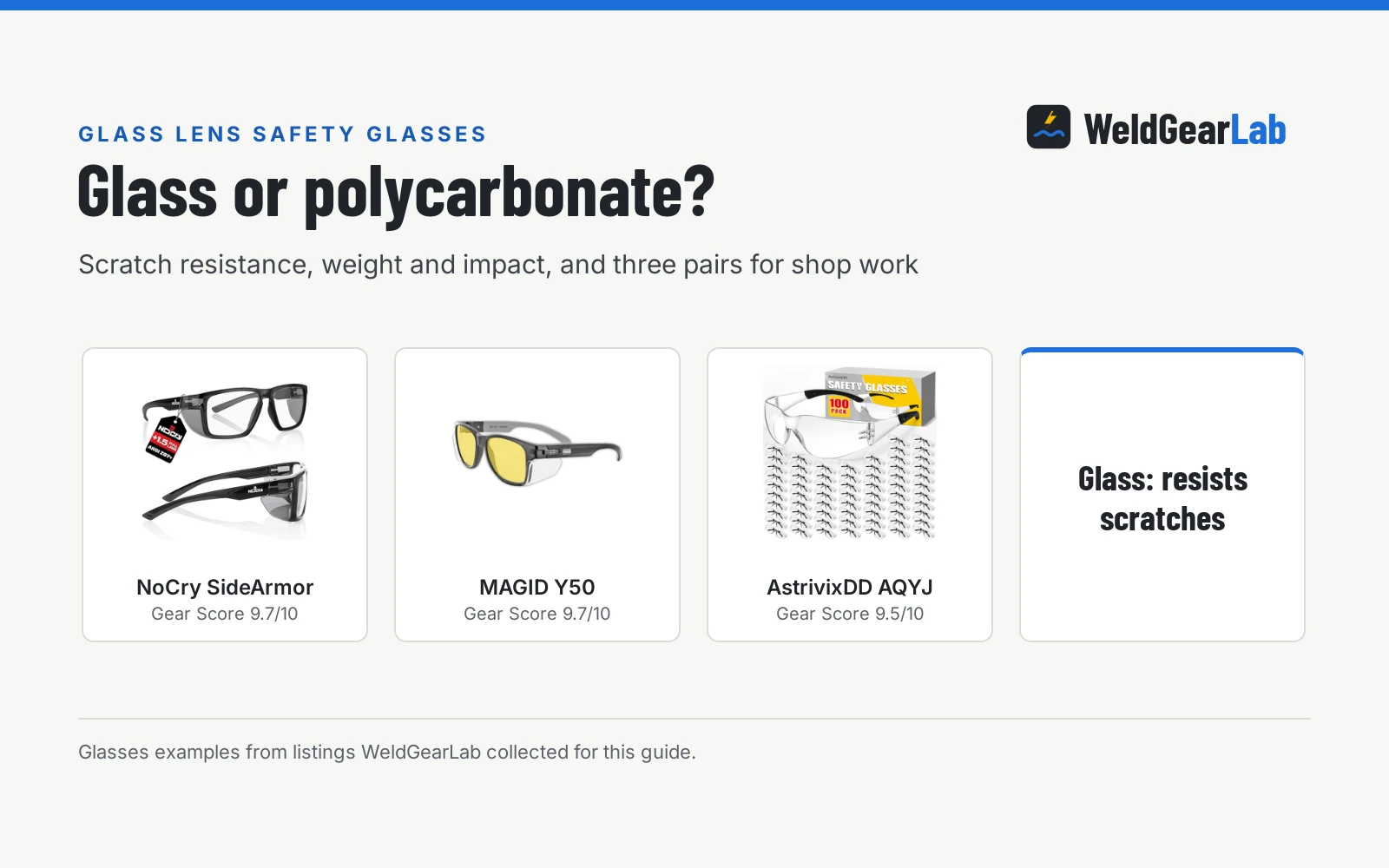
All three pairs use polycarbonate lenses; none of the listings here states a glass lens. The NoCry pair adds reader magnification, the MAGID pair carries the strongest stated impact rating, and the AstrivixDD pack covers a crew or a lab bench with 100 pairs in the box.
The glasses for this job
Eye protection on a grinding or cutting job needs an impact-rated lens with side cover, and the three pairs below cover that job three ways: reading fine marks, cutting glare, and keeping spares on hand.
For more options, see our welding safety gear guides.
FAQ for welders
Are glass lens safety glasses better than polycarbonate?
For scratch resistance, glass has the edge. For impact, polycarbonate has it: it tends to bend where glass can crack, and every impact-rated pair in this guide uses a polycarbonate lens. Pick glass where scratch resistance matters most and impact is not the main hazard, and polycarbonate for grinding and cutting.
What does ANSI Z87.1+ mean on safety glasses?
The plus marks the high-impact rating of the ANSI Z87.1 standard. The MAGID pair in this guide meets ANSI Z87.1+ and the Canadian CSA Z94.3 standard, while the NoCry pair meets ANSI Z87.1. A pair with no stated rating, like the bulk pack here, leaves the impact question open.
Can safety glasses with readers replace a separate pair of reading glasses?
The NoCry pair builds a 1.5 reader lens into the full lens, so it covers reading and protection in one pair, with 2.0 and 2.5 reader strengths also listed. It is a full-lens reader, not a bifocal, so the magnification covers the whole lens.
Why do shop safety glasses use polycarbonate instead of glass?
Polycarbonate is light and tends to bend on impact rather than crack, which suits grinding, cutting and chipping. Glass is harder and resists scratches, but it is heavier and a hard hit can crack it. The three pairs in this guide all use polycarbonate lenses, the usual choice for impact-rated shop glasses.
Do amber lenses help outdoors?
Amber lifts contrast in bright light, and the MAGID pair uses an amber lens with 99.9% UV protection. Indoors, a clear lens keeps colours true, and the NoCry pair uses a clear lens with 100% UV385 protection.
Related: best safety glasses with side shields, welding goggles vs safety glasses, and best lens for welding helmet.