Everlast Powertig 200DV Review: Pros, Cons & Who It’s For
An Everlast PowerTIG 200DV review from the listing: a 200A AC/DC pulse TIG welder for 120V or 240V shops, with its low-amp starts, gaps and who it fits.

On this page
When you have aluminum tubing, thin sheet brackets or stainless steel exhaust sections clamped on the fab bench, you need precise control over heat and arc starts. That is where an everlast powertig 200dv review comes in. The listing describes an AC and DC pulse TIG welder running on dual voltage with low starting amps, aimed at fabricators who need more puddle control than a wire feed gun delivers. We have not used this welder ourselves; this review is based on Everlast’s Amazon listing for the PT-200DV and the specs published there.
As an Amazon Associate I earn from qualifying purchases. WeldGearLab gets a commission on purchases made through links on this page, and your price stays the same. Read our affiliate disclosure.
The welder

Everlast PowerTIG 200DV 110/220 Dual Voltage
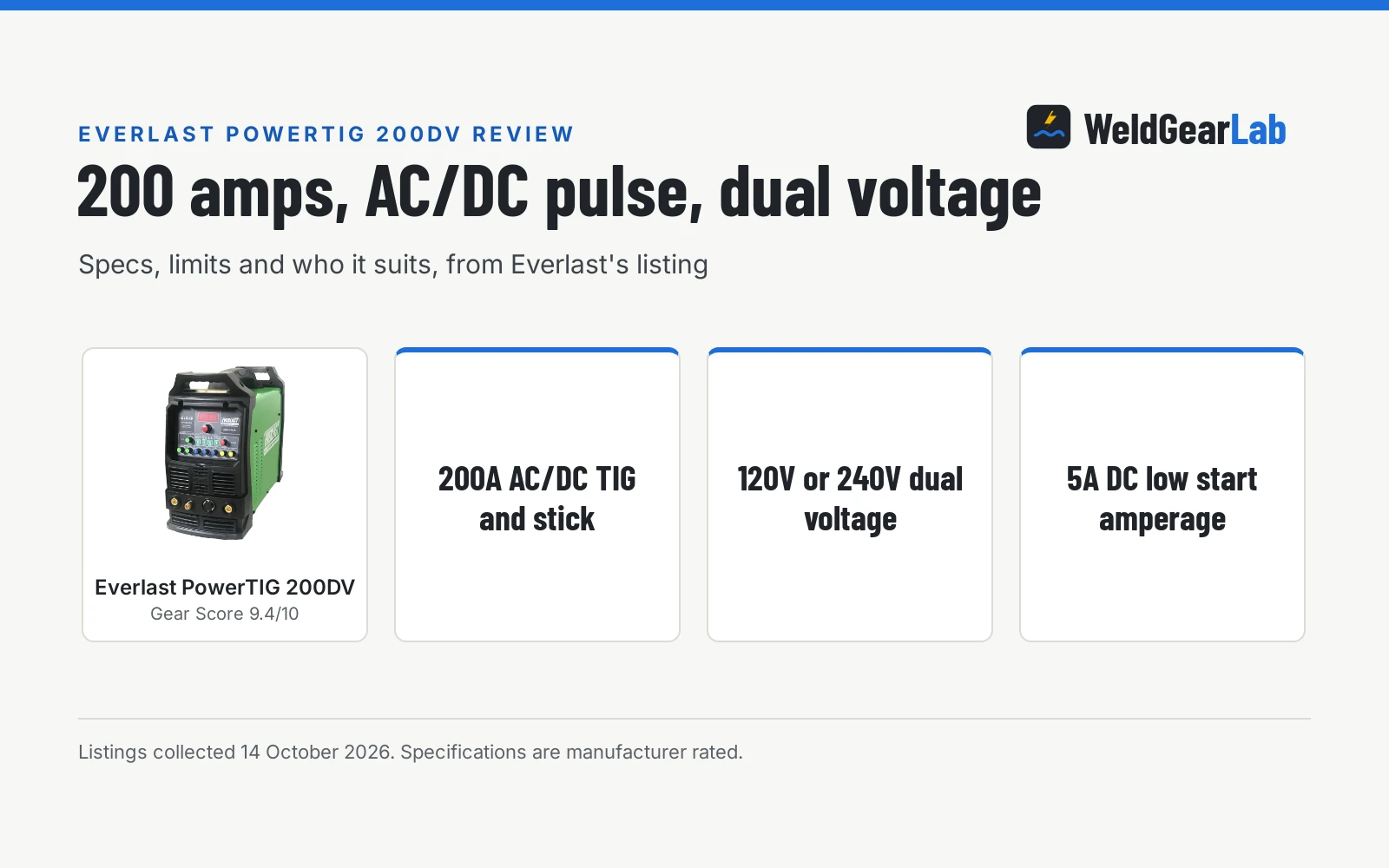
A 200A AC/DC pulse TIG and stick welder with 120V/240V dual voltage input, low 5A DC starting amperage, lift start mode, and pre and post-flow gas control.
Pros
- Dual-voltage input runs on 120V and 240V power sources
- 200-amp maximum output with AC and DC pulse TIG capability
- Low start amperage down to 5 Amps for DC TIG work
- Pre-flow and post-flow gas control with Arc Force DIG control
Cons
- Duty cycle is not stated on the listing
- No warranty term is stated on the listing
- No CSA, UL or ETL safety certification stated
Everlast Powertig 200DV review: the short verdict
The Everlast PowerTIG 200DV is an inverter welding machine designed for AC and DC TIG plus stick welding. Alternating current handles aluminum by breaking through surface oxides, while direct current welds carbon steel, chromoly and stainless steel. The listing identifies the model as PT-200DV, rated for up to 200amp output.
Several listed specifications stand out for small shop fabricators. Dual voltage circuitry accepts 120V or 240V power sources, providing flexibility when moving between a home garage and a wired shop. The low start amperage rating begins at 5 Amps for DC TIG, which prevents blowouts on thin material before a puddle forms. You also get pulse capability to manage heat buildup, pre and post-flow gas controls to protect the weld puddle, and a lift start mode alongside high-frequency ignition.
The problem is what the listing fails to provide and what it scrambles. The seller omits duty cycle ratings, provides no warranty term, and lists no CSA, UL or ETL electrical certification. Even worse, the Amazon spec table is contaminated with car and dashcam details like video resolution and optical sensors. Those gaps mean buyers must verify build and support facts directly with the manufacturer before ordering.
Key specs
| Model | Processes | Output | Input Voltage |
|---|---|---|---|
| Everlast PowerTIG 200DV | AC/DC TIG, Pulse TIG, Stick | 200A | 120V/240V |
All specs here repeat what the maker rates and the listing prints, copied down 14 October 2026. Output amperage, input voltage and arc start modes reflect the seller’s published bullet points and product description.
What the PowerTIG 200DV does well
Low-amperage DC start on thin sheet
Starting an arc without blowing holes through thin tubing or sheet metal requires low initial current. The listing states this machine starts as low as 5 Amps for TIG in DC. Having a 5-amp floor on DC gives fine control when tacking thin stainless flange joints or sheet metal seams where excessive heat ruins the fit-up. For aluminum, the listing notes an AC start amperage of 20 Amps for arc initiation.
Dual-voltage flexibility for 120V and 240V
The listing highlights 120V/240V dual voltage operation, while the title also references 110/220 dual voltage. That dual-input design allows you to plug into a standard household wall receptacle for light maintenance or plug into a 240V circuit for heavier shop fabrication. The listing does not state output amperage limits when running on 120V input, so plan to run on a 240V circuit whenever you need the full 200amp output.
AC and DC TIG with pulse control
Combining AC and DC processes in one machine covers common metals on the fabrication bench. DC handles carbon steel, chromoly and stainless, while AC provides the cleaning action to weld aluminum. The listing also notes an adjustable pulse rate. Pulse welding cycles between peak and background current, lowering overall heat input to help prevent thin stock from warping and assist puddle control. Our guide on pulse TIG welding covers how pulsing helps manage heat on critical joints.
Lift start and Arc Force stick control
The listing specifies a lift start function for situations where high-frequency arc starting is not desirable. Lift start lets you strike an arc by touching the tungsten to the work and lifting smoothly, avoiding high-frequency electrical noise that can disrupt sensitive electronics, computers or CNC controls. For stick welding, the listing notes an Arc Force control, also known as DIG, which boosts amperage when arc voltage drops to reduce spatter and keep rods from sticking in the puddle.
Limitations
- No duty cycle stated: the listing never states a duty cycle percentage at 200amp or any lower setting. Without duty cycle numbers, you cannot know how long the machine welds before thermal overload shuts it down.
- No warranty term stated: the listing publishes no warranty duration or coverage terms, so buyers cannot verify warranty protection from the Amazon page.
- No safety certification listed: no CSA, UL or ETL electrical certification mark appears on the page, leaving electrical safety compliance unverified on paper.
- Contaminated spec table: the Amazon specification table contains absurd entries, listing video capture resolution, vehicle position, CMOS sensors and frame rates instead of welding data. Buyers must ignore the spec table and rely solely on the title and bullets.
- Higher start amperage on AC: while DC starts down at 5 Amps, AC starts at 20 Amps, which provides less control when initiating arcs on very thin aluminum sheet.
How we scored it
| Product | Gear Score | Perf. /35 | Build /25 | Value /25 | Safety /10 | Warranty /5 |
|---|---|---|---|---|---|---|
| Everlast PowerTIG 200DV | 9.4 | 28 | 19 | 20 | 0 | 0 |
A pick’s weighted total decides where it lands between a 9.2 floor and a 9.8 ceiling, and a bigger total never produces a smaller number.
The Gear Score weighs performance, build, value, safety and warranty, as explained on our how we pick page. The PowerTIG 200DV scores well on performance because 200amp output, AC/DC capability, pulse controls and a 5-amp DC start cover serious fabrication tasks. Build is penalized because duty cycle is missing and the spec table is riddled with camera errors. Safety and warranty both score zero because the listing states no electrical certification and no warranty term.
Who should buy the Everlast PowerTIG 200DV, and who should skip it
If you are deciding between processes for your shop, our TIG vs MIG welding for beginners guide breaks down the learning curve and equipment requirements. Here is how this specific Everlast model fits different shop needs.
Buy it if
- You need an AC/DC machine to weld both aluminum and steel on the bench.
- You want a low 5-amp DC starting floor for thin stainless or chromoly tubing.
- You work in environments with sensitive electronics where lift start is required.
- You have both 120V and 240V power sources available in your shop.
Skip it if
- You require verified duty cycle ratings on paper before purchasing equipment.
- Your shop rules demand a stated CSA, UL or ETL safety listing.
- You need a clear manufacturer warranty policy stated upfront on the retail page.
- You need a lightweight field machine; the listing gives no reliable weight figure.
Alternatives
- Dedicated aluminum welding: if aluminum fabrication is your primary focus, look through our best TIG welder for aluminum roundup for machines with published balance controls.
- Automotive and roll cage fabrication: our best TIG welder for automotive fabrication guide covers machines tuned for chromoly tubing and exhaust work.
- Starting out in TIG: if this is your first purchase, check out our best entry level TIG welder guide for simpler setups.
Before You Strike an Arc
- Confirm your electrical supply: check whether you are connecting to a 120V wall outlet or a 240V circuit, and verify your breaker rating matches your intended amperage output.
- Unpack the combo set: inspect the torch head, gas line, ground clamp and lead cables for tight electrical lugs and intact rubber insulation.
- Connect shielding gas: attach clean argon cylinders to your flowmeter, secure the hose clamps, and dial in pre-flow and post-flow to shield the tungsten electrode and hot puddle.
- Choose your arc start mode: use lift start in areas where high-frequency arc interference can affect digital electronics, computers or CNC controls, and use high-frequency start on the fab bench to initiate the arc without touching the tungsten to the work.
FAQ for welders
Can the Everlast PowerTIG 200DV run on 120V?
Yes. The listing describes dual voltage capability that operates on 120V or 240V power sources. The title also lists 110/220 dual voltage, offering flexibility for home garages or field jobs. The listing does not state output limits when running on lower input voltage, so treat 240V as the supply needed for the maximum 200amp output.
Can the Everlast PowerTIG 200DV weld aluminum?
Yes. The listing states that this model provides both AC and DC output. Alternating current is the standard process for TIG welding aluminum with argon shielding gas, using the positive half of the AC cycle to clean the surface oxide layer and the negative half to penetrate the base metal. The listing also includes pulse settings to help control heat input on thin sections.
Does the Everlast PowerTIG 200DV have lift start?
Yes. The listing specifies a lift start function alongside high-frequency arc initiation. Lift start allows smooth arc starts in areas where high-frequency electrical interference could disrupt computers, vehicle electronics or CNC controls. You touch the tungsten to the work and lift to establish the arc without high-frequency discharge.
What is the minimum amperage on the Everlast PowerTIG 200DV?
The listing states that the machine starts as low as 5 Amps for TIG in DC. For AC welding, the listing states a minimum start amperage of 20 Amps. A 5-amp start helps prevent burning through thin stainless steel or sheet metal, while 20 Amps is the floor when switching to AC for aluminum joints.
What does DIG control do on the Everlast PowerTIG 200DV?
The listing highlights added Arc Force control, also called DIG, to improve performance and reduce spatter during stick welding. DIG increases amperage automatically when the arc voltage drops, preventing the rod from sticking in the molten puddle. This feature assists when running stick electrodes on dirty or heavy steel repairs.
Related: entry level TIG welder guide, pulse TIG welding guide, lift TIG vs scratch start TIG, and the TIG welders hub.