Electro Permanent vs Permanent Lifting Magnet: Which One Should You Buy?
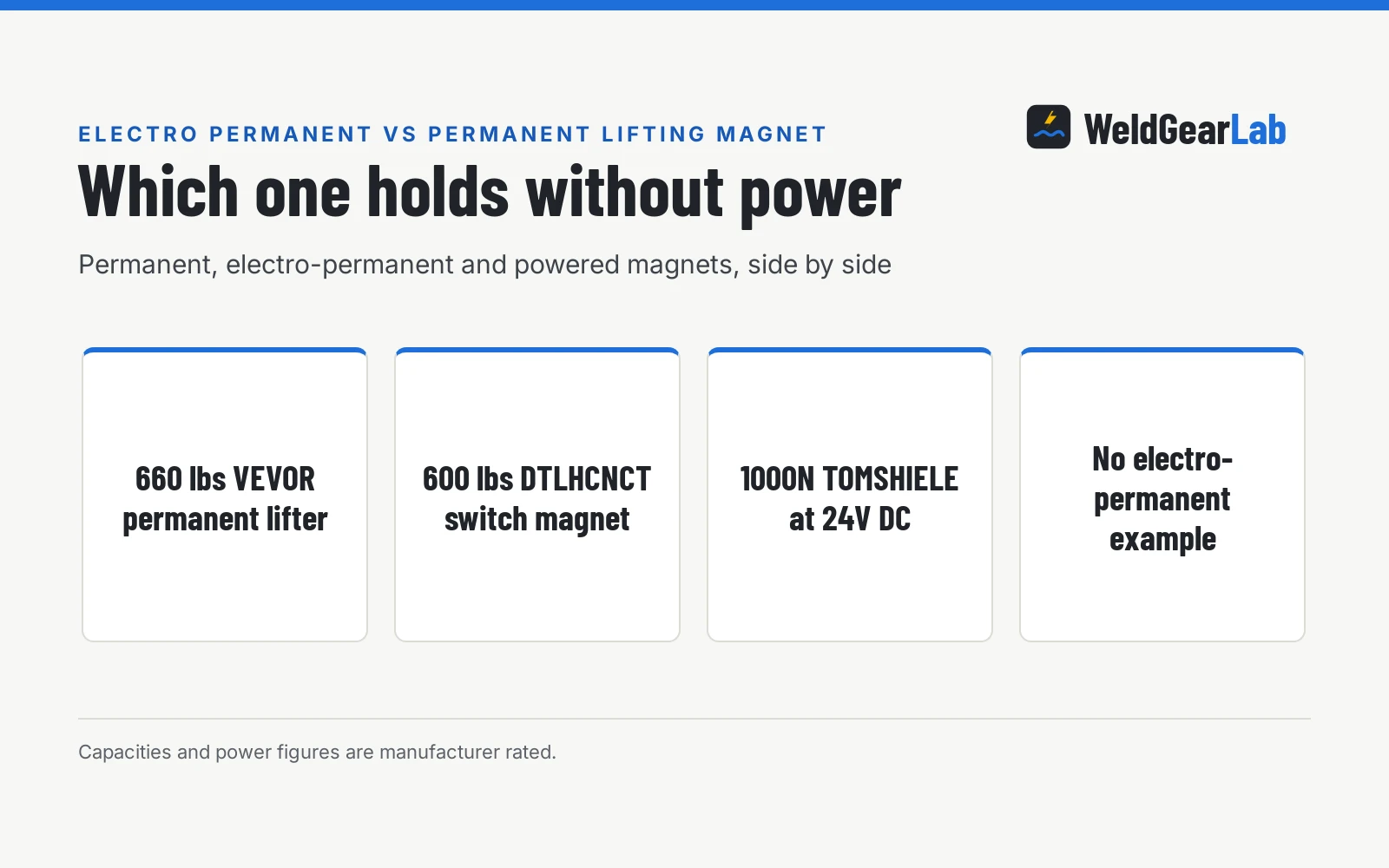
Two permanent magnets and one DC electromagnet show the real difference: one kind holds without power, the other needs a 24V supply.

On this page
Plate steel on the bench needs holding while the fit-up gets tacked, and a magnet that lets go at the wrong moment turns a simple job into a scramble. The question in electro permanent vs permanent lifting magnet is which kind of magnet holds the load, and the plain answer is that this guide has no electro-permanent magnet in it: the three magnets here are two permanent magnets and one DC electromagnet, so the choice runs on what each one actually does. A permanent magnet holds without power and switches with a handle, while a DC electromagnet needs current to hold.
As an Amazon Associate I earn from qualifying purchases. This guide links to our product roundups, where WeldGearLab gets a commission on purchases made through links on this page, and your price stays the same. Read our affiliate disclosure.
Electro permanent vs permanent lifting magnet: the difference in one paragraph
A permanent lifting magnet stays on until a handle switches it off. No cord, no power supply, no warm-up. An electro-permanent magnet uses a short electric pulse to switch the holding magnet on or off, then holds the load with no current flowing. A plain DC electromagnet is different again: it only holds while current flows, so it needs a power supply the whole time it carries a load. The three magnets in this guide show the first and third kinds, not the second.
Side by side
| Permanent lifting magnet | Electro-permanent lifting magnet | DC electromagnet | |
|---|---|---|---|
| Power to hold | None | None | 24V DC, continuous |
| How it switches | Handle | Electric pulse | Switching the supply on and off |
| Holds if power is lost | Yes | Yes | No |
| Stated capacity | 600 lbs and 660 lbs | No example | 1000N peak, 100 kg suction |
| Heat during use | Not stated | Not stated | May become warm |
| Examples in this guide | DTLHCNCT, VEVOR | None | TOMSHIELE |
The TOMSHIELE is the powered magnet here, and it is a DC electromagnet, not an electro-permanent magnet. The maker rates it at 24V DC and 10W, with a peak force of 1000N and suction of 100 kg, and notes that it may become warm during use, so the allowable operating time and temperature need checking before installation. That makes it a part for equipment assemblies, transport, assembly lines and robotic arms, not a hand-held lifting magnet with a release handle.
The three magnets in this guide
The VEVOR permanent lifter leads the three on stated capacity. The maker rates it at 660 lbs, or 300 kg, with a 2.5 safety factor, and builds it with N42 neodymium magnets and steel. The hook is chrome-plated high-strength steel, a safety switch guards the handle against accidental startup, and a limit bolt fixes the handle in place. The U-shaped bottom groove fits flat plates and round steels, and the whole magnet weighs 20.3 pounds. The maker lists steel sheets, blocks, rods and cylindrical stock among the loads, and shop crane, hoist, block and board work among the uses.
The DTLHCNCT switch magnet is the second permanent magnet, rated at a 600 lb pull-off force. A handle switches the suction on and off, and when the magnet is off the adsorbed metal comes off on its own, so the face stays clean. The maker lists welding positioning, lifting and handling, metal screening, metal salvage, salvage, crane work, machining positioning and building template positioning among the uses, and includes complete instructions for use and maintenance. It is the compact one of the two permanent magnets here, with a red body.
The TOMSHIELE electromagnet is the powered option, and it works a different way from the other two. The maker rates it at 24V DC and 10W, with a peak force of 1000N, suction of 100 kg, and a body 80 by 38 mm with an M5 by 8 thread and a 24 cm lead. The maker lists transport, assembly lines and robotic arm applications, and notes to check voltage and mounting fit before installation. The electromagnet may become warm during use, so the allowable operating time and temperature need checking for the model before installation.
When a permanent magnet is the better choice
- No power on the job. Field work, a farm repair, or a bench with no outlet nearby. The magnet holds with no cord and no supply.
- Positioning plate for a tack weld. The DTLHCNCT maker lists welding positioning among the uses, and the handle switches the hold on and off.
- Round stock as well as flat plate. The VEVOR maker states the U-shaped groove fits flat plates and round steels.
- Simple release. Turn the handle off and the hold lets go, with a safety switch and limit bolt on the VEVOR guarding the handle.
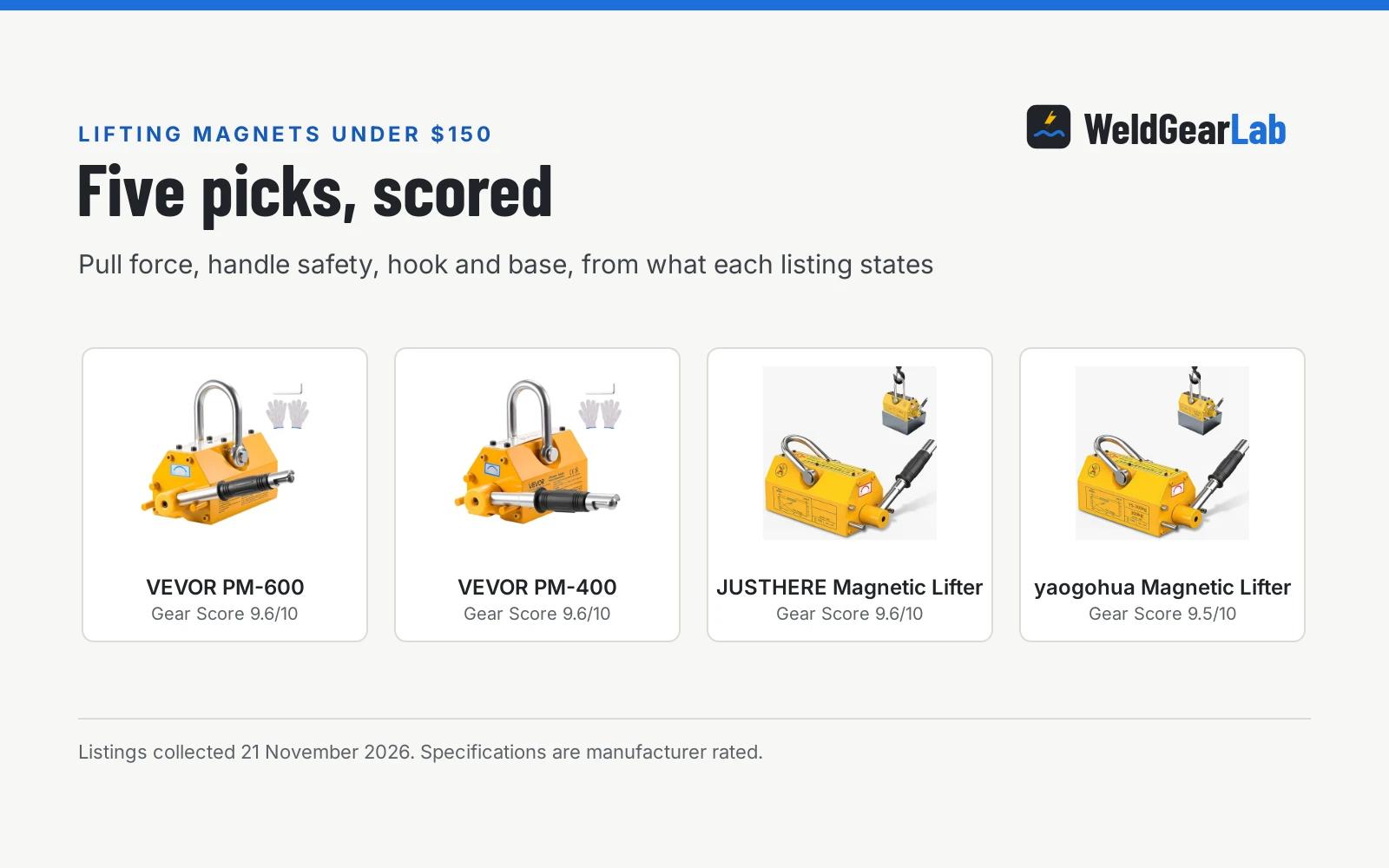
See the lifting magnet picks and industrial lifting magnets for more permanent magnet picks.
When a powered magnet is the better choice
- Fixed equipment. Assembly lines, transport rigs and robotic arms, which the TOMSHIELE maker lists as applications.
- Switching with current. The TOMSHIELE switches when current is applied, not by a hand on a handle.
- Repeat cycles. An electro-permanent magnet switches with a pulse and then holds with no current, which suits equipment that cycles on and off.
- Small parts in a fixture. The TOMSHIELE body measures 80 by 38 mm, which suits mounting into equipment assemblies.
How to tell what a magnet is
Check three things before buying. First, the power: a permanent magnet has no cord and no voltage rating, while the TOMSHIELE lists 24V DC and 10W. Second, the switching: a handle on the body points to a permanent switch magnet, like the DTLHCNCT and the VEVOR. Third, the holding: a DC electromagnet only holds while current flows, so a loss of power drops the load, while a permanent magnet and an electro-permanent magnet keep holding with no power. If the listing names no voltage and no lead, that points to a magnet that holds without power, but check the switching type before buying.
Lifting magnets and dropped loads. Quote the rated capacity exactly as listed and never exceed it, and never lift a load over people. The VEVOR is rated at 660 lbs with a 2.5 safety factor, and the DTLHCNCT at a 600 lb pull-off force, so match the magnet to the plate and check the handle, including the VEVOR limit bolt, before the lift. For the powered magnet, check the voltage and mounting fit before installation, and check the allowable operating time and temperature, since the maker notes it may become warm during use.
FAQ for welders
Can a permanent lifting magnet drop a load if the power goes out?
No. A permanent magnet uses no power to hold, so a power cut changes nothing. The VEVOR and the DTLHCNCT both switch with a handle, and the VEVOR adds a safety switch and a limit bolt to guard the handle. Match the load to the rated capacity, 660 lbs for the VEVOR and a 600 lb pull-off force for the DTLHCNCT, and never lift over people.
What does an electro-permanent lifting magnet need to switch?
It needs a short electric pulse to switch on or off, then holds the load with no current flowing. That is the difference from a DC electromagnet, which needs current the whole time it holds. No electro-permanent magnet is in this guide, so no switching pulse figure is stated here.
Can the TOMSHIELE electromagnet lift a steel plate on its own?
The maker rates it at a peak force of 1000N with suction of 100 kg and lists transport, assembly lines and robotic arm applications. It is a part for equipment assemblies, not a hand-held lifting magnet with a handle and release. Check the voltage and mounting fit before installation, and check the allowable operating time and temperature, since the maker notes it may become warm during use.
How much can the VEVOR lifting magnet lift?
The maker rates it at 660 lbs, or 300 kg, with a 2.5 safety factor. Never exceed the rated capacity, and never lift a load over people. The U-shaped groove fits flat plates and round steels.
Which magnet suits welding positioning?
The DTLHCNCT maker lists welding positioning among the uses, along with lifting and handling, metal screening and metal salvage. Its handle switches the suction on and off, and the maker includes complete instructions for use and maintenance. The VEVOR maker lists sheet metal lifting for shop crane and hoist work.
Related: electric hoist vs winch, manual chain hoist, types of lifting clamps, and chain vs nylon lifting slings.