Electric Hoist vs Chain Hoist: Which One Should You Buy?
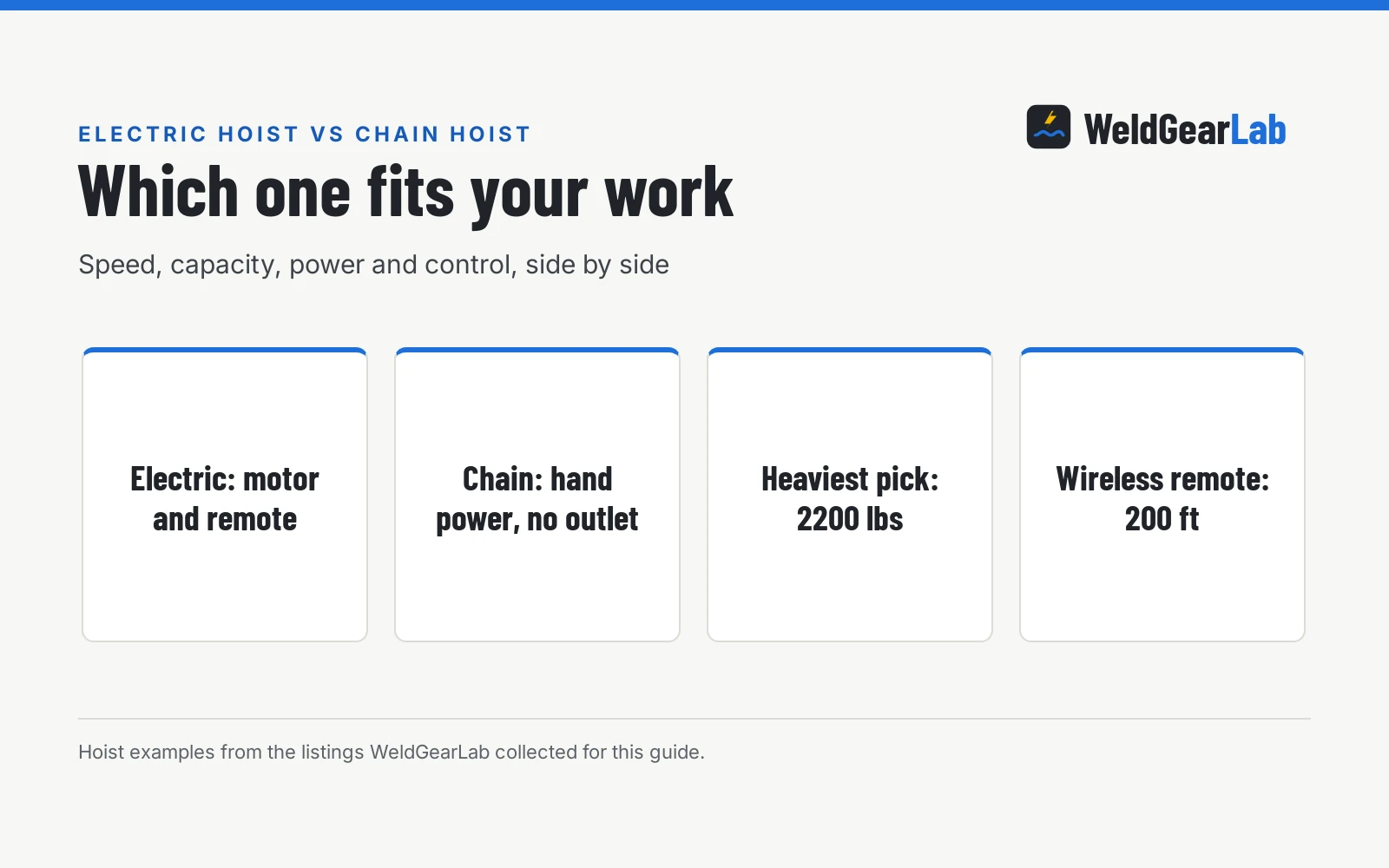
Electric hoists lift with a motor and a remote, chain hoists lift by hand, and the right pick comes down to how heavy the load is and how often you lift it.

On this page
Top picks at a glance
As an Amazon Associate I earn from qualifying purchases.
- 1
 VEVOR Hand Chain Hoist 3 Ton 6600 lbs Load Capacity Manual9.7/10View on Amazon
- 2
 BIG RED Hand Chain Hoist 1 Ton 2200 Lbs Capacity 8 Feet with9.6/10View on Amazon
- 3
 VEVOR Manual Lever Chain Hoist9.6/10View on Amazon
- 4
 VEVOR Electric Hoist 440 Lbs with 328ft Wireless 14 ft WiredView on Amazon
- 5
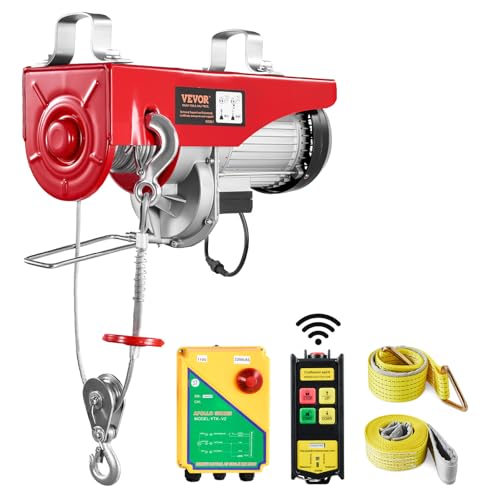 VEVOR Electric Hoist 2200lbs with 328ft Wireless Remote 110vView on Amazon
- 6
 3-in-1 Electric Hoist with RemotesView on Amazon
- 7
 VEVOR Electric Chain Hoist 2200 lbs 20 ft Lift Single PhaseView on Amazon
- 8
 SpprVine 3-in-1 Electric Hoist 110/120VView on Amazon
- 9
 Electric Chain Hoist 2200 lbs 20 ft LiftView on Amazon
A heavy engine block, a beam that needs a lift, a load that has to go up and come back down safely. That is the job an electric hoist vs chain hoist choice has to answer. This guide compares electric and chain hoists by power, speed, capacity and control. The listings here cover electric hoists only, with no chain hoist among them.
Other welders and gear to compare
 VEVOR Electric Hoist 440 Lbs with 328ft Wireless 14 ft WiredCheck price on Amazon
 VEVOR Electric Hoist 2200lbs with 328ft Wireless Remote 110vCheck price on Amazon
 3-in-1 Electric Hoist with RemotesCheck price on Amazon
 VEVOR Electric Chain Hoist 2200 lbs 20 ft Lift Single PhaseCheck price on Amazon
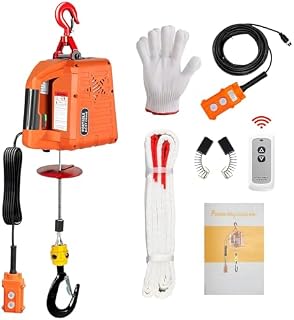 SpprVine 3-in-1 Electric Hoist 110/120VCheck price on Amazon
 Electric Chain Hoist 2200 lbs 20 ft LiftCheck price on Amazon
This guide links to our product roundups, where WeldGearLab gets a commission on purchases made through links on this page, and your price stays the same. Read our affiliate disclosure.
Electric hoist vs chain hoist: the difference in one paragraph
An electric hoist lifts with a motor and a wired or wireless remote, so the operator stands clear of the load. A chain hoist lifts by hand, with the operator pulling a chain to raise the load, and it needs no outlet and no motor. That single difference decides where each one fits: electric where power is close and lifts repeat, chain where power is absent or the lift is occasional.
Side by side
| Electric hoist | Chain hoist | What to note | |
|---|---|---|---|
| Power | 110V motor, wired or wireless remote | Hand chain, no power needed | Electric needs an outlet nearby |
| Lift speed | 13 ft/min to 32 ft/min | Hand speed | Electric is steadier on repeat lifts |
| Rated capacity | 440 lbs to 2200 lbs | Check the plate | Never exceed the rated capacity |
| Lift height | 19.7 ft to 40 ft | Chain length sets the height | Match height to the beam |
| Control | 14 ft wired, up to 200 ft wireless | Pull the hand chain by hand | Remote keeps you clear of the load |
| Suits | Repeat lifts in a garage, factory or warehouse | Occasional lifts and places with no power | Pick by how often you lift |
| Weight of the hoist | 24.2 pounds (VIVOHOME) to 56.0 pounds (VEVOR 2200 lbs); weight not stated for the other two models | Lighter with no motor | Check the beam can carry both |
| Safety features | Emergency stop, limit switch, auto brake, anti-spin rope on the VEVOR and ZHAN YING models; overload protection on the VIVOHOME | Check hooks and brake before each lift | Never lift over people |
Check capacity first: quote the rated capacity exactly as listed and never exceed it. The electric models here are rated from 440 lbs to 2200 lbs, and the lift heights listed run from 19.7 ft to 40 ft.
The electric hoists in this guide
The strongest pick is the VEVOR 2200 lbs electric hoist, rated at 2200 lbs on a double line and 1100 lbs on a single line, with a 1600W motor and a 14 ft wired remote. Single line runs at 32 ft/min to 39.4 ft, and double line at 16 ft/min to 19.7 ft. It weighs 56.0 pounds, with 4 security features: emergency stop button, limit switch, auto brake and anti-spin rope.
Next is the VIVOHOME 1540 lbs electric hoist winch, rated at 1540 lbs with a 1500W motor. It lifts at up to 13 ft/min to a max height of 40 ft, and it is the only model here with a wireless remote, rated at 200 ft, plus a 19 ft wired remote and manual operation. Overload protection cuts power when the weight limit is exceeded. It weighs 24.2 pounds.
The VEVOR 440 lbs electric hoist is the smaller-capacity VEVOR here, rated at 440 lbs on a double line and 220 lbs on a single line, with a 480W motor and a 14 ft wired remote. Single line runs at 32 ft/min to 39.4 ft, and double line at 16 ft/min to 19.7 ft.
The ZHAN YING 440 lbs electric hoist matches the VEVOR 440 lbs model on capacity, rated at 440 lbs on a double line and 220 lbs on a single line, with a 450W motor and a 13-foot remote control cord. Single line runs at 32 ft/min to 40 ft, and double line at 16 ft/min to 20 ft. It also carries 4 security features: emergency stop button, limit switch, auto brake and anti-spin rope.
When an electric hoist is the better choice
- Repeat lifts. A motor and a remote keep the pace steady when the same load goes up and down through the day.
- Heavy loads. The models here run from 440 lbs to 2200 lbs, so the top end covers loads a hand chain would make slow work of.
- Working clear of the load. A 14 ft wired remote, or a 200 ft wireless remote on the VIVOHOME, keeps the operator away from the load.
- Garage, factory and warehouse work. The makers list garages, factories, warehouses and construction sites as the places these hoists suit.
For a hand-powered comparison, see the lever hoist vs chain hoist guide.
When a chain hoist is the better choice
- No power nearby. A chain hoist needs no outlet, so it works where an electric hoist cannot plug in.
- Occasional lifts. For a load that goes up now and then, a hand chain is simple, with no motor to maintain.
- Outdoor and remote jobs. With no cord and no motor, there is nothing to plug in.
- Less weight on the beam. With no motor, a chain hoist adds less of its own weight to the beam.
A chain hoist still needs the same respect for rated capacity: never lift over people, and quote the rated capacity exactly as listed. For pulling loads, see the come along vs winch guide.
How to read a hoist listing
- Single line and double line. Single line gives the higher speed and height, double line the higher capacity: 220 lbs at 32 ft/min against 440 lbs at 16 ft/min on the 440 lbs models, and 1100 lbs at 32 ft/min against 2200 lbs at 16 ft/min on the strongest model.
- Remote length. The VEVOR models list a 14 ft wired remote, the ZHAN YING a 13-foot remote control cord, and the VIVOHOME a 200 ft wireless remote with a 19 ft wired remote.
- Motor power. The makers list 480W, 450W, 1500W and 1600W across the models in this guide. Match the motor to the load and the lift height.
- What comes in the box. The VEVOR models list a 13 ft lifting sling strap and a 3.2 ft shaft belt with a metal ring.
Never exceed the rated capacity, and never lift over people. Check the hook, the rope and the brake before each lift, and hang the hoist only from a beam rated for the load and the hoist.
Can one hoist cover both jobs?
An electric hoist covers the lifting in this guide, and a chain hoist covers the lifts where power is absent. For a shop with power at the beam and lifts through the day, the VEVOR 2200 lbs model sits at the top. For occasional lifts with no outlet, a chain hoist is the simpler answer, and the rated capacity on its plate is the number to respect.
FAQ for welders
Is an electric hoist stronger than a chain hoist?
Not by definition. Strength comes from the rated capacity on the plate, and the electric models here run from 440 lbs to 2200 lbs. A chain hoist is rated the same way, so compare the two ratings in front of you, and never exceed them.
Does an electric hoist need power?
Yes. The models here are 110V machines, and the VEVOR models and the ZHAN YING use a wired remote, while the VIVOHOME also offers a 200 ft wireless remote. A chain hoist needs no power at all.
What does single line and double line lift mean?
Single line runs the cable to the load, and double line runs it through a pulley block back to the hoist. On the 440 lbs models, single line lifts 220 lbs at 32 ft/min and double line lifts 440 lbs at 16 ft/min. The strongest model lifts 1100 lbs at 32 ft/min single line and 2200 lbs at 16 ft/min double line.
Can you hang an electric hoist from a garage ceiling beam?
The makers describe hanging these hoists from a ceiling or a beam with mounting brackets. The beam must carry the hoist and the load, and the rated capacity is the limit. If the beam rating is not stated, ask a professional before hanging a load from it.
Which electric hoist in this guide lifts the heaviest load?
The VEVOR 2200 lbs model, rated at 2200 lbs on a double line and 1100 lbs on a single line, with a 1600W motor. The VIVOHOME follows at 1540 lbs, and the VEVOR and ZHAN YING 440 lbs models follow that.
Related: lever hoist vs chain hoist, come along vs winch, and the how we pick page.