Brake Cleaner vs Acetone for Welding: Which One Should You Buy?
Brake cleaner and acetone degrease metal before welding, but they differ on residue, flammability, and a serious hazard. How they compare, and which to reach for.

On this page
The joint is fit up, the metal looks clean, but there is a film of oil from the last handling. Reach for the wrong solvent here and you either fight porosity or invite real danger. For brake cleaner vs acetone for welding, the short answer is: acetone evaporates fully and leaves no residue, while brake cleaner works only if you know which kind you hold and let it dry completely before striking an arc.
This guide compares them on cleaning power, residue, flammability and the hazard that matters most, then lays out a prep routine that keeps the weld clean and the shop safe.
As an Amazon Associate I earn from qualifying purchases. This guide links to our product roundups, where WeldGearLab gets a commission on purchases made through links on this page, and your price stays the same. Read our affiliate disclosure.
Brake Cleaner vs Acetone for Welding: The Short Answer
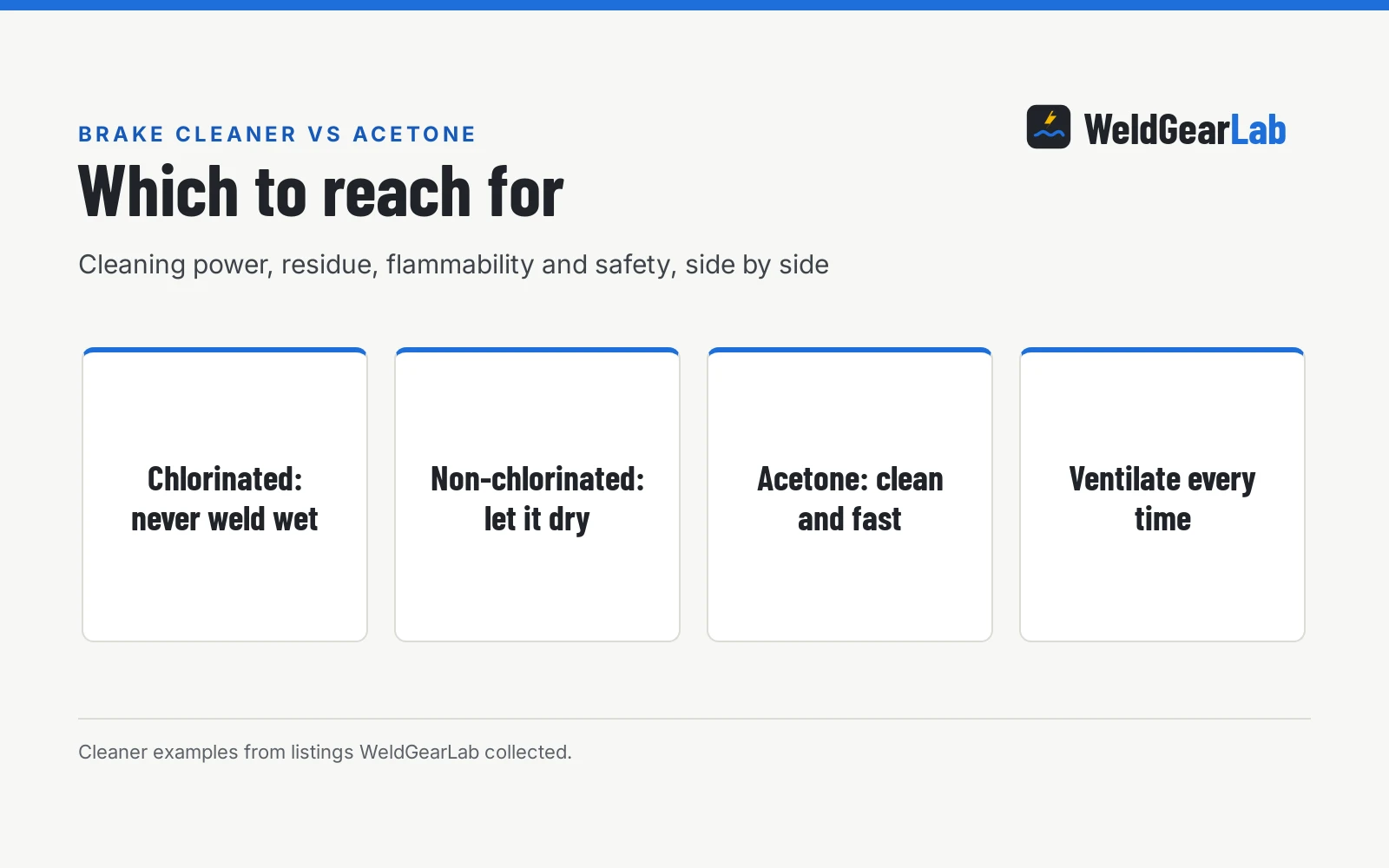
Brake cleaner is a strong degreaser sold in aerosol cans; the listings include chlorinated non-flammable formulas and non-chlorinated low VOC formulas in 19 oz cans. Acetone is a fast-evaporating solvent that leaves no residue, which is exactly what a weld joint wants. The catch: chlorinated brake cleaner can produce phosgene gas when arc heat or UV hits it, so it must never be welded on while wet. Acetone is flammable and its fumes demand ventilation.
Side by side
| Chlorinated brake cleaner | Non-chlorinated brake cleaner | Acetone | |
|---|---|---|---|
| Cleaning strength | Strong on grease and oil | Strong; low VOC formulas | Strong on oils; evaporates fully |
| Residue | None; listings state residue free | None; listings state no residue | None; evaporates clean |
| Flammability | Non-flammable per listings | Flammable solvent | Flammable solvent |
| Drying | Fast drying per listings | Fast drying per listings | Very fast evaporation |
| Welding hazard | Phosgene risk if welded while wet | Fume and fire risk; let dry, ventilate | Fire risk; let dry fully, ventilate |
| Typical can size | 19 oz cans listed | 19 oz and 14 oz cans listed | Not stated |
The table tells the story: chlorinated brake cleaner cleans well but carries the hazard you cannot ignore; non-chlorinated cleaner and acetone are simpler choices for weld prep, with drying time and ventilation doing the safety work.
The chlorinated brake cleaner warning
This is the part to read carefully. Chlorinated brake cleaner, such as the non-flammable chlorinated formulas listed here, contains chlorinated solvents; a listing names perchloroethylene outright. When chlorinated solvents meet the heat and ultraviolet light of a welding arc, they can break down into phosgene, a toxic gas. The fix is simple: never weld on metal that is still wet with chlorinated brake cleaner.
If chlorinated cleaner is all you have, spray it, wipe it, then give the joint time to dry fully in moving air before you weld. Better yet, save the chlorinated cans for brake jobs and keep a non-chlorinated solvent or acetone at the welding bench. Check the can: listings that say non-flammable are the chlorinated kind.
When brake cleaner is the right call
- Heavy grease on non-welded parts. Brake cleaner was built for brake dust, oil and grime, and it cuts through shop grease fast.
- You checked the formula. Non-chlorinated, low VOC formulas, like the 19 oz non-chlorinated formulas or the 14 oz cans sold in a pack of 4 listed here, avoid the phosgene hazard.
- You let it dry. Even the safe formulas need full drying time and ventilation before the arc starts.
When acetone is the right call
- Final wipe before welding. Acetone evaporates fully and leaves no residue, so the joint is as clean as the wipe.
- TIG and critical joints. Where contamination shows up as porosity or tungsten fouling, a residue-free wipe earns its keep.
- Simple shop stocking. No formula to check on the can.
Acetone is flammable, so treat it like fuel: cap the container, keep it away from sparks and the arc, and ventilate. For dirty metal that needs more than a wipe, combine the solvent with mechanical prep; our best angle grinder for welding prep guide covers the tools, and best MIG wire for dirty metal covers wire that tolerates less than perfect steel.
A safe prep routine
Degrease, then abrade. Wipe the joint with the solvent, let it dry fully, then hit it with a grinder or wire wheel to remove mill scale and oxides. Keep the solvent can off the welding table and away from the arc while you work. Ventilate the area, keep your head out of the plume, and see our best welding respirator and the welding safety gear checklist for beginners.
Solvents and welding fumes. Degreasing solvents add their own fumes on top of welding fume, and some coatings add worse. Galvanized steel is its own hazard; read how to weld galvanized steel safely before striking an arc on it. Work with ventilation or outdoors with your head out of the plume, clear anything flammable from the area, and keep a fire watch after hot work. See the OSHA welding overview.
FAQ for welders
Can I weld right after spraying brake cleaner?
No. Let the joint dry fully and ventilate the area. Never strike an arc on metal that is still wet with chlorinated brake cleaner, since arc heat and UV can turn its solvents into phosgene gas. When in doubt, wait longer and move more air.
Is non-chlorinated brake cleaner safe for welding prep?
Safer than the chlorinated kind, but it is still a flammable solvent with fumes. Let it dry completely, ventilate, and keep the can away from sparks and the arc. Check the label: non-flammable on the can means chlorinated.
Does acetone leave residue on metal?
No. Acetone evaporates fully, which is why welders favor it for the final wipe before a weld. It is flammable, so cap it, store it away from heat, and ventilate while you work.
What is phosgene and why do welders worry about it?
Phosgene is a toxic gas that can form when chlorinated solvents meet welding arc heat and ultraviolet light. Welders worry about it because chlorinated brake cleaner is common in shops. The prevention is simple: never weld on wet chlorinated cleaner, and prefer non-chlorinated solvents or acetone for weld prep.
Do I need a respirator when degreasing before welding?
It is good practice. Solvent fumes stack on top of welding fume, and ventilation alone does not always clear a small shop. See our best welding respirator for galvanized steel and the respirator requirements for welding guide for what fits under a helmet.
Related: best angle grinder for welding prep, best MIG wire for dirty metal, best welding respirator, and how to weld galvanized steel safely.