Best Pink Welding Helmet (2026): 3 Auto-Darkening Picks
Three auto-darkening welding helmets compared by sensors, shade range, viewing area, weight and certification, with the Gear Score and who should skip each one.

On this page
Top picks at a glance
As an Amazon Associate I earn from qualifying purchases.
- 1
 Best OverallJackson 471049.7/10View on Amazon
- 2
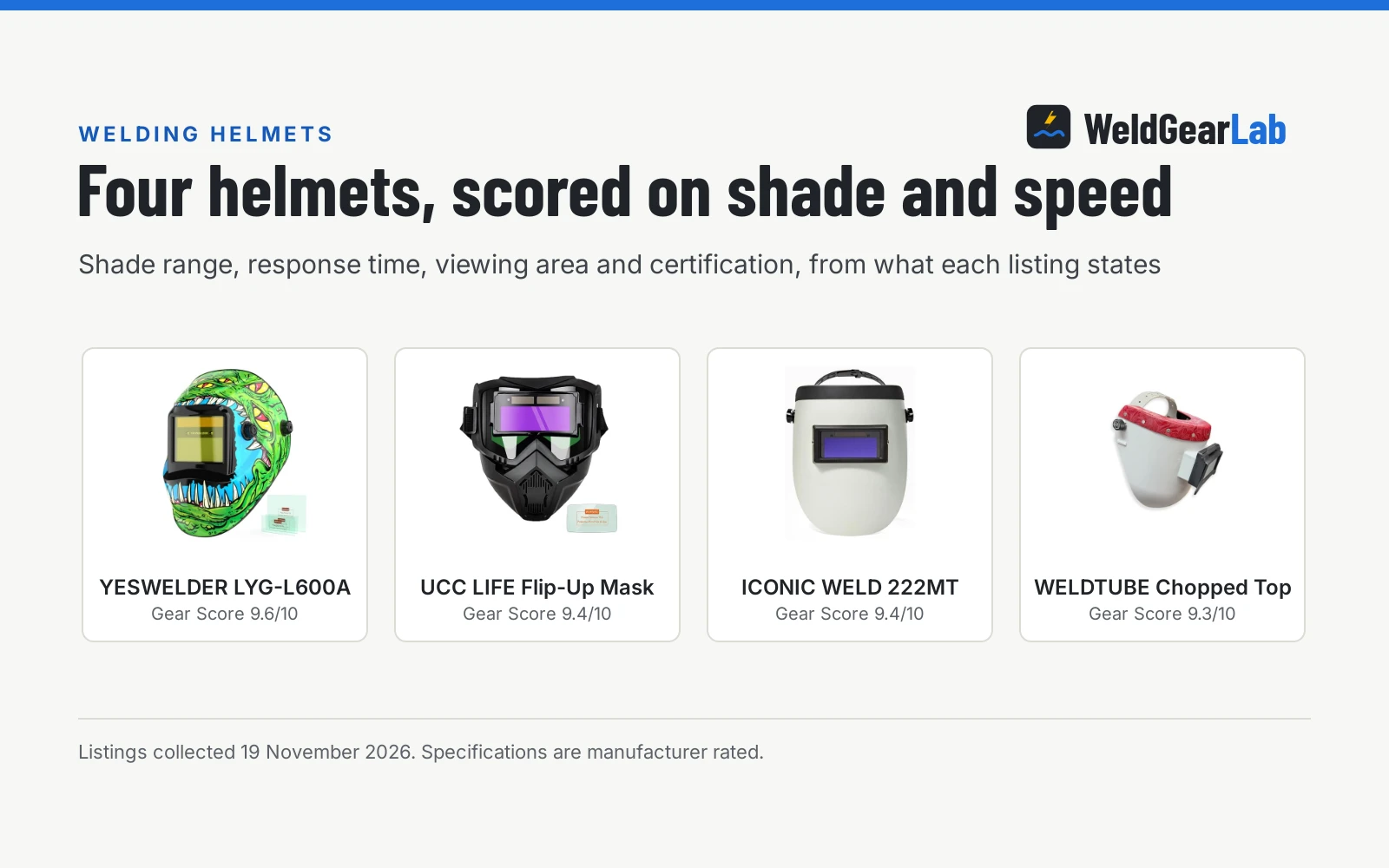
 Best Shade RangeYESWELDER LYG-L600A9.6/10View on Amazon
- 3
 Simplest PickHobart 7708699.3/10View on Amazon
Shopping for the best pink welding helmet starts with the lens, not the paint. A helmet lives or dies on its sensors, shade range and optical clarity, and the listings here state their colors plainly: camouflage, blue and white graphics, and a listing that states no color at all. So this roundup scores what the listings do state, flags each listed color plainly, and lets you decide whether the specs outweigh the color.
WeldGearLab gets a commission on purchases made through links on this page, and your price stays the same. Read our affiliate disclosure.
Quick picks
- Best Overall Jackson 47104: Highest Gear Score here: 4 sensors, ANSI Z87.1+ and a stated 2-year warranty Check price on Amazon
- Best Shade Range YESWELDER LYG-L600A: 3.5/9-13 shade with 1/1/1/1 clarity and replaceable CR2450 battery Check price on Amazon
- Simplest Pick Hobart 770869: Grind mode and a stated 2-year warranty in a sparse, no-frills listing Check price on Amazon
The machines

Jackson Safety Premium Graphics Auto Darkening
Four-sensor hood with 1/1/1/1 clarity, a 10.4 sq in viewing area, ANSI Z87.1+ certification and a stated 2-year warranty.
Pros
- 4 arc sensors, the most stated here, at 1/20,000 sec
- ANSI Z87.1+ and CAN/CSA Z94.3 stated, plus CE
- 1.26 lb stated weight with ratcheting 370 speed dial headgear
- 2-year warranty stated on the listing
Cons
- CR2032 battery is not included, per the listing
- Fixed 3/10 shade, less range than the YESWELDER's 3.5/9-13
- Blue and white graphics stated, not pink

YESWELDER Auto Darkening Welding Helmet 1/1/1/1
True-color hood with 3.5/9-13 shade for TIG, MIG, ARC and grind, blue light blocking lens and a replaceable CR2450 battery.
Pros
- 3.5/9-13 shade covers TIG, MIG, ARC and GRIND, per the listing
- 1/30,000 sec response with 1/1/1/1 optical clarity
- Blue light blocking outer lens, per the listing
- Solar panel plus replaceable CR2450 battery
Cons
- 2 sensors, fewer than the Jackson's 4
- No warranty term stated on the listing
- No weight stated on the listing
- No color stated on the listing, pink or otherwise

Hobart 770869 Auto-Darkening Welding Helmet
No-frills auto-darkening hood with 3 independent arc sensors, a 7.1 sq in viewing area, a grind mode and a stated 2-year warranty.
Pros
- 3 independent arc sensors, per the listing
- Grind mode prevents darkening while grinding, per the listing
- 1.2 lb, the lowest stated weight here
- 2-year limited manufacturers warranty stated
Cons
- No shade range stated on the listing
- No safety certification stated on the listing
- No power source stated on the listing
- Camouflage colorway stated, not pink
Other welders and gear to compare
 TRQWH Large Viewing Welding Helmet with Light Auto DarkeningCheck price on Amazon
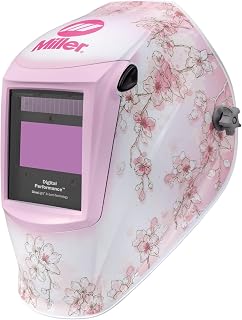 Miller Digital Performance™ Welding HelmetCheck price on Amazon
 YESWELDER Auto Darkening Welding Helmet 1/1/1/1 True ColorCheck price on Amazon
 YESWELDER Auto Darkening Welding HelmetCheck price on Amazon
 Lincoln Electric VIKING 3350 All American Welding HelmetCheck price on Amazon
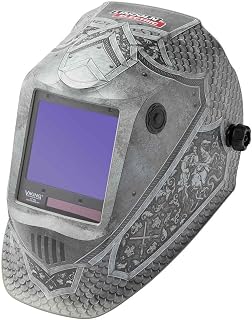 Lincoln Electric VIKING 3350 Medieval Welding HelmetCheck price on Amazon
Spec sheet comparison
| Model | Gear Score | Sensors | Shade | Viewing area | Weight | Power | Warranty |
|---|---|---|---|---|---|---|---|
| Jackson 47104 | 9.7/10 | 4 | 3/10 fixed | 10.4 sq in | 1.26 lb | Solar + CR2032 (not incl.) | 2-year |
| YESWELDER LYG-L600A | 9.6/10 | 2 | 3.5/9-13 | 3.64 x 1.67 in | Not stated | Solar + CR2450 replaceable | Not stated |
| Hobart 770869 | 9.3/10 | 3 | Not stated | 7.1 sq in | 1.2 lb | Not stated | 2-year limited |
Helmet details as published on each listing, collected 22 October 2026.
What the best pink welding helmet needs
Color aside, a good auto-darkening helmet needs fast sensors, a shade range that covers your process, a clear view of the puddle and headgear you can wear all day. The sections below walk through each factor with the stated numbers. A helmet that scores well on sensors but lists no shade range, like the Hobart, needs a manual check before you buy.
Sensors and switching speed
Arc sensors trigger the darkening, and more sensors mean fewer blocked-arc misses. The Jackson lists 4 arc sensors with a 1/20,000 sec reaction speed, the Hobart lists 3 independent arc sensors, and the YESWELDER lists 2 arc sensors with a 1/30,000 sec response. The Jackson and YESWELDER both claim 1/1/1/1 optical clarity. If you weld out of position where a sensor can be blocked, the 4-sensor Jackson has the most stated coverage. See the two sensor vs four sensor welding helmet comparison for the full breakdown.
Shade range
Shade range decides which processes the helmet covers. The YESWELDER lists 3.5/9-13, covering TIG, MIG, MMA stick and grind, per the listing. The Jackson lists a fixed 3/10 shade, though its title says variable shade while the bullets and spec table say fixed; the fixed figure is used here since two of the three agree. The Hobart listing states no shade range. For TIG work at low amps, the YESWELDER’s 3.5/9-13 range gives the lowest light end stated here.
Viewing area
Viewing area is stated three ways. The Jackson lists 10.4 sq in (3.94 x 2.64 in in the title), the Hobart lists a 7.1 sq in viewing area, and the YESWELDER lists 3.64 x 1.67 in. A bigger window helps on long beads and fit-up; a smaller one keeps the hood light.
Weight and headgear
Only two listings state weight: the Jackson at 1.26 lb and the Hobart at 1.2 lb, making the Hobart the lowest stated weight here. The Jackson lists a patented 370 speed dial ratcheting headgear with an easy-grip knob, and the YESWELDER lists pivot style headgear for comfort and balanced weight. The Hobart listing gives no headgear detail beyond its grind-mode note. If you weld overhead, headgear adjustability matters as much as weight.
Power: solar, battery or both
Power source is stated for two of the three. The YESWELDER runs on a solar panel plus a replaceable CR2450 lithium battery. The Jackson runs on solar power plus a CR2032 replaceable battery that is not included, per the listing. The Hobart states no power source. Solar assists the battery rather than replacing it, so check what the battery costs before you buy. See the solar powered welding helmet roundup for more solar-plus-battery hoods.
Grind mode and extra modes
Two listings name a grind mode. The Hobart lists a grind mode that prevents the lens from darkening while grinding. The YESWELDER covers GRIND in its 3.5/9-13 shade range. The Jackson lists welding, grinding, cutting and carbon arc gouging as uses but names no dedicated grind mode. If you grind with the hood down, a stated grind mode is worth having. See the welding helmet with grind mode picks for more.
Check the lens extras
Two listings state what spare lenses come in the box. The YESWELDER includes 2 outer replacement lenses and 1 inner replacement lens, and the Hobart includes a protective lens kit. The Jackson listing states no spare lenses. Outer lenses take the spatter, so a stated spare set saves an order later. If the listing is silent, budget for replacements up front.
Certification and warranty checks
Certification and warranty separate these three listings more than any other factor. The Jackson states ANSI Z87.1+, CAN/CSA Z94.3 and CE certification, and the YESWELDER states ANSI Z87.1 and CSA Z94.3. The Hobart listing states no safety certification at all, so a buyer who needs a stated standard on the listing has only two picks here. On warranty, the Jackson states a 2-year warranty and the Hobart states a limited 2-year manufacturers warranty, while the YESWELDER states no warranty term. That leaves the shade-range pick without a stated warranty, which matters if the helmet will see daily shop use. Read the warranty wording on the listing before buying, and confirm what it covers, since a stated term on one listing is not a promise that every listing in this roundup carries one.
Fit checks follow the same pattern: stated detail on two listings, silence on the third. The Jackson lists a patented 370 speed dial ratcheting headgear, and the YESWELDER lists pivot style headgear for comfort and balanced weight, while the Hobart listing gives no headgear detail. Weight is stated on the same two listings in reverse order: the Jackson at 1.26 lb and the Hobart at 1.2 lb, with no weight stated for the YESWELDER. A hood that fits badly will not stay down for a full bead, so weigh the stated headgear and weight figures against the shade and sensor figures before choosing, and confirm any unstated figure with the maker before buying.
The color question
To be plain: no listing here states a pink colorway. The Hobart is camouflage, the Jackson is blue and white Reapers N’ Roses graphics, and the YESWELDER states no color. If the color is the point, the red welding helmet roundup is the closest sibling on this site. Otherwise pick from the scores below and repaint, or wear the specs and skip the paint.
Color names on listings can mislead, so read the color field rather than the graphics name alone. The Jackson listing names its style Reapers N’ Roses while its color field states blue and white, and the Hobart listing names its model Creator Series, Camo while its color field states camouflage. The YESWELDER listing states no color field at all. If a pink finish is required for shop identification or for a gift, none of these three listings states one, so the honest move is to look at another roundup on this site or wait for a listing that states pink in its color field.
Before You Strike an Arc
- Match the shade range to your process: the YESWELDER lists 3.5/9-13 for TIG, MIG, ARC and GRIND, while the Jackson lists a fixed 3/10.
- The Jackson’s CR2032 battery is not included, per the listing; have one on hand before first use.
- The Hobart listing is sparse: shade range and power source are not stated, so confirm both before buying.
- Check the viewing area against your work: 10.4 sq in on the Jackson versus 3.64 x 1.67 in on the YESWELDER, per the listings.
FAQ for welders
Do auto darkening welding helmets use batteries?
Two of the three here do. The YESWELDER pairs a solar panel with a replaceable CR2450 lithium battery, and the Jackson pairs solar power with a CR2032 battery that is not included. The Hobart listing states no power source at all.
How does an auto darkening welding helmet work?
Arc sensors detect the arc and trigger the lens to darken. The YESWELDER lists 2 sensors with a 1/30,000 sec response, the Jackson lists 4 sensors at 1/20,000 sec, and the Hobart lists 3 sensors. Adjustable sensitivity and delay controls, listed on the YESWELDER, tune the helmet to the arc and the shop light.
Why do welding helmets have solar panels?
The solar panel assists the battery and extends its life. The YESWELDER listing says its solar panel converts arc light into electrical energy for longer service life, and the Jackson lists solar power alongside its replaceable battery. Solar does not replace the battery on either listing here. Check the battery door and contacts on arrival.
Are solar welding helmets good?
On these listings, solar comes paired with a replaceable battery on both the YESWELDER and the Jackson, which is the practical combination. Note the Jackson’s CR2032 is not included, so factor that in. The Hobart listing makes no solar claim either way.
Related: welding helmets, best red welding helmet, welding helmet with grind mode, and solar powered welding helmet.
More picks: two sensor vs four sensor welding helmet, lightweight vs standard welding helmet, and analog vs digital welding helmet.
Scoring, line by line
The Gear Score weighs the sensors and switching speed, the shade range and clarity, the viewing area and weight, the stated safety certifications, and the warranty. The Jackson and YESWELDER state ANSI and CSA certifications; the Hobart states none. Two of the three state a 2-year warranty. Sensor count and switching speed drive the performance score, while shade range and clarity drive build. Listed color is noted on every pick but not scored, since no listing here states pink.
| Product | Gear Score | Perf. /35 | Build /25 | Value /25 | Safety /10 | Warranty /5 |
|---|---|---|---|---|---|---|
| Jackson 47104 | 9.7 | 30 | 21 | 21 | 8 | 3 |
| YESWELDER LYG-L600A | 9.6 | 29 | 20 | 21 | 8 | 0 |
| Hobart 770869 | 9.3 | 24 | 18 | 19 | 0 | 3 |
A pick’s weighted total decides where it lands between a 9.2 floor and a 9.8 ceiling, and a bigger total never produces a smaller number.