Air Cooled vs Water Cooled Tig Torch: Which One Should You Buy?
Air cooled and water cooled TIG torches handle heat differently, shaping torch size, duty cycle, cable weight and cooler requirements for your welding setup.

On this page
Top picks at a glance
As an Amazon Associate I earn from qualifying purchases.
- 1
 CK17 Air Cooled TIG Torch Kit9.5/10View on Amazon
- 2
 TOOLIOM Lift TIG TorchView on Amazon
- 3
 WeldingCity 125-amp Air-cooled TIG Welding Torch Body WP-9FVView on Amazon
- 4
 WeldingCity 250-amp Water-cooled TIG Welding Torch BodyView on Amazon
When you are sitting at the welding bench facing an aluminum intake manifold repair, a roll cage build, or thin stainless exhaust tubing, choosing an air cooled vs water cooled tig torch decides how long you can weld and how comfortable your hand stays. An air-cooled torch relies on argon shielding gas and surrounding air to shed heat, making it simple, portable, and ideal for quick repairs, field jobs, and moderate amperage. A water-cooled torch routes chilled liquid directly through the torch head, keeping the handle cool and allowing a smaller, lighter torch to run continuous beads at high duty cycles without burning your glove. This guide explains how torch cooling works, compares cable weight and cooler setups, and helps you pick the right torch for your shop.
Other welders and gear to compare
 TOOLIOM Lift TIG TorchCheck price on Amazon
 WeldingCity 125-amp Air-cooled TIG Welding Torch Body WP-9FVCheck price on Amazon
 WeldingCity 250-amp Water-cooled TIG Welding Torch BodyCheck price on Amazon
This guide links to our product roundups, where WeldGearLab gets a commission on purchases made through links on this page, and your price stays the same. Read our affiliate disclosure.
Air cooled vs water cooled tig torch: the difference in one paragraph
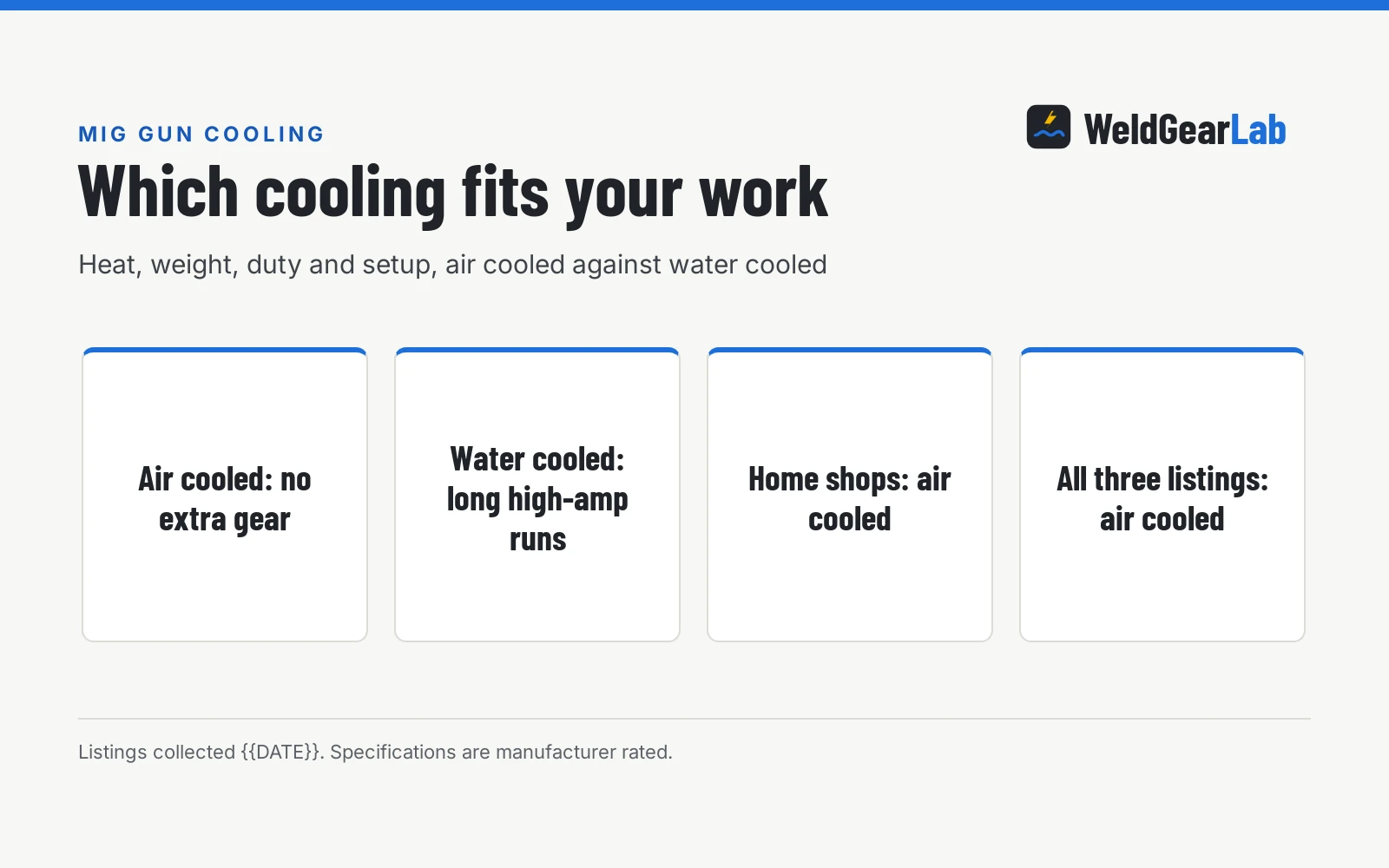
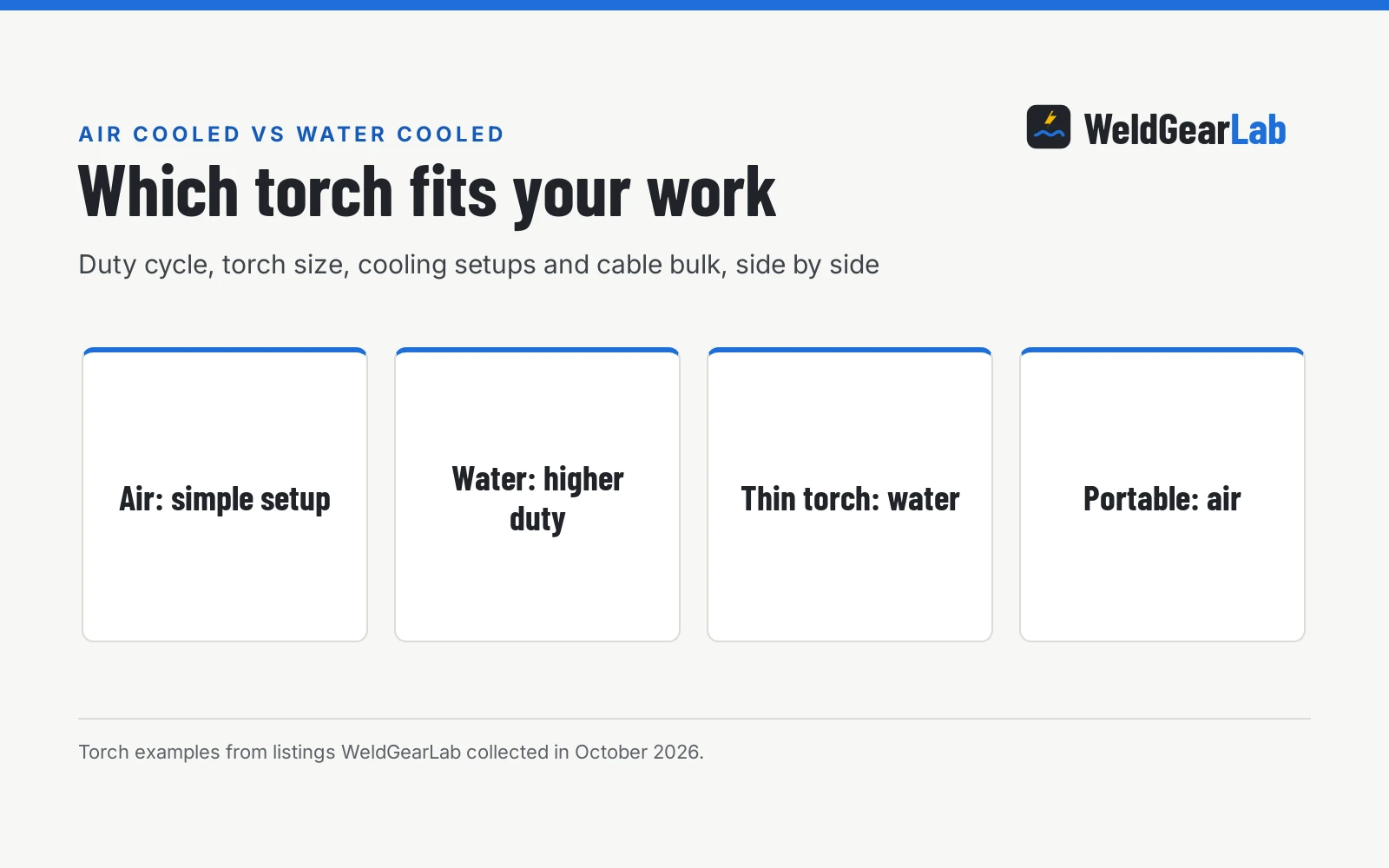
Every TIG arc generates intense heat at the tungsten electrode, and that heat flows directly back into the torch head, collet, and power cable. An air-cooled TIG torch cools itself entirely by passing the shielding gas through the torch body and radiating heat into the shop atmosphere, which requires heavier copper conductors and a bulkier rubber body. A water-cooled TIG torch uses a closed loop with a pump, radiator, and reservoir to circulate coolant through internal channels right behind the collet before returning the warm liquid through the power cable line. Because liquid absorbs heat far more efficiently than gas, a water-cooled torch runs much cooler with a fraction of the torch head mass, but it requires plumbing, coolant hoses, and an external cooler.
Side by side
| Air-cooled (9 series) | Air-cooled (17 series) | Water-cooled (20 series) | |
|---|---|---|---|
| Cooling medium | Argon shielding gas and room air | Argon shielding gas and room air | Liquid coolant through radiator |
| Typical duty rating | Light duty; lower continuous amperage | Moderate duty; 150A rated capacity | High duty; continuous high amperage |
| Torch head profile | Smallest air-cooled profile | Heavier and bulkier copper body | Compact head with water jacket |
| Handle heat on long passes | Heats quickly on sustained beads | Heats up during extended passes | Stays cool to the touch |
| Cable and lead bundle | Single gas and power line | Single gas and power line | Separate water in, return and gas lines |
| Equipment required | Direct connection to welder | Direct connection to welder | Water cooler, pump and hoses |
| Shop portability | High; plugs straight into welder | High; plugs straight into welder | Stationary; tied to cooler unit |
| Tight joint access | Good; compact torch body | Fair; bulkier neck and head | Excellent; slim head profile |
| Maintenance | Consumables and cable inspection | Consumables and cable inspection | Inspect coolant lines and prevent freezing |
Cooling performance directly affects torch size and duty cycle; always verify the rated amperage and cooling requirements listed in your torch documentation and machine manual. While air-cooled models connect directly to standard dinse or threaded output studs, water-cooled models require dedicated coolant hookups and leak checks before striking an arc.
When an air-cooled TIG torch is the better choice
- Mobile and field repairs. Service calls, truck beds, fences, and outdoor fabrications where dragging an auxiliary cooler and coolant hoses is impractical.
- Light garage and hobby fabrication. Short beads, tacking brackets, automotive sheet metal, and small projects where arc-on time is intermittent.
- Simple equipment setup. No radiator to flush, no coolant pump to wire, no hoses that can leak on your shop floor, and no winter freezing concerns.
- Lower entry investment. An air-cooled torch plugs directly into the welder power lug and gas outlet without requiring an external cooling unit.
For portable setups and everyday repairs, our best TIG torch guide reviews several air-cooled models that connect directly to standard welding machines.
When a water-cooled TIG torch is the better choice
- Continuous production and heavy sections. Long passes on aluminum, thick plate bevels, and structural joints where heat builds up fast.
- Comfort during extended welding. The torch handle stays cool to the touch through back-to-back passes, protecting your fingers and gloves.
- Tight joint clearance. A smaller torch head profile allows clear vision and tight torch angles inside roll cages, header collector tubes, and narrow brackets.
- Lighter torch weight in the hand. Less copper in the torch head reduces wrist fatigue during intricate puddle manipulation and walking the cup.
When fabricating heavy assemblies or running high current on AC aluminum, pairing your machine with an efficient cooling setup keeps your puddle control precise. Check our best TIG welder for aluminum roundup for machines that benefit most from water-cooled hardware.
Torch sizes, ratings and duty cycle differences
The physical difference between air and water cooling shows up clearly in published torch specs. Standard torch numbering groups models by physical size and cooling design. Air-cooled torches commonly use 9 or 17 series bodies, whereas water-cooled models commonly use 20 series bodies. Comparing published listings shows how cooling medium changes physical dimensions and weight:
- Air-cooled torch dimensions and weight. In specs from CK Worldwide, an air-cooled CK17 torch head measures 8-1/8 inches (20.6cm) and weighs 5 oz (141gm), carrying a rating of 150 amp ACHF or DCSP @ 100%. A flex-valve version from CK Worldwide allows bending the head up to 40 degrees from centerline while using 3 Series head accessories. Complete packaged setups add cable bulk: Lincoln Electric lists its air-cooled PTA-9 torch with a 12.5 FT cable at 3 pounds total weight, while the Bestarc WP-17FV listing publishes 2.71 pounds with a 13FT power cable and 3.2FT gas hose.
- Water-cooled torch compactness. By routing liquid directly through the torch head, water cooling shrinks the tool while maintaining high duty capacity. Specs from CK Worldwide for its 20 Series water-cooled CK20 torch show a head measuring 7-1/2 inches (19.0cm) and weighing just 3 oz (85gm) with 2 Series head accessories. That gives the water-cooled model a lighter head in the hand than the air-cooled CK17, despite handling equal or greater continuous current.
- Duty cycle ratings on air-cooled listings. Air-cooled torches frequently derate on alternating current or extended duty cycles. The Welding Knight TIG17V listing rates its air-cooled torch at 150Amp overall, but specifies a duty cycle of 35% DC 140Amp and 35% AC 125Amp with an electrode size range of 0.5-2.4mm. Similarly, Rstar lists its air-cooled WP17 torch with a 13 feet (4 meter) cable rated at 150A DC and 120A AC with electrodes from 0.02 inch to 3/32 inch.
For more details on torch sizing numbers and collet compatibility across series, see our guide on TIG torch sizes explained.
What gear is required for a water-cooled torch setup
Stepping up to a water-cooled torch requires auxiliary equipment beyond the power supply and argon cylinder. Understanding this plumbing helps you evaluate whether your shop space and workflow justify the hardware:
- Dedicated water cooler. A cooling unit houses a fluid reservoir, a continuous-duty positive displacement pump, a radiator core, and an electric fan. The unit circulates cooled liquid constantly through the torch lines while the welder is energized.
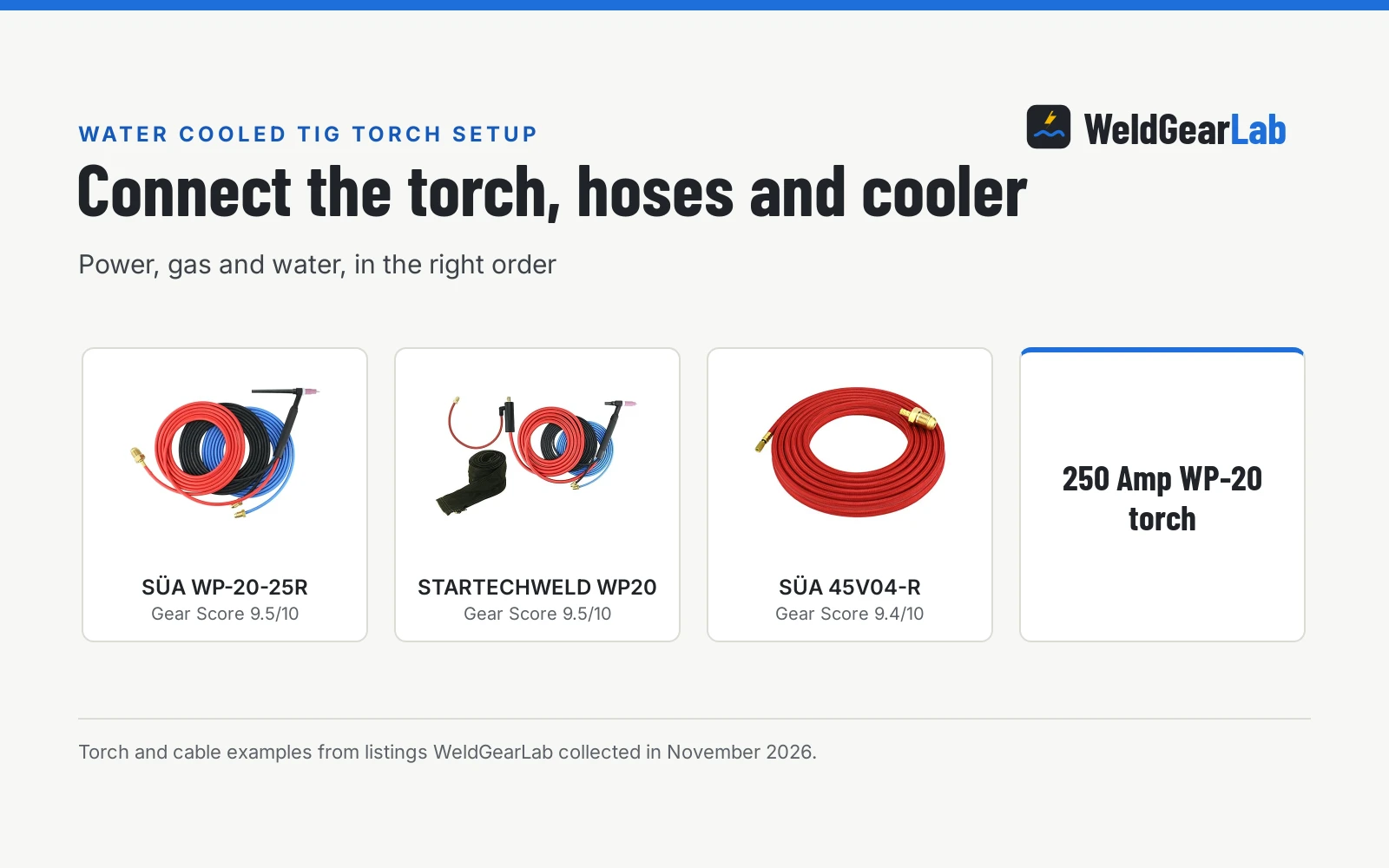
- Separate-line torch hose bundle. Unlike a single-cable air-cooled torch, a water-cooled torch uses separate conduits bundled in a protective sheath: a clean water delivery hose, a gas hose for shielding argon, and a power cable enclosed inside the water return hose where circulating fluid directly cools the high-amperage copper conductor.
- Power adapter block. Because current runs through the return water line, a specialized brass adapter block connects the torch assembly to your welder output stud while providing threaded ports for coolant return and gas routing.
- Coolant selection. Welding coolers require clean fluid formulated for high-frequency TIG applications. Automotive antifreeze must never be used because its additives and silicate leak sealers can clog narrow torch passages and conduct electrical current.
Can you run a water-cooled torch on any TIG welder?
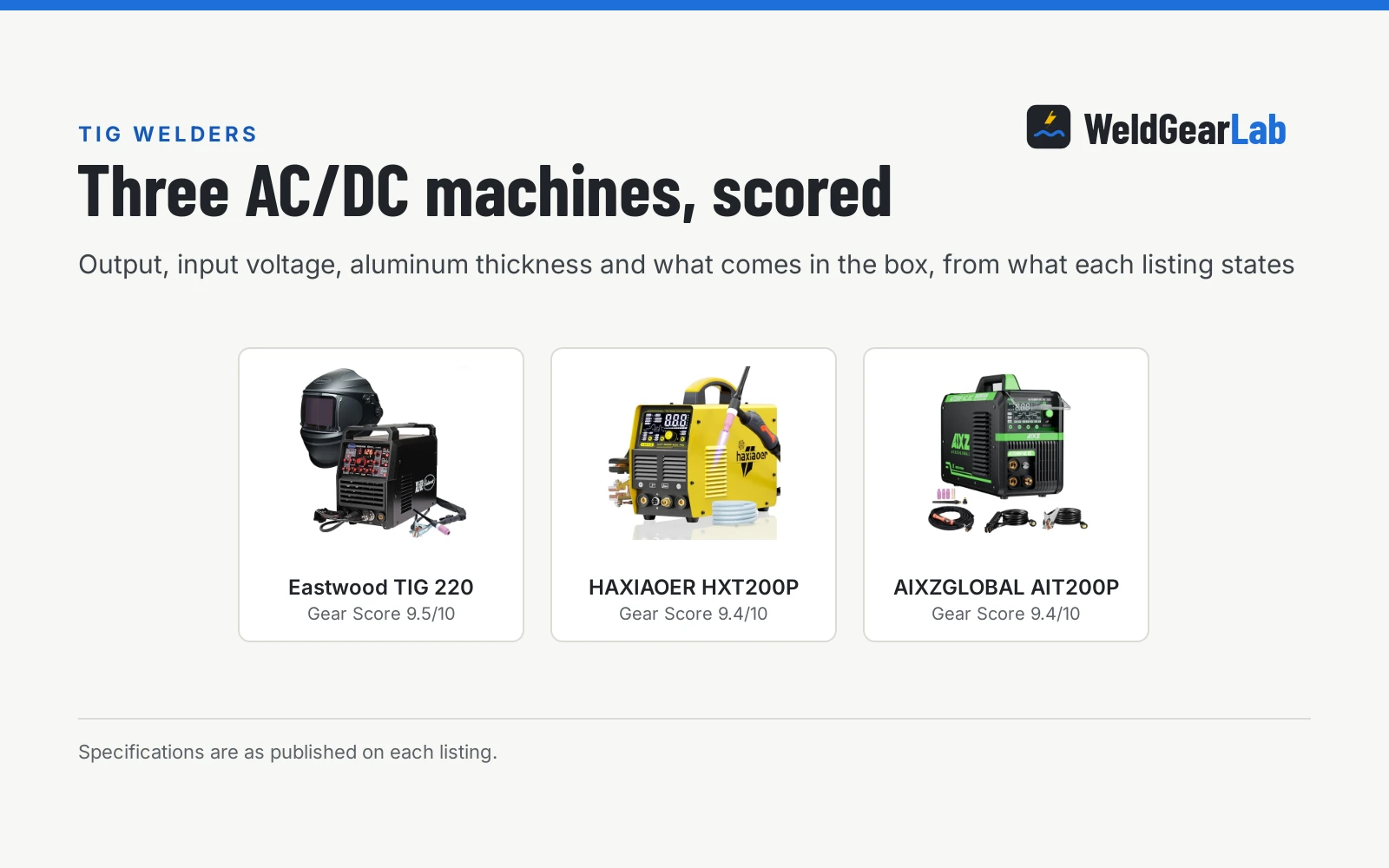
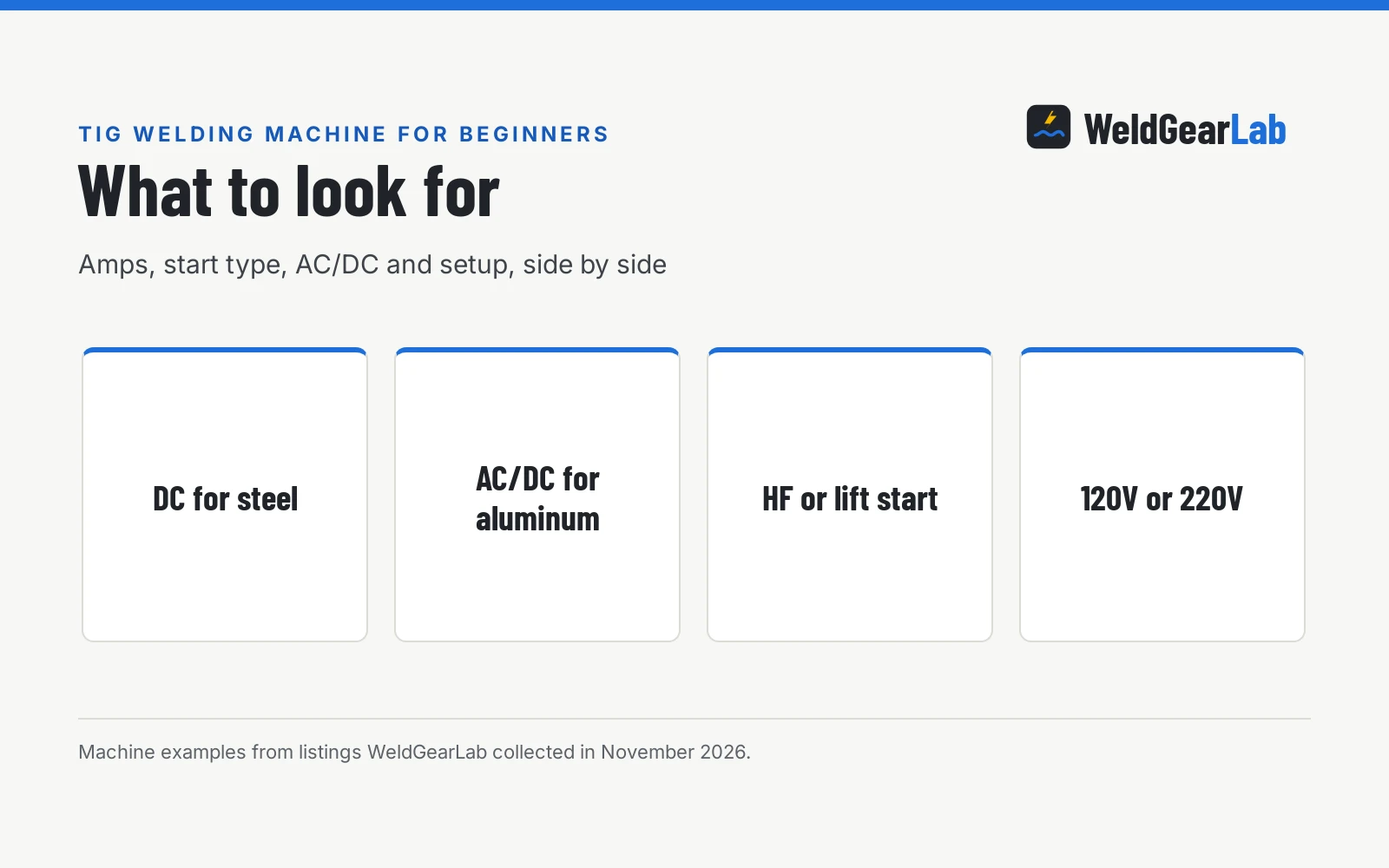
Yes. A water-cooled torch does not depend on internal welder electronics to operate. The cooling circuit functions as an external loop between the torch and the water cooler. As long as you have the proper power adapter block to connect the welder dinse or lug terminal, any DC or AC TIG machine can power a water-cooled torch. If you are setting up your welding area, see our best entry level TIG welder guide to explore capable power supplies, and review AC vs DC TIG welding to match your current type to your metal fabrication needs.
Electrical and coolant safety. Water and high-amperage electricity share the same torch bundle, making leak inspection critical. Always inspect torch hose connections, o-rings, and adapter fittings before powering your machine. Never operate a water-cooled torch without coolant circulation, as the compact copper conductor will melt within moments of arc strike. Keep coolant reservoirs topped up, maintain clean shop floors clear of spilled fluid, ensure dedicated equipment grounding, and route cables away from sharp metal edges and hot tack welds. Consult your equipment manual and OSHA welding safety standards for recommended shop ventilation and electrical grounding procedures.
FAQ for welders
Can I weld aluminum with an air-cooled TIG torch?
Yes, an air-cooled torch can weld aluminum on AC polarity, but high heat reflection quickly limits your duty cycle. Because aluminum conducts heat away from the joint rapidly, it demands higher amperages that heat up an air-cooled torch handle within a short run. For occasional aluminum repair on sheet metal, an air-cooled torch works fine if you pause between passes to let the copper body cool down.
Can a water-cooled TIG torch run without a cooler?
No. You must never strike an arc with a water-cooled TIG torch without active coolant flow. The internal copper conductor inside a water-cooled power cable is very thin because it relies on circulating liquid to carry heat away. Stripping away that liquid cooling will cause the internal power lead to overheat and melt almost immediately upon arc ignition.
Do I need a water-cooled torch if my welder only outputs 150 amps?
For most work at or below 150 amps, an air-cooled torch is completely adequate. A quality air-cooled torch handles light sheet metal, brackets, and short repairs without excessive handle heating. You only need a water-cooled setup at this power level if you require an ultra-compact torch head for cramped joint access or run long, uninterrupted beads.
What coolant should you put in a TIG torch water cooler?
Use dedicated welding coolant formulated with deionized water and propylene glycol designed for high-frequency TIG applications. Never use automotive antifreeze or tap water in your cooler unit. Automotive coolants contain additives that can gum up small torch passages and conduct electricity, while tap water deposits minerals that restrict coolant flow.
Which torch cooling style is easier for beginners?
An air-cooled torch is much easier for beginners because it connects straight to the welding machine with no extra hardware. There are no pumps to plug in, no fluid levels to monitor, and no coolant lines that can develop leaks. Beginners can focus entirely on torch angle, arc length, and filler rod feeding before considering an auxiliary cooling system.
Related: TIG torch sizes explained, best TIG torch, best entry level TIG welder, and the TIG welders hub.