Adjustable vs Fixed Height Welding Table: Which One Should You Buy?
Adjustable and fixed height welding tables suit different shops and work; how they differ on height range, stability, tilt, capacity and storage, and which side the listings support.

On this page
Top picks at a glance
As an Amazon Associate I earn from qualifying purchases.
- 1
 Homanu Hose Clamps Stainless Steel DIY 8.5 FT Metal Strap + 69.6/10View on Amazon
- 2
 Adjustable Welding Table [350 lb. Capacity]View on Amazon
- 3
 S AFSTAR Folding WorkBeachView on Amazon
- 4
 Klutch Adjustable Welding TableView on Amazon
- 5
 DEWALT 46 in. x 18 in. Adjustable Height Portable FoldingView on Amazon
- 6
 Ultrawall Workbench for GarageView on Amazon
- 7
 Betterhood 70" Adjustable Height WorkbenchView on Amazon
Fit up and beads wear on you in places you only notice when you stop. The height of your table decides whether you hunch over the joint or stand tall with a steady torch, and that is why adjustable vs fixed height welding table is a standing shop question. Both styles hold steel and take clamps, but they trade convenience against simplicity in different ways. This guide compares the two for home, farm and hobby shops and shows four adjustable tables from current listings so you can see what the adjustable side actually offers.
Other welders and gear to compare
 Adjustable Welding Table [350 lb. Capacity]Check price on Amazon
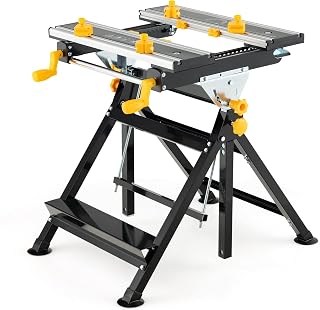 S AFSTAR Folding WorkBeachCheck price on Amazon
 Klutch Adjustable Welding TableCheck price on Amazon
 DEWALT 46 in. x 18 in. Adjustable Height Portable FoldingCheck price on Amazon
 Ultrawall Workbench for GarageCheck price on Amazon
 Betterhood 70" Adjustable Height WorkbenchCheck price on Amazon
This guide links to our product roundups, where WeldGearLab gets a commission on purchases made through links on this page, and your price stays the same. Read our affiliate disclosure.
Adjustable vs fixed height welding table: the difference in one paragraph
A fixed height welding table holds the work surface at a single height, set when the table is made, with legs that stay put. An adjustable height welding table lets you raise or lower the surface, sometimes tilt it, and often fold the legs for storage. The adjustable side costs you moving parts and setup time, and the fixed side costs you the freedom to change the height when the job changes.
Side by side
| Adjustable height | Fixed height | Home shop note | |
|---|---|---|---|
| Height | Set in steps or continuously: 29.5 to 36.5 inches, 30 to 37 inches, or 28 to 43 inches on the listings we saw | One fixed working height | Standing work or shared benches suit adjustable; one steady position suits fixed |
| Tilt | Some tilt the top: 5 adjustable angles on the JEGS, multiple angles on the YESWELDER | Top stays level | Out of position joints favor a tilt top |
| Capacity | 350 pounds, 400 pounds, 500 pounds and 1100 pounds on the four listings | Rated for what the frame takes, no moving joints | Match capacity to your heaviest job |
| Stability | Leg joints and wheels can flex; the FUNTECK lists locking pins and screws | Solid welded frame, no moving parts | Check leg locks before heavy work |
| Storage | The VEVOR and YESWELDER fold; the YESWELDER folds to 7.5 inches thick | Keeps its floor space | Small shops often pick folding |
| Fixturing | 0.63 inch holes spaced 2 inches apart and 6 tool slots on the VEVOR; edge guides on the JEGS; guide rails on three sides of the YESWELDER | Usually a plain or slatted top | Repeat fit up likes holes |
| Mobility | Casters on the FUNTECK, wheels on the YESWELDER | Stationary unless you add casters | Roll it out when the bay is needed |
| Upkeep | More parts to adjust and keep tight | Set it down and weld | Low maintenance favors fixed |
Every table in our listings sits on the adjustable side, so the right side of the table above is about the general fixed height style. The notes in the last column are the practical trade offs we weighed while comparing the listings.
When adjustable height wins
- Shared bench. Welders of different heights use one bench, or you switch between standing and sitting during the same project.
- Comfort on long jobs. Bring the joint closer to eye level instead of hunching, and change the height when you move from tacking to grinding.
- Angled welds. The JEGS lists 5 adjustable angles on its top, and the YESWELDER states a tiltable desktop with multiple angles, which beats shimming the work.
- Small shops. The VEVOR and YESWELDER fold their legs, and the YESWELDER folds to 7.5 inches thick, so the table disappears when the car needs the bay.
- Move the work around. Casters on the FUNTECK and wheels on the YESWELDER let you roll the table out of the way or into the driveway.
When a fixed height table wins
- One welder, one position. A fixed table has no locks or pivots that can loosen, so it stays exactly where you left it.
- Heavy plate and hammering. A welded frame without moving joints takes beating and rework with less flexing.
- Simple ownership. Fewer moving parts means nothing to adjust, seize or re tighten, and setup is one step: set it down and weld.
- Stable heavy capacity. Fixed tops are easy to load near their stated capacity without worrying about a pin or screw taking the shear.
Four adjustable tables from the listings
JEGS adjustable welding table. The listing states a 350 pound capacity, a 30 by 20 inch zinc-plated steel top and a height of 32.59 inches in the level position. Note what the adjustability is: 5 adjustable positions of the top angle, not a change of leg height, plus retractable edge guides for fencing in parts.
VEVOR foldable welding table. A 44 by 21 inch carbon steel top rated for 500 pounds, with 4 level height adjustment from 29.5 to 36.5 inches. The top carries 0.63 inch fixture holes spaced 2 inches apart and 6 tool slots, the legs fold for storage, and the table weighs 45.2 pounds.
FUNTECK portable steel work platform. Rated for 1100 pounds on a 55 by 14 inch galvanized tabletop, with height adjustable from 28 to 43 inches in 1 inch increments. The legs have both locking pins and locking screws, and four casters carry the 41.8 pound table around the shop.
YESWELDER foldable welding table. A 20 by 30 inch carbon steel top rated for 400 pounds, with four adjustable heights from 30 to 37 inches and a tiltable desktop for angled work. Wheels and a carry handle move it, it folds to 7.5 inches thick, and three sides have vertical steel guide rails for clamping workpieces. The listing names MIG and TIG welding in its title. Note a contradiction: the spec table lists the base type as Pedestal while the bullets describe wheels and folding legs; the title and bullets win there.
For full picks with Gear Scores, see our best welding table for a home shop roundup.
FAQ for welders
Is an adjustable welding table less stable than a fixed table?
Moving parts are the trade off. Height steps, leg pivots and casters add places where a table can flex or shift, while a fixed table is usually one welded frame. Look for locking pins or screws on the legs, like the FUNTECK lists, and keep the stated capacity in mind for heavy work.
What height should I set a welding table to?
Set it so you can hold a steady torch and see the puddle without hunching, whether you stand or sit. An adjustable table lets you lower it for seated detail work and raise it for standing over a long joint. If one height serves all your work, a fixed table is simpler.
Can a welding table tilt for angled welds?
Some adjustable tables tilt the top: the JEGS listing states 5 adjustable angles, and the YESWELDER states a tiltable desktop with multiple angles. That helps when the joint sits at an angle you would otherwise fight. Check whether the listing means the top tilts or the legs change height, because the JEGS height is stated at 32.59 inches in the level position only.
Does a 500 pound capacity include the weight of the table?
Listings state a load capacity, like 500 pounds on the VEVOR or 1100 pounds on the FUNTECK, but do not say whether the table’s own weight counts toward it. Treat the stated number as the load you can place on the top and stay under it for heavy fab work.
Should a welding table have fixture holes?
Holes make clamping and layout faster: the VEVOR lists 0.63 inch fixture holes spaced 2 inches apart, and the YESWELDER lists vertical guide rails on three sides for clamping workpieces. If you mostly tack small brackets, a flat top with clamps does fine. Shops that repeat the same fit up will use holes more.
Related: best welding table for a home shop, how to choose a MIG welder, welding duty cycle explained, and the welding tables and carts hub.