Fixture Table vs Steel Plate Welding Table: Which One Should You Buy?
Here is how fixture tables and steel plate welding tables compare on hole grids, clamping flexibility, durability, materials and what the listings leave unclear.
 By WeldGearLab Editorial
Updated October 10, 2026
By WeldGearLab Editorial
Updated October 10, 2026
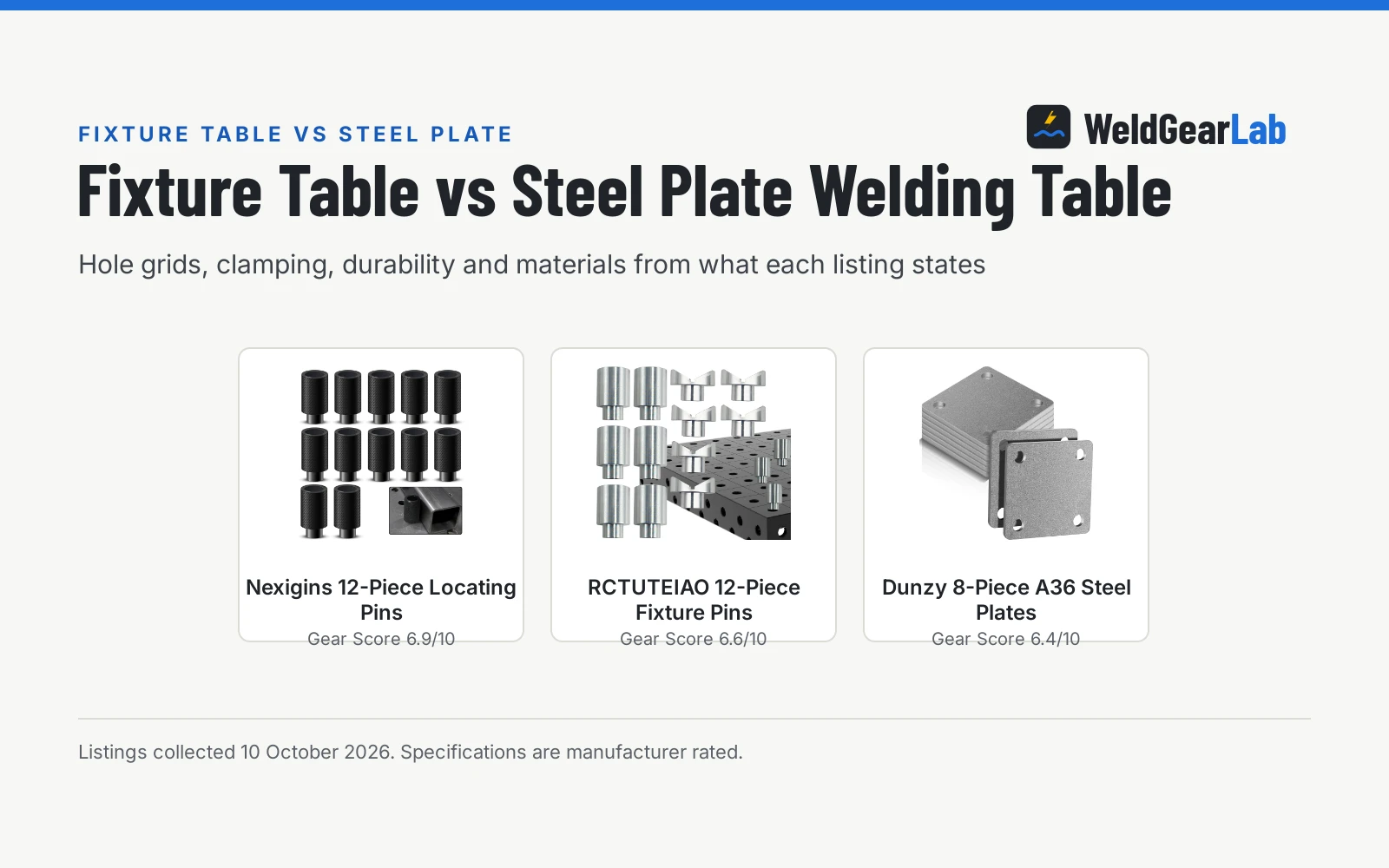
Verdict. A fixture table is the better choice for welders who build frames, railings, or repeat assemblies requiring fast squaring and clamp-down alignment using precision hole grids and locating pins. A steel plate welding table fits fabricators who want a solid, continuous conductive surface where they can tack temporary stops directly to the plate and grind them flush later. In this fixture table vs steel plate welding table comparison, the Nexigins carbon steel pins lead our score table with sturdy alignment, followed by RCTUTEIAO aluminum pins and Dunzy A36 steel plates.
Choosing between a fixture table and a solid steel plate bench is one of the foundational equipment decisions in metal fabrication. A fixture table relies on a grid of machined holes to position modular clamps and stops, while a steel plate welding table provides an unbroken ground plane for heavy clamping and direct tacking. This head-to-head comparison evaluates the fixture table vs steel plate welding table approaches using three representative products: Nexigins locating pins, RCTUTEIAO fixture pins, and Dunzy A36 steel plates.
As an Amazon Associate I earn from qualifying purchases. WeldGearLab earns a commission when you buy through links on this page, at no extra cost to you. Read our affiliate disclosure.
Side by side
| Nexigins Locating Pins | RCTUTEIAO Fixture Pins | Dunzy Steel Plates | |
|---|---|---|---|
| Gear Score | 57 | 54 | 53 |
| Side | Fixture table | Fixture table | Steel plate welding table |
| Material | Medium carbon steel | Aluminum alloy (bullets), Aluminum (table) | A36 hot rolled steel plate |
| Piece count | 12 pieces (bullets), 1 piece (table) | 12 pieces (6 square, 6 V-groove) | 8 pieces |
| Dimensions | 5/8 x 1 x 2 in (bullets), 1 x 1 x 2 in (table) | 1 in OD, 1.5 in height (bullets), 1 x 1.09 in (table) | 3 x 3 in, 3/16 in thick (0.48 cm) |
| Hole size fit | 5/8 in (16mm) holes | 5/8 in (0.63 in) holes | 4 pre-drilled 3/8 in (9.55 mm) holes |
| Finish / Color | Galvanized (bullets), Polished / Black (table) | Standard finish, Aluminum color | Gray black color, rounded corners |
| Weight | Not stated | Not stated | 1.61 kg (spec table) |
| Safety listing | None stated | None stated | Specification Met: True in table; standard not stated |
| Warranty | Not stated | Not stated | Not stated |
Specifications are manufacturer rated, as published on each listing and collected 10 October 2026. None of the three listings state a CSA, UL or ETL safety certification, and none state a written warranty term.
Workpiece alignment and hole patterns
The defining operational difference between these two table styles is how workpieces are held in position. A fixture table relies on evenly spaced holes across its surface to anchor tooling. Both the Nexigins and RCTUTEIAO examples are designed to seat into 5/8-inch (16mm, or 0.63-inch) table holes. Nexigins provides stackable locating pins that adjust in height for thicker workpieces, while RCTUTEIAO supplies 6 square tube pins and 6 V-groove pins dedicated to supporting round pipe.
A steel plate welding table typically provides a continuous steel plane without a modular hole grid. Fabricators using solid plate work with edge clamps or tack-weld scrap blocks directly to the bench to create stops. The Dunzy A36 steel plate example features 4 pre-drilled holes measuring 3/8 inch (9.55 mm) in diameter. That 3/8-inch dimension applies only to the Dunzy plates, where the listing specifies mounting holes for structure support rather than a modular 5/8-inch fixture table hole grid.
Plate thickness and table construction
Table surface thickness dictates how much heat and mechanical force a welding bench can handle before losing flatness. Dunzy publishes an exact thickness of 3/16 inch (0.48 cm) for its A36 hot rolled steel plates, which the maker describes for structure support and anchoring. That 3/16-inch figure describes the Dunzy plates only, as steel plate welding tables vary in plate thickness. Table thickness affects rigidity, thermal stability, and clamping force; our guide on how thick a welding table top should be breaks down plate selection for different welding processes.
On a fixture table, top thickness also dictates pin engagement depth. The Nexigins pins list a height of 2 inches (with a 5/8 by 1 by 2 inch size in bullets and 1 by 1 by 2 inches in the table), while the RCTUTEIAO pins list a total height of 1.5 inches in bullets and 1.09 inches in the table. Neither fixture listing specifies a minimum table plate thickness, leaving the ideal table plate thickness for these accessories unspecified in their listings.
Materials and spatter resistance
The materials used on each side reflect differing priorities in the shop. Nexigins lists medium carbon steel for its locating pins, designed for high-temperature use. The Nexigins bullets state a galvanized finish, though its specification table lists a polished finish and black color.
The RCTUTEIAO listing states its pins are made of aluminum alloy to withstand repeated use where welding slag often adheres to fixtures. Aluminum is softer than medium carbon steel under heavy clamping force. On the plate side, Dunzy lists A36 hot rolled steel, which the listing states can be welded, machined, and painted.
Piece counts and package contents
Package quantities determine how many reference points a welder can establish in a single setup. The RCTUTEIAO package includes 12 pins in total, split evenly into 6 square alignment stops and 6 V-groove circular stops. This combination allows a fabricator to align rectangular frames and round tubing on the same bench.
The Nexigins package provides 12 fixture pins per its title and bullets, though its specification table lists Number of Pieces as 1. A set of 12 identical pins allows multiple reference planes across large assemblies. Dunzy provides 8 pieces of 3 by 3 inch square steel plates per pack, offering multiple weldable pads or mounting brackets for shop fabrication.
Weight and physical specifications
Physical mass is critical when evaluating workbench components. The Dunzy listing publishes a package weight of 1.61 kg for its 8 steel plates. In contrast, neither the Nexigins listing nor the RCTUTEIAO listing publishes an item weight. Because the fixture pin listings omit weight figures, the listings leave a direct weight comparison between the hardware unclear.
Warranty and safety certifications
None of the three listings publish a written warranty term. In our scoring system, an unstated warranty term scores 0 points under warranty, ensuring that marketing descriptions are not mistaken for formal manufacturer guarantees.
None of the listings claim independent safety certifications such as UL, CSA, or ETL. The Dunzy specification table marks Specification Met as True, but the listing text does not name a specific certifying organization or industrial standard. As a result, safety scores for all three products remain at 0 in our evaluation.
Choose a fixture table if
- You build square frames, handrails, or repetitive assemblies requiring fast setup.
- You want to use modular 5/8-inch locating pins like the Nexigins or RCTUTEIAO examples.
- You work with round tubing and benefit from dedicated V-groove alignment blocks.
- You prefer mechanical clamping through hole grids over tack-welding stops to your bench.
Choose a steel plate welding table if
- You need a solid, continuous conductive surface for heavy grounding and clamping.
- You prefer tacking scrap metal stops directly to the table and grinding them flush later.
- You build custom brackets, base plates, or machinery mounts using weldable A36 steel like the Dunzy plates.
- You want an unbroken bench surface without clearing welding spatter or slag from fixture holes.
Fixture table vs steel plate welding table
| Award | Product | Gear Score About the Gear ScoreThe Gear Score runs from 0 to 10 and weighs performance (35%), build (25%), value (25%), safety (10%, where it applies) and warranty (5%), using only what the manufacturer and the listing publish. How we pick › | |
|---|---|---|---|
 12 Pcs 5/8" x 2" Welding Table Locating Pins
|
6.9/10 | Check price on Amazon | |
 Welding Table Fixture Pins 12 Pcs 5/8 x 1 x 1.5
|
6.6/10 | Check price on Amazon | |
 Dunzy 8 Pcs A36 Steel Plate 3 x 3 Inch
|
6.4/10 | Check price on Amazon |
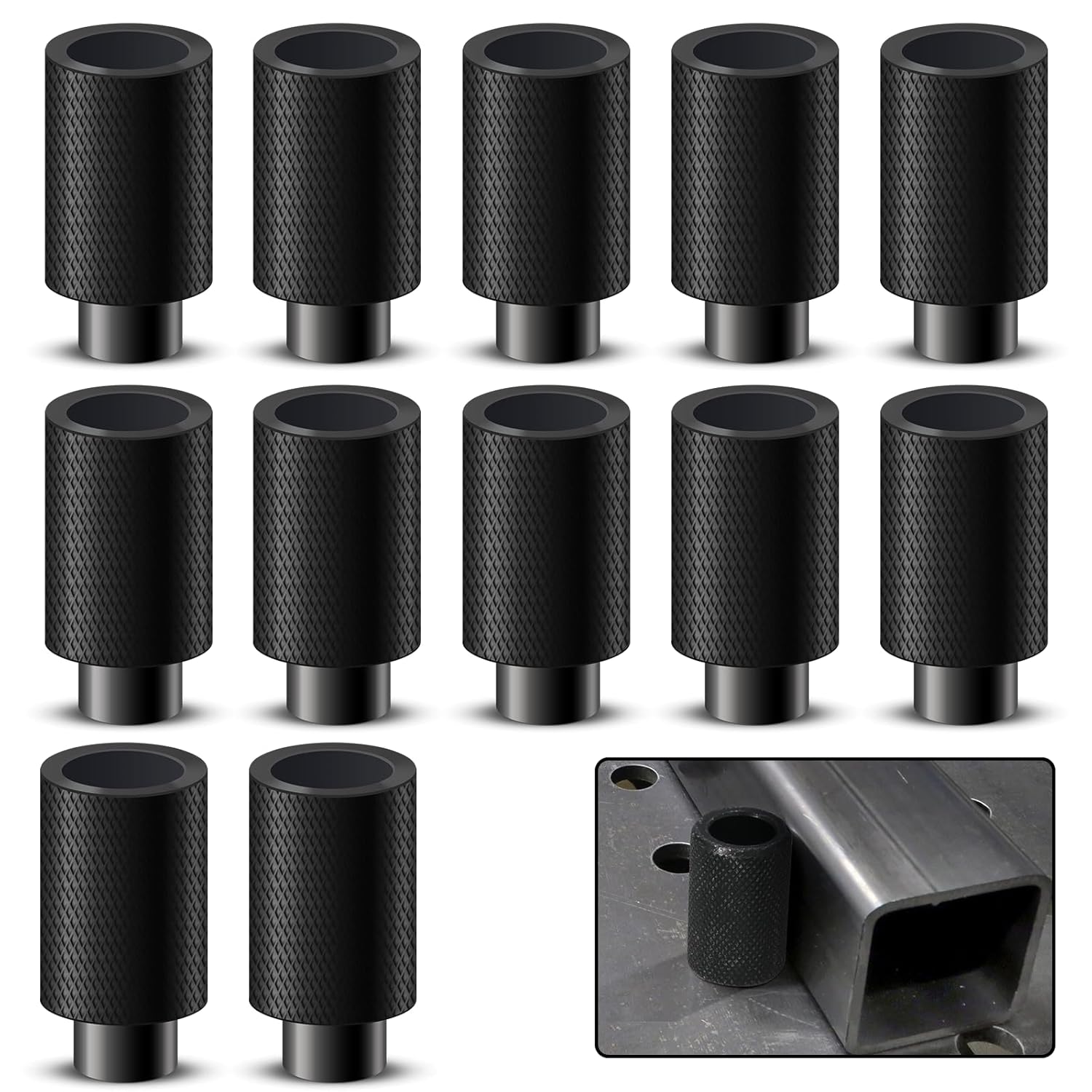
12 Pcs 5/8" x 2" Welding Table Locating Pins
A 12-piece set of medium carbon steel locating pins sized 5/8 by 1 by 2 inches for fixture tables with 5/8-inch holes.
Pros
- Medium carbon steel construction designed for high temperature shop use
- Sized for standard 5/8-inch (16mm) fixture table holes
- Stackable design allows height adjustment for larger workpieces
- 12 pins in the set provide multiple alignment points across a table
Cons
- Spec table states 1 piece, contradicting the 12-piece title and bullets
- Finish listed as galvanized in bullets but polished in the specification table
- No warranty term is stated
- Listing does not state an item weight
Welding Table Fixture Pins 12 Pcs 5/8 x 1 x 1.5
A 12-piece aluminum fixture pin set with 6 square stops and 6 V-groove stops for 5/8-inch welding table holes.
Pros
- Includes 6 square tube pins and 6 V-groove pins for round tubing
- Fits standard 5/8-inch (0.63-inch) fixture table holes
- Aluminum alloy material helps prevent welding spatter adhesion
- V-block design supports circular pipe without sliding
Cons
- Height is listed as 1.5 inches in bullets but 1.09 inches in the table
- Aluminum alloy is softer than carbon steel under heavy clamping
- No warranty term is stated
- Item weight is not stated in the listing
Dunzy 8 Pcs A36 Steel Plate 3 x 3 Inch
An 8-piece pack of 3 by 3 inch, 3/16-inch thick A36 hot rolled steel plates with pre-drilled 3/8-inch holes.
Pros
- Solid A36 hot rolled steel plate is fully weldable and machinable
- Pre-drilled with 4 mounting holes measuring 3/8 inch (9.55 mm) in diameter
- Rounded corners reduce sharp edges on workpieces
- Published package weight of 1.61 kg confirms physical density
Cons
- Small 3 by 3 inch footprint requires welding or bolting to form larger benches
- 3/8-inch holes are smaller than standard 5/8-inch fixture table accessories
- No warranty term is stated
- Specification Met is marked True without naming an independent standard
How we scored them
All three products are scored out of 100 on performance, build, value, safety listing and warranty, with the weights published on our How We Pick page.
| Product | Gear Score | Perf. /35 | Build /25 | Value /25 | Safety /10 | Warranty /5 |
|---|---|---|---|---|---|---|
| Nexigins 12-Piece Locating Pins | 6.9 | 28 | 21 | 20 | 0 | 0 |
| RCTUTEIAO 12-Piece Fixture Pins | 6.6 | 27 | 19 | 20 | 0 | 0 |
| Dunzy 8-Piece A36 Steel Plates | 6.4 | 26 | 20 | 19 | 0 | 0 |
Before you strike an arc. Wear a welding helmet with the correct shade, safety glasses, leather gloves, and flame-resistant clothing. Ensure adequate ventilation to avoid fumes, keep a fire extinguisher nearby, and establish a clean electrical ground on your table. Consult our welding tables and carts hub for related equipment advice.
Frequently Asked Questions
What is the main difference between a fixture table and a steel plate table?
A fixture table features an engineered grid of holes that accepts modular locating pins and clamps for repeatable alignment. A steel plate table provides an uninterrupted steel top where fabricators clamp from exterior edges or tack stops directly to the plate.
Can you use fixture table pins on a regular steel plate table?
Standard fixture pins require matching precision holes, such as the 5/8-inch (16mm) holes specified on the Nexigins and RCTUTEIAO listings. A standard steel plate table without pre-machined holes cannot accept these pins unless matching holes are drilled into the top.
Why are some fixture table pins made from aluminum instead of steel?
The RCTUTEIAO listing states its aluminum alloy pins withstand repeated use where welding slag adheres to fixtures. Aluminum is softer than carbon steel, so aluminum pins offer less resistance to deformation under heavy clamping force.
Can you tack weld directly to a fixture table top?
Tack welding directly to a precision fixture table top can ruin its machined flatness and contaminate the hole pattern. In contrast, fabricators using a dedicated steel plate bench frequently tack scrap stops to the surface and grind them flush once the joint is welded.
Which table style is better for beginner welders?
A steel plate welding table offers a simple, forgiving surface for learning arc control and basic joint tacking without worrying about spatter damaging holes. Beginners tackling repeat assemblies or square frames may prefer a fixture table to simplify squaring workpieces.
Related: best welding table for home shop, how to build a welding table, how to keep a welding table from warping, and our comparison of Certiflat vs Strong Hand welding table.
About the author
WeldGearLab Editorial is the editorial team behind WeldGearLab. We research product listings, specifications, safety listings and warranty terms, score every pick with the published Gear Score method, and correct errors when readers report them. We do not run our own shop trials; see How We Pick for exactly how picks are made.